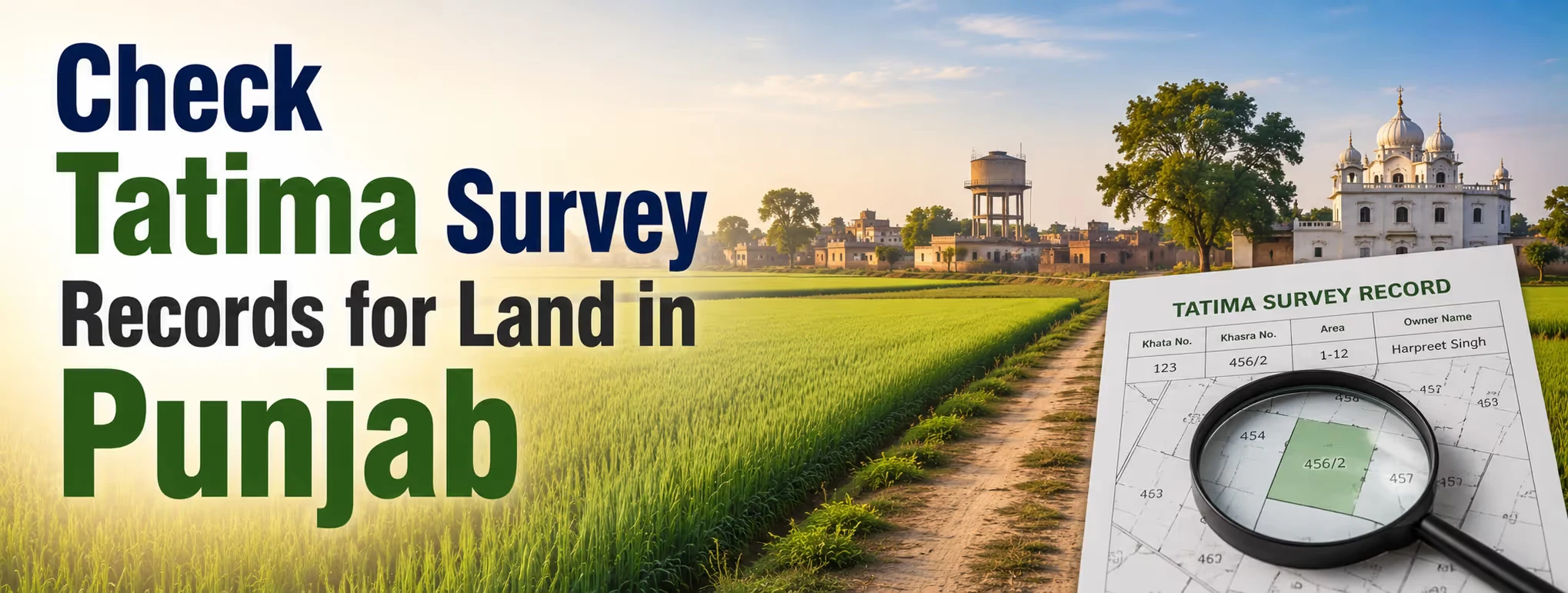
Ask most first-time land buyers in Punjab what a Tatima is, and you'll get a blank look. It's one of those revenue terms that patwaris and lawyers throw around casually, assuming everyone already knows, when in reality most buyers stumble across it for the first time only when a plot they're interested in turns out to be part of a larger family holding that's been split up over the years. That splitting is exactly what Tatima records track. And if you're buying land in Punjab, especially anything that's been inherited or divided among siblings and cousins, you need to understand this document before you get anywhere close to a sale deed.
What a Tatima Actually Is?
In plain terms, Tatima means the division of a plot. When a joint family holding gets split, say, three brothers each taking their share of ancestral farmland, the patwari prepares a Tatima to record exactly how the original field was carved up. It shows the new boundaries, the size of each resulting piece, and how these smaller plots relate to the original khasra number. There's a related term worth knowing too: Tatima Shajra. Where the Tatima is essentially the mutation-style record of the division itself, the Tatima Shajra is the updated map drawn afterward, showing the newly separated plots visually, the way the original Shajra showed the whole village.
Punjab currently has a large backlog of these records. Revenue departments across the region have flagged that a significant number of Tatima entries are still pending update, which matters a lot for anyone buying, because an unfinalised Tatima can mean the boundaries on paper haven't caught up with what's actually happening on the ground.
Why This Matters When You're Buying?
Here's the practical issue. If you're looking at agriculture land for sale in Punjab, India, and the plot you like is one piece of a larger field that was divided among family members, the Tatima is what confirms your specific portion is legally and physically separated from the rest. The same document is just as important when selling property online, as it gives potential buyers confidence that the land boundaries are clearly defined and officially recorded. Without a properly recorded Tatima:
- The boundaries of your plot might exist only informally, agreed upon by the family but never formalised in revenue records
- Getting a loan against the land can become difficult, since banks generally want tatima-cut plots with clear individual boundaries before they'll lend
- Reselling later gets harder, because the next buyer will run into the same ambiguity you're facing now.
- Disputes between co-sharers can resurface years later if the original division was never properly documented.
I've seen cases where a buyer paid for what they believed was a standalone three-acre plot, only to discover the Tatima had never been finalised, and technically the land was still recorded as an undivided share within a much larger joint holding. Untangling that after the fact is a slow, expensive process.
Tatima vs Related Punjab Land Records
| Document | What It Shows |
| Jamabandi | Ownership and cultivation records, typically revised every five years. |
| Khasra/Khatauni | Field-level details including plot size, soil type, and cultivator information. |
| Tatima | Record showing how a plot was divided among co-sharers. |
| Tatima Shajra | Updated map prepared after partition, showing the separated plots. |
| Fard/Girdawari | Crop inspection and current possession records. |
None of these substitute for the other. A clean Jamabandi with an unresolved Tatima is still a half-finished picture, and that gap is exactly where disputes tend to grow.
How to Check Tatima Records in Punjab?
The process runs through the patwari's office and the state's digitised land record systems, primarily PLRS (Punjab Land Records Society) and the Fard portal.
| Step | What to Do |
| 1 | Note the original khasra number of the field before division, along with the village and tehsil details. |
| 2 | Visit the PLRS portal (jamabandi.punjab.gov.in) and search using the khasra number or the owner's name. |
| 3 | Check whether the Jamabandi reflects the divided plots individually or still shows the original undivided entry. |
| 4 | If the division is not reflected, request the Tatima record from the local Patwarkhana. |
| 5 | Cross-check the Tatima Shajra map against the boundaries described in your sale agreement. |
| 6 | If there is any ambiguity, obtain written confirmation from the Tehsildar before proceeding with registration. |
A quick tip here: don't rely purely on the online portal for this one. Tatima updates often lag behind actual field-level changes, so a visit or a written request to the patwari is sometimes the only way to get current status, especially in villages where digitisation hasn't fully caught up.
Common Mistakes Buyers Make
A few patterns show up repeatedly with Tatima-related purchases across Punjab:
- Assuming a verbal family agreement is enough — informal division among heirs means nothing to a bank or a future buyer without a recorded Tatima
- Not checking whether the Tatima Shajra matches the physical plot — boundary shifts happen, and the map should reflect reality, not just intention.
- Skipping verification when buying from just one co-sharer — if the land hasn't been formally divided, one sibling selling "their share" can create ownership disputes with the others.
- Overlooking pending Tatima backlogs — some villages have a real lag in processing these records, so don't assume "it's probably done by now"
If you're comparing listings for farm land for sale in Punjab India, particularly older agricultural holdings that have passed through a generation or two, ask directly whether the plot has a finalised Tatima. It's a fair question, and any serious seller should be able to answer it without hesitation.
What This Means If You're Selling?
If you're planning to sell land in Punjab that was originally part of a larger family holding, getting your Tatima sorted before listing saves a lot of friction later. Buyers today, especially anyone financing the purchase, will ask for it early in the process. A finalised Tatima with a clean Tatima Shajra makes your listing far more attractive than one where the boundaries are still technically shared with relatives. This applies whether you're going through a local broker or looking at selling property online; either way, having the paperwork ready upfront shortens the time between listing and closing.
Where 2Bigha Fits In?
Chasing down Tatima records, cross-checking them against Jamabandi entries, and confirming boundaries takes real effort, particularly if you're comparing several plots of agricultural land in Punjab before deciding where to invest. 2Bigha does this groundwork before a listing ever goes live. Every plot comes with background verification already completed, so division and boundary issues are flagged upfront rather than discovered halfway through a deal. Whether you're searching for farmlands near me across Punjab's districts or comparing verified listings side by side, 2Bigha gives you documentation you can actually trust, cutting out the guesswork that usually comes with buying through scattered local brokers. Browse verified listings at 2Bigha.
Disclaimer: This article is for informational purposes only and should not be considered investment, legal, financial, or property advice. Real estate regulations, infrastructure plans, market conditions, and government policies may change over time. Readers are advised to verify information with relevant authorities and consult qualified professionals before making any investment or property-related decisions.