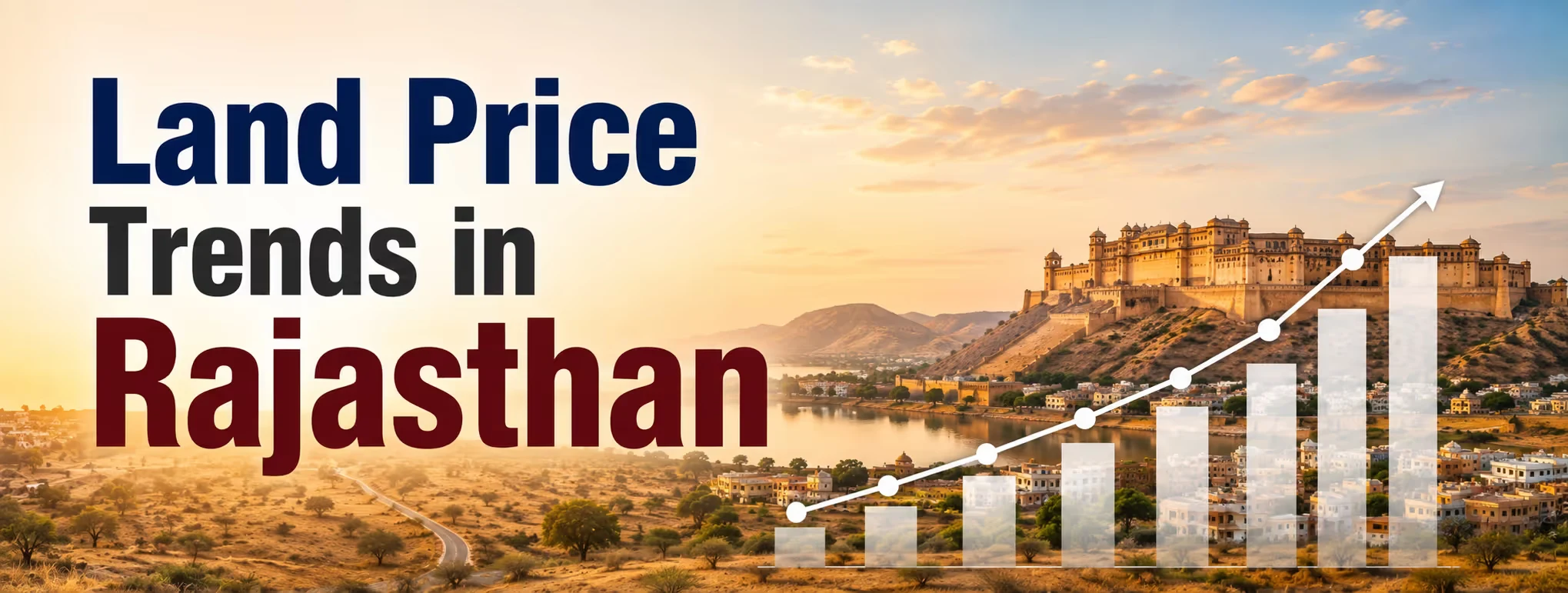
Rajasthan is one of those states where the phrase "land price" barely means anything on its own. A plot near Jaipur can cost fifty times more than a similar-sized plot two districts away, and the gap often has less to do with the district's name and more to do with a single factor: water. If you're tracking land price trends in Rajasthan to decide where to invest, this guide walks through what's actually driving prices up, which districts are showing real momentum, and where the state's next wave of growth is likely to come from.
The One Factor That Explains Most of Rajasthan's Price Gaps
Unlike states with more uniform rainfall, Rajasthan's land values split sharply along irrigation lines. Canal-irrigated land near the Indira Gandhi Canal can cost roughly ₹15–25 lakh per acre, while barren desert land just 50 km away sells for as little as ₹50,000 to ₹2 lakh. That's not a small gap; it's a completely different asset class within the same state. This is why two buyers looking at "Rajasthan land" can end up with completely different experiences. Someone buying agricultural land in Rajasthan near a canal command area is essentially buying productive, income-generating farmland. Someone buying in a rain-fed desert pocket is buying a much cheaper, higher-risk asset that depends entirely on monsoon patterns and groundwater depth.
Districts Showing the Strongest Price Momentum
A few districts stand out clearly when you look at where demand and irrigation are combining well:
| District | What's Driving Growth | Land Type |
| Sri Ganganagar | Assured canal water, strong wheat, mustard and cotton belt | Agricultural |
| Hanumangarh | Similar canal-linked irrigation, steady cropping intensity | Agricultural |
| Jaipur (outskirts) | Urban expansion and infrastructure spillover from the capital | Residential/Commercial plots |
| Udaipur | Tourism-linked demand, farmhouse and resort interest | Agricultural/Mixed-use |
| Sikar | Improving connectivity, moderate but consistent price growth | Agricultural |
| Alwar | Proximity to the Delhi-NCR industrial corridor | Agricultural/Commercial |
Sri Ganganagar and Hanumangarh in particular show gradual but steady agricultural land price growth, largely because assured water access supports intensive cropping of wheat, mustard, and cotton, a pattern that's held fairly consistently over recent years.
Why the Desert Belt Still Lags Behind?
Not every part of Rajasthan is growing at the same pace. While emerging land markets in Rajasthan are attracting more buyers and investment, large parts of the Thar region continue to see slow price growth due to limited rainfall and poor water availability. If a plot seems unusually cheap, take a closer look. Sometimes the low price reflects long-term challenges, not a hidden opportunity.
That said, this isn't uniformly bad news for buyers. Government efforts around canal expansion, climate-resilient crop promotion, and agroforestry are gradually lifting land values in select productive pockets, which means some of today's lower-priced districts could see meaningful appreciation as these programs mature.
Why Is Rajasthan Being Called an Emerging Land Market?
Several recent market analyses now group Rajasthan among the country's more promising emerging land markets in Rajasthan and neighbouring low-cost states. Rajasthan, alongside Madhya Pradesh and eastern Uttar Pradesh, combines relatively low base prices, more liberal purchase laws, and active infrastructure development, a combination that tends to favour buyers at current price levels.
The logic here is straightforward: the cheapest states, including Rajasthan, have consistently delivered higher compound annual growth rates compared to already-expensive states, which tend to show only single-digit growth. For a buyer with a 5–10 year horizon, this points toward a genuinely favourable risk-reward setup, provided the specific plot has real irrigation or infrastructure backing it.
Farm Land vs Residential Plots: Where the Real Growth Sits
It's worth separating two very different buyer intentions here. Farm land for sale in Rajasthan in the canal-irrigated belts is largely an agricultural income play; buyers are betting on crop yield and water security, not urban expansion.
Residential and commercial plots in Rajasthan, especially around Jaipur's outskirts or along the Delhi-NCR-facing districts like Alwar, follow a different growth story entirely, driven by urban sprawl, highway connectivity, and industrial corridor development rather than agricultural productivity. Knowing which category your target land falls into changes how you should evaluate it.
Practical Checks Before You Buy Into a "Trending" District
Rising average prices in a district don't automatically mean every plot inside it is a good buy. Before purchasing, verify:
- Actual irrigation source – canal access, river lift, borewell, or purely rain-fed, since this single factor swings value more than almost anything else
- Distance from the irrigation command area – prices can drop sharply even a few kilometres outside a canal zone
- Groundwater depth trends – borewell-dependent land carries more long-term risk than canal-fed plots
- Local mutation and khatedari records – confirm the seller is the legally recorded owner before any payment
- Conversion status – if you're eyeing agricultural land near an expanding town, check whether non-agricultural conversion is realistically possible
How 2bigha Helps You Navigate This Market?
Given how sharply prices swing within short distances in Rajasthan, doing this research plot-by-plot on your own is genuinely time-consuming. 2bigha lists verified agricultural land for sale in Rajasthan with background checks and ownership verification already completed, so you can compare a canal-irrigated parcel in Sri Ganganagar against a growth-stage plot near Jaipur without starting your due diligence from zero each time.
This also benefits sellers. If you're a landowner in Rajasthan looking into selling property online, listing through a platform with built-in verification tends to attract more serious, ready-to-transact buyers, since they aren't relying purely on your word about irrigation access or title status. You can explore current Rajasthan listings directly at 2bigha.ai.
Common Mistakes Buyers Make When Chasing Price Trends
- Buying in a "trending" district without confirming the specific plot has actual irrigation access
- Assuming low price automatically means good long-term value, without checking why it's cheap
- Ignoring groundwater depth data when the land depends on a borewell
- Overlooking khatedari and mutation verification because the deal "seemed straightforward"
- Comparing agricultural land prices to residential/commercial plot prices as if they follow the same growth logic