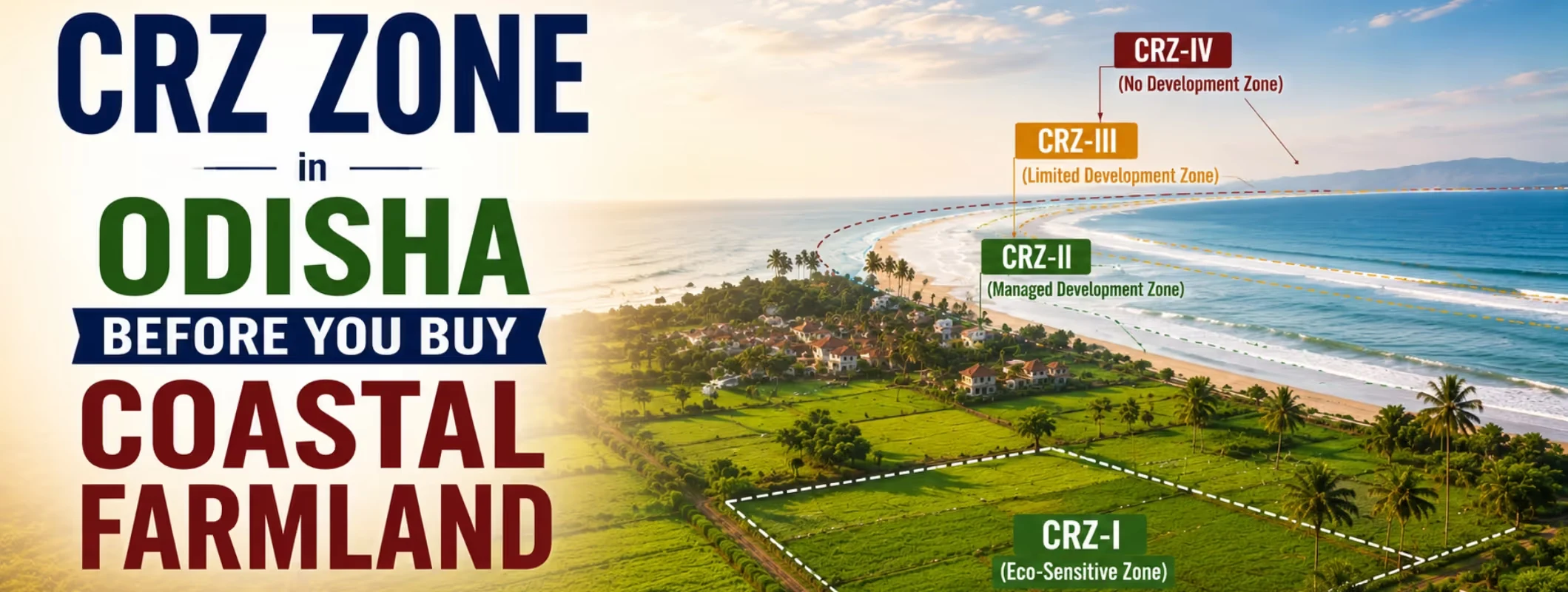
The state of Odisha extends for nearly 500 km along the Bay of Bengal, and most of the state’s choicest real estate - the plots surrounding Puri, Konark, Chilika, and the wetlands of Bhaitarkanika - falls within the government’s designated Coastal Regulation Zone. If you are eyeing a piece of land that borders the sea or a creek or a backwater or a tidal river, you should first determine whether it falls within the CRZ before you buy the plot. That way, you avoid buying land that you cannot build on or have severely restricted use of. In most cases, it is one of the first items on a competent lawyer’s agenda when dealing with coastal real estate in Odisha, along with reviewing the paper trail.
What the CRZ Notification Actually Covers?
The coastal regulation zone notification is issued by the Ministry of Environment, Forest and Climate Change, and the current Notification was issued in 2019. It deals with construction, land use, and development activity along the entire coast of the country, of which the coastline of Odisha is a part. It classifies coastal land into four categories:
| Zone | Description | Typical Restriction Level |
| CRZ-I | Ecologically sensitive areas including mangroves, coral reefs, turtle nesting beaches, and intertidal areas between the Low Tide Line (LTL) and High Tide Line (HTL). | Highest. Construction is almost entirely prohibited. |
| CRZ-II | Developed shoreline land within municipal limits that already has roads and civic infrastructure. | Moderate. Regulated development is permitted. |
| CRZ-III | Relatively undisturbed rural or semi-rural coastal land not covered under CRZ-II. | Moderate to high. A No Development Zone (NDZ) applies inland from the High Tide Line (HTL). |
| CRZ-IV | Water areas from the Low Tide Line (LTL) to 12 nautical miles into the sea, including tidal-influenced backwaters, creeks, and estuaries. | Regulates water-based activities, not land purchases directly. |
For most buyers who are searching for land in Odisha near the coast, CRZ-III is the one that comes up repeatedly, since it covers much of the state's rural farmland belt along the shoreline. Within CRZ-III, there's typically a No Development Zone (NDZ) measured inland from the High Tide Line, and the exact distance depends on whether the panchayat is classified as densely populated (rural) or falls under lower population density norms.
Orissa also carries a special designation worth knowing about: Bhaitarkanika is treated as a Critically Vulnerable Coastal Area under the notification, because of its mangrove cover. Land anywhere near that belt comes with restrictions layered on top of the standard CRZ classification, so it needs an extra round of checking.
Quick Breakdown: What's Generally Allowed vs Restricted
| Activity | CRZ-II | CRZ-III |
| Agriculture / horticulture | Generally allowed | Generally allowed |
| Repair of existing structures | Allowed with conditions | Allowed with conditions |
| New residential construction | Permitted within municipal norms | Restricted within the No Development Zone (NDZ); generally allowed beyond it, subject to applicable regulations. |
| Resorts / tourism structures | Regulated and requires clearance | Heavily regulated and dependent on distance from the High Tide Line (HTL). |
| Industrial units | Mostly prohibited | Mostly prohibited |
| Roads, jetties, and essential infrastructure | Permitted with approval | Permitted with approval |
Why Checking This Before You Buy Actually Matters?
Here's where buyers most often get caught out. A plot can look completely ordinary, dry, fenced, cultivated for years, and still sit inside a No Development Zone where construction is heavily restricted or banned outright. Farming may continue undisturbed. Putting up a house, a farmstay, or a resort on the same plot might not be an option at all.
I've come across buyers who assumed decades of paddy or cashew cultivation on a plot meant it was automatically free of CRZ restriction. That assumption is wrong more often than people expect. Agricultural use and CRZ classification are two entirely separate layers, and a single plot can carry both at the same time: farmable today, but restricted for anything beyond that.
If you're evaluating agricultural land for sale in Odisha, particularly around Puri, Ganjam, Kendrapara, or Bhadrak districts, checking CRZ status isn't optional paperwork tacked on at the end. It decides whether the plot can actually be used the way you're planning, or whether you're buying into permanent restrictions nobody flagged during the deal.
Step-by-Step: How to Check CRZ Status for a Plot in Odisha?
If you're following an Odisha Land Investment Guide, checking a property's Coastal Regulation Zone (CRZ) status should be one of the first due diligence steps. The verification is carried out through the Odisha Coastal Zone Management Authority using official coastal maps prepared and maintained by the Odisha Space Applications Centre (OSAC).
| Step | Action | Why It Matters |
| 1 | Note the exact khasra/plot number, village, and tehsil. | Needed to locate the plot precisely on the CZMP maps. |
| 2 | Access the Coastal Zone Management Plan (CZMP) for Odisha through the State Forest, Environment and Climate Change Department or the OSAC mapping portal. | This is the official map showing CRZ zone boundaries. |
| 3 | Locate the plot and identify its CRZ category. | Confirms whether the land falls under CRZ-I, CRZ-II, CRZ-III, or CRZ-IV. |
| 4 | Measure the distance from the High Tide Line (HTL) if the plot is near the shoreline. | No Development Zone (NDZ) restrictions are based on distance, not just the CRZ category. |
| 5 | Apply for CRZ clearance through the Odisha Coastal Zone Management Authority if construction or commercial use is planned. | Required before any regulated activity begins. |
| 6 | Cross-check with the local Tehsildar or a coastal zone consultant for plots near a CRZ boundary. | Boundary-line plots are among the most commonly disputed cases. |
If the map reading feels ambiguous, and for plots sitting right at a zone boundary, it often does, get written confirmation from the district revenue office rather than relying on a broker's word. This single check can prevent a legal tangle that's genuinely difficult to undo once construction has already begun.
Common Mistakes Buyers Make With Coastal Odisha Land
A handful of mistakes keep showing up in coastal property transactions, whether you're buying land or selling property online in Orissa:
- Assuming farmland status rules out CRZ restriction; the two are unconnected, and both can apply to the same plot simultaneously
- Not checking the exact CRZ sub-category, CRZ-II and CRZ-III carry meaningfully different rules, and mixing them up changes what you can legally build.
- Ignoring proximity to mangrove or backwater zones, areas near Bhaitarkanika often carry extra protection layered on top of standard CRZ rules.
- Skipping written CRZ clearance before construction plans, verbal reassurance from a seller carries no legal weight if the authority hasn't formally approved it.
- Relying only on the seller's paperwork, always cross-verify independently through CZMP maps rather than trusting documents handed over during negotiation.
Anyone putting together an Odisha Land Investment Guide for their own reference should treat CRZ verification as step one, well before price negotiation even starts. It's far easier to drop a plot from your shortlist early than to discover a restriction after money has already changed hands.
Where 2Bigha Fits Into This?
Tracking down CZMP maps, revenue records, and coastal clearance status on your own takes real time, especially when you're comparing several plots across different districts before deciding where to invest. 2Bigha handles this groundwork upfront. Listings on the platform come with background verification already completed, including flagging land classification issues like CRZ status wherever relevant, so you're not left piecing it together yourself.
Whether you're browsing farm land for sale in Odisha or weighing coastal plots against inland alternatives, 2Bigha gives you verified listings with documentation already reviewed, cutting out the usual back-and-forth that comes with buying through scattered local brokers. If you're on the other side of the deal and considering selling property online, listing through a platform that flags zoning issues upfront tends to attract buyers who are genuinely ready to move forward, not just browsing. Explore verified listings at 2bigha.ai.
Disclaimer: This article is for informational purposes only and should not be considered investment, legal, financial, or property advice. Real estate regulations, infrastructure plans, market conditions, and government policies may change over time. Readers are advised to verify information with relevant authorities and consult qualified professionals before making any investment or property-related decisions.