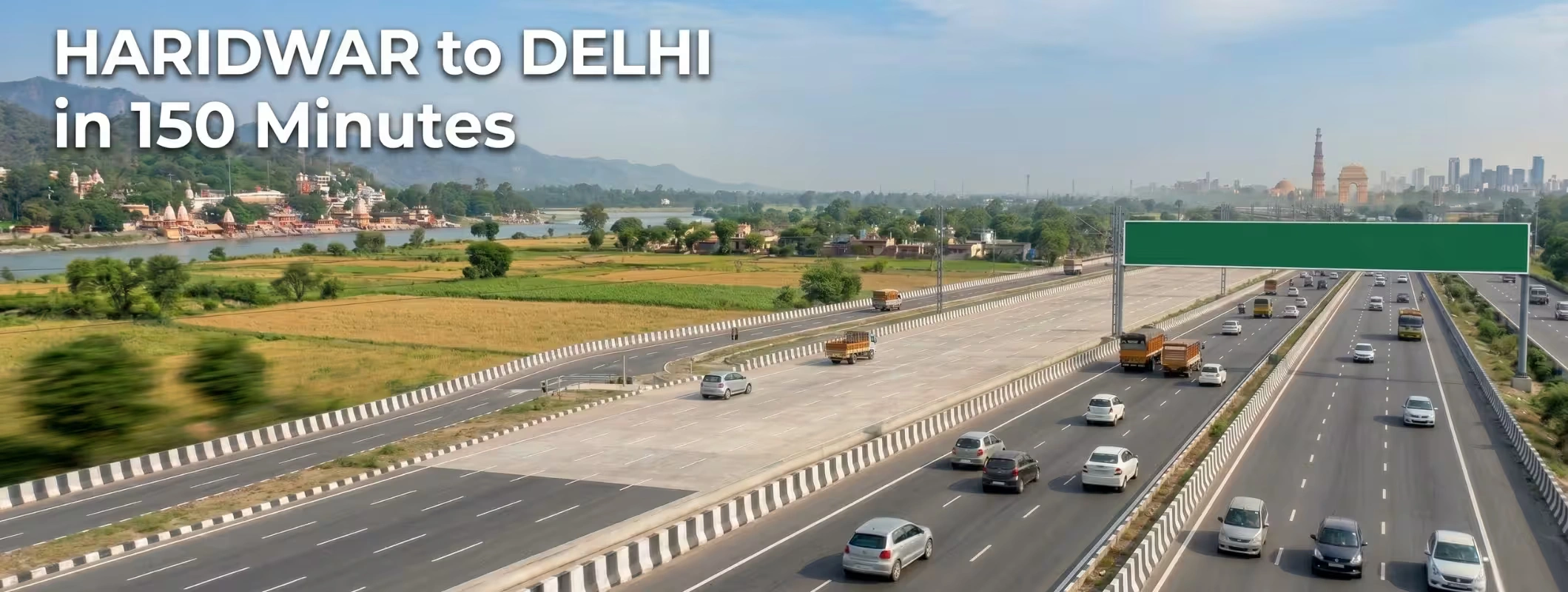
Key Takeaways
- The big story is not just one road. The faster Haridwar-Delhi route depends on the already inaugurated Delhi–Dehradun Economic Corridor plus the Haridwar spur and the Haridwar greenfield bypass working together.
- The 6-lane access-controlled spur to Haridwar was sanctioned at ₹2,095.21 crore under Bharatmala in 2021, and recent reporting says the 51-km Saharanpur-bypass-to-Haridwar stretch is scheduled for inauguration in June 2026.
- A separate four-lane Haridwar greenfield bypass is expected by October 2026, which matters because city decongestion is just as important as expressway speed when you want real travel-time reduction.
- The “150 minutes” headline is best treated as a possible best-case outcome once the wider corridor ecosystem is functioning smoothly. Official sources confirm Delhi–Dehradun at about 2.5 hours and confirm a Haridwar spur, but they do not firmly guarantee Delhi–Haridwar in exactly 150 minutes in all conditions.
- For real estate, the bigger takeaway is corridor-led demand. Property portals already show active plot inventory and pricing in Haridwar, while recent real-estate commentary around the Delhi–Dehradun corridor points to rising demand for plots, holiday homes, and land-led investment along the influence zone.
Introduction
The phrase “Haridwar to Delhi in 150 minutes” sounds like a headline built to grab attention. And frankly, it does. But behind the headline is a much more important real estate and infrastructure story. North India’s road map is changing fast. The Delhi–Dehradun Economic Corridor was inaugurated on April 14, 2026, and the government has already linked it with a spur towards Haridwar. On top of that, a 51-km six-lane stretch from the Saharanpur bypass to Haridwar is now being positioned as the next important piece of this travel puzzle, while a separate Haridwar greenfield bypass is expected to reduce local congestion later in 2026.
That matters more than weekend travel. When a religious city like Haridwar gets stronger highway access, faster corridor movement, and cleaner city-edge connectivity, the impact usually goes beyond transport. It affects tourism, logistics, second-home demand, plotted developments, hotel-led activity, and long-term land investment near new approach roads. That is why this topic is not only an infrastructure story. It is also a property story.
What is Actually Happening on the Route
Let us separate the hype from the confirmed updates. The Delhi–Dehradun Economic Corridor has already been inaugurated. Official and recent reporting puts it at about 210–213 km, with a design speed of 100 kmph, and says it cuts Delhi–Dehradun travel time from around 6.5 hours to 2.5 hours. The project also includes a spur towards Haridwar, which is the part that makes Haridwar travel-time headlines more believable than they were a year ago.
On the Haridwar side, the next critical piece is the 6-lane access-controlled spur. The government sanctioned the Haridwar spur in 2021 with a budget of ₹2,095.21 crore. More recently, reporting around the project describes a 51-km six-lane Saharanpur-Haridwar bypass / spur section, linked to the larger corridor, and says it is scheduled for inauguration in June 2026.
Then comes the city-level fix: the Haridwar four-lane greenfield bypass, which recent reporting places at about ₹1,600 crore or ₹861 crore depending on the package/description cited in media summaries, with completion targeted around October 2026. The consistent takeaway across current reporting is not the exact media shorthand on cost, but that a major Haridwar bypass is expected to decongest pilgrimage traffic and redirect movement away from the city core.
That distinction matters. A fast highway gets attention. A bypass that removes urban bottlenecks creates actual daily usability.
What Buyers, Travellers, and Investors Should Know
Confirmed and Current
- Delhi–Dehradun Economic Corridor inaugurated on April 14, 2026.
- Official sources confirm a spur towards Haridwar as part of the broader corridor logic.
- The Haridwar spur was sanctioned at ₹2,095.21 crore.
Scheduled / Expected
- The 51-km six-lane Saharanpur bypass to Haridwar stretch is reported as scheduled for inauguration in June 2026.
- The Haridwar four-lane greenfield bypass is expected by October 2026.
Still a Projection, not a fixed Guarantee
- The idea of Haridwar to Delhi in 150 minutes is best understood as a projected best-case route benefit after multiple pieces operate smoothly, not as a legally guaranteed or everyday travel promise.
Is 150 Minutes Realistic
Possibly in ideal network conditions. But it is smarter to write this carefully. Official sources clearly support the claim that Delhi to Dehradun can drop to about 2.5 hours on the new corridor. They also confirm that the corridor has a Haridwar spur. Recent project reporting says the Haridwar-linked six-lane stretch could reduce Delhi–Haridwar travel by around 2.5 to 3 hours compared with current slower routes.
Still, road travel times are shaped by more than one number. Final route efficiency depends on interchange performance, entry-exit convenience, local bottlenecks, operational readiness, toll behaviour, seasonal rush, and event-driven congestion like Kanwar Yatra traffic. Even with the corridor open, the government previously clarified that a small service-road issue around one ramp would not affect the main expressway, though it could affect a small part of local service movement.
Why this Highway Update Matters for Haridwar Real Estate
This is where the conversation becomes more valuable for buyers, sellers, and investors.
In Indian property markets, travel time reduction is rarely just about comfort. It changes the mental map of a city. Once a place starts feeling “closer” to Delhi NCR, its property profile can shift from pilgrimage-only demand to a broader mix of:
- second-home interest
- plotted investment
- retirement-led buying
- short-stay hospitality demand
- logistics and warehousing spillover
- corridor-facing commercial activity
Recent real-estate coverage on the Delhi–Dehradun corridor says towns and influence zones along the route could see 15% to 25% appreciation in some micro-markets over the next 18 to 24 months, especially where connectivity improves sharply and land-led investment enters early. Those comments are expert projections, not guaranteed outcomes, but they reflect how the market is already reading the corridor.
Haridwar stands to benefit for a different reason than Saharanpur or Muzaffarnagar. It is not just a transit point. It is a spiritual city with year-round relevance, strong footfall cycles, education and wellness pull, and demand that often supports plots, small residential assets, dharamshala-zone activity, hospitality, and longer-hold land investments. Better road access can widen its buyer pool beyond pure pilgrims.
Also Read: Delhi–Meerut Expressway: Route, Phases & NCR Impact
What the Property Portals are already Showing
The real estate signals are not theoretical anymore.
Housing.com’s Haridwar District trends page currently shows an average property price of ₹4,708 per sq ft, up 21.25% year-on-year. That tells you the district is already moving, even before all corridor-side road benefits are fully absorbed into the market.
For plots specifically, Housing.com says the average price per sq ft for plots in Haridwar is about ₹3,221, with a range from ₹225 to ₹8,000 per sq ft. It also lists active plot demand in places such as Jwalapur, BHEL Township, Haripur Kalan, and Aneki Hetmapur.
This does not mean every parcel near a road becomes gold. But it does mean the market is already giving early signals that road connectivity north India themes are starting to influence buying behaviour.
Where Smart Buyers Should Look
If you want to invest around a corridor-led story, stop thinking only in city names. Think in micro-markets.
For Haridwar and the wider route story, these categories matter most:
1. Plots near existing or improving highway access
Plots near major approach roads, NH-linked belts, and clean-entry localities often move first when travel routes improve. Buyers searching for plots near new expressway Delhi Haridwar or property near expressway corridor are usually responding to this exact logic.
2. Land near bypass roads and future diversion routes
If the Haridwar greenfield bypass removes city congestion the way it is expected to, land around bypass influence pockets could gain importance for logistics, roadside commerce, gated plotting, and low-rise residential demand.
3. Peripheral residential plots over highly crowded core pockets
Many buyers make the mistake of assuming the most famous central zone is always the best investment zone. Often, the better-performing assets sit one layer outside the legacy core, especially where future access improves and pricing is still more rational.
4. Farm and land-led opportunities with caution
Search interest around farmland near highway investment and land near Delhi highway will obviously rise as corridor stories become popular. But farmland investment must be treated carefully. Access, title, zoning, land-use restrictions, mutation records, flood sensitivity, and resale liquidity all matter. Never buy just because a parcel sits near a future road line.
Why 2Bigha Fits this Story
For corridor-led land research, 2Bigha fits naturally into the buyer journey. 2Bigha positions itself as a land-focused platform where users can search land anywhere, explore current land prices, review investment opportunities, and use verified ownership records and property insights to make more confident land decisions. It also offers a map-led exploration flow, which is especially useful when your investment thesis depends on location and route visibility rather than just a broker’s phone pitch.
That makes it useful for people exploring:
- land near Haridwar highway
- plots near new expressway Delhi Haridwar
- property near expressway corridor
- residential plots near highway India
- longer-hold land options that depend on future road-led growth
In simple words, if your plan is to invest before the corridor effect gets fully priced in, you need tools that help you compare land logically, not emotionally. That is where a land-first platform like 2Bigha becomes valuable.
Should You Buy Now or Wait
That depends on what you are buying.
If you want a self-use apartment in central Haridwar, this road story may support long-term confidence, but your decision should still depend on neighbourhood quality, legal comfort, and liveability.
If you are looking at plots for sale in Haridwar or land-led options, then the current phase can be interesting because markets often begin repricing before full road utility is felt on the ground. That is why many early investors focus on corridor-adjacent land while the infrastructure story is still moving from announcement to actual usage.
Still, smart buying in this market means checking:
- title chain and mutation
- road approach and actual access, not brochure access
- land-use and zoning
- flood and drainage conditions
- authority approvals
- distance from real junctions, not map exaggerations
- resale demand, not just seller narratives
Final Verdict
Yes, the new 6-lane bypass and the wider expressway ecosystem could genuinely change the Haridwar-to-Delhi route.
But the smarter conclusion is not just “Haridwar to Delhi in 150 minutes.” The smarter conclusion is this:
Haridwar is moving closer to Delhi in a practical, investment-relevant way. The Delhi–Dehradun corridor is live, the Haridwar spur has official backing, the Saharanpur-Haridwar six-lane stretch is now being tied to a June 2026 target, and the Haridwar greenfield bypass is expected later in 2026. Together, these projects can reshape travel behaviour, tourism flow, and property demand across the corridor.
For buyers, that means one thing: do not wait for the market to become obvious and expensive before you start researching. Track the route, study the micro-markets, compare land carefully, and use a platform like 2Bigha when your interest is land-led rather than brochure-led.
FAQs - Delhi to Haridwar in 150 Minutes
1. Is the Haridwar to Delhi expressway already fully ready?
Not as one single standalone “Haridwar to Delhi expressway” in that simple headline form. What is active is the Delhi–Dehradun Economic Corridor, which includes a Haridwar spur, while the 51-km Saharanpur-Haridwar six-lane stretch is being reported as scheduled for June 2026, and the Haridwar greenfield bypass is expected later in October 2026.
2. Will Haridwar really come within 150 minutes of Delhi?
It could in favourable conditions once the corridor and bypass pieces work together, but official sources do not give a blanket guaranteed everyday figure of exactly 150 minutes for Delhi–Haridwar. That number should be treated as a strong projection, not a fixed promise.
3. What is the new 6-lane bypass between Haridwar and Delhi?
The current discussion is around the 51-km six-lane Saharanpur bypass to Haridwar stretch, linked to the larger Delhi–Dehradun Economic Corridor and its Haridwar spur. Media reporting identifies it as NH-344B and says it will connect Haridwar, Roorkee, and Saharanpur.
4. Why is this road project important for real estate?
Because improved travel time usually expands a city’s demand base. Better connectivity can support tourism, second homes, plotted developments, logistics, and corridor-facing commercial growth. Recent real-estate reporting around the Delhi–Dehradun corridor suggests improved demand and possible appreciation across multiple micro-markets along the route.
5. Are plots in Haridwar already expensive?
They are not uniform. Housing.com shows average plot pricing in Haridwar at around ₹3,221 per sq ft, while MagicBricks shows residential land in Haridwar at an average around ₹70.1 lakh and a median around ₹37.5 lakh. Actual values depend heavily on access, approvals, and locality.
6. How can 2Bigha help if I want land near the corridor?
2Bigha is useful for land-focused discovery because it offers a map-led search flow, land-price visibility, investment-oriented exploration, and ownership-related insights that help buyers compare options more confidently.
7. Is this a good time to invest near the Haridwar highway corridor?
It can be a good research window, especially for long-term plot and land buyers, because infrastructure-led repricing often starts before the full traffic benefit becomes obvious on the ground. But do not buy without checking approvals, title, access, and land-use details.