The Delhi–Meerut Expressway is one of the most important infrastructure corridors in North India because it reshaped road connectivity between Delhi, Ghaziabad, and Meerut. This improved connectivity is also attracting investors looking to buy land online in Delhi and nearby NCR regions due to better accessibility and rising development potential.
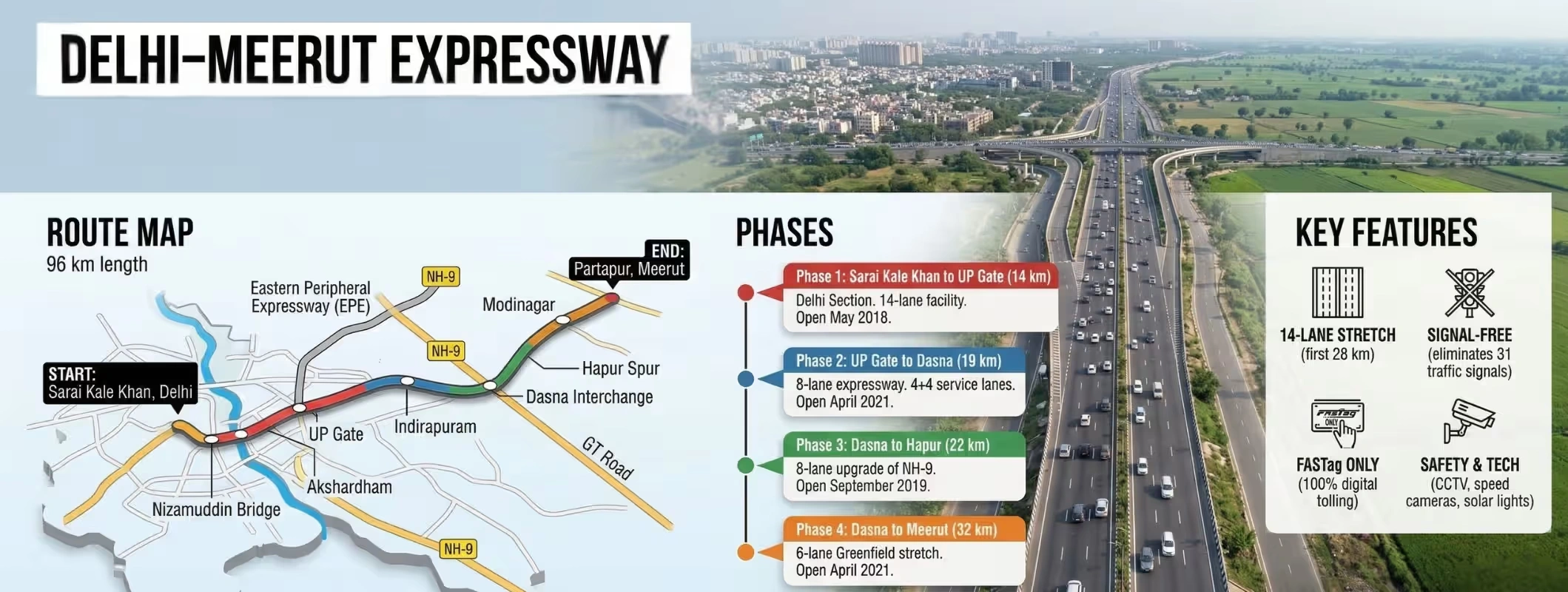
In simple terms, it starts from the Nizamuddin Bridge side in Delhi, runs toward the Delhi–UP border and Dasna, and then connects onward through the Dasna–Hapur stretch and the greenfield Dasna–Meerut alignment. Official documents consistently show it as a four-package project.
Key Takeaways
- The corridor was planned as a four-package Delhi–Meerut road project beginning at Nizamuddin Bridge and moving through UP Border, Dasna, Hapur, and Meerut-side connectivity.
- Package I made headlines as the first 14-lane National Highway section in India, with a 6-lane expressway in the centre and 4+4 service lanes.
- Public references show two length figures: earlier PIB material described the project as 82 km, while a later NHAI publication referred to a 96 km Delhi–Meerut Expressway developed in 4 phases. In practice, that difference appears to reflect whether the source is describing the core project or the broader upgraded corridor.
- The corridor is also commonly associated with reducing travel time between Delhi and Meerut to approximately 45-60 minutes, depending upon the source cited and the state of the traffic.
- The corridor continues to develop post-opening in terms of ANPR tolling pilots, safety interventions, and junction redesign work, thus not being a “completed and forgotten highway” in the first place.
What is the Delhi–Meerut Expressway?
The Delhi-Meerut Expressway is a high-speed highway that will improve connectivity between Delhi and Meerut, as well as provide connectivity to the Western UP and Uttarakhand regions. According to the project note released by the PIB in 2018, the Delhi-Meerut Expressway highway stretches to a length of 82 km. In this highway, the first 27.74 km has been developed into a highway of 14 lanes, while the remaining distance has been developed into a highway of 6 lanes.
At the same time, NHAI’s later Rajmaarg publication referred to it as a 96 km long Delhi–Meerut Expressway developed in four phases. That is why different websites quote different total lengths.
Delhi–Meerut Expressway Route Map Explained
If you want the route in plain language, think of it like this:
Delhi (Nizamuddin Bridge / Sarai Kale Khan side) → Delhi–UP Border → Dasna → Hapur-side upgraded stretch + Dasna–Meerut greenfield link → Meerut / Meerut Bypass side. This alignment is reflected in official PIB project notes and the published location map.
The 2015 PIB release says the alignment starts at Nizamuddin Bridge, follows the existing NH-24 up to Dasna, and from Dasna continues on a new alignment up to Meerut, terminating near the Meerut bypass side.
Phase-Wise / Package-Wise Breakdown
The phase summary below is based on the official package breakup published by PIB.
| Package / Phase | Section | Broad Design |
| I | Nizamuddin Bridge to UP Border | 6-lane expressway + 4+4 service lanes |
| II | UP Border to Dasna | 6-lane expressway + 4+4 service lanes |
| III | Dasna to Hapur | 6-laning of NH-24 with service roads |
| IV | Dasna to Meerut | 6-lane greenfield expressway |
PIB’s 2018 release gives the key phase lengths as 8.36 km, 19.28 km, 22.27 km, and 31.78 km respectively for Packages I to IV. The earlier 2015 note also confirms the same overall package structure.
Key Features of Delhi–Meerut Expressway
One of the reasons this expressway stands out is that it was not just about widening a road; it was about creating a faster, safer, and cleaner road with several features incorporated into it. The official releases highlight major features such as 11 flyovers/interchanges, 5 major bridges, 24 minor bridges, 3 rail overbridges, 36 vehicular underpasses, 14 pedestrian underpasses, and approximately 5.91 km of elevated sections.
Package I was very famous because it was said to be the first 14-lane National Highway in the country. The same official note also mentions a 2.5-metre-wide cycle track on either side, a vertical garden on the Yamuna Bridge, solar lighting, and drip irrigation for plants.
PIB also stated that the project would be the first expressway with dedicated bicycle tracks on nearly 28 km between Delhi and Dasna. That detail still makes the corridor unusual in India’s highway landscape.
How Much Time Does it Save?
This is the question most users care about. The answer is that the Delhi–Meerut Expressway was publicly positioned as a corridor that would cut Delhi–Meerut travel from over 2.5 hours or even around 4 hours in older traffic conditions to roughly 45–60 minutes. The variation comes from different official statements made at different stages of completion and under different travel assumptions.
For daily commuters, logistics players, developers, and land buyers, that time compression matters more than the headline number itself. Faster, more predictable travel changes where people are willing to live, invest, warehouse goods, and buy farm land. That is exactly why the Delhi NCR infrastructure corridor, Meerut growth corridor, and Ghaziabad real estate connectivity story keeps attracting attention.
Why This Expressway Matters for Real Estate
In NCR, infrastructure usually drives perception first and pricing later. The Delhi–Meerut Expressway improves access across the Ghaziabad–Dasna–Hapur–Meerut belt, which strengthens the case for residential demand, industrial movement, plotted development, and land-led growth along connected micro-markets.
This story becomes even stronger when you look at the corridor in a wider mobility context. NCRTC’s Delhi–Ghaziabad–Meerut corridor converges at Sarai Kale Khan, and NCRTC describes the project as an 82 km regional transit corridor on the same broad axis. That means the Delhi–Meerut belt is no longer just a road corridor; it is increasingly a multi-modal connectivity corridor.
For property buyers and land investors, that matters. Better roads plus faster regional transit usually improve market visibility, catchment size, and long-term usability. If you are exploring farmland, plotted land, or investment-led locations, this is the kind of corridor logic you should evaluate before buying on hype alone. That is also where platforms like 2Bigha become useful: not just for free verified listings, but for comparing land opportunities against actual infrastructure access, growth direction, and future mobility logic.
2026 Reality Check: The Corridor Is Open, but the Story Is Still Evolving
A lot of blogs stop at inauguration details. That is lazy content. The real picture is that the corridor is still being refined from an operations and safety angle. NHAI’s 2021–22 Annual Report noted that a pilot for gantry-mounted Automatic Number Plate Recognition (ANPR) technology was under progress on the Delhi–Meerut Expressway as part of a broader “zero wait time” tolling vision.
Recent reporting also shows that authorities have continued to intervene on the corridor for pedestrian safety and junction efficiency. In 2025, NHAI planned iron barricades along a 15 km stretch to reduce dangerous jaywalking, and a key DME–NH9 cut near Ghaziabad was shut temporarily for redesign because it had become a serious choke point.
That matters for readers because it tells you something important: this is not just a prestige expressway. It is a heavily used NCR mobility spine that is still being tuned for real-world traffic behaviour.
How Buyers and Investors can Track this Corridor Closely?
If you are looking at Delhi NCR real estate, Meerut property growth, Ghaziabad land investment, industrial plots, or even agricultural land with future corridor value, the Delhi–Meerut Expressway deserves attention because it changes travel behaviour and market reach. But access alone is not enough. You still need to check:
- legal title
- land use
- actual approach road
- nearby urban expansion
- toll and commuting practicality
- flood and drainage conditions
- last-mile connectivity beyond the expressway
That is the difference between infrastructure-led investment and blind speculation.
FAQs - Delhi–Meerut Expressway
1) What is the starting point of the Delhi–Meerut Expressway?
Official project notes say the alignment starts at Nizamuddin Bridge in Delhi and continues toward the Delhi–UP Border before moving onward to Dasna and the Meerut-side sections.
2) How many phases does the Delhi–Meerut Expressway have?
It is structured in four packages / phases. Official PIB releases list them as Nizamuddin Bridge–UP Border, UP Border–Dasna, Dasna–Hapur, and Dasna–Meerut.
3) Is the Delhi–Meerut Expressway 82 km or 96 km?
Both numbers appear in public sources. PIB’s project release described it as an 82 km project, while a later NHAI Rajmaarg publication referred to it as a 96 km expressway developed in four phases. Readers should understand that sources are not always counting the corridor in exactly the same way.
4) How much travel time does it save?
Official and public statements around the project generally place Delhi–Meerut travel at about 45 to 60 minutes, compared with much longer earlier travel times.
5) Why is this expressway important for property buyers?
Because major expressways change commuting patterns, improve market access, and often increase the visibility of nearby locations to homebuyers, developers, and businesses. On the Delhi–Meerut axis, that effect becomes stronger when seen alongside wider NCR connectivity upgrades such as the regional transit corridor.
Final Word
The Delhi–Meerut Expressway is not just a road project. It is a Delhi NCR growth corridor, a connectivity multiplier, and a major reason why the Ghaziabad–Meerut side of the market keeps showing up in infrastructure-led real estate discussions.
- For commuters, it means speed.
- For businesses, it means reach.
- For investors, it means opportunity.
- For careless buyers, it can still mean mistakes.
That is why the smart move is simple: follow the corridor, but verify the location properly before you invest.