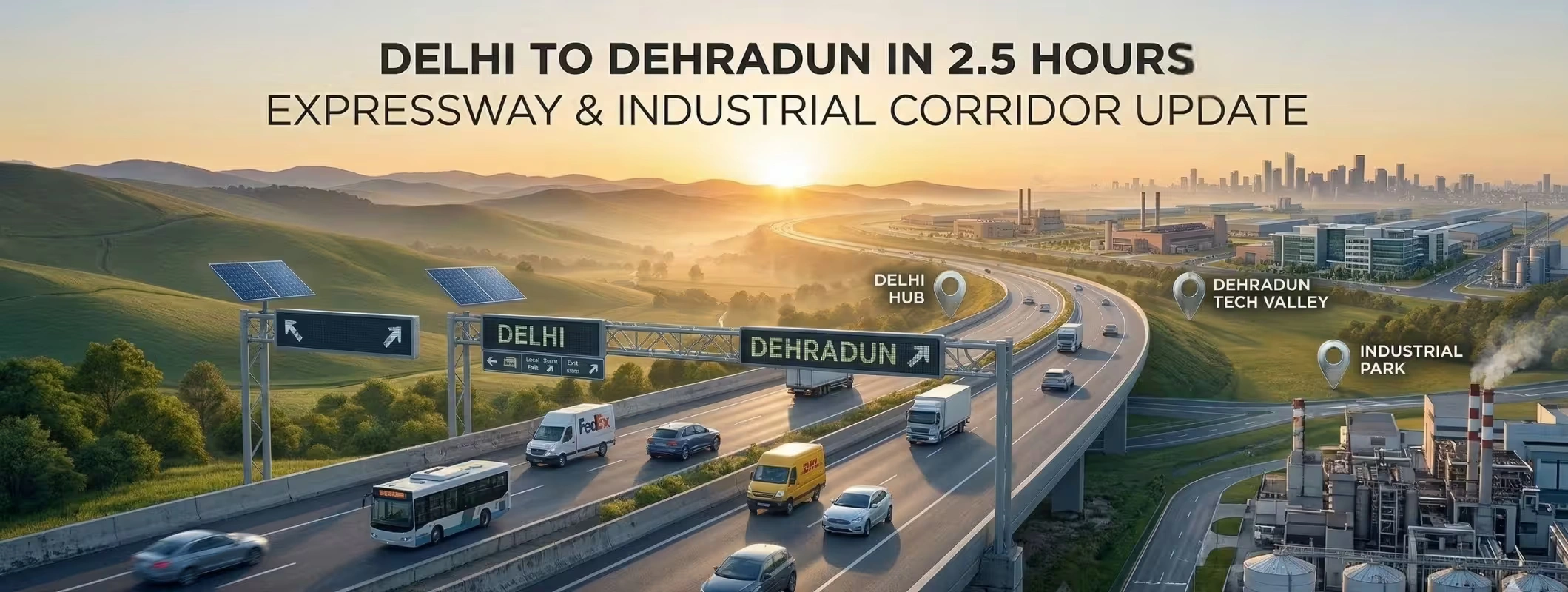
If you track NCR-to-Uttarakhand connectivity, this is one of the biggest infrastructure stories shaping travel, tourism, logistics, and real estate in North India right now. The Delhi–Dehradun Economic Corridor / Delhi–Saharanpur–Dehradun Expressway is designed to sharply reduce travel time and improve regional movement. Because of this connectivity boost, interest in buy land in Delhi, nearby NCR zones, and emerging corridors along western Uttar Pradesh is also increasing among investors and developers.
As of 5 March 2026, the project narrative is clear: travel time compression is real, phased operational readiness and trials have already happened on sections, and the corridor’s impact is expanding beyond transport into industrial land development, logistics hubs, and future real estate demand corridors across the Delhi–UP–Uttarakhand belt.
Key Takeaways
- Delhi–Dehradun travel time is expected to drop to around 2.5 hours once the full corridor is operational.
- The expressway is a ~210 km access-controlled corridor connecting Delhi to Dehradun via key UP districts/towns including Baghpat, Baraut, Muzaffarnagar, Shamli, and Saharanpur.
- The project cost is around ₹12,000 crore, with a designed speed benchmark cited at 100 km/h.
- A public trial run on an initial stretch was reported in late 2025, signaling phased readiness before full public rollout.
- The corridor includes a major eco-sensitive feature: a 12-km elevated section in/around Rajaji landscape to reduce wildlife disruption.
- Recent updates indicate a proposed industrial corridor/IMLC development push along the Delhi–Dehradun route in UP, including land identification efforts in the Baghpat belt and wider district coverage discussions.
Expressway & Corridor Update at a Glance
| Item | Current Update (as of Mar 5, 2026) | Why It Matters |
| Travel time claim | ~2.5 hours Delhi to Dehradun (full corridor impact) | Major tourism + business commute boost |
| Corridor length | ~210 km | Faster regional connectivity across NCR–UP–Uttarakhand |
| Project status | Final-stage completion narrative + section-wise trials reported | Indicates near-term operational impact, but full commissioning depends on official notification |
| Route influence | Delhi → western UP belt → Dehradun | Strong demand uplift for logistics, roadside services, warehousing, plotted development |
| Industrial angle | UP-side industrial corridor/IMLC planning discussions reported | Long-term employment + land-use change potential |
The table above reflects a practical market view based on official project communication and recent public updates.
What is the Delhi–Dehradun Expressway and Why is Everyone Talking About it?
This is not just another highway update. It is a high-impact mobility corridor designed to improve travel between Delhi/NCR and Uttarakhand, especially for Dehradun, Haridwar, Rishikesh and nearby destinations through better access-controlled connectivity and linked routes. Official updates consistently highlight the same headline benefit: a major reduction in travel time from roughly 6–7 hours to around 2.5 hours.
2026 Status Update: What’s Open, What’s in Final Readiness
Here’s the straight answer: don’t assume the entire corridor is fully commissioned just because a trial stretch was used.
- A public trial run was reported for an initial stretch (including the Delhi-to-Baghpat-side connectivity segment), showing visible progress on the ground.
- Later updates described the project as being in the final stages, with minor finishing work pending before public opening.
- More recent communications continued emphasizing the corridor’s role in reducing travel time and boosting regional connectivity.
Practical takeaway for Travellers and Investors
If you are planning travel, logistics routing, or property decisions, track official opening notifications and traffic advisories for full operational status, because phased readiness does not always equal full-scale opening. That small distinction matters a lot for real planning.
Industrial Corridor Update: Why this Changes the Real Estate Conversation
This is where the story gets bigger than tourism.
Recent updates indicate that the Uttar Pradesh side is moving to identify land for industrial-corridor-style development along/around the Delhi–Dehradun greenfield route, with discussions around:
- Baghpat district focus
- ~1,000 hectares land identification
- coverage linked to multiple districts (some reports mention 26 districts in the wider initiative context)
At the same time, state-level industrial development planning continues under larger frameworks such as:
- Integrated Manufacturing & Logistic Clusters (IMLCs)
- Defence Industrial Corridors (DIC)
- PPP / investor participation models for industrial parks and bulk allotments
Why this matters for Property Buyers and Developers
When an expressway corridor starts attracting industrial and logistics planning, nearby land markets typically see a shift in demand mix:
- pure agriculture users,
- farm plotting/speculative buyers,
- warehousing/logistics interest,
- worker housing/rental demand,
- commercial support uses (fuel, food, repair, hospitality, storage).
That does not mean every parcel will be appreciated equally. It means location quality + legal clarity + zoning compatibility become much more important than “just being near the expressway.”
Real Estate Impact: Who Stands to Benefit First?
1. Logistics and industrial land players
These are usually the earliest movers when corridor-led planning becomes visible. Land with clear access roads, proximity to junctions/interchanges, and minimal title complications tends to attract early attention.
2. Hospitality and travel service businesses
A faster Delhi–Dehradun route supports:
- weekend travel,
- religious travel routes (via linked connectivity),
- highway amenities,
- stay/food/service clusters.
3. End users and second-home buyers
Time compression changes behaviour. A route that earlier felt “long and tiring” becomes a much easier weekend drive, which can increase interest in:
- plotted development belts,
- farmhouse demand (where legally permissible),
- outskirts growth pockets around access nodes.
4. Local landowners
Industrial corridor planning can create opportunities, but also challenges:
- valuation confusion,
- speculative pricing,
- documentation pressure,
- land-use misunderstandings,
- acquisition-related uncertainty in some zones.
This is where professional due diligence becomes non-negotiable.
What Smart Buyers Should Check Before Investing Near the Corridor
If you are considering land near Dehradun–Delhi route influence zone, don’t buy on headlines alone. Use this checklist:
Legal & title checks
- Title chain and mutation records
- Encumbrance status
- Revenue records / khasra details
- Court disputes / family disputes
- Road access rights (not just “map pe road hai”)
Planning & development checks
- Land-use category (agricultural / industrial / mixed-use potential)
- Master plan alignment
- Proposed interchange distance (actual, not approximate)
- Flood risk / drainage / eco-sensitive restrictions
- Utility readiness (power, water, approach road)
Commercial viability checks
- Who will use this land in 3–5 years?
- Is there real demand, or only broker hype?
- Is the location suited for warehousing, hospitality, plotting, or farming?
- What is the exit strategy?
This is the difference between infrastructure-led investing and speculation-led buying.
Final Word: What This Means for 2026
The Delhi–Dehradun Expressway story is no longer just a “future promise” headline. The project has moved into a stage where travel-time benefits are widely discussed, sections have seen trial movement, and the wider corridor is now being discussed in the context of industrial and economic development.
For real estate stakeholders in North India, the opportunity is real — but so is the risk of rushing. The winners in this cycle will be the ones who combine speed with due diligence.
FAQs - Delhi to Dehradun in 2.5 Hours
1. What is the latest update on the Delhi–Dehradun Expressway in 2026?
The Delhi – Dehradun Expressway is at an advanced stage of development, with major sections of the project progressing and test movement reported to have been undertaken on the sections of the project that have been developed. Once operational, the Delhi – Dehradun Expressway is expected to enhance the connectivity between Delhi/NCR and Dehradun significantly. For the investor and the traveler, the important thing to note is that announcements for the opening of the sections of the project will likely be made officially, although the sections of the project will likely be opened in phases.
2. Will the Delhi to Dehradun travel time really reduce to 2.5 hours?
Yes, that is the widely discussed target travel-time outcome linked to the expressway’s access-controlled design and improved route efficiency. The actual travel time may still vary based on entry point in Delhi/NCR, traffic at interchanges, weather, and final operational conditions. But compared to the older route, the expressway is expected to deliver a major reduction in journey time.
3. How will the Delhi–Dehradun Expressway impact real estate in UP and nearby areas?
The expressway also may stimulate demand for logistics land, commercialization along the roadside, plotted development, and support facilities in the influence areas around interchanges and major expressway access points. Locations that have good accessibility, ownership, and legal usability of the land are likely to gain first, but the land along the expressway may not have the same benefits, and the buyer must look for location quality, land use, and demand rather than accessibility.
4. What is the industrial corridor update linked to the Delhi–Dehradun route?
Recent updates indicate planning momentum for industrial/logistics-led development along parts of the corridor, especially on the Uttar Pradesh side. This can change the demand pattern from purely agricultural use to mixed opportunities such as warehousing, small industrial support, transport services, and worker housing in select belts. For investors, this means the corridor is becoming an economic growth story, not just a travel route.
5. What should buyers check before investing in land near the Delhi–Dehradun Expressway?
Before buying, check:
- Title and ownership records
- Land-use category (agricultural / commercial / industrial suitability)
- Road access and approach width
- Distance from interchange/junction (actual, not verbal claims)
- Disputes, encumbrances certificate, and local development restrictions
A smart buyer should verify documents first and buy later. Infrastructure projects create opportunity, but due diligence protects your investment.