
 List Your Land
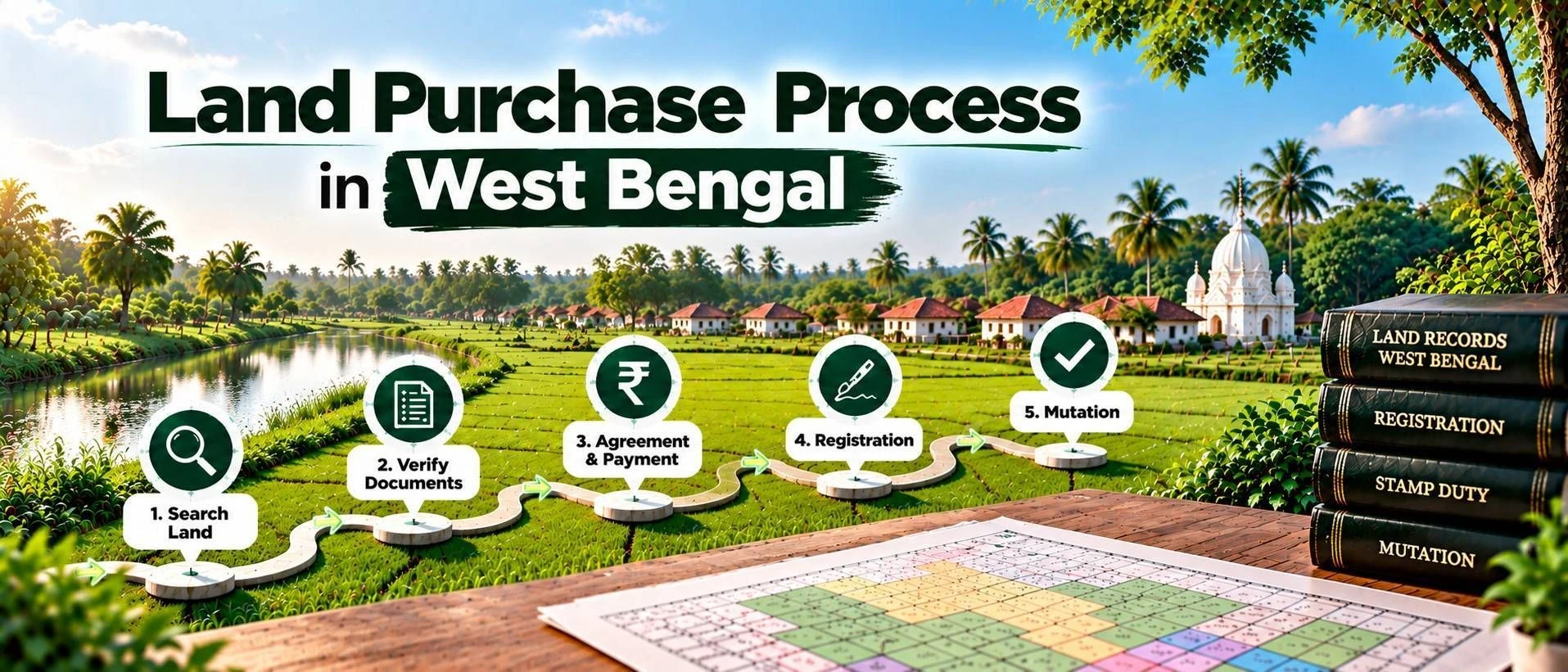
Buying land in West Bengal means moving through three linked stages — verifying the Khatian and deed history, registering the sale, and completing mutation — with the specific checks required varying meaningfully depending on where in the state you're buying. It matters because a plains city purchase in a place like Durgapur and a hill-area purchase in Darjeeling can involve genuinely different due diligence, and applying the wrong checklist to the wrong location wastes time or, worse, misses a real restriction. This guide covers the realistic step-by-step process to buy land in West Bengal, the state's land ceiling law, and what actually differs about buying in the Darjeeling hills versus the plains. Whether you're buying agricultural land, farmland for a crop loan, or a residential plot, this is the sequence you'll need to follow.
Section 1 — What is Land Purchase Process in West Bengal?
Before working through the process itself, it's worth seeing what's actually on the market — browse land for sale in West Bengal on the 2Bigha map to get a realistic sense of location, size, and price before starting due diligence on a specific plot.
In simple terms, buying land in West Bengal means confirming the Khatian and deed history is clean, registering the sale deed, and completing mutation — with the exact due diligence depending on the land's location and classification.
A purchase in a plains industrial city like Durgapur generally follows the standard state process: check the LR Khatian, verify the deed chain, confirm there's no unresolved Bargadar entry if the land is agricultural, register the deed, and complete mutation — the main state-specific constraint to keep in mind is West Bengal's land ceiling law, which caps private agricultural holdings at 17.5 acres for irrigated land and 24.5 acres for rainfed land, and urban holdings at 7.5 cottahs, under the West Bengal Land Reforms Act.
Buying in the Darjeeling hills is a different picture. There's no blanket restriction on Indian citizens, including buyers from outside the state, purchasing general land in the Darjeeling hills — but two categories there need specific verification that simply don't come up in the plains: land officially classified as belonging to the area's Scheduled Tribe communities carries transfer restrictions consistent with how tribal-classified land is treated elsewhere in India, and land within or attached to tea gardens is a distinct, largely non-transferable leasehold category under separate rules, currently subject to an evolving and locally contested state policy on limited diversion to non-tea use.
Anyone buying land in West Bengal needs to match their due diligence to the actual location — over-applying hill-area caution to a straightforward Durgapur purchase wastes time, while under-applying it to a Darjeeling-area plot risks missing a real classification issue that a plains-standard checklist won't catch.
Land ownership note: For any purchase approaching or exceeding the West Bengal Land Reforms Act's ceiling limits, get professional advice on how the ceiling applies to your specific holding structure before finalizing a deal — exceeding it without proper structuring can affect the transaction's validity.
Expert Tip: For Darjeeling, Kalimpong, or Kurseong purchases specifically, verify the land's classification and tea-garden status directly with the local Land & Land Reforms office or the Gorkhaland Territorial Administration before making any commitment — this isn't a check you can complete remotely with the same confidence as a plains transaction, and the current tea-garden land policy is genuinely still evolving.
Section 2—How to Get Land Purchase Process in West Bengal?
The land purchase process in West Bengal splits between what you can verify online and what requires an in-person step, with the balance shifting depending on your location.
Method | Cost | Time | Legally valid for registration? |
|---|---|---|---|
Online (due diligence: Khatian, RS-LR check, deed search) | Free to nominal | Can largely be done in a few sessions | Verification only — doesn't complete a purchase on its own |
Online (e-stamp + pre-registration via GRIPS) | Stamp duty + registration fee | Pre-registration is quick; final step needs an SRO appointment | Becomes valid once registration is formally completed |
Offline (SRO registration + BL&LRO mutation) | Same fees plus mutation fee | Registration typically same-day; mutation and hill-area checks vary | Yes — this is what makes you the fully recorded, registered owner |
1. Check the LR Khatian and land classification — Use Banglarbhumi's Khatian section to confirm current ownership, classification, and any recorded Bargadar entry.
2. Cross-check the RS Khatian for older or agricultural land — Use the RS-LR Plot Information tool to trace the historical ownership chain where relevant.
3. Search the deed chain — Use wbregistration.gov.in to confirm the seller's registered ownership history for digitized deeds.
4. Calculate stamp duty and complete pre-registration — Use GRIPS and wbregistration.gov.in to calculate costs and book your registration appointment.
1. For Darjeeling-area land, verify classification and tea-garden status first — Confirm with the local Land & Land Reforms office or GTA whether the plot carries any tribal-land or tea-garden restriction before proceeding further.
2. Complete registration at the Sub-Registrar's Office — Both parties appear in person with documents to finalize the deed.
3. Apply for mutation at the BL&LRO — Submit your registered deed and ID proof to update the Khatian via mutation.
4. Confirm the updated record — Verify through Banglarbhumi that mutation has been completed before considering the purchase fully settled.
For a standard plains purchase, this offline portion can move relatively quickly once due diligence is done. For Darjeeling hill-area land, budget significantly more time for classification verification, and don't assume the same timeline that would apply to a Durgapur or similar plains purchase. Regardless of location, confirm both registration and mutation are complete before treating any purchase as fully settled.
Section 3 — What Does Land Purchase Process Contain?
Because this is a process rather than a single certificate, what to check is really a due-diligence checklist spanning several records. For land that's already been through this process cleanly, start from the 2Bigha homepage.
Field | What it means | What to check |
|---|---|---|
Land classification (LR Khatian) | Whether the land is standard, tribal-classified, or tea-garden leasehold (for hill areas) | Confirmed directly from the Khatian and, for Darjeeling-area land, the local office |
Bargadar/tenancy status | Whether a registered sharecropper holds rights on agricultural land | Checked on the Khatian, not assumed absent |
Deed and RS/LR chain completeness | Whether ownership history is fully traceable and unbroken | Cross-checked across RS, LR, and deed records for older property |
Ceiling-law compliance | Whether the purchase, combined with any existing holdings, stays within the legal limit | Reviewed for any large agricultural or urban land purchase |
Good sign: A land purchase that's genuinely ready to proceed has a Khatian showing clear, current classification and ownership with no unresolved Bargadar entry, a complete and traceable deed and Khatian chain, and — for Darjeeling-area land — written confirmation from the local office that no tribal-classification or tea-garden restriction applies. If any of these checks turns up something unclear, that's a reason to pause, not a formality to skip.
Section 4 — Common Issues & How to Fix Them?
Most land purchase problems in West Bengal come down to skipping a location-specific check, not general paperwork carelessness.
For a question specific to your transaction, the How to Buy Land in West Bengal official website connects you to the Land & Land Reforms Department directly.
Skipping the Bargadar check on agricultural land
Issue: A registered sharecropper's tenancy rights can survive a sale, regardless of how clean the deed itself looks. Fix: Check the Khatian for any Bargadar entry and resolve it with the BL&LRO before finalizing an agricultural land purchase.
Assuming Darjeeling hill land has no restrictions at all
Issue: While there's no blanket ban on outsiders, tribal-classified and tea-garden leasehold land are genuinely distinct, more restricted categories in the hills. Fix: Verify classification and tea-garden status with the local office before treating any Darjeeling-area plot as freely purchasable.
Applying hill-area caution unnecessarily to plains purchases
Issue: A straightforward purchase in a city like Durgapur doesn't require the same classification checks as a Darjeeling hill plot. Fix: Match your due diligence to the property's actual location rather than defaulting to the most restrictive checklist everywhere.
Exceeding the land ceiling without realizing it
Issue: Combining a new purchase with existing holdings can push a buyer over the Land Reforms Act's limit without it being obvious upfront. Fix: Review total holdings against the ceiling limit before finalizing any large agricultural or urban land purchase.
Registering without completing mutation afterward
Issue: A registered deed doesn't update the Khatian automatically, leaving the buyer's ownership unrecorded in the government's own system. Fix: Apply for mutation through Banglarbhumi immediately after registration.
Relying only on the LR Khatian for older property
Issue: The current record alone can miss history that only the RS Khatian reveals. Fix: Cross-check the RS Khatian for any property with a long or unclear ownership history — see the RS Khatian guide.
Section 5 — Recent Changes in 2026
Following a 2 July 2026 amendment to the Bengal Records Manual, 1943, digitally signed Khatian and Plot Information are now available free through Banglarbhumi, making due diligence checks meaningfully more accessible statewide. Separately, a state policy allowing limited diversion of tea garden land to non-tea use has been an active and contested topic through 2025 and 2026, with hill community organizations opposing the move; buyers interested in any land connected to a tea estate in the Darjeeling hills should treat this as an unsettled area and verify current status directly with the GTA or district administration rather than assuming a fixed rule.
Section 6 — Why Land Purchase Process Matters for Land Buyers?
Matching due diligence to location — plains versus hill-area — prevents wasted time and missed restrictions alike.
The Bargadar check specifically protects buyers of agricultural land from a tenancy claim surviving the sale.
Understanding the land ceiling law prevents structuring a large purchase in a way that later proves non-compliant.
A clean deed chain and completed mutation are what actually make you the recognized owner, not just the buyer named on a sale deed.
For Darjeeling-area purchases, knowing the realistic timeline in advance avoids planning around an unrealistic assumption.
A buyer who understands this process end-to-end is far better positioned to spot a problematic deal before paying anything.
Section 7 — Land Purchase Process vs. Agreement to Sell
Aspect | Land Purchase Process | Agreement to Sell |
|---|---|---|
Legal status | The final, registered document that actually transfers ownership | A preliminary contract outlining terms before the sale is finalized |
Registration requirement | Must be registered at the Sub-Registrar's Office to be valid | Not always compulsorily registered, though registration adds protection |
What it means for the buyer | Establishes you as the legal owner, subject to mutation | Only a promise to sell — does not transfer ownership by itself |
Once you're through this full process — registered, mutated, and holding clean documentation — you're also well positioned on the other side of a future transaction, including if you decide to start selling land or list agriculture land for sale in West Bengal on 2Bigha.
Section 8 — Related Documents
RS Khatian West Bengal Complete Guide 2026
Title Deed West Bengal Complete Guide 2026
West Bengal District Wise Real Estate Guide 2026
Check Bhu Naksha West Bengal Online
