
 List Your Land
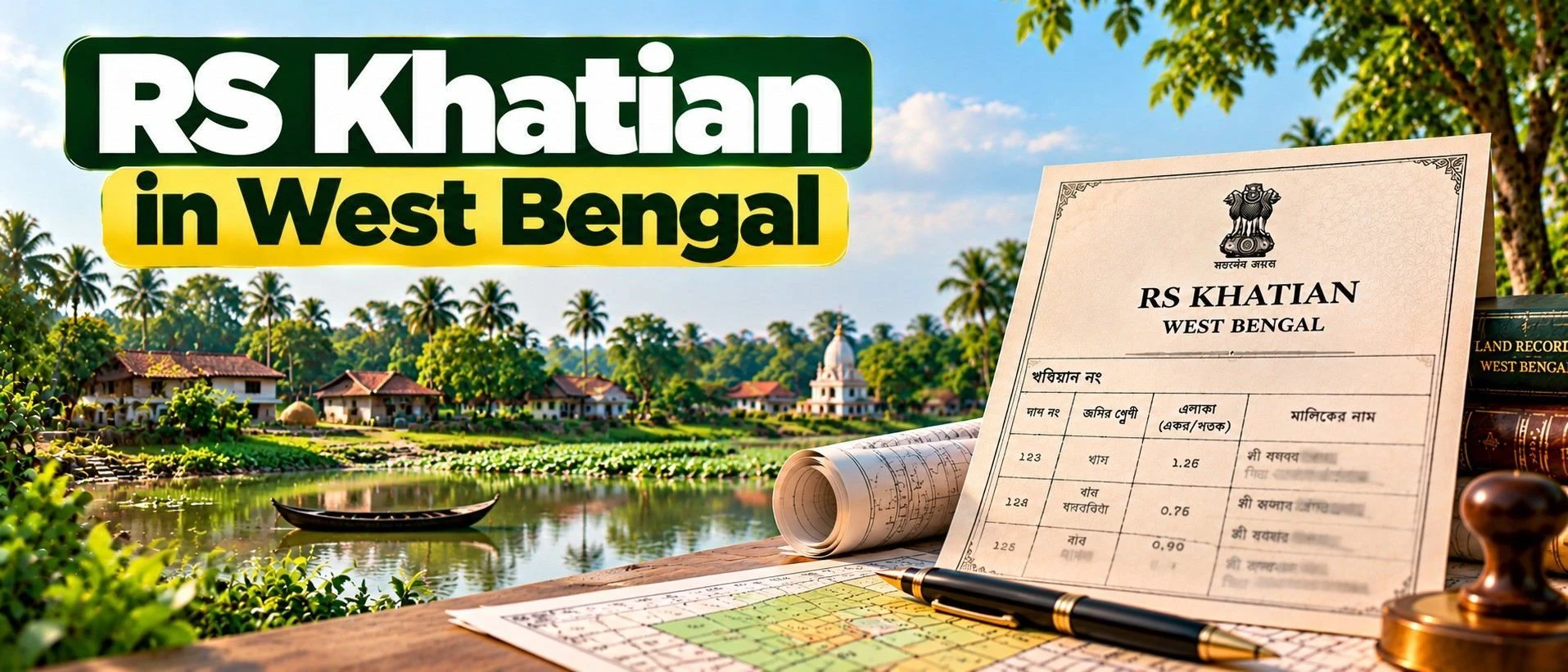
RS Khatian, short for Revisional Survey Khatian, is the record of rights prepared during West Bengal's Revisional Settlement of the 1950s and 1960s under Section 51 of the West Bengal Land Reforms Act. It matters because it's the backbone of a property's ownership history — while the current LR Khatian tells you who owns the land today, the RS Khatian is what courts and BL&LRO officers rely on to trace that ownership backward and confirm the chain is genuinely clean. This guide covers how to do an RS Khatian search West Bengal step by step, what a correct record should contain, and how it connects to the current LR system. Whether you're buying agricultural land, applying for a crop loan, or settling an inheritance, this is the historical record you may be asked to produce alongside your current Khatian.
Section 1 — What is RS Khatian in West Bengal?
Tracing a property's history matters most before you commit to buying — it's worth browsing agricultural land for sale in West Bengal
on the 2Bigha map while you get familiar with how far back a clean title chain needs to go.
In simple terms, RS Khatian is the ownership and land-classification record finalized during West Bengal's Revisional Survey of the 1950s and 1960s, sitting between the older British-era Cadastral Survey (CS) and the current LR (Land Reforms) Khatian.
It's frequently confused with the LR Khatian, but the two serve different purposes: the LR Khatian is the current, actively used Record of Rights — what you see when you check ownership on Banglarbhumi today — while the RS Khatian is historical, capturing ownership, plot data (the Dag or plot number), and land classification as they stood during the mid-20th-century settlement. Because the RS data was hand-checked across the state at the time, courts and BL&LRO officers still treat it as the cleanest historical evidence when tracing a title backward.
The RS Khatian sits in the middle of a three-layer chain — CS, then RS, then LR — and for a fully clean title, ideally all three should be consistent with each other. An unexplained gap between the RS record and either the older CS record or the current LR record is exactly the kind of thing a careful buyer or a BL&LRO officer will want explained before treating the property as clear.
A buyer needs this specifically because relying on the current LR Khatian alone doesn't always tell the full story — many older properties, especially agricultural land that's changed hands within families over generations, carry history that's only fully visible by checking the RS record as well.
Land ownership note: The RS Khatian uses an older plot number, the Sabek Dag, while the current LR system uses the Hal Dag. Many old RS plots were subdivided into multiple LR plots over time, so the two numbers aren't always a simple one-to-one match — always use Banglarbhumi's RS-LR Plot Information tool to confirm exactly how an old Sabek Dag connects to today's Hal Dag before assuming they refer to the same thing.
Expert Tip: Where the property or region is old enough, pull the CS Khatian as well and check that the CS, RS, and current LR records tell a consistent story. Skipping the CS layer and only checking RS and LR is a common shortcut that occasionally misses the very first, root ownership entry a serious title dispute would start from.
Section 2 — How to Get RS Khatian in West Bengal?
Checking an RS Khatian in West Bengal has become significantly more accessible following a 2026 policy change making digital copies free.
Method | Cost | Time | Legally valid for registration? |
|---|---|---|---|
Online (basic view on Banglarbhumi) | Free | Instant | Reference only for basic viewing |
Online (digitally signed copy) | Free, since the 2 July 2026 Bengal Records Manual amendment | Instant to same day | Yes — digitally signed copies now carry official standing |
Offline (certified physical copy from BL&LRO) | Nominal fee | A few days | Yes, once issued and signed |
1. Visit the Banglarbhumi portal — Go to banglarbhumi.gov.in and locate the Khatian or RS-LR Plot Information section.
2. Select District, Block, and Mouza — Narrow down to the exact revenue area where the property is located.
3. Enter the RS Khatian or Dag number — Search using the RS Khatian number, or the Sabek Dag if that's what you have from an old deed.
4. Review the record — Check the Mouza, police station, Khatian number, plot details, land class, and listed owners.
5. Download the digitally signed copy — Since the 2026 rule change, this digitally signed copy is free and carries official standing — save it for your records.
1. Visit the BL&LRO office for your Mouza — Bring the RS Khatian number, Mouza name, and your ID proof.
2. Request a certified physical copy (RS Porcha) — Submit a written request specifying the exact Khatian and Dag details.
3. Pay the applicable fee — Pay as quoted and collect a receipt with a reference number.
4. Collect the signed and stamped RS Porcha — Verify the Khatian number, Dag, and owner names before leaving the office.
A physical certified copy is still worth getting for court proceedings, older government scheme compensation claims, or any situation specifically requiring a BL&LRO-issued original rather than a digital printout. Before relying on any RS Khatian for a transaction, cross-check it against the current LR Khatian and, where relevant, the CS record — a mismatch anywhere in that chain is worth resolving before you proceed.
Section 3 — What Does RS Khatian Contain?
An RS Khatian carries specific fields worth checking carefully, since it's often the only record proving an older property's true history. For land with an already well-documented chain, start browsing from the 2Bigha homepage.
Field | What it means | What to check |
|---|---|---|
Mouza and police station | Confirms which revenue village and jurisdiction the record belongs to | Matches your other land documents exactly |
Khatian number and RS Dag (Sabek Dag) | Identifies the exact historical plot | Cross-checked against the current Hal Dag via the RS-LR tool |
Class of land and area | States what type of land it was classified as, and its size, at settlement | Consistent with the current LR classification, or with an explainable change over time |
Owner name(s) and share | Shows who held rights to the land at the time of the Revisional Survey | Traceable forward to the current owner through the deed and mutation chain |
Good sign: A usable RS Khatian clearly states the Mouza, police station, Khatian and Dag numbers, land class and area, and the owner names and shares recorded at settlement. If the RS record's owner name has no traceable connection to the current seller — no deed, inheritance, or mutation chain linking the two — that's a real gap to resolve, not a detail to skip past.
Section 4 — Common Issues & How to Fix Them?
Most RS Khatian issues in West Bengal come down to plot-number confusion or an unexplained gap between historical and current records.
For a query specific to your property, the RS Khatian West Bengal official website is the right place to start.
RS Dag (Sabek Dag) doesn't match the current LR Dag (Hal Dag)
Issue: Many old RS plots were subdivided into several LR plots, so the numbers don't always correspond one-to-one. Fix: Use Banglarbhumi's RS-LR Plot Information tool to confirm exactly how the old and current plot numbers connect.
RS record shows an old or zamindari-era name with no clear link to the current owner
Issue: This is common for land that's changed hands informally or through inheritance without every step being formally recorded. Fix: Trace the connecting deeds, inheritance records, or mutations that link the RS-era name to the current owner before relying on the property's history.
No result found when searching by Mouza and Block
Issue: Selecting the wrong Block or Mouza, or a slight name variation, can return no match even when the record exists. Fix: Confirm the exact Mouza and Block spelling with the seller or a local BL&LRO official before assuming the record isn't digitized.
A Bargadar (sharecropper) entry appears on the old RS record
Issue: West Bengal's tenancy protections mean a registered Bargadar's rights can persist and aren't automatically cleared by a change in ownership. Fix: Resolve any Bargadar entry with the BL&LRO before finalizing a purchase of agricultural land carrying one.
Need a physical certified copy but only the free digital version is readily available
Issue: Courts and some government schemes specifically require a BL&LRO-issued physical original. Fix: Visit the BL&LRO office directly to request the certified physical RS Porcha for those specific purposes.
Discrepancy between CS, RS, and LR records
Issue: Any unexplained break across the three historical layers can indicate a gap in the chain of title. Fix: Have the discrepancy reviewed by the BL&LRO or a local advocate before treating the property's title as clean.
Section 5 — Recent Changes in 2026
Following an amendment to the Bengal Records Manual, 1943, notified on 2 July 2026, the West Bengal government now provides digitally signed Khatian (Record of Rights) and Plot Information — including RS records — completely free through the official Banglarbhumi portal. As of August 2026, this represents a significant shift from earlier practice, where certified copies typically required a fee and an in-person BL&LRO visit; applicants should confirm which specific services at their local office have been updated to reflect this change.
Section 6 — Why RS Khatian Matters for Land Buyers?
It's the primary evidence used to trace a property's ownership backward and confirm a genuinely clean title.
Courts and BL&LRO officers treat it as the most reliable historical record for resolving ownership disputes.
It's required for many government compensation and welfare scheme claims involving older, pre-LR-settlement property.
It helps explain and validate any gap or inconsistency found in the current LR Khatian.
A documented RS-to-LR chain materially strengthens a property's standing on real estate listing websites and with serious buyers.
Section 7 — RS Khatian vs. LR Khatian (Current Record of Rights)
Aspect | RS Khatian | LR Khatian (Current Record of Rights) |
|---|---|---|
Time period | Historical — reflects the 1950s–1965 Revisional Settlement | Current — reflects ownership and updates as of today |
Plot number used | Sabek Dag (old RS plot number) | Hal Dag (current LR plot number) |
Primary use | Tracing ownership backward, proving a clean historical chain | Confirming who owns the land right now for an active transaction |
Agricultural land in West Bengal with a documented, traceable RS-to-LR chain is significantly easier to move when selling property online — if that's true of your land, you can list it for sale on 2Bigha.
Section 8 — Related Documents
Title Deed West Bengal Complete Guide 2026
How to Buy Land in West Bengal (2026 Guide)
How to Download Porcha Online in West Bengal
West Bengal Land Record Search by Name (2026 Guide)
