
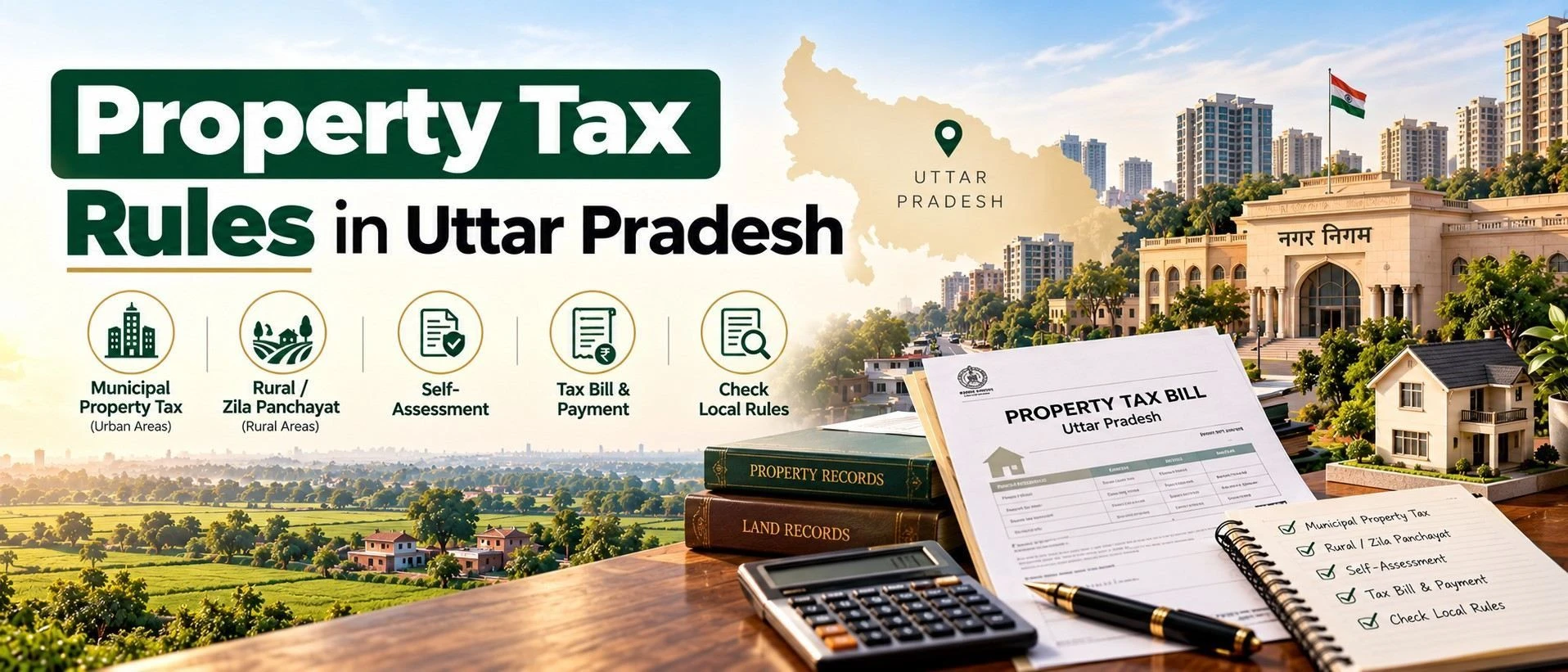
Property tax in Uttar Pradesh is the annual tax levied by Nagar Nigams, Nagar Palika Parishads, and Nagar Panchayats on residential, commercial, and other built properties within their jurisdiction. It matters because unpaid dues accumulate monthly interest and can eventually lead to a demand notice or attachment of the property, and an unpaid history can quietly become the buyer's problem after a purchase.
This guide covers how property tax works across UP's urban local bodies, how to pay and download receipts online, and what to check before buying a property with a tax history. Whether you're a current property owner settling this year's dues, or a buyer checking a seller's payment record before purchasing farm land for sale in Uttar Pradesh or a built property, this is the process you'll need to understand.
Section 1 — What is Property Tax in Uttar Pradesh?
If you're weighing a built property purchase alongside plots to buy land in Uttar Pradesh more broadly, it also helps to see how land parcels are listed and compared across the state.
Definition: Property tax is an annual levy imposed by the local urban body — Nagar Nigam, Nagar Palika Parishad, or Nagar Panchayat, depending on the town's size — on residential, commercial, and other built properties within their jurisdiction, based on assessed property value.
Property tax paying is different from land revenue (lagaan) on agricultural land: property tax specifically applies to built or urban properties under municipal jurisdiction, while agricultural land in rural areas is instead subject to nominal land revenue recorded through the Khatauni system rather than municipal property tax.
A buyer specifically needs to check a seller's property tax payment history because unpaid dues can carry forward as a liability tied to the property itself, and home loan lenders routinely verify tax records, alongside Bhulekh ownership details and encumbrance status, during due diligence.
Assessment and rates vary by which urban body governs the property, its zone, and its usage category — a commercial property is generally assessed differently from a purely residential one, so understanding your specific local body's structure matters.
State-specific note: Property tax online payment portals differ across UP — the statewide e-NagarSewa portal (enagarsewaup.gov.in) covers most towns, but some larger cities like Lucknow, Ghaziabad, Agra, Jhansi, and Kanpur run their own dedicated property tax management systems, so confirm which portal applies to your specific city.
Expert Tip: Before buying any built property, request tax receipts covering the last three to five years, not just the most recent one, and separately verify dues directly on the Nagar Nigam's portal using the Property ID — a seller's paper receipts can occasionally be incomplete or out of date compared to the official online record.
Section 2 — How to Pay Property Tax Online in Uttar Pradesh?
Most UP towns now support property tax online payment, though the exact portal depends on which urban body governs your property.
Method | Cost | Time | Legally Valid for Registration? |
Online (status/dues check) | Free | Instant | No — reference only |
Online (payment via e-NagarSewa or city portal) | Tax amount owed | Instant to same day for receipt | Yes |
Offline (Nagar Nigam/Nagar Palika counter) | Tax amount owed | Same day | Yes |
1. Visit e-NagarSewa or your city's dedicated portal — Go to enagarsewaup.gov.in, or a dedicated city portal where one exists (e.g., onlinegnn.com for Ghaziabad).
2. Register or log in — One-time citizen registration is required; keep your credentials for future use.
3. Search your property — Enter your Property ID, or search by city, house number, owner name, and address.
4. Verify dues and pay — Review the bill details and pay via UPI, net banking, or debit/credit card, then download the receipt.
1. Visit the Nagar Nigam/Nagar Palika/Nagar Panchayat office — Carry your Property ID or previous receipts.
2. Confirm the amount due — Staff will verify current dues, including any accrued interest.
3. Pay at the counter — Payment is typically accepted via cash, cheque, or card at the counter.
4. Collect your receipt — Collect the physical receipt as proof of payment.
Typical turnaround: Same day in most cases. Before you leave the office, check that your Property ID, owner name, and the financial year on the receipt are correct, and that there's no residual balance shown from a prior year.
Section 3 — What Does a UP Property Tax Receipt Contain?
Whether you're confirming your own payment or checking a seller's history before you buy land in uUttar Pradesh with an existing structure, these are the fields to check. You can also browse verified land listings and mapping tools at the 2Bigha homepage.
Field | What It Means | What to Check |
Property ID | Unique identifier linking the receipt to your property | Matches prior receipts and municipal records |
Owner name | Name registered with the urban body | Matches your ID and other property documents |
Financial year | The specific year the tax covers | Correct and consecutive, with no missing years |
Tax amount and rebate applied | Amount paid and any applicable discount | Reasonable for the property's size, zone, and usage |
Transaction ID and payment date | Confirms successful processing | Present and matching your bank statement |
Good sign: A valid receipt clearly shows your Property ID, the correct financial year, a matching owner name, and a transaction ID — with an unbroken payment history when checked across multiple years.
Section 4 — Common Issues & How to Fix Them
Most property tax problems in UP come down to Property ID confusion, portal fragmentation across cities, or gaps in payment history after a change of ownership. Before troubleshooting further, it's worth checking current guidance directly on the Property Tax Rules on the Uttar Pradesh official website.
Confusion over which portal to use — Some cities have their own dedicated property tax portal separate from the statewide e-NagarSewa system. Fix: Confirm with your Nagar Nigam whether a dedicated city portal exists before assuming the statewide portal is correct.
Property ID not found — Newer constructions may not yet have an assigned Property ID in the system. Fix: Visit the local Nagar Nigam office to get your property formally assessed and assigned an ID.
Missing years in payment history — A gap can mean unpaid dues plus significant accrued penalty interest. Fix: Retrieve the full record and clear any pending years promptly, since interest of roughly 1.5–2% per month accrues.
Owner name not updated after a sale or inheritance — Municipal records may still show the previous owner if mutation wasn't completed. Fix: Apply for mutation in municipal records — generally required within 90 days of registration — alongside separate tehsil-level revenue mutation.
Rebate not applied for an eligible category — Senior citizens, ex-servicemen, women sole owners, and physically disabled persons may qualify for rebates that go unclaimed. Fix: Check eligibility criteria with your local body and apply for the applicable rebate.
Payment made through an unofficial third-party app — Some aggregator apps process payments without clearly confirming they're linked to the correct Property ID. Fix: Prefer paying directly through enagarsewaup.gov.in or your city's official portal to ensure the payment is correctly recorded.
Section 5 — Recent Changes in 2026
Uttar Pradesh's urban local bodies continue expanding property tax online payment access through both the statewide e-NagarSewa portal and dedicated city-level systems. No single, uniform statewide fee or rate change has been reported as of August 2026 — rates and rebate structures continue to be revised periodically by individual local bodies, so property owners should confirm current figures directly with their specific Nagar Nigam, Nagar Palika Parishad, or Nagar Panchayat.
Section 6 — Why Property Tax Matters for Land Buyers?
Unpaid dues on a property can carry forward as a liability after a sale.
Banks check tax payment history before approving home loans against a property.
It supports mutation applications in municipal records after a purchase or inheritance.
A clean, unbroken payment history reduces the risk of hidden penalty claims after buying.
It's part of standard due diligence alongside Bhulekh, encumbrance, and dispute status checks.
It confirms how the local body currently classifies and assesses the property.
Section 7 — Property Tax vs. Land Revenue (Lagaan)
These two are commonly confused because both are periodic government charges on land or property. Property tax applies specifically to built properties within urban local body jurisdiction — Nagar Nigams, Nagar Palika Parishads, and Nagar Panchayats. Land revenue (lagaan) is a separate, generally nominal charge on agricultural land recorded through the rural Khatauni system, administered by the Revenue Department rather than a municipal body.
If you're planning to sell agricultural land in Uttar Pradesh, buyers typically won't ask about property tax at all — that only becomes relevant once land is built upon and falls within a municipal boundary. You can also explore listing land through https://2bigha.ai/sell.
Aspect | Property Tax | Land Revenue (Lagaan) |
|---|---|---|
Applies to | Built properties in urban local body areas | Agricultural land in rural revenue records |
Collected by | Nagar Nigam / Nagar Palika Parishad / Nagar Panchayat | Revenue Department (via the tehsil) |
Typical amount | Assessed based on property value, size, zone, usage | Nominal, tied to land classification and area |
Section 8 — Related Documents
Legal Checklist Before Buying Land in Uttar Pradesh
Jamabandi/ROR Guide in Uttar Pradesh
Property Inheritance Laws in Uttar Pradesh
Partition Deed Process in Uttar Pradesh
