
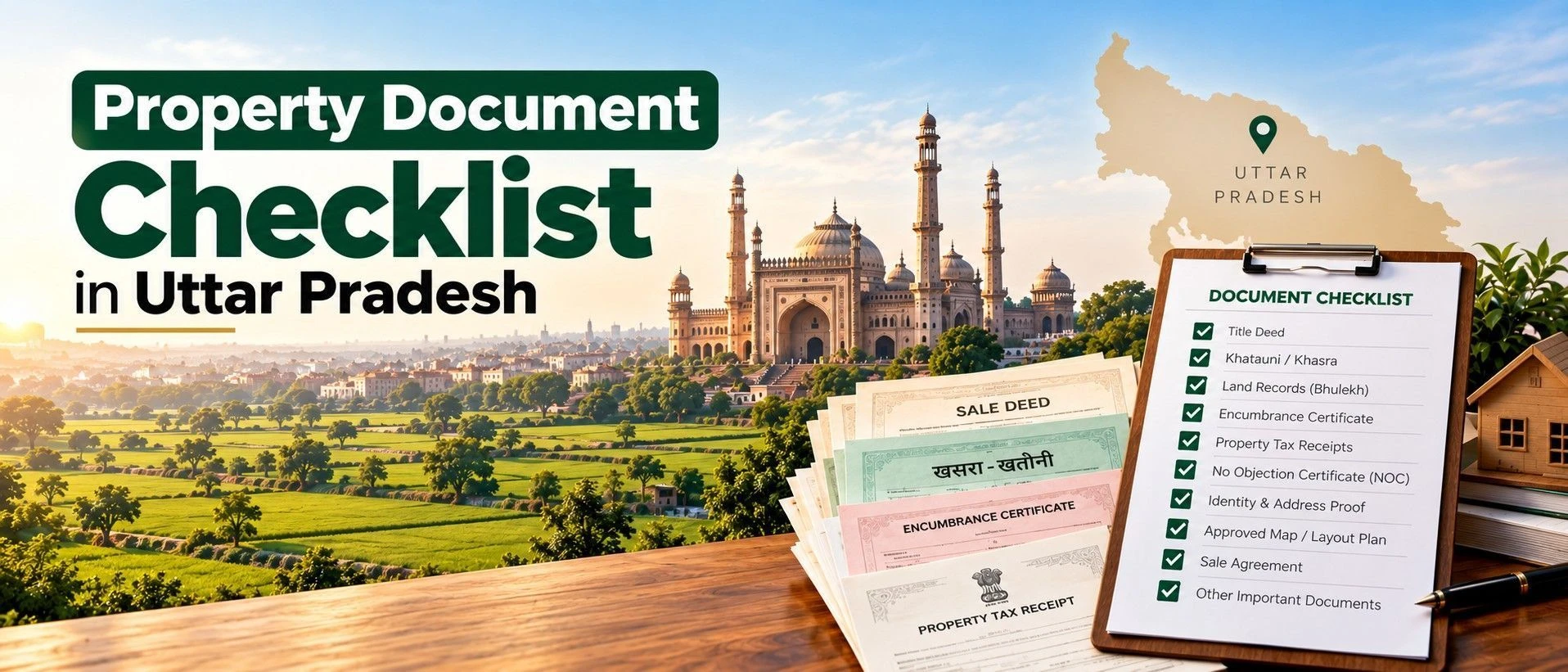
A property document checklist is the complete set of papers a buyer should verify before completing any land or property purchase in Uttar Pradesh — covering ownership, revenue records, dues, and, where applicable, approvals. It matters because missing even one document in this list is one of the most common reasons buyers end up in disputes, discover hidden loans against a property, or find out too late that a structure was never legally approved. This guide walks through the full checklist, organized by what each document actually protects you from. Whether you're buying land in Uttar Pradesh for the first time, evaluating farm land for sale in Uttar Pradesh, or double-checking a deal that's already underway, this is the list every serious buyer should work through before paying anything.
Section 1 — What Does the Property Document Checklist in Uttar Pradesh Cover?
Before working through the checklist itself, it helps to see the plot's surroundings — you can browse the 2Bigha map for Uttar Pradesh while you gather documents for a specific property.
Definition: The property document checklist is the standard set of legal, revenue, and financial records a buyer verifies to confirm a property's ownership, classification, and dues status before purchase.
It's easy to think a clean sale deed is enough — it isn't. The deed only proves the previous transaction; it says nothing about whether the land carries an unpaid loan, whether mutation was ever completed, or whether a structure on it was legally approved. Each document in the checklist answers a different, narrower question, and skipping any one of them leaves a specific gap: skip the encumbrance certificate and you might inherit a hidden mortgage; skip mutation status and you might buy from someone whose own ownership was never formally recorded. A buyer needs the full set, not just the most obvious document, because fraud and disputes typically hide in exactly the gap a partial check leaves open.
State-specific note: In UP, the Sub-Registrar's registered document search (via IGRSUP) is now one of the most reliable single checks available — it reveals every registered sale, gift, mortgage, and partition against a property, which means hidden prior transactions the seller didn't disclose often surface here first.
Expert Tip: Don't just check the most recent transaction — pull at least 10–15 years of transaction history (sometimes called a "Barah Sala" or 13-year record) for the property on IGRSUP. A property that changed hands unusually often, or has an unexplained gap in its documented chain, is worth investigating further before you buy.
Section 2 — How to Work Through the Property Document Checklist in Uttar Pradesh?
Most checks can be done online, with certified copies and legal review as the offline complement. Compare the two:
Method | Cost | Time | Confirms a property is safe to buy? |
Online (Bhulekh + IGRSUP self-check) | Free for most checks | Days | Partially — a strong first pass, not a substitute for legal review |
Online + certified copies | Nominal fee per certified copy | Few days to a week | More reliably, for anything requiring formal legal weight |
Offline (Tehsil/SRO in-person + legal consultation) | Legal consultation fee, plus certification costs | 1–2 weeks | Yes, most thorough for high-value or complex transactions |
Check the land record on UP Bhulekh. Confirm the Khasra number, current owner's name, area, and classification.
Search registered documents on IGRSUP. Pull the transaction history and check for any registered mortgage, gift, or partition affecting the property.
Request an encumbrance certificate. Confirm the property is free of loans or legal liabilities as of the current date.
Verify RERA registration (for developer/project purchases) on the UP-RERA website, and check for the relevant NOCs (fire, water, and other departments) where applicable.
Check the property tax and mutation status. Confirm dues are cleared and the current owner's name is reflected.
Visit the Tehsil office to confirm mutation status and obtain a certified Khatauni copy if needed.
Visit the Sub-Registrar Office for a certified copy of the sale deed and to formally confirm the encumbrance status.
Consult a property lawyer to review the full document set together, especially the sale agreement's terms before signing.
Cross-check with the local municipal body for property tax records and any pending notices, if the property is urban.
A thorough check typically takes one to two weeks when documents are readily available, longer if certified copies or field verification are needed. Before signing any agreement, check that every document — sale deed, Khatauni, encumbrance certificate, mutation record, and tax receipt — tells a consistent story about the same property and the same current owner.
Section 3 — What Should Each Document in the Checklist Confirm?
The same completeness matters whether you're checking this list for agricultural land for sale in uttar pradesh or an urban plot — a partial check is often worse than no check, since it can create false confidence.
Field | What it means | What to check |
Sale deed | The legal record of the property's transfer history | Names, khasra number, and area should be consistent across every past transaction |
Khasra/Khatauni | Current land classification and recorded owner | Should match the seller's identity and the sale deed |
Encumbrance certificate | Whether the property carries any loan or legal claim | Should show no pending liability as of the current date |
Mutation record | Whether ownership is reflected in revenue records | Should show the current seller as the recorded owner |
RERA registration/NOCs (if applicable) | Regulatory compliance for developer projects | Confirm registration status and required departmental clearances |
Good sign: every document names the same current owner, the transaction history has no unexplained gaps, the encumbrance certificate shows a clean record, and — for developer projects — RERA registration and NOCs are all in place and verifiable independently, not just claimed by the seller.
Section 4 — Common Issues & How to Fix Them
A Property Document Checklist in Uttar Pradesh helps identify issues such as hidden mortgages, incomplete mutation, missing NOCs, or gaps in ownership records. Checking the Property Document Checklist Uttar Pradesh official website and verifying each relevant document before making a payment can help reduce legal and financial risks.
Relying on the sale deed alone – Buyer skips the encumbrance and mutation checks. Fix: always complete the full checklist, since each document covers a different risk.
Hidden mortgage discovered late – Encumbrance certificate wasn't checked before payment. Fix: get the EC before any advance payment, not after.
Mutation never completed by a prior owner – The Khatauni doesn't match the seller's claimed ownership. Fix: trace and resolve the mutation gap before proceeding.
Missing NOCs on a developer project – Fire, water, or other departmental clearances aren't in place. Fix: verify each NOC independently rather than accepting the developer's assurance.
Unexplained gaps in transaction history – Property changed hands unusually often or has a suspicious timeline. Fix: investigate the reason for each transfer before buying.
Relying on documents shown weeks or months earlier – Status can change between viewing and closing. Fix: re-verify encumbrance and mutation status close to the actual transaction date.
Section 5 — Recent Changes in 2026
Uttar Pradesh introduced mandatory Aadhaar-based biometric authentication for property registration from February 1, 2026, along with OTP-based verification and PAN validation, aimed at reducing fake registrations and identity fraud in land deals. UP RERA continues to tighten compliance requirements for developers, with authorities noted as demanding stricter adherence in 2026. No major standalone change to the core document checklist itself has been confirmed as of August 2026 — the fundamentals (sale deed, Khatauni, encumbrance certificate, mutation, and applicable NOCs) remain the same, though verification is increasingly digital-first.
Section 6 — Why the Property Document Checklist Matters for Land Buyers
Each document closes a specific risk — skipping any one leaves that exact gap open for a dispute.
Confirms the seller actually has clean, unencumbered title to sell.
Protects against inheriting hidden loans or legal claims tied to the property.
Confirms government records (mutation, tax) match the seller's representation.
For developer projects, confirms regulatory compliance that protects against future demolition or shutdown risk.
Strengthens your position for bank financing, since lenders run largely the same checklist themselves.
Section 7 — Document Checklist vs. Legal Due Diligence
Document Checklist | Full Legal Due Diligence | |
What it covers | The standard set of documents to gather and review | Interpreting those documents, tracing 20–30 years of title, and assessing legal risk |
Who typically does it | The buyer, often independently | A property lawyer or due-diligence professional |
Needed for | A solid first-pass check on any property | High-value, complex, or agricultural land transactions especially |
The checklist tells you what to gather; due diligence is what a professional does with it. If you're selling land in uttar pradesh, having your own documents complete and consistent before listing — rather than scrambling once a serious buyer asks — noticeably speeds up closing.
Section 8 — Related Documents
Sale Deed verification in Uttar Pradesh — the central document in the checklist
Bhulekh Records in Uttar Pradesh — checking Khasra and Khatauni details
Dakhil Kharij in Uttar Pradesh — confirming mutation status
How to Avoid Land Fraud in Uttar Pradesh — red flags that go beyond the basic checklist
Legal Checklist Before Buying Land in Uttar Pradesh — the broader legal due-diligence process
