
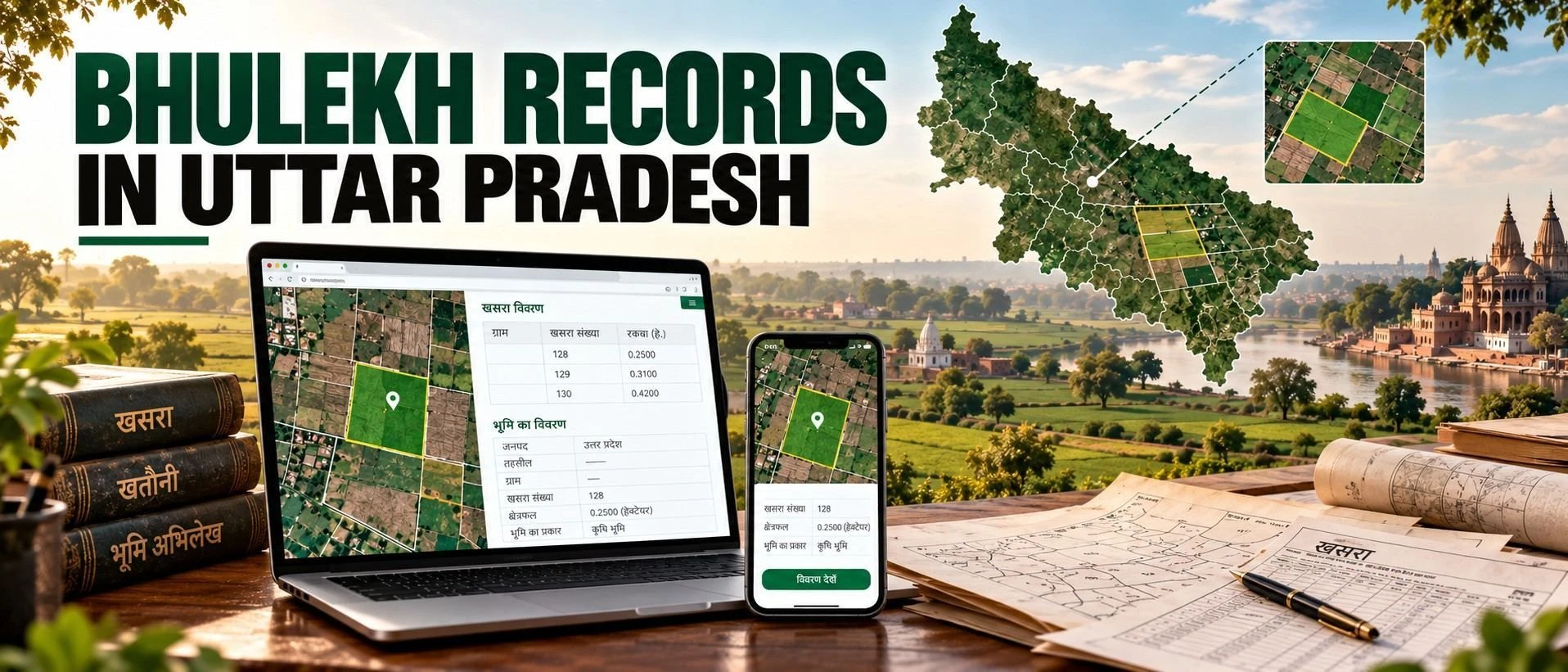
Bhulekh, meaning "land record," is the digital system maintained by Uttar Pradesh's Revenue Department that lets anyone check a plot's Khasra, Khatauni, and Bhu Naksha (land map) online, free of cost. It matters because it's the fastest way to confirm who a plot's recorded owner is, what category the land falls under, and its exact boundaries — all before you ever visit the site or the Tehsil office. This guide covers how to search UP Bhulekh step by step, what each record shows, and how to read the results correctly. Whether you're comparing agricultural land for sale in uttar pradesh, verifying a seller's claim, or confirming your own land's details, this is the first check every serious buyer runs.
Section 1 — What are Bhulekh Records in Uttar Pradesh?
Alongside checking land records, it can help to see the plot's surroundings visually — you can browse the 2Bigha map for Uttar Pradesh while you cross-reference Bhulekh details.
Definition: Bhulekh is UP's online land record portal, letting citizens view Khasra (plot-level details), Khatauni (owner-level record of rights), and Bhu Naksha (land maps) for any recorded parcel in the state.
It's worth being clear on what each piece actually shows. Khasra is the plot-level record — a specific parcel's number, size, and land category. Khatauni is the owner-level record — all plots held by a particular titleholder under one khata number. Together, they give a complete picture of ownership, area, and classification, and the Bhu Naksha shows the plot's physical boundaries on a map. A buyer needs Bhulekh specifically because it's the fastest, free way to independently confirm a seller's claims about a plot before spending money or time on a site visit.
State-specific note: If you're checking ancestral or inherited property, the owner's name on Khatauni may still reflect an earlier generation until mutation is filed — cross-reference the Khata number to see the full holding before drawing conclusions about who currently owns the land.
Expert Tip: Search using the Gata/Khasra number wherever possible instead of the owner's name — names are prone to spelling variations and duplicates across a village, while the Gata number is a unique identifier with no ambiguity.
Section 2 — How to Check Bhulekh Records in Uttar Pradesh?
You can check records online in minutes, or request a certified copy in person if you need one for legal use. Compare the two:
Method | Cost | Time | Legally valid for court/registration use? |
Online (informational view) | Free | Instant | No — for reference only |
Online (downloaded PDF, unsigned) | Free | Instant | No — not certified |
Offline (certified copy from Tehsil) | Roughly ₹20–₹50 | Same day to a few days | Yes, once signed and stamped |
Visit the official portal: Open upbhulekh.gov.in directly — avoid third-party aggregator sites.
Select "Khatauni (Adhikar Abhilekh): This is the main record-of-rights section on the homepage.
Complete the captcha and select district, tehsil, and village: Narrow down to the exact location.
Search using Khasra/Gata number, Khata number, or owner name: The Gata number is the most reliable search option.
View and download the record: Review the displayed Khasra/Khatauni details, then download or print for your own reference.
Visit the relevant Tehsil office for the plot's district and tehsil.
Request a certified copy of the Khasra or Khatauni, citing the khasra number.
Pay the nominal certification fee at the office.
Collect the signed, stamped copy to use for any purpose requiring legal validity.
The online check is instant, so there's little reason to skip it before any negotiation. Before relying on a certified copy for a transaction, check that the khasra number, owner's name, and area shown all match what the seller has represented, and note whether the record shows any pending "vaad grast" (under dispute) flag.
Section 3 — What Do Bhulekh Records Contain?
The same reading discipline applies here as it does when reviewing any farm land for sale in uttar pradesh listing — treat the Bhulekh record as your independent source of truth, not the seller's description.
Field | What it means | What to check |
Khasra/Gata number | Unique identifier for the specific plot | Should match the sale deed and any listing |
Khatauni/Khata number | Owner-level record grouping all their plots | Confirm the current recorded owner matches the seller |
Land category | Agricultural, non-agricultural, or other classification | Confirm it matches the intended use |
Area | The recorded size of the plot | Should match what's being represented in the sale |
Dispute status | Whether the plot is flagged "vaad grast" (under dispute) | Any flag here is a serious reason to pause and investigate. |
Good sign: the Khasra number is consistent across the record, the sale deed, and any listing; the owner's name matches the seller (or shows a clear, documented chain if inherited); and there's no dispute flag against the plot.
Section 4 — Common Issues & How to Fix Them
A Bhu Abhilekh in Uttar Pradesh can show issues such as outdated owner names, missing online records, dispute flags, or mismatches with the sale deed. Checking the Bhu Abhilekh Uttar Pradesh official website and verifying the record with the concerned Tehsil office can help confirm the property's ownership and legal status before proceeding.
Owner name shows an earlier generation – Common on inherited land where mutation hasn't been filed. Fix: cross-reference the Khata number and confirm the mutation status separately.
No record found online – Some older or recently subdivided plots aren't yet fully indexed. Fix: check directly at the Tehsil office rather than assuming the plot doesn't exist in records.
"Vaad grast" (dispute) flag on the record – The plot shows a pending legal dispute. Fix: investigate the nature of the dispute before proceeding with any purchase.
Khasra number doesn't match the sale deed – A discrepancy between what's listed and what's recorded. Fix: resolve this with the seller and the Tehsil before any payment.
Relying on an uncertified copy for a loan or legal matter – Banks and courts often require certified copies, not online printouts. Fix: get a certified copy from the Tehsil for anything beyond informal verification.
Confusing Khasra with Khatauni – Treating the plot-level record as the full ownership picture. Fix: check both — Khasra for the specific plot, Khatauni for the owner's complete holding.
Section 5 — Recent Changes in 2026
UP Bhulekh continues to expand its real-time Khatauni features, allowing dispute status ("vaad grast") checks and digital record access without a Tehsil visit for most routine informational needs. No major standalone policy change to the Bhulekh system itself has been confirmed as of August 2026 — the core process of checking Khasra, Khatauni, and Bhu Naksha online, and obtaining certified copies from the Tehsil for legal use, remains as described above.
Section 6 — Why Bhulekh Records Matter for Land Buyers
Gives an independent, free way to confirm a seller's ownership claim before any payment.
Reveals the land's official classification (agricultural vs. converted), which affects what you can legally build.
Flags disputes ("vaad grast") that a seller might not disclose voluntarily.
Confirms the exact area recorded, useful for cross-checking against what's being sold.
Required as supporting reference before registration and mutation.
Available instantly, making it the natural first step before any site visit or negotiation.
Section 7 — Bhulekh vs. Registered Sale Deed
Bhulekh (Khasra/Khatauni) | Registered Sale Deed | |
What it proves | Current land classification, area, and recorded owner | The specific transaction of sale legally took place |
Issued by | Revenue Department via upbhulekh.gov.in | Sub-Registrar Office via IGRSUP |
Needed for | Ownership and classification checks before buying | Proving the actual transfer of title |
Bhulekh tells you what the government's records currently say about a plot; the sale deed is the legal instrument that changes those records going forward. If you're selling land in Uttar Pradesh, having a clean, current Bhulekh record ready to show buyers — with no dispute flag and matching khasra details — speeds up their due diligence considerably.
Section 8 — Related Documents
Dakhil Kharij in Uttar Pradesh — updating the Khatauni after a sale
Jamabandi/ROR Guide in Uttar Pradesh — the broader record-of-rights concept
Bhu Naksha Guide in Uttar Pradesh — reading the land map specifically
How to Register Land in Uttar Pradesh — the registration process that follows verification
Property Document Checklist in Uttar Pradesh — the full list of papers to check
