
 List Your Land
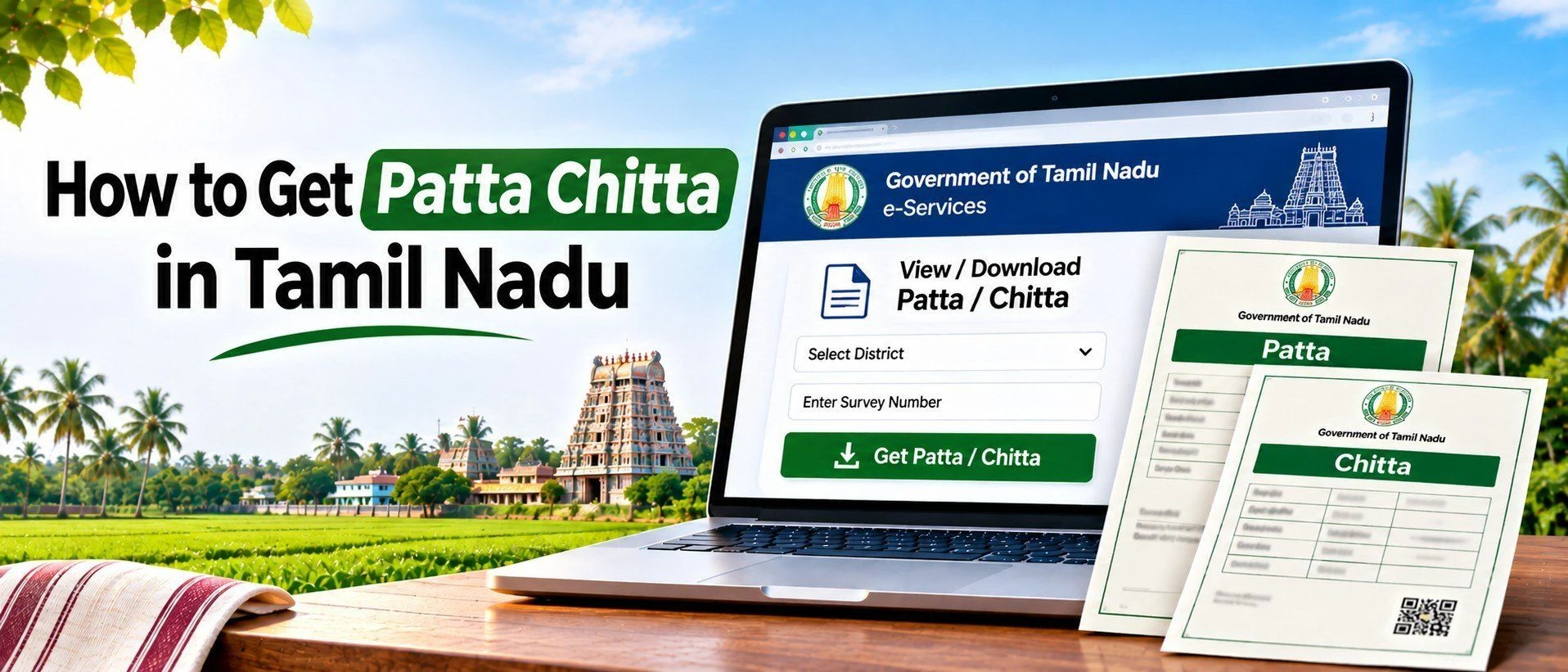
Patta Chitta is the land record that shows who holds a piece of land in Tamil Nadu, along with its survey number, extent, and classification. Tamil Nadu Patta Chitta matters because every sale, bank loan, or inheritance on land depends on it, and one wrong entry can hold up the whole deal. This guide explains how to use Patta Chitta Online, how to check the application status, how to verify a copy, and what to do when something looks wrong. Whether you are buying farm land, applying for a crop loan, or settling a family property, this is the record you will be asked for first. To view or verify a record, use the Patta Chitta Tamil Nadu official website, the e-Services of Land Records portal run by the Revenue Department.
Section 1 — What is Patta Chitta in Tamil Nadu?
Anyone looking at land for sale in Tamil Nadu should first understand this record, because it shows who the government treats as the owner. Since 2015, the earlier separate registers have been combined, so one extract now carries both parts, and the same record is what people mean when they search "TN Patta Chitta" or "EPatta Tamil Nadu" on the portal.
Definition: Patta is the record of the owner's name against a survey number, and Chitta is the record of land details such as extent and classification. Together they form the main Tamil Nadu Land Records entry for a rural or natham plot.
The Patta Chitta does not prove a sale by itself. That job belongs to the registered sale deed. What the Patta Chitta proves is that the revenue department currently recognises a person as the holder of that survey number. A buyer needs both, because a deed without a matching patta can cause trouble later with loans and resale. These Land Ownership Records in Tamil Nadu are also where the land type shows up, such as nanjai (wet land), punjai (dry land), or natham (village habitation).
State-specific note: Rural and natham land is shown through Patta Chitta, while land inside towns and cities is shown through a TSLR extract. If your plot is in a town, check which of the two applies before you search.
Expert Tip: Always look at the sub-division number along with the survey number. Many plots are part of a larger survey number, and buyers sometimes check the parent number and miss that the sub-division has a different owner or extent.
Section 2 — How to Get Patta Chitta in Tamil Nadu?
Most people only need to view an existing record, and that is free and quick. Patta Online Tamil Nadu services let you do this from home with TN Patta Online search, while a fresh patta or a name change goes through the Tahsildar and takes longer.
Method | Cost | Time | Legally valid for registration? |
Online view (survey or patta number) | Free | Instant | Supporting record; verify it using the reference number |
Online transfer application (e-Sevai / Tamil Nilam) | Fee as notified | About 15–30 days | Yes, once the Tahsildar approves |
Offline (Taluk office) | Nominal | Varies by office | Yes |
Open the portal — Go to eservices.tn.gov.in and choose the option to view Patta and FMB, Chitta, or TSLR extract. This is the official route for Chitta Patta Online.
Pick the area type — Choose rural or natham for Patta Chitta, or urban for a TSLR extract.
Enter location details — Select district, taluk, and village from the drop-down lists.
Do a Patta Number Search — Search by patta number or by survey and sub-division number, and complete the captcha.
View and save — The record opens on screen. Use the print or save option if you need a Patta Document Download for your own file.
Visit the Taluk office or an e-Sevai centre — Carry ID proof and the survey details of the land.
Submit the request or transfer application — Attach the registered sale deed if you are asking for a name change.
Pay the fee — Pay the amount notified for the service and keep the receipt.
Follow up on the order — The Tahsildar passes the order, after which the record is updated.
A new patta or transfer usually takes about two to four weeks. In many registered sale cases, the change is triggered after registration, but sub-division cases need a separate application. Before you collect or rely on any copy, check that the owner name, survey number, and extent match the sale deed.
Section 3 — What Does a Patta Chitta Contain?
A proper Patta Land Records entry is short and easy to read, so you can spot a problem quickly. Whether you use Chitta Online Tamil Nadu or Tamil Nadu Patta Online to Patta Chitta View Online before a purchase, go through each field below.
Field | What it means | What to check |
Patta number | The number of the holding in the village | Should match the number on the seller's copy |
Owner name | The person recorded as the holder | Should match the seller's ID exactly |
Survey and subdivision number | The land parcel identifier | Should match the sale deed and the field |
Extent | Area of the land | Should match the area being sold |
Land classification | Wet, dry, or natham, and tax details | Should match how the land is being used |
Good sign: A clean record shows one named owner, a survey and sub-division number that match the deed, the correct extent, and no mismatch in classification. Use Patta Verification Online on the same portal, with the reference number printed on the web copy, to confirm the copy is genuine.
Section 4 — Common Issues & How to Fix Them?
Most people find the portal easy to use, but the same few problems come up again and again. Most delays are caused by wrong data in old records or by incomplete transfer papers, and not by the website. For current service options and fees, the best place to check is the Patta Chitta Tamil Nadu, official website.
Name not updated after a sale – The patta still shows the old owner even though the deed is registered. Fix: Check Patta Chitta Status on the portal, and if there is no change, file a transfer application with the deed.
Wrong extent or survey number in the record – A small clerical error can show a different area than the deed. Fix: apply for correction at the Taluk office with the sale deed and an FMB sketch.
Record not found in the search – The village name or number may be entered wrongly. Fix: reselect the district, taluk, and village, and try the survey number if the patta number fails.
Sub-division pending after part sale – A part of a survey number was sold, but the new sub-division was not created. Fix: apply for sub-division along with the transfer so the buyer gets a separate patta.
Confusion between rural and urban records – Buyers search Patta Chitta for a town plot and find nothing. Fix: use the TSLR extract for urban land, since it is kept separately.
Application stuck without an update – Transfer applications sometimes wait at the verification stage. Fix: follow the application status, and meet the Tahsildar's office if there is no movement.
Section 5 — Recent Changes in 2026
No major changes have been reported as of November 2026. The process stays the same: you can view records online for free, and transfer applications go through e-Sevai or the Tamil Nilam portal. Since the portal's service list can be updated, check it once before you apply.
Section 6 — Why Patta Chitta Matters for Land Buyers
It shows who the revenue department treats as the current owner of the land.
Banks ask for it before giving a loan against the land.
It helps buyers of land for sale in Tamil Nadu avoid paying for land that has a different name on record.
It shows the land type, which tells you whether the plot can be used for farming or building.
It supports a clean sale later, since a buyer is more comfortable with updated Tamil Nadu Property Records.
It helps anyone who wants to sell land in Tamil Nadu, because buyers will ask for the patta first.
Section 7 — Patta Chitta vs. Sale Deed: What's the Difference?
Basis | Patta Chitta | Sale Deed |
What it shows | Current holder in revenue records | A registered transfer of ownership |
Issued by | Revenue Department | Registration Department |
Changes when | Mutation or transfer is approved | Never; it records one past sale. |
Common mistake | Treated as proof of the sale | Treated as proof that the revenue record is updated |
People confuse the two because both carry the owner's name, but they come from different offices and serve different purposes. You need the sale deed to prove the sale and the patta to show the government has updated its books. Once both are clear, you can list the land on trusted property listing websites, which brings you serious buyers who ask about documents before they make an offer.
Section 8—Related Documents
Encumbrance Certificate in Tamil Nadu: How to Check It Online
FMB Sketch in Tamil Nadu: How to View It Online
TSLR Extract in Tamil Nadu: Urban Land Records Guide
Patta Transfer in Tamil Nadu: Step-by-Step Process
Sale Deed Registration in Tamil Nadu: Complete Guide
