
 List Your Land
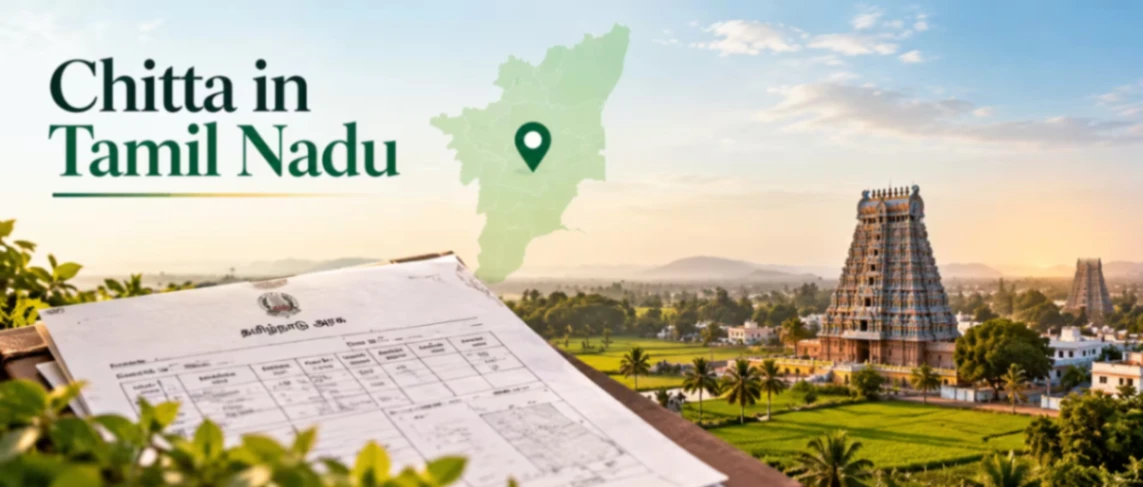
Chitta is the land classification record maintained by the Village Administrative Officer, showing whether a piece of land is nanjai (wetland) or punjai (dryland), along with its extent and survey number. It matters because land classification directly affects what a property can legally be used for and how it's taxed — buying land without checking it can mean discovering later that a plot sold as "residential-ready" is still classified in a way that complicates construction or resale. This guide covers how to view Chitta online (now merged with Patta), what a correct record should show, and how to fix the mismatches that come up most often. Whether you're buying agricultural land, looking for organic farmland, or verifying a plot before purchase, this is the record you'll be asked for.
Section 1 — What is Chitta in Tamil Nadu?
Before checking land classification on a shortlisted plot, it helps to see what's currently available — browse buy land in Tamil Nadu on the 2Bigha map to compare listings by location.
Definition: Chitta is the land revenue record that classifies a specific survey number as nanjai (wetland) or punjai (dryland), maintained at the village administrative level and, since 2015, merged with the Patta into a single combined document called Patta Chitta.
It's often confused with the Patta, but the two record different things — the Patta establishes who owns the land, while the Chitta records what kind of land it is and how it's classified for taxation and usage purposes; together, along with the Adangal (which records cultivation and crop details), they form the complete picture of a parcel's ownership and land-use status. A buyer needs to check land classification specifically because it affects both property tax treatment and what the land can legally be used for — converting classified agricultural land for residential construction, for instance, generally requires a separate approval process before building can begin.
State-specific note: Since the 2015 merger, you no longer request Patta and Chitta as two separate documents in Tamil Nadu — a single Patta Chitta download from eservices.tn.gov.in now carries both ownership details and land classification together, so always ask for "Patta Chitta," not just "Chitta," when referring to the current combined record.
Expert Tip: When reviewing land marketed as suitable for organic farmland or specific agricultural use, don't rely on the seller's description alone — check the Chitta classification (nanjai vs. punjai) directly, since irrigation source and land classification affect both suitability for certain crops and eligibility for agricultural subsidies or loans tied to specific land categories.
Section 2 — How to Get Chitta (Patta Chitta) in Tamil Nadu?
Comparison of routes:
Method | Cost | Time | Legally valid for registration? |
|---|---|---|---|
Online (View/Download Patta Chitta, eservices.tn.gov.in) | Free | Instant | For reference; certified copy needed for legal use |
Online (Verify Patta Chitta by number, cross-check) | Free | Instant | For verification purposes |
Offline (Taluk Office/VAO) | Nominal fee, if a certified copy is required | A few days | Yes |
Visit eservices.tn.gov.in and select "Land Records" from the services menu on the homepage.
Choose Rural land and click "View/Download Patta Chitta" (for urban/city land, select the TSLR Extract option instead).
Select District, Taluk, and Village, then search using your Survey/Sub-division number or Patta Chitta number — or use the owner's name search if you don't know the Patta number.
Enter the captcha code and your 10-digit mobile number, then verify using the OTP sent to your phone.
View your Patta Chitta on screen, showing ownership and classification together, and click "Download PDF" to save it.
Visit the local Taluk Office or the Village Administrative Officer covering the village where the land is located.
Request the Patta Chitta extract for the specific survey number, providing whatever details you have — survey number, sub-division, or the owner's name.
Pay the applicable fee, if a certified physical copy is required, and collect it once verified.
Offline requests typically take a few days if the record needs manual cross-checking with village registers. Before relying on the extract, check that the land classification (nanjai or punjai), survey number, and extent are consistent with the A-Register and any other documents you've already verified.
Section 3 — What Does the Chitta (Patta Chitta) Record Contain?
For a broader look at verified land listings and documentation before finalising a purchase, visit 2Bigha.
Field | What it means | What to check |
|---|---|---|
Owner name | Current recorded owner of the land | Matches the seller's ID and Sale Deed |
Survey number and sub-division | Identifies the exact plot | Consistent with the A-Register and Sale Deed |
Land classification (nanjai/punjai) | Wetland or dryland category | Matches the intended use — agricultural, residential, or organic farming |
Extent | Recorded size of the land | Consistent across all related documents |
Patta type | Single owner, joint, Natham, or converted Patta | Correctly reflects the property's actual status |
Good sign: A correct Patta Chitta shows an owner name matching the seller, survey details consistent with the A-Register, and a land classification that aligns with what the property is actually being used or sold for.
Section 4 — Common Issues & How to Fix Them?
Most Chitta-related issues in Tamil Nadu come from data mismatches between the merged Patta Chitta record and older separate documents, rather than genuine ownership disputes. Confirm your record status directly on the Chitta Tamil Nadu "official website" before assuming a discrepancy is permanent.
Confusing old separate Chitta with the current merged Patta Chitta – Buyers sometimes look for a standalone Chitta that no longer exists as a separate document. Fix: Request "Patta Chitta" directly, since the two have been combined into a single record since 2015.
Land classification doesn't match actual use – Chitta shows agricultural classification while the land is being marketed for residential use. Fix: Confirm whether land use conversion has been completed and approved before purchase; unconverted land may require additional approval before construction.
Owner name search returns multiple results – Common names can return several matches. Fix: Narrow the search using survey number or Patta Chitta number instead of relying solely on the owner's name.
OTP verification fails – A technical hurdle when accessing the portal. Fix: Ensure you're using a valid, accessible 10-digit mobile number, and retry during off-peak hours if the portal is slow.
Mismatch between Patta Chitta and A-Register – Classification or extent differs between the two records. Fix: Cross-check both documents together and raise a correction request with the Taluk Office if a genuine discrepancy exists.
Joint ownership not clearly reflected – Multiple owner names missing or inconsistently listed. Fix: Verify supporting documents establish all joint owners correctly, and request a corrected Patta Chitta if names are incomplete.
Section 5 — Recent Changes in 2026
No major changes have been reported as of August 2026. The 2015 merger of Patta and Chitta into a single Patta Chitta document remains the current framework, with the Tamil Nadu e-Services portal continuing to offer free online viewing and downloading across all 38 districts.
Section 6 — Why Chitta Matters for Land Buyers?
Land classification (nanjai or punjai) directly affects property tax treatment and permitted usage.
It determines eligibility for certain agricultural subsidies, loans, or organic farming certifications tied to land category.
Buyers planning residential construction need to confirm whether agricultural land has been properly converted first.
A Patta Chitta with consistent classification and ownership details supports smoother property registration.
It's a standard document banks check alongside the A-Register and Encumbrance Certificate before loan approval.
Verifying it early helps buyers avoid land whose classification doesn't match its marketed use.
Section 7 — Chitta (Patta Chitta) vs. Adangal
Aspect | Chitta (part of Patta Chitta) | Adangal (A-Register) |
|---|---|---|
What it shows | Land classification — wet or dry, extent, survey details | Cultivation details, crops grown, and survey-wise ownership history |
Maintained by | Village Administrative Officer, merged with Patta at the Taluk office | Village Administrative Officer, as the deeper village account |
Primary use | Confirming land type and combined ownership proof | Verifying cultivation status and historical ownership chain |
If your Patta Chitta and land classification records are clear, you can list your property to reach genuine buyers looking for real estate listing sites through 2Bigha.
Section 8 — Related Documents
A-Register Extract Tamil Nadu
Building Plan Approval Tamil Nadu
Encumbrance Certificate guides
Patta Transfer guides
