
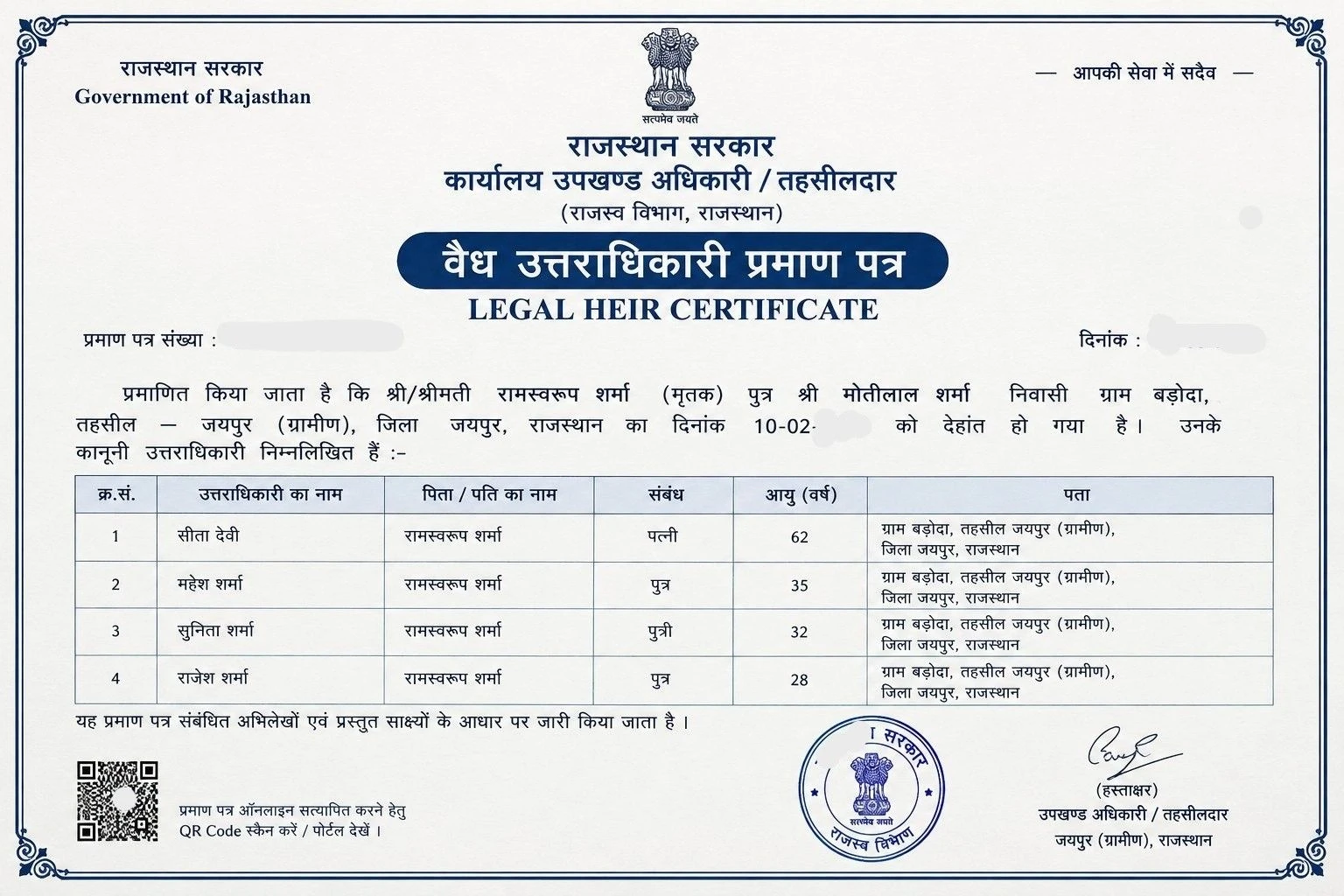
An heirship certificate is an important legal document that is provided by the Revenue Department as evidence of the true heirs of the dead person. The reason why it is important to prove heirship is that banks, court houses, and land registration offices will not hand over anything belonging to the deceased without the heirship certificate. This guide covers the application process, the legal heir certificate documents required, timelines, and where families commonly get stuck. Whether you're settling a parent's estate, claiming land in Rajasthan left behind by a relative, or simply trying to access a deceased family member's bank account, this is the process you'll need to work through correctly.
Section 1 — What is a Legal Heir Certificate in Rajasthan?
Prior to the commencement of the process, it is beneficial to know where this certificate stands in relation to the entire transfer of property, especially in situations where an inheritance includes farmland for sale in Rajasthan, which will be sold by the family at some point in time.
Legal heir certificate: This is defined as a document that legally proves the relationship between a deceased individual and his/her family members.
The certificate itself doesn't transfer ownership of anything. What it does is give banks, revenue offices, insurance companies, and pension departments a government-recognised basis to release funds or update records in the names of the confirmed heirs. Legal heirship isn't automatically documented anywhere by default — someone has to apply and go through the verification process before an authority formally certifies it. Without this step, even close family members can find themselves unable to access a deceased parent's bank account or claim insurance benefits, regardless of how clear the situation seems within the family.
For anyone dealing with agriculture land for sale that's part of an inherited estate, or families who need to formalise heirship before applying for mutation, this certificate is usually the first document in a longer chain of paperwork.
Rajasthan-specific point: In this state, the procedure has become hybrid in nature. You will apply for your application online using either the e-Mitra and land selling website or the Rajasthan SSO portal, but the field inspection by the Patwari called “Mauka Paricha” will be mandatory before you get your certificate from the Tehsildar.
Pro tip: Ensure that the death of the person in question has been registered in the Jan-Aadhaar database.
Many departments now cross-verify heir claims against the Jan-Aadhaar family ID, and a mismatch here can quietly stall your application without anyone telling you exactly why.
Section 2 — How to Get a Legal Heir Certificate in Rajasthan?
The application starts online but still requires physical verification before the certificate is issued. Here's how the process breaks down:
Method | Cost | Time | Legally valid for claims? |
Hybrid (e-Mitra initiation + Patwari verification) | ₹150–₹300 approx. | 15 to 30 days | Yes |
Fully offline (Tehsil office) | Similar charges at counter | 15 to 30 days, sometimes longer | Yes |
Civil court succession certificate (for disputed cases) | Court and lawyer fees | Several weeks to months | Yes, broader scope |
Visit an e-Mitra kiosk or the SSO portal. Use the official e-Mitra locator to find an authorised centre near you, or log in via sso.rajasthan.gov.in.
Fill in the application. Enter the deceased's details and information for all claimed legal heirs.
Upload supporting documents. Attach the death certificate, ID proofs, relationship proof, and the affidavit.
Note your transaction ID. This is generated once the digitised application is submitted, and it's used to track progress.
Await the Patwari field inquiry. A local revenue official visits to verify the family details, often with two neighbours as witnesses.
Visit the Tehsil office. Approach the Tehsildar or Naib Tehsildar covering your area of residence.
Collect and submit the application form. Provide all required documents along with the affidavit and photographs.
Pay the applicable charges. Cover the stamp paper and processing fees at the counter.
Attend the verification inquiry. The Patwari or VAO conducts a spot inquiry before the Tehsildar signs off.
Regardless of the starting method, the field verification stage is unavoidable in Rajasthan. If there's a delay beyond the usual 15 to 30 day window, applicants can approach the Revenue Division Officer (RDO) directly to follow up.
Section 3 — What Does a Legal Heir Certificate Contain?
A properly issued certificate lists specific details establishing the heirship clearly.
Field | What it means | What to check |
Deceased's Details | Name, date of death, last address | Must match the death certificate exactly |
List of Legal Heirs | All heirs formally recognised | Should include every eligible family member |
Relationship to Deceased | How each heir is related | Should match the relationship proof submitted |
Issuing Authority | Tehsildar/Naib Tehsildar who signed | Confirms the certificate's official validity |
Issue Date | Date the certificate was granted | Useful reference, though the certificate itself doesn't expire |
Good sign: A clean certificate lists every eligible heir accurately, matches the death certificate details precisely, and carries the Tehsildar's signature with no pending objections noted during the field inquiry.
Section 4 — Common Issues & How to Fix Them?
Application stalls after submission – A common cause is a mismatch between the claimed heirs and the Jan-Aadhaar family record. Fix: confirm the death and family details are correctly updated in Jan-Aadhaar before or alongside applying.
Patwari inquiry delayed – Field verification can take time depending on the local office's workload. Fix: follow up periodically using your transaction ID, and escalate to the RDO if delays exceed the standard timeline.
Missing witnesses during spot inquiry – The Patwari's "Mauka Paricha" often requires two neighbours to confirm family details. Fix: arrange for available, reliable witnesses in advance to avoid rescheduling.
Disputed heirship among family members – Disagreements over who qualifies as a legal heir can complicate or freeze the application. Fix: for genuinely disputed cases, a succession certificate from a civil court may be needed instead of, or alongside, the legal heir certificate.
Incomplete legal heir certificate documents required at submission – Missing an affidavit or relationship proof is a common reason for rejection. Fix: double-check the full document checklist before submitting to avoid a resubmission cycle.
Confusion between legal heir certificate and succession certificate – Families sometimes apply for the wrong document for their actual need. Fix: understand that a legal heir certificate confirms who the heirs are, while a succession certificate additionally grants authority to collect debts, shares, or securities.
Section 5 — Recent Changes in 2026
As of August 2026, Rajasthan's legal heir certificate process continues to operate on the hybrid digital-plus-physical-verification model, with Jan-Aadhaar cross-verification of heirs now a standard part of the field inquiry stage across most districts.
Section 6 — Why a Legal Heir Certificate Matters for Families?
Required before banks release a deceased person's funds or accounts to surviving family members
Necessary for claiming pension benefits, insurance payouts, and government scheme dues
Forms the foundation for updating land mutation records tied to plots in Rajasthan
Prevents delays and disputes when multiple family members share a claim to the same estate
Establishes a clear, government-recognised basis before starting the succession certificate process, if needed
Supports smoother transactions later, whether the family plans on selling property online or handling it privately
Section 7 — Legal Heir Certificate vs. Succession Certificate
These two documents are frequently confused, though they serve different legal purposes.
Aspect | Legal Heir Certificate | Succession Certificate |
Issued by | Revenue Department (Tehsildar) | Civil Court |
What it confirms | Who the legal heirs are | Authority to collect debts, shares, and securities |
Typical use | Pension, bank accounts, basic property claims | Disputed or complex asset recovery |
Cost and time | ₹150–₹300, roughly 15–30 days | Higher court fees, often several weeks to months |
A legal heir certificate simply confirms the heirs. A succession certificate goes further, granting legal authority to actually recover specific assets. For families planning eventual transactions like agriculture land for sell, starting with the legal heir certificate is usually the correct first step before deciding whether a succession certificate is also needed.
Section 8 — Related Documents
Nakal Mutation Rajasthan guide for updating land ownership after inheritance
Encumbrance Certificate guide for checking claims on inherited property
Gift Deed guide for voluntary transfers during a person's lifetime
Property Document Checklist guide for full pre-transaction verification
Land Registration guide for completing a legally valid property transfer
