
 List Your Land
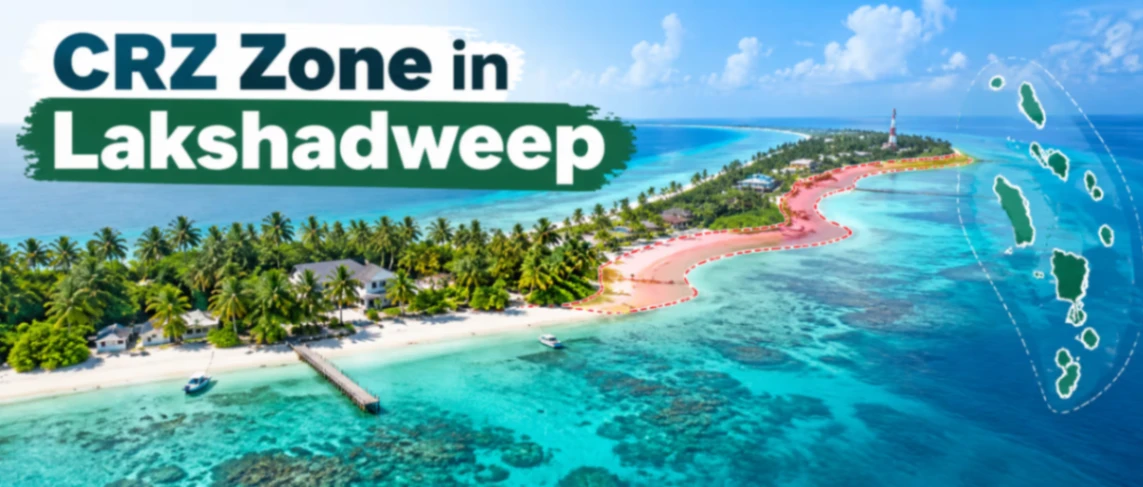
CRZ Clearance is the environmental permission required under the Coastal Regulation Zone framework before you can construct, repair, or expand a structure near Lakshadweep's shoreline. It matters because Lakshadweep is treated differently from mainland coastal states — the islands follow their own, tighter setback rules rather than the standard CRZ-I to CRZ-IV zoning, and getting this wrong can mean a structure that's flagged for removal regardless of how solid your building plan approval is. This guide explains what CRZ rules Lakshadweep actually apply, how to check whether your plot falls inside the restricted zone, and what construction is and isn't permitted there. Anyone planning to build, buy, or invest in a coastal plot on the islands needs to understand this before the building plan stage, not after.
Section 1 — What is CRZ Clearance in Lakshadweep?
Coastal plots are some of the most sought-after real estate on the islands, and before deciding on one it's worth browsing what's currently listed in Lakshadweep on the 2Bigha map so you have a realistic sense of location options relative to the shoreline.
In simple terms, CRZ Clearance confirms that your construction plans respect the legally protected distance from the high tide line, under rules specifically written for how close you're allowed to build to the sea.
It's easy to assume Lakshadweep follows the same CRZ-I through CRZ-IV zoning used across mainland coastal states, but it doesn't — the CRZ Notification, 2019 explicitly excludes the islands of Lakshadweep and Andaman & Nicobar from that standard classification, and instead routes them through Integrated Island Management Plans (IIMPs) notified separately for these territories.
In practice, this means Lakshadweep applies a uniform 20-metre setback from the high tide line on the landward side across its inhabited islands — a much tighter, simpler rule than the mainland's population-density-based zoning, but one with almost no flexibility: existing dwellings within that 20-metre band may be repaired or reconstructed, but no new construction is permitted inside it at all.
A buyer or builder needs this clearance specifically because Lakshadweep's inhabited islands are narrow, meaning a meaningful share of any given plot can realistically fall inside that 20-metre restricted band — skipping this check is one of the fastest ways to end up with land you legally cannot build on.
Land ownership note: Because nearly all inhabited land in Lakshadweep sits close to the coast, CRZ restrictions here function less like an occasional edge case and more like a standing constraint on almost every plot. Combine this with the fact that non-islanders generally require the Administrator's permission before acquiring land at all, and it's worth confirming both land-purchase eligibility and CRZ setback distance before you commit to any coastal plot.
Expert Tip: Ask specifically whether your plot's foreshore area qualifies for the limited exceptions — fishing jetties, fish drying yards, net mending yards, boat building yards, ice plants, and boat repair facilities are permitted within CRZ limits subject to environmental safeguards, which is a narrower list than most first-time applicants assume.
Section 2 — How to Get CRZ Clearance in Lakshadweep?
Checking your CRZ status and getting a construction plan cleared against it isn't a single online form the way some mainland state portals work — here's how the routes actually differ for Lakshadweep.
Method | Cost | Time | Legally valid for registration? |
|---|---|---|---|
Online (viewing published CRZ/IIMP framework) | Free | Immediate — for reference only | Not a clearance by itself, informational only |
Online (application through building plan / PWD process) | Bundled with building plan fee | Runs alongside building plan scrutiny | Yes, once the sanctioned building plan reflects CRZ compliance |
Offline (Revenue Sub-Division / Administration office) | As applicable, confirm locally | Varies by island and case | Yes, once formally cleared and reflected in your sanction |
1. Check the published setback rule — Review the current CRZ Notification and Lakshadweep-specific IIMP provisions to confirm the 20-metre high-tide-line rule applies to your case.
2. Identify your plot's distance from the high tide line — Use your survey map, ideally cross-checked with a site visit, to estimate how much of your plot falls inside the restricted band.
3. Submit your building plan with CRZ details noted — When applying for building plan approval, clearly mark the setback distance so it's scrutinized against CRZ rules in the same review.
4. Respond to any CRZ-specific queries — If the scrutiny raises a setback concern, provide the requested clarification or revised drawing promptly.
1. Visit the Revenue Sub-Division office — Raise your CRZ query directly with the local Revenue Sub-Division office or Deputy Collector/BDO for your island.
2. Request a site-specific setback confirmation — Ask for written confirmation of the applicable setback distance for your exact survey number.
3. Carry this confirmation into your building plan application — Attach the written confirmation to your building plan submission to avoid a second round of scrutiny.
Because there's no dedicated fast-track CRZ portal for Lakshadweep, offline confirmation from the local office is often the more reliable route. Before relying on any verbal confirmation, ask for it in writing — a setback distance you were told informally carries no weight if the building plan scrutiny later disagrees.
Section 3 — What Does CRZ Clearance Contain?
A CRZ clearance is less a single certificate and more a set of confirmed facts about your plot's location relative to the sea. If your priority is simply finding land that isn't inside a restricted band to begin with, it's worth starting from the 2Bigha homepage and filtering for verified listings.
Field | What it means | What to check |
|---|---|---|
Distance from high tide line | Whether your plot falls inside or outside the 20-metre restricted band | Measured distance stated clearly, not estimated |
Permitted activity type | What kind of construction, if any, is allowed at that distance | Matches the limited list — repair of existing dwellings or specific foreshore facilities |
Existing structure status | Whether there's already a dwelling that can be repaired/reconstructed under the rule | Clearly documented if claiming the repair exception |
IIMP reference | Confirms which Integrated Island Management Plan provision applies to your island | Cited explicitly rather than left generic |
Good sign: A properly cleared plot has its distance from the high tide line explicitly measured and stated (not eyeballed), and if it falls inside the 20-metre band, the only activity noted is repair/reconstruction of an existing dwelling or one of the specific permitted foreshore facilities — never new general construction. If your paperwork describes new construction inside that band without one of those narrow exceptions, treat it as a red flag rather than a formality.
Section 4 — Common Issues & How to Fix Them?
Coastal clearance issues in Lakshadweep tend to be about restricted expectations rather than paperwork errors — the rule itself is stricter than most first-time applicants assume. For questions specific to your island that this guide can't answer, the CRZ Zone Lakshadweep official website connects you to the right department.
Assuming mainland CRZ-I to CRZ-IV zoning applies
Issue: Applicants sometimes plan construction based on mainland coastal rules, not realizing Lakshadweep is explicitly excluded and follows its own 20-metre rule instead. Fix: Always confirm you're referencing the island-specific IIMP provisions, not the general mainland CRZ notification.
New construction proposed inside the 20-metre band
Issue: The rule permits repair or reconstruction of existing dwellings in that band, but not brand-new construction. Fix: If your plot falls inside the band, plan only for repair/reconstruction of an existing structure, or look further inland.
No written setback confirmation before finalizing drawings
Issue: Relying on an informal estimate of distance from the high tide line often doesn't match what scrutiny finds. Fix: Get the distance measured and confirmed in writing by the local office before finalizing your building plan.
Foreshore facility claimed without meeting the specific category
Issue: Applicants sometimes assume any small structure near the water qualifies for the foreshore exception. Fix: Check your structure genuinely matches the permitted list — jetty, fish drying yard, net mending yard, boat building yard, ice plant, or boat repair — before applying under that exception.
Treating CRZ compliance and building plan approval as separate processes
Issue: Some applicants apply for building plan approval without flagging CRZ setback details, causing delays later. Fix: Submit setback information as part of your building plan application from the start, not as an afterthought.
Section 5 — Recent Changes in 2026
No major changes have been reported as of August 2026 specific to Lakshadweep's CRZ framework beyond the existing CRZ Notification, 2019 and the Integrated Island Management Plan provisions notified for the islands. The broader Town and Country Planning and Development Regulation, 2026 notified for Lakshadweep may affect how construction near the coast is administered going forward, so applicants should confirm with the local Revenue Sub-Division whether any procedural changes apply to their specific project.
Section 6 — Why CRZ Clearance Matters for Land Buyers?
It determines whether a coastal plot can be built on at all, before you invest in drawings or a building plan application.
It protects buyers from purchasing land that looks buildable but sits inside a restricted setback band.
It affects resale value — a plot with confirmed, favorable CRZ status is a materially easier sale than one with an unclear coastal status.
Non-compliant construction in the restricted band can be flagged for removal regardless of other approvals held.
It's directly tied to environmental protection of Lakshadweep's coral reefs and fisher-community livelihoods, which the islands' land-use rules are specifically designed around.
Section 7 — CRZ Clearance vs. Building Plan Approval
Aspect | CRZ Clearance | Building Plan Approval |
|---|---|---|
Governing framework | Central environmental law (Environment Protection Act, CRZ Notification) | Local building bye-laws and planning regulation |
What it checks | Distance from the high tide line and permitted coastal activity | Overall structural design, plinth area, and general setbacks |
Sequence | Should be confirmed before finalizing building plan drawings | Applied for once CRZ-compliant drawings are ready |
If you hold a coastal plot in Lakshadweep with its CRZ status already documented, that clarity is exactly what makes a listing easier to sell — you can list verified land for sale on 2Bigha once ownership and coastal status are confirmed.
Section 8 — Related Documents
Building Plan Lakshadweep 2026 — the construction sanction that CRZ setback distance directly feeds into
Land Purchase Rules Lakshadweep 2026 — ownership eligibility, which matters before CRZ status becomes relevant at all
Survey Map Lakshadweep 2026 — how your plot's distance from the high tide line is actually measured
Revenue Record Lakshadweep 2026 — confirms the classification of the land your CRZ check applies to
