
 List Your Land
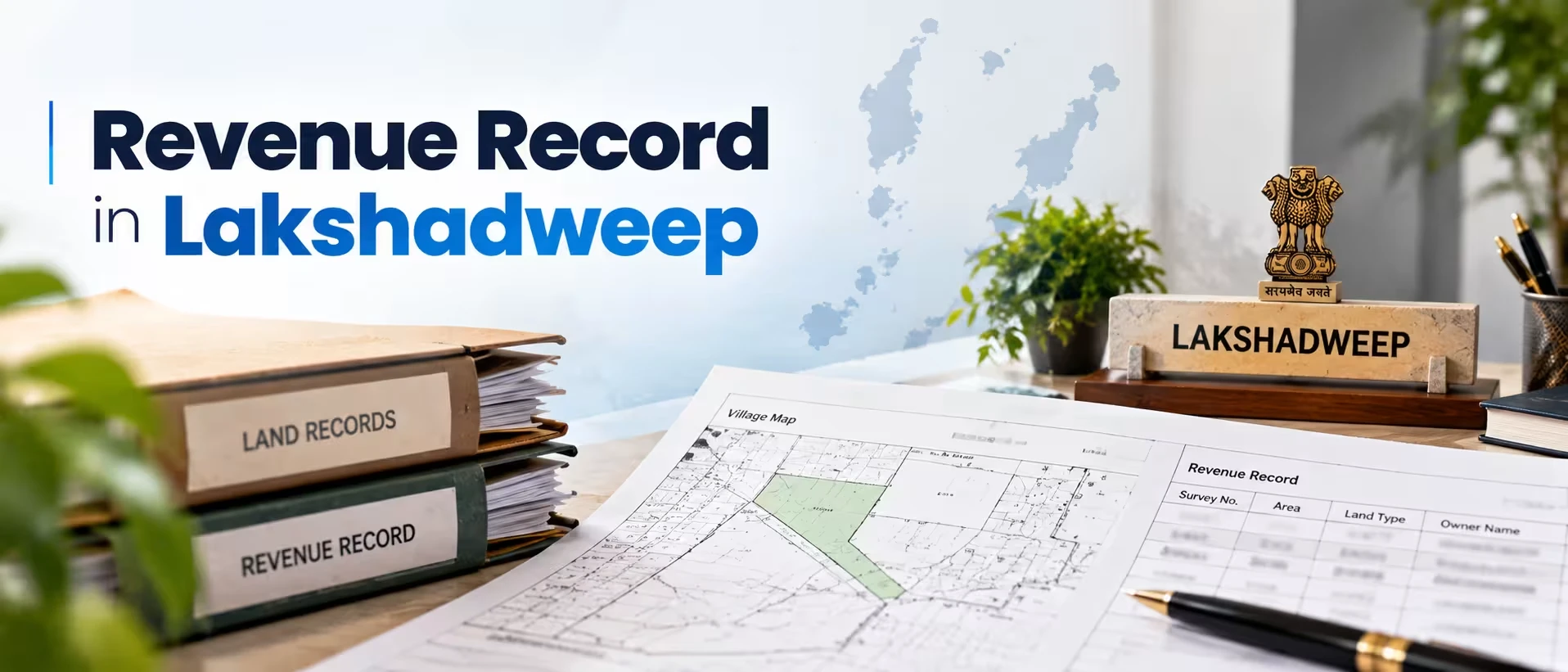
A Revenue Record is the Land Revenue Department's official register showing a property's ownership, classification, and other core details for a given survey number. It matters because it's the primary reference point almost every other land process in Lakshadweep — mutation, NA conversion, building plan approval — checks before proceeding.
This guide covers how Lakshadweep land records online access currently works, what a Lakshadweep land record search should show you, and where records commonly fall short of being fully current. Anyone buying, inheriting, or simply confirming what they already hold needs to check this before relying on any other document.
Section 1 — What is Revenue Record in Lakshadweep?
Checking the revenue record is one of the first things worth doing before getting attached to a specific plot — you can cross-reference what's currently listed in Lakshadweep on the 2Bigha map against the actual record for that survey number. If you're buying land in Lakshadweep, this basic check can help you understand whether the property's recorded details match what is being offered.
In simple terms, a Revenue Record is the official government register that shows who owns a piece of land, how it's classified, and other core details tied to its specific survey number.
It's often confused with a Survey Map, but they capture different kinds of information. The Revenue Record is textual — names, classification, ownership history — while the Survey Map is spatial, showing the plot's actual boundaries, shape, and dimensions.
Lakshadweep runs these as genuinely separate systems: LRIS for textual land record data, and Collab Land for survey and boundary digitization — checking one doesn't tell you what the other shows.
For land in Lakshadweep, the Revenue Department has been working to bring records online and keep them updated on an island-wise and tehsil-wise basis, with Land Record Computerization Cells functioning at the tehsil/island level for issuing certificates and updated records — but this modernization is an ongoing, uneven process rather than something uniformly complete across all islands.
A buyer, heir, or anyone confirming their own land needs this record specifically because it's the reference point every other process checks. A mismatch between what you believe you own and what the Revenue Record actually states is one of the most common reasons a transaction or application stalls unexpectedly.
Land ownership note: Because Lakshadweep's land digitization has been rolled out unevenly across islands, don't assume your island's record is as current or complete as one you may have seen for a different island or a mainland state. Confirm directly with your local Revenue Sub-Division office rather than assuming uniform online coverage.
Expert Tip: Ask specifically when the record for your survey number was last formally updated, not just when the system itself was launched. A portal can be live and functioning while the specific entry for your plot still reflects an outdated classification or ownership status.
Section 2 — How to Get Revenue Record in Lakshadweep?
Checking a revenue record can range from a quick informal look to a formally certified extract, and the right route depends on what you're using it for.
Method | Cost | Time | Legally valid for registration? |
Online (informal LRIS check, where accessible for your island) | Free | Immediate | Reference only — not valid for registration or legal use |
Online (certified extract requested via correspondence) | Nominal fee | A few days, depending on office | Yes, once issued as a certified copy |
Offline (Revenue Sub-Division office) | Nominal fee | Instant to a few days | Yes, once issued and signed |
1. Check LRIS availability for your island — Confirm whether your specific island's records are currently accessible through the LRIS system.
2. Search by survey number or owner name — Enter the details you have to locate the relevant record entry.
3. Review the informal result — Use this to confirm basic details, but treat it as a starting point rather than a final answer.
4. Request a certified copy if needed — For any legal, financial, or registration purpose, follow up with the Revenue Sub-Division office for a formally certified extract.
1. Visit the Revenue Sub-Division office — Bring the survey number or owner name, and ID proof if requesting a certified copy.
2. Request the record extract — Specify whether you need a certified copy or an informal check is sufficient for your purpose.
3. Pay the applicable fee — Pay as quoted for a certified extract, if applicable.
4. Collect and verify the extract — Check the owner name, classification, and survey number match what you expect before relying on it.
Turnaround is generally faster for a straightforward informal check and slower for a certified extract requiring formal sign-off, especially if the record needs manual cross-verification against older physical registers.
Before relying on any extract for a transaction, confirm how recently that specific entry was actually updated, not just when you requested the copy.
Section 3 — What Does Revenue Record Contain?
A revenue record has a handful of fields that matter far more than the rest. If you'd rather start from land with a clearly documented record already, browse the real estate websites on the 2Bigha homepage for verified listings.
Field | What it means | What to check |
Owner name | Confirms who the record currently shows as owner | Matches current ID and, ideally, a recent mutation entry |
Survey/khata number | Identifies the exact plot | Matches your ownership document and survey map |
Land classification | States whether the land is agricultural, non-agricultural, or another category | Matches actual, intended, and lawful use of the land |
Record last-updated date | Shows how current the entry actually is | Reasonably recent, not several owners or years out of date |
Good sign: A well-maintained record shows the current owner's name matching recent mutation, a clear classification consistent with lawful use, and a last-updated date that isn't years stale.
If the record's owner name doesn't match who you believe holds the land, or the classification looks inconsistent with how it's actually used, resolve that with the Revenue Sub-Division before treating any transaction as safe to proceed.
Section 4 — Common Issues & How to Fix Them?
Because Lakshadweep's digitization push is real but uneven, most revenue record issues come down to gaps in how current or complete a specific island's data actually is.
For a record-specific query, the Revenue Record Lakshadweep official website is the right starting point.
Record not available online for a specific island
Issue: LRIS coverage has been rolled out island-wise, so some plots may not yet be visible through the online system. Fix: Visit the Revenue Sub-Division office directly for islands where online access isn't yet available.
Record shows an outdated owner name
Issue: Mutation wasn't completed after a past sale or inheritance, leaving the record several transactions behind. Fix: Trace and complete any pending mutation rather than assuming the record will self-correct.
Classification doesn't match actual land use
Issue: The record may still show agricultural classification for land that's informally used for another purpose. Fix: Apply for formal NA Conversion rather than assuming informal use has updated the classification.
Survey number discrepancy between record and map
Issue: Because textual records (LRIS) and spatial survey data (Collab Land) are separate systems, mismatches can occur. Fix: Cross-check the survey number against both systems, and raise any mismatch with the Revenue Sub-Division for correction.
Delay obtaining a certified copy
Issue: Some requests require manual verification against older physical registers, particularly for older properties. Fix: Allow extra time for certified copies on plots with a long ownership history.
Section 5 — Recent Changes in 2026
No major changes have been reported specific to Revenue Record issuance in Lakshadweep as of August 2026. The Revenue Department's continued rollout of LRIS, alongside the PEARL registration system and Collab Land survey digitization, remains an active, ongoing modernization effort. Buyers and heirs should confirm current coverage and completeness for their specific island directly with the local Revenue Sub-Division office.
Section 6 — Why Revenue Record Matters for Land Buyers?
A Revenue Record matters because:
It's the foundational document every other land process — mutation, conversion, building plan — checks against.
It's usually the fastest way to confirm current ownership before committing time or money to a transaction.
It reveals a plot's official land classification, which determines what you can legally do with it.
A current, clean record materially reduces risk for both buyers and lenders evaluating a property.
It provides an official reference point if ownership or classification is ever disputed later.
Checking it early can save significant time by surfacing mutation or classification issues before you're deep into a transaction.
Section 7 — Revenue Record vs. Survey Map
Aspect | Revenue Record | Survey Map |
Type of information | Textual — ownership, classification, record history | Spatial — boundaries, shape, and dimensions |
System it comes from | LRIS (Land Records Information System) | Collab Land (survey/FMB digitization) |
What checking it tells you | Who owns it and how it's classified | Exactly where the boundaries actually sit on the ground |
A property with a clean, current Revenue Record is a far easier sell — if your land's record is in good order, you can sell land in Lakshadweep on 2Bigha.
Section 8 — Related Documents
The following documents may also be relevant:
Survey Map Lakshadweep 2026 — the spatial counterpart to this textual record
Mutation Lakshadweep 2026 — the process that keeps this record's ownership entry current
NA Conversion Lakshadweep 2026 — relevant when the record's classification needs to change
Encumbrance Certificate Lakshadweep 2026 — a separate, complementary check on financial/legal charges
