
 List Your Land
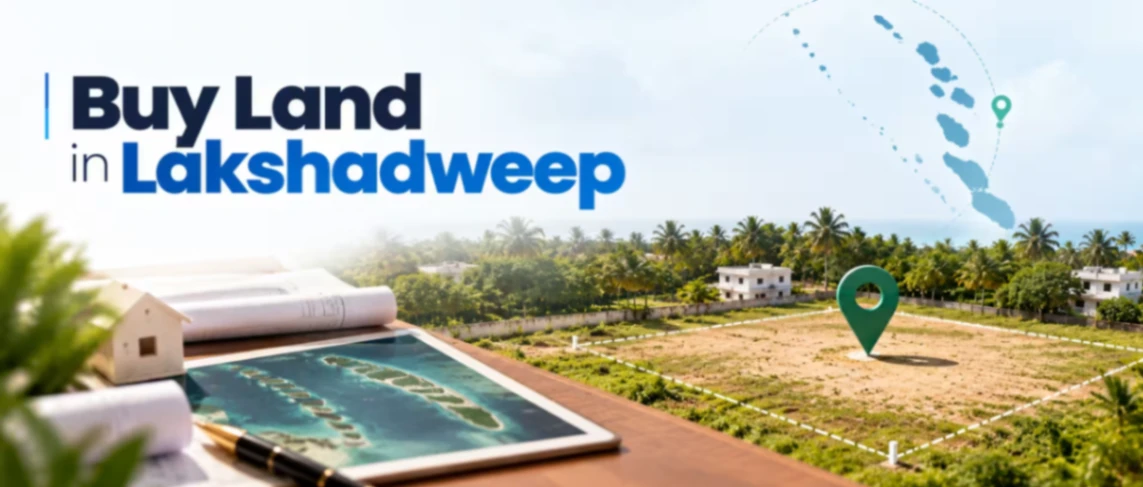
Buying land in Lakshadweep is fundamentally different from buying land anywhere else in India — it's governed by the Laccadive, Minicoy and Amindivi Islands (Protection of Scheduled Tribes) Regulation, 1964, a law that prohibits alienation of land to non-tribals across the entire Union Territory. It matters because, unlike most Indian states where outsiders face extra paperwork or higher fees, in Lakshadweep the honest starting point for most prospective outside buyers is that open-market land purchase largely isn't available at all. This guide covers who can realistically buy or hold land here, what limited options (mainly leasehold, tourism-related arrangements) exist for non-islanders, and how to verify any claim before committing money. Whether you're an islander navigating your own eligibility, an NRI exploring residency options, or simply researching before assuming this works like buying property in Goa or Kerala, this guide is meant to set realistic expectations first.
Important context before you read further: Please read this before anything else: 94–98% of Lakshadweep's landowners are Scheduled Tribes, and the 1964 Regulation prohibits land alienation to non-tribals across the entire territory. There is no functioning open real estate marketplace here in the way that exists in most Indian states — land for sale in Lakshadweep listings aimed at general investors should be treated with real skepticism until verified directly with the Lakshadweep Administration. This guide explains the actual legal landscape rather than presenting land investment here as routine.
Section 1 — What is the Land Purchase Process in Lakshadweep?
Before you look into buying land in Lakshadweep, it helps to first browse verified listings — you can see this on the 2Bigha map by opening the map, typing 'Lakshadweep' into the search box, and using the state-level results that come up. If you're researching buy land in Lakshadweep, however, remember that listings alone do not establish that a transaction is legally permitted.
In simple terms, 'buying land in Lakshadweep' for most people researching this online does not work the way it does in mainland India — the realistic starting point is understanding whether you're even eligible to hold land here at all, before thinking about price, location, or process.
It differs from buying property in almost every other Indian state or union territory because the restriction here isn't a matter of extra permission or a higher fee for outsiders (as with some hill states) — it's a near-total prohibition on land alienation to non-tribals, rooted in protecting the demographic character, traditional livelihoods, and land security of an indigenous population that makes up the overwhelming majority of the territory.
Anyone researching this needs to understand it specifically because a search for 'land for sale in Lakshadweep' or 'farmland for sale' can surface marketing content, listings, or informal offers that don't reflect this legal reality — treating Lakshadweep as an open investment destination based on such content risks wasted money or worse, participation in a transaction that has no legal standing.
State-specific note: For non-islander Indian citizens, the closest thing to an established path onto island land historically has been leasehold arrangements for tourism-related purposes, administered through the Lakshadweep Tourism Development Corporation (LTDC) rather than freehold purchase — even this is not equivalent to buying land in the conventional sense, and terms should always be confirmed directly with LTDC and the Administration.
Expert Tip: Before taking any online claim about buying property in Lakshadweep at face value — including listings using phrases like invest in land or land marketplace — verify it directly against the Department of Revenue and, if genuine legal advice is warranted, a lawyer with specific Lakshadweep land law experience; general Indian real estate knowledge, even from experienced professionals in other states, often doesn't carry over here.
Section 2 — How to Get Land Purchase Process in Lakshadweep?
There isn't a standard 'method comparison' the way there would be in most states, because there isn't a routine open-market purchase pathway for non-islanders. Here's how the realistic options actually differ.
Path | Who it's realistically for | What you get | Freehold ownership? |
Inheritance / family transfer / eligible islander-to-islander sale | Scheduled Tribe islanders and their legal heirs | Registered title, subject to land protection rules | Yes, within the eligible community |
LTDC leasehold for tourism-related purposes | Non-islanders pursuing tourism ventures, historically | A lease, not ownership, for a defined purpose and term | No — leasehold only |
General 'investment' land purchase by outside individuals | Not a realistic, legally supported path for most people | High risk of an unenforceable or void transaction | No |
Verify your eligibility first. Before any other step, establish honestly whether you fall into a category (Scheduled Tribe islander, legal heir) that can hold land here directly.
Check land records for any specific plot. Use land.utl.gov.in to check the current recorded status and classification of any plot you're being told is 'for sale.'
Contact the Department of Revenue directly. Reach out to the Lakshadweep Administration's Revenue Department for written confirmation on eligibility and process, rather than relying on a broker or listing site.
If pursuing a tourism-related lease, contact LTDC directly. Any tourism-related leasehold interest should be pursued and verified directly with the Lakshadweep Tourism Development Corporation.
Obtain an Entry Permit if travel is needed. Non-natives require a permit under the LM&A (Restriction of Entry & Residence) Rules, 1967, well before any island visit, via epermit.utl.gov.in.
Engage a local lawyer. Given how different this legal framework is, engage a lawyer specifically experienced with Lakshadweep land law before proceeding with anything.
Verify at the Sub-Registrar's Office. For any genuinely eligible transaction, verification and registration take place at the Lakshadweep Administration Secretariat in Kavaratti.
Do not send money before written eligibility confirmation. Treat any request for advance payment before you have direct, written confirmation of transaction eligibility as a serious red flag.
There is no standard timeline to quote here, precisely because most inquiries from outside buyers don't lead to a legally supported transaction at all. Before proceeding with anything that looks like a land deal in Lakshadweep, check that you have direct written confirmation from the Department of Revenue — not just a broker's or listing site's assurance — that the specific transaction is legally permitted.
Section 3 — What Does the Land Purchase Process Contain?
If you do reach a genuinely eligible transaction, the resulting documentation should mirror standard Indian land purchase paperwork — title deed, land record entry, encumbrance certificate — while additionally confirming compliance with Lakshadweep's land protection framework. For a broader look at land documents and property websites across India, visit the 2Bigha homepage.
Document | What it confirms | What to check |
Title deed / deed of conveyance | The specific registered transaction | Parties are eligible under the 1964 Regulation |
Land record (land.utl.gov.in) | Current recorded ownership and classification | Matches what you've been told about the plot |
Encumbrance Certificate | No pending claims or prior transactions of concern | Obtained fresh from the Sub-Registrar's Office |
Entry Permit (if applicable) | Legal basis for you to be on the islands at all | Valid for the specific island and dates involved |
Good sign: A genuinely sound process shows direct written eligibility confirmation from the Department of Revenue before any money changes hands, a land record and title deed that match each other, a clean Encumbrance Certificate, and — if travel is involved — a properly issued Entry Permit. If any of these is missing, treat the transaction as unverified, regardless of what a broker or website claims.
Section 4 — Common Issues & How to Fix Them
Given how restricted this market genuinely is, most 'issues' non-islander buyers encounter are really warning signs that a transaction isn't legally supported at all, rather than fixable paperwork problems. For the most accurate, current procedure, always cross-check against the Land Purchase Process in Lakshadweep official website, the Lakshadweep Administration.
Listings advertising 'land for sale' to general investors – Marketing content or listing sites present Lakshadweep as an open investment destination. Fix: Treat such listings with significant skepticism and verify directly with the Department of Revenue before engaging further.
Pressure to pay before eligibility is confirmed – A seller or broker asks for money before any written confirmation of transaction legality. Fix: Do not pay anything until you have direct, written eligibility confirmation from the Revenue Department.
Confusing a tourism lease with land ownership – Buyer believes an LTDC leasehold arrangement is equivalent to buying the land. Fix: Understand clearly that this is a lease with a defined term and purpose, not freehold ownership.
Attempting a transaction through a tribal proxy – A non-eligible buyer tries to use an islander as a nominal owner to work around the restriction. Fix: This is a serious legal and ethical problem, not a workaround — avoid it entirely; such arrangements can be voided and carry legal consequences.
Relying on outdated or informal information about the rules – Buyer assumes older, looser rules still apply without checking current status. Fix: Confirm the current, applicable regulation directly with the Department of Revenue, especially given the 2026 draft amendment under discussion.
No Entry Permit obtained before travel – Buyer or their representative travels to Lakshadweep without securing a permit. Fix: Apply for an Entry Permit via epermit.utl.gov.in well in advance of any visit — entry without one is not permitted.
Section 5 — Recent Changes in 2026
In 2026, the Lakshadweep Administration published a draft amendment to the 1964 Protection of Scheduled Tribes Regulation intended to streamline scrutiny of land transactions, which has drawn significant public objection from islanders concerned it could open the door to greater outside commercial and tourism-related land use. Separately, the Administration simplified Entry Permit rules in April 2026, removing the requirement for a local sponsor for tourist visits — though permits remain mandatory for all non-natives. As of August 2026, the land regulation amendment remains a draft under public consultation, not finalised law.
Section 6 — Why Land Purchase Process Matters for Land Buyers
Understanding this framework upfront prevents wasted money on a transaction that may have no legal standing.
It protects you from unknowingly participating in an arrangement (like a tribal proxy purchase) that carries real legal risk.
For eligible islanders, understanding the process correctly protects family land rights during inheritance or partition.
It sets realistic expectations against marketing content that doesn't reflect the actual legal landscape.
The 2026 regulatory debate means this is an actively evolving area — staying informed matters more here than in most states.
Respecting this framework matters beyond individual transactions — it's tied to protecting a fragile island ecosystem and an indigenous population's land security.
Section 7 — Buying Land in Lakshadweep vs. a Typical Indian State Purchase
It's worth being explicit about how different this is from buying property in, say, Kerala or Goa, since general Indian real estate knowledge doesn't map cleanly here.
Aspect | Typical Indian State | Lakshadweep |
Baseline for non-locals | Usually possible, sometimes with extra permission/fees | Alienation to non-tribals is prohibited across the territory |
Open real estate market | Established listings, agents, and marketplaces | Effectively absent for freehold purchase by outsiders |
Realistic non-islander path | Direct purchase and registration | Limited leasehold, mainly tourism-related, via LTDC |
This comparison exists to set expectations honestly, not to discourage legitimate interest. If you are an eligible islander with land you're genuinely entitled to transfer, and want to explore what it means to sell land in Lakshadweep, the process there follows the more familiar open-market model this guide describes above — Lakshadweep itself simply isn't that kind of market. You can explore selling options on 2Bigha.
Section 8 — Related Documents
Title Deed Lakshadweep — the registration document that matters for any genuinely eligible island land transaction
