
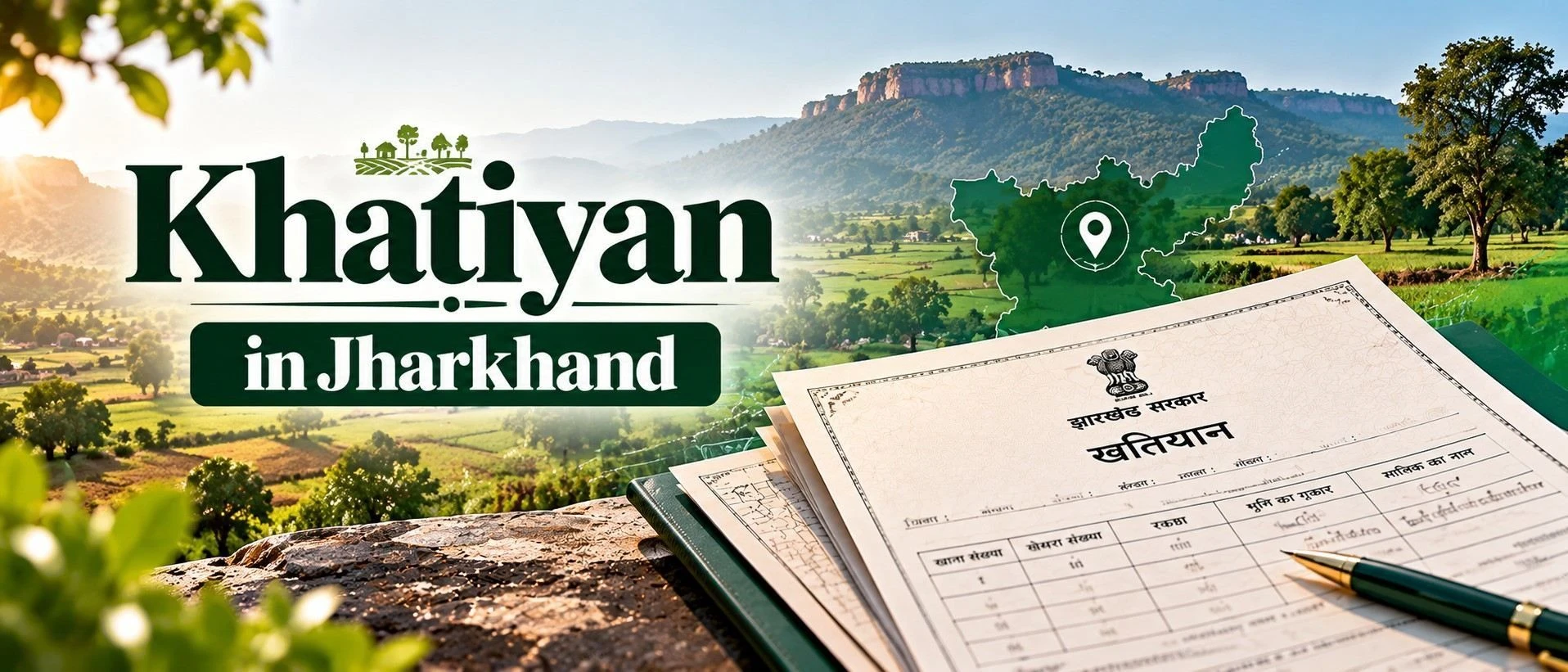
A Khatiyan, also called Apna Khata, is the official record of rights document in Jharkhand that details land ownership, classification, and holding information for a specific khata or khasra number. It exposes buyers to real risk when skipped — the Khatiyan is where a plot's CNT/SPT tribal-land classification, current recorded owner, and land type are all confirmed together, and relying on a sale deed alone misses exactly this picture. This guide covers how to download your Khatiyan online, what it actually proves versus what it doesn't, and how to read it correctly. Whether you're buying land in Jharkhand, comparing options to buy land in Jharkhand, or working through inheritance of agricultural land in Jharkhand, this is the record every serious transaction depends on.
Section 1 — What is a Khatiyan in Jharkhand?
Before pulling a specific plot's Khatiyan, it helps to see the wider area — you can check the 2Bigha map for Jharkhand while you shortlist land in Jharkhand to verify.
Definition: A Khatiyan is the official record of rights document that shows a landholding's ownership details, khata and khasra numbers, land classification, and area, maintained by Jharkhand's revenue department.
It's tempting to treat the Khatiyan as proof of ownership outright, but that's not quite accurate. Legal title in Jharkhand ultimately rests on the registered title deed (Mula Deed) issued through the Sub-Registrar's office — the Khatiyan is the revenue department's own record, used to cross-check that the registered ownership is correctly reflected in government land records. The two should tell the same story; when they don't, that gap is exactly what a careful buyer needs to investigate before paying anything. A buyer needs the Khatiyan specifically because it's where land classification lives — including whether a plot falls under CNT or SPT Act protections — information the sale deed alone won't necessarily spell out as clearly.
State-specific note: In Jharkhand, the Khatiyan for tribal-classified land carries far more legal weight than in states without similar protections — a Khatiyan showing Scheduled Tribe raiyati status is the starting point for understanding whether a transfer to a non-tribal buyer is even legally possible.
Expert Tip: Don't stop at viewing the Khatiyan online — request the Register-II record for the same plot in the same visit if you go to the Circle Office. Register-II shows the mutation history in more granular detail, and cross-checking both together catches inconsistencies that either document alone might miss.
Section 2 — How to Check a Khatiyan in Jharkhand?
You can view and download your Khatiyan online in minutes, or request a certified copy at the Circle Office.The same records are useful when preparing for land selling because sellers can use them to ensure their ownership, area, classification, and khata/khasra details are consistent before completing a transaction. Compare both:
Method | Cost | Time | Legally valid for registration purposes? |
|---|---|---|---|
Online (view/download, unsigned) | Free | Instant | No — a portal printout isn't a certified document |
Online (via CSC-assisted request, where available) | Nominal, if any | Same day to a few days | Depends on the specific service |
Offline (Circle Office/Anchal Karyalay) | Nominal fee, confirmed at the office | Same day | Yes, once issued as a certified copy |
Visit the Jharbhoomi portal. Go to jharbhoomi.jharkhand.gov.in and click on "Apna Khata" on the homepage.
Select your district. Choose from the digital district map.
Choose your circle/block. A block-level list will appear once you select the district.
Search using Khata number, Khesra number, or account holder name. Enter the relevant details for your specific plot.
View and download. Your Khatiyan will display khata number, khesra number, land type, and ownership details; download the PDF for your records.
Identify the correct Circle Office (Anchal Karyalay) for the block where the land is located, confirmed via the Jharbhoomi district list.
Carry supporting documents. Bring your plot or khata number, ID proof (Aadhaar or PAN), and the property's mauja details.
Request the Khatiyan, and Register-II details for the same plot in the same visit to save a second trip.
Confirm the exact form name and fee with the Circle Office at the time of visit.
Offline processing is typically same-day. Before treating the record as final, always confirm the current owner's name, land classification, and khata/khasra numbers all cross-check consistently against your sale deed and other documents.
Section 3 — What Does a Khatiyan Contain?
This same discipline matters broadly — whether you're checking a Khatiyan here or reviewing farm land for sale in Jharkhand listed elsewhere, always confirm the record's details against the seller's claims before relying on any single document.
Field | What it means | What to check |
|---|---|---|
Khata number | The owner-level account this land falls under | Should match the current or historically recorded owner |
Khasra number(s) | The specific plot(s) under this Khata | Cross-check against the sale deed and Register-II |
Land classification | Raiyati status and any CNT/SPT applicability | Critical for tribal-land transfer compliance |
Owner's name | The recorded titleholder | Should match the seller, or show a clear, documented chain if inherited |
Area | The recorded size of the holding | Should match what's being represented in the sale |
Good sign: the Khata and Khasra numbers are consistent with Register-II and the sale deed, the owner's name matches the seller (or shows a documented inheritance chain), and the land classification is clearly stated with no unresolved CNT/SPT flag.
Section 4 — Common Issues & How to Fix Them
Most Khatiyan-related disputes come down to an outdated record, a classification that wasn't checked, or confusion between the Khatiyan and actual legal title. When in doubt, verify directly through the Khatiyan Jharkhand "official website" (jharbhoomi.jharkhand.gov.in) rather than relying on a printed copy shown by the seller.
Owner name doesn't match the seller – The Khatiyan still shows a previous or deceased relative's name. Fix: confirm whether mutation has been completed, and if not, request the legal heir certificate and mutation status before proceeding.
Overlooking CNT/SPT classification – Buyer doesn't check the land-type field for tribal-transfer restrictions. Fix: always check this field; Scheduled Tribe raiyati land generally cannot be transferred to non-tribal buyers without specific, limited exceptions and Deputy Commissioner approval.
Treating the Khatiyan as final proof of ownership – Buyer skips checking the registered title deed separately. Fix: cross-verify with the Mula Deed via JharNibandhan, since the Khatiyan is a revenue record, not the legal title itself.
Outdated online record – Recent mutation not yet reflected online. Fix: request Register-II at the Circle Office for the most current mutation status.
Khata/Khasra mismatch across documents – The numbers on the Khatiyan don't match the sale deed. Fix: get this discrepancy resolved at the Circle Office before any payment.
Relying on a portal printout for legal purposes – An informal printout used where a certified copy is required. Fix: obtain the certified copy from the Circle Office for bank loans or legal proceedings.
Section 5 — Recent Changes in 2026
The Jharbhoomi portal has become fully mobile-friendly as of 2026, allowing citizens to check Khatiyan, Register-II, Bhu Naksha, and mutation status directly from a mobile browser without needing OTP verification, login, or account creation for basic viewing. This has meaningfully reduced the need for in-person Circle Office visits for routine checks across all 24 districts. No major standalone policy change to the underlying CNT/SPT classification framework reflected in the Khatiyan has been confirmed as of August 2026.
Section 6 — Why the Khatiyan Matters for Land Buyers
Confirms land classification, including whether CNT/SPT tribal-transfer restrictions apply.
Cross-checks the registered title deed against the government's own revenue records.
Reveals whether mutation has been completed after a previous sale or inheritance.
Required by banks alongside the Khasra record to verify land type before loan approval.
Provides essential context for spotting a broken or unclear ownership chain.
Serves as a foundation for future mutation, partition, or resale documentation.
Section 7 — Khatiyan vs. Title Deed (Mula Deed)
When comparing land records with information published on property websites, remember that online property listings are not substitutes for official revenue records or registered title documents. Property websites can help buyers discover land, but ownership and classification should still be checked against the Khatiyan and title deed.
Khatiyan | Title Deed (Mula Deed) | |
|---|---|---|
What it proves | Current revenue department record — classification, area, and recorded owner | The actual legal transfer of ownership |
Issued by | Department of Revenue, Registration and Land Reforms | Sub-Registrar's office via JharNibandhan |
Needed for | Cross-checking classification and mutation status | Establishing legal title to the property |
The Khatiyan tells you what the government's revenue records currently say; the title deed is the legal instrument that actually establishes ownership. Buyers who rely on one without the other are missing half the picture. If you're selling agricultural land in Jharkhand, having a current Khatiyan that matches your registered title deed exactly removes a major friction point for buyers running their own due diligence.
Section 8 — Related Documents
Khasra Number Jharkhand — the specific plot-level identifier within a Khatiyan
Legal Heir Certificate Jharkhand — needed before mutation on inherited land
NA Order Jharkhand — converting agricultural land for non-agricultural use
CNT/SPT Act compliance check — confirming tribal-land transfer eligibility
Title Deed verification in Jharkhand — confirming legal ownership via JharNibandhan
