
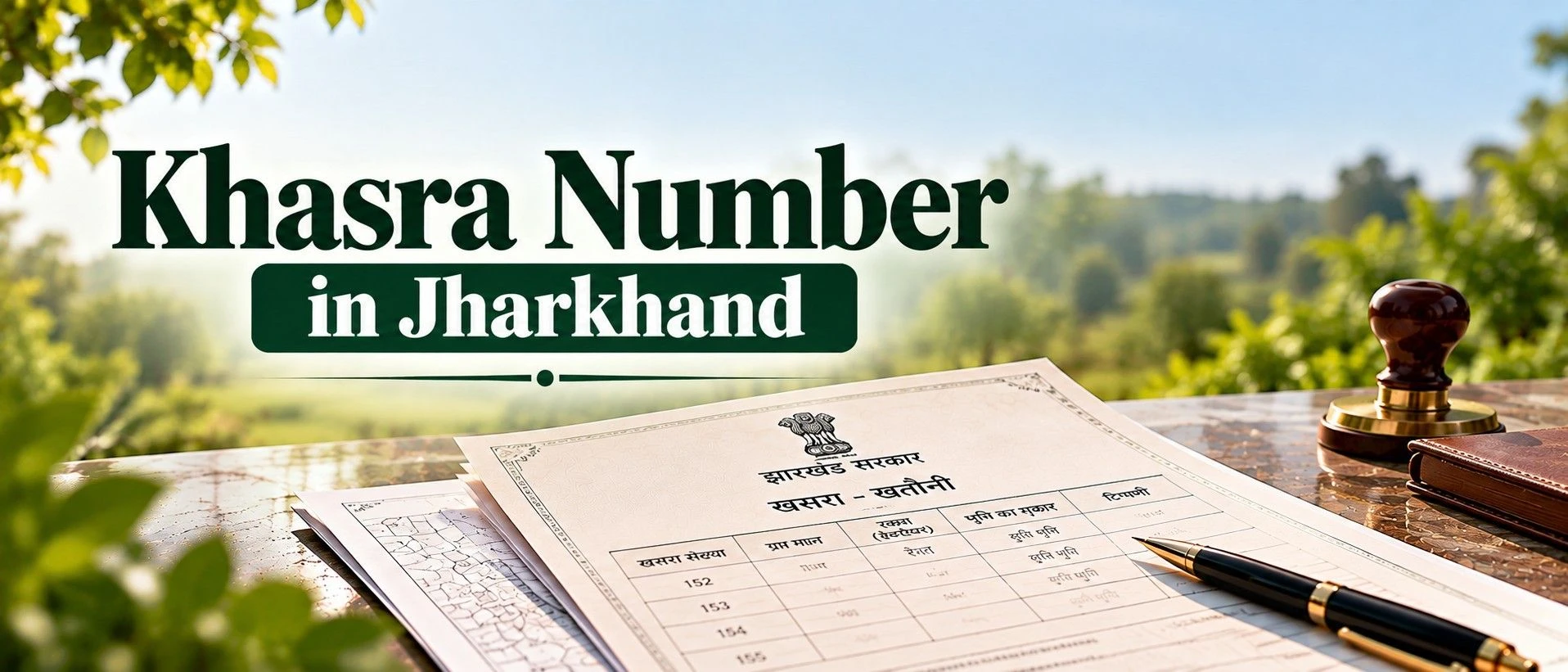
A Khasra number, locally spelled Khesra, is a unique identification number assigned to a single plot of land in Jharkhand's revenue records, distinguishing that exact parcel from every other plot in the same village. It exposes buyers to real risk when skipped — a mismatched or unverified Khasra number is one of the fastest ways to end up disputing boundaries or, worse, discovering the land is under CNT/SPT Act tribal-transfer restrictions after money has already changed hands. This guide covers how to search and verify a Khasra number online, what it reveals about a plot's classification, and why banks depend on it before approving any loan. Whether you're evaluating agricultural land for sale in Jharkhand, checking a plot before you buy farmland in Jharkhand, or preparing to sell land in Jharkhand, this is the number every land record traces back to.
Section 1 — What is a Khasra Number in Jharkhand?
Before checking a specific plot, it helps to see the surrounding land—you can browse the 2Bigha map for Jharkhand while you shortlist agricultural land in Jharkhand to verify.
Definition: A Khasra number is a unique survey-level identification number assigned to a single land parcel, used to locate that exact plot within Jharkhand's revenue and land record system.
It's easy to confuse with the Khata number, but the two work at different levels. A Khata number identifies a landholding account—one family or owner may hold several plots grouped under a single Khata. A Khasra number identifies one specific plot within that account. Both numbers appear together in the Khatiyan (the record of rights) and in Register-II, and a buyer needs the Khasra number specifically because it's the anchor that every other check—classification, mutation status, and encumbrance—is built around. Get the Khasra number wrong, and every subsequent check is effectively checking the wrong plot.
State-specific note: In Jharkhand, the Khasra record's land-type field can show whether a plot is classified as raiyati land under the Chota Nagpur Tenancy Act (CNT Act, 1908) or the Santhal Pargana Tenancy Act (SPT Act, 1949) — both of which impose serious restrictions on transferring tribal land to non-tribals. Never skip this field.
Expert Tip: If the Khasra record shows the land as Scheduled Tribe raiyati land, understand this isn't a minor procedural hurdle—non-tribal buyers generally have no legal route to acquire such land without prior Deputy Commissioner permission, and in many cases no route at all. Any agent or seller who tells you otherwise should be treated with serious caution, since this is one of the most consequential checks in any Jharkhand land purchase.
Section 2—How to Check a Khasra Number in Jharkhand?
You can search and view Khasra records online in minutes, or get a certified copy at the Circle Office. The same records are useful when preparing documents for land selling because buyers can use the Khasra number to cross-check the plot details provided by the seller.
Method | Cost | Time | Legally valid for registration? |
|---|---|---|---|
Online (view/download, unsigned) | Free | Instant | No — a portal printout isn't a certified document |
Online (via CSC-assisted certified request, where available) | Nominal, if any | Same day to a few days | Depends on the specific service used |
Offline (Circle Office/Anchal Karyalay) | Nominal fee, confirmed at the office | Same day | Yes, once issued as a certified copy |
Visit the Jharbhoomi portal. Go to jharbhoomi.jharkhand.gov.in and select "Check your Account" or the record-of-rights (Khatiyan) section.
Select the district, then the block. A digital map of Jharkhand's districts appears; click through to your specific block.
Choose your search method. Search by Mauja (village) name, Khesra number, Khata number, or account holder name.
Fill in the required details. Enter the specific field values for your search method.
View and download the record. The Khasra-wise record will show plot number, land type, area, khata number, and any mutation notes; download the PDF for reference.
Identify the correct Circle Office (Anchal Karyalay) for the block where the land is located, confirmed from the Jharbhoomi district list.
Carry plot details. Bring the mauja name, approximate location, and any existing document showing the khata or plot number, along with Aadhaar or PAN.
Request the Khasra-wise record and, in the same visit, the Register-II details for the same plot, since this shows the mutation history.
Confirm the exact form name and fee with the Circle Office at the time of your visit.
Offline processing is typically same-day. Before relying on the record, always download a fresh copy close to your transaction date, and check that the land-type field, area, and khata number all match what the seller has represented.
Section 3 — What Does a Khasra Record Contain?
The same discipline applies broadly — whether you're checking a Khasra record here or reviewing farm land for sale in Jharkhand listed elsewhere, always confirm the land-type classification before relying on possession or a seller's description alone. General property information is also available at 2Bigha if you want to cross-reference listings.
Field | What it means | What to check |
|---|---|---|
Khasra/Khesra number | The unique identifier for this specific plot | Must match the sale deed and Khatiyan exactly |
Khata number | The owner-level account this plot falls under | Confirm it matches the current or claimed owner |
Land type | Whether the plot is raiyati (and under CNT/SPT restrictions) or another classification | Critical to check before any tribal-land transaction |
Area | The recorded size of the plot | Should match the sale deed and any listing |
Mutation notes | Any recorded change in ownership | Confirm the current owner is reflected accurately |
Good sign: the Khasra number is consistent across the Khatiyan, Register-II, and sale deed; the land-type field is clearly stated and, where CNT/SPT restrictions apply, properly documented as compliant; and mutation notes reflect the actual current owner.
Section 4 — Common Issues & How to Fix Them
Most Khasra-related problems trace back to a mismatch between the record and the seller's claims, or to a missed CNT/SPT classification check. If anything looks unclear, verify it directly through the Khasra Number Jharkhand "official website" (jharbhoomi.jharkhand.gov.in) rather than relying on a photocopy.
Khasra number mismatch with the sale deed – The number quoted by the seller doesn't match the online record. Fix: get this clarified at the Circle Office before any payment.
Missed CNT/SPT tribal land restriction – Buyer overlooks that the land type is Scheduled Tribe raiyati. Fix: check this field specifically; non-tribal transfer generally requires prior Deputy Commissioner permission, and in some cases isn't legally possible at all.
Portal printout used for a bank loan – Banks generally require a certified copy, not a portal printout, for loan documentation. Fix: obtain a certified copy from the Circle Office for anything requiring formal proof.
Outdated online record – The digital record hasn't caught up with a recent mutation. Fix: cross-check with Register-II at the Circle Office for the most current mutation status.
Village not yet fully digitized – Some maujas have incomplete online coverage. Fix: visit the Circle Office directly rather than assuming the online absence of a record means no land exists.
Confusing Khata and Khasra numbers – Treating the account-level Khata as if it were the plot-specific Khasra. Fix: understand the distinction — a single Khata can cover multiple Khasra plots, and only the Khasra pinpoints the exact parcel.
Section 5 — Recent Changes in 2026
The Jharbhoomi portal now covers all 24 districts of Jharkhand as a single GIS-based system integrating cadastral mapping, ownership records, and revenue data, reducing the need for in-person Circle Office visits for routine record checks. No major standalone policy change specific to Khasra number allotment or the underlying CNT/SPT transfer restrictions has been confirmed as of August 2026 — those long-standing tribal land protections remain fully in effect, so continue treating land-type verification as essential for every transaction.
Section 6 — Why the Khasra Number Matters for Land Buyers
Anchors every other verification — classification, mutation, and encumbrance checks all reference this number.
Reveals whether CNT/SPT Act tribal-land restrictions apply, which can make a transfer legally impossible for non-tribal buyers.
Required by banks to verify land type, area, and encumbrance status before sanctioning any land or home loan.
A mismatch between the Khasra number and other documents is one of the clearest early warning signs of a problematic deal.
Confirms the plot's exact area and boundaries as recognized by the state's revenue records.
Needed as a reference point for mutation, Register-II checks, and future resale.
Section 7 — Khasra Number vs. Khatiyan
Khasra Number | Khatiyan | |
|---|---|---|
What it is | A unique identifier for one specific plot | The complete record of rights document for a landholding |
Issued by | Assigned during survey, recorded in Jharkhand's revenue system | Department of Revenue, Registration and Land Reforms |
Needed for | Pinpointing the exact plot in any record search | Confirming ownership details, land type, and rights comprehensively |
Think of the Khasra number as the address and the Khatiyan as the full file at that address — you need the number to find the right record, and the Khatiyan to understand what that record actually says.If you're selling land in Jharkhand, having your Khasra number, Khatiyan, and mutation status consistent and ready to show buyers considerably speeds up their due diligence. Buyers may also compare listings across different property websites, so keeping your land records and plot details accurate can make the selling process more transparent. You can list verified land directly through 2Bigha's sales page.
Section 8 — Related Documents
Khatiyan Jharkhand — the full record of rights tied to a Khasra number
Legal Heir Certificate Jharkhand — needed for inherited land before mutation
NA Order Jharkhand — converting agricultural land for non-agricultural use
CNT/SPT Act compliance check — verifying tribal-land transfer restrictions
Title Deed verification in Jharkhand — confirming legal ownership via JharNibandhan
