
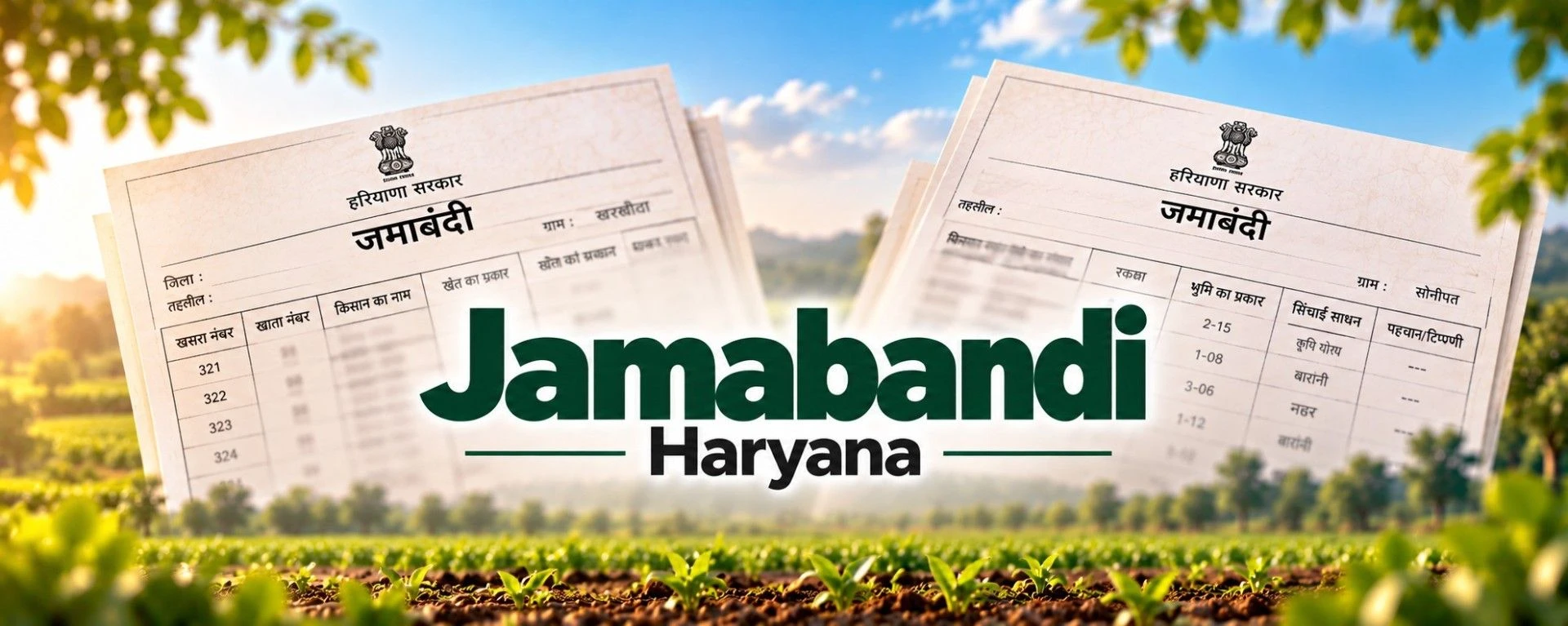
Jamabandi serves as the official Record of Rights in Haryana that contains details of each piece of land in the form of the owner's name, land size, category, and all the rights associated with each piece of land in Haryana, prepared by the Revenue Department every five years. It is important due to the fact that it is this one record that any bank, sub-registrar, and even a judge refer to first when there is a need to resolve a conflict or transaction, and according to the Punjab Land Revenue Act, 1887, which is still being used in the state for the collection of land revenues, all the entries in the record of rights enjoy a presumption of correctness. This guide describes the process of checking jamabandi nakal haryana records online, downloading the online fard haryana, viewing the jamabandi map haryana, and other aspects of verifying any copy you find. Whether you're buying agriculture land for sale in Haryana, settling a family plot, or just confirming your own land's status, this is the record everything else is built on.
Section 1 — What is Jamabandi in Haryana?
Definition: Jamabandi is the Record of Rights, which is prepared at regular intervals and relates to a piece of land. It includes information such as the name of the owner, area, and type of land, along with the rights over it. With online land selling becoming more common, checking Jamabandi records online can help buyers verify land ownership and other important property details before proceeding with a transaction.
The record isn't updated continuously. A Patwari prepares a fresh Jamabandi every five years, and a revenue officer attests it, with two copies made — one kept in the district record room and one with the Patwari. Between these five-year revisions, any change in ownership rides on top through separate mutation entries, locally called intkal haryana. This implies that the Jamabandi available for download will reflect the status of the property as of the last revision, along with all those mutations that have been approved after that. It is possible for those purchasing through just the basic Jamabandi without consulting the online mutation register to miss an important transaction.
Anybody assessing farm land in Haryana would do well to start off with the above system first, since only looking at one side of it can lead to serious gaps.
Haryana Specific Information: The digitalization of land in Haryana is done through the Haryana Automated Rural Information System (HARIS). Besides the simple Jamabandi, HARIS also gives Shajra Nasb, which is basically the tree of ownership.
Pro Tip: Don’t just verify your Jamabandi Haryana documents online through the Internet. Compare the name of the owner with the registration sale deed and Encumbrance Certificate before signing anything because you might have clean Jamabandi documents sitting above some pending loans or claims that can be found only through the Encumbrance Certificate.
Section 2 — How to Check Jamabandi in Haryana?
Jamabandi records can be checked instantly online or obtained as a certified copy through the Patwari's office. Here's how the options compare:
Method | Cost | Time | Legally valid for bank/legal use? |
Online view (jamabandi.nic.in) | Free | Instant | No, reference only |
Certified Fard (via Patwari/Tehsil) | Nominal fee | A few days | Yes |
Offline record room search (older records) | Prescribed fee | Longer, case-dependent | Yes |
Visit the Jamabandi portal. Go to jamabandi.nic.in and click on the Jamabandi tab in the navigation menu.
Select "Jamabandi Nakal for Checking." Choose this option from the dropdown menu on the homepage.
Enter search details. Search using Owner Name, Khewat Number, Khasra or Survey Number, or Date of Mutation.
Select your location. Choose the District, Tehsil or Sub-Tehsil, and Village from the available options.
View and download. The Jamabandi details appear on screen, and you can print or download the document for reference.
Visit the Patwari or Tehsil office. Go to the office covering the village where the land is located.
Request the certified Fard. Provide the Khewat or Khasra number, or the owner's name, and file a request for a certified copy.
Pay the applicable fee. Clear the nominal charges for the certified copy.
Collect the stamped Fard. This certified, Patwari- or Tehsildar-stamped copy is what banks and courts will actually accept.
As of the middle of 2026, GIS maps for Haryana jamabandi map visualization have been included in the urban searches through the portal, allowing the buyer to get a better picture of the Haryana jamabandi map besides the document itself. Before considering the use of any downloaded document, ensure that all the information in the Jamabandi, the registered document, and the mutation record agrees with one another.
Section 3 — What Does a Jamabandi Record Contain?
A complete Jamabandi entry lists several fields describing the land and its ownership.
Field | What it means | What to check |
Khewat Number | Ownership record number | Must match the sale deed and other documents |
Khatoni Number | Cultivator or tenancy details for the land | Confirms who's recorded as working the land, if different from the owner |
Khasra Number | Unique identifier for the specific plot | Should match across every document you hold |
Owner Name | The recorded Bhumiswami | Should match the ID proof and the registered deed |
Land Area and Type | Size and classification of the parcel | Confirms suitability for the intended use |
Rights and Remarks | Tenancy rights, dues, or mutation notes | Any pending remark should be resolved before relying on the record |
Positive sign: If the Jamabandi is clean, with consistent names of the owner in all records, no mutation entries, and the area of land mentioned therein matches the sale deed and reality on the ground.
Section 4 — Common Issues & How to Fix Them
Jamabandi shows an owner who sold the land years ago – Since the base record only updates every five years, a completed but unrecorded mutation can leave the old name showing. Fix: Always check the live mutation register on jamabandi.nic. Alongside the base Jamabandi, not instead of it.
Free online copy used for a bank loan application – Lenders typically reject the plain online view for final disbursement. Fix: request the certified Fard, stamped by the Patwari or Tehsildar, well before your loan processing deadline.
Inconsistency in the Khasra number – It may happen due to typographical errors while transcribing the numbers from Jamabandi to the sale deed. Solution: The problem should be sorted out from its root cause, i.e., by checking with the Patwari.
Confusion between Khewat and Khatoni numbers – Buyers sometimes search using the wrong reference entirely. Fix: Remember Khewat identifies ownership records, while Khatoni relates more to cultivation and tenancy details on the same land.
Portal downtime during urgent searches – The Jamabandi site does experience both scheduled and occasional unscheduled downtime. Fix: download and save any needed record well ahead of a loan or registration deadline, rather than waiting until the last moment.
Boundary or map mismatch with the textual record – The Jamabandi map doesn't always match on-ground reality without a proper survey check. Fix: Use the integrated GIS map view alongside a physical site visit before relying solely on the paper record.
Section 5 — Recent Changes in 2026
As of August 2026, the Jamabandi portal has integrated GIS maps for urban boundary visualisation, rolled out mid-year, and the state continues expanding Bhu-Aadhaar (ULPIN) coverage under the central DILRMP scheme. The portal's May 2026 integration with the Integrated Grievance Redressal System has also helped speed up related mutation updates.
Section 6 — Why Jamabandi Matters for Land Buyers?
Serves as the legal starting point that any bank, court, or sub-registrar checks first during a dispute or transaction
Confirms the current recorded owner before any advance payment is made
Reveals land classification and area details essential for agricultural loan or subsidy applications
Helps buyers of agriculture land for sale in Haryana cross-check the seller's claims against official records
Supports smoother due diligence when reviewing farmland in Haryana with an unclear ownership history
Builds buyer confidence during land selling, since a clean, verifiable Jamabandi reassures serious purchasers
Section 7 — Jamabandi vs. Fard
These two terms are often used interchangeably, though there's a practical distinction worth knowing.
Aspect | Jamabandi (Online View) | Fard (Certified Copy) |
What it is | The digital reference copy from the portal | The physical, stamped, certified copy |
Issued by | Available directly via jamabandi.nic.in | Patwari or Tehsildar office |
Legal standing | Reference only | Accepted for legal and bank purposes |
Best used | Quick preliminary checks | Final registration, loans, or court matters |
The online Jamabandi gives you a fast first look. The certified Fard is what you'll actually need for anything formal. Serious buyers exploring options through land selling platform should plan for both — a quick online check first, followed by the certified copy once a deal is close to final.
Section 8 — Related Documents
Intkal Mutation guide for tracking ownership changes between Jamabandi revisions
Property Document Checklist guide for complete pre-purchase verification
Encumbrance Certificate guide for checking claims against the property
Land Registration guide for completing a legally valid transfer
Legal Heir Certificate guide for inherited agricultural land
