
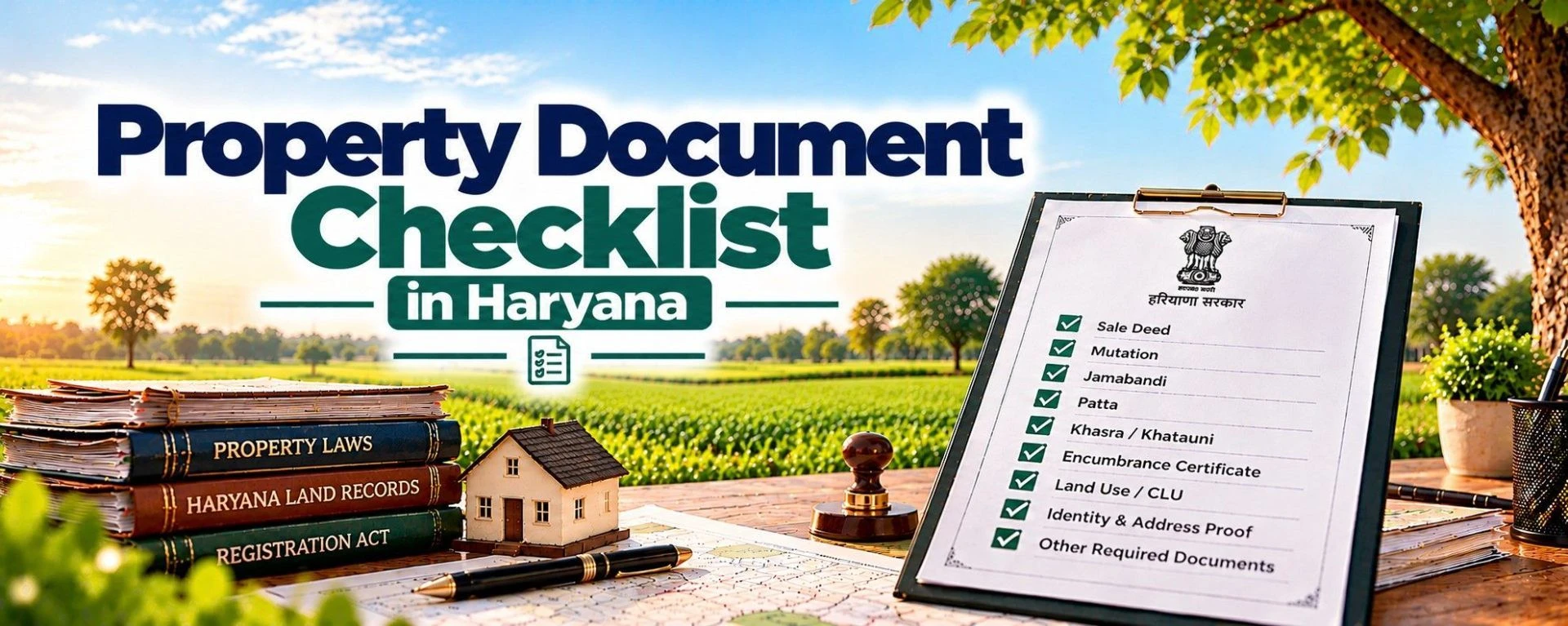
A property document checklist is simply the list of papers you need in hand — and need to check — before you pay for land in Haryana. It exists because land disputes rarely start with the price; they start with a missing signature, an unclear title, or an old mutation that was never updated. In Haryana specifically, this matters more than most states because a large share of the land under sale is agricultural, and agricultural land carries its own record layer — Jamabandi, Fard, khasra, khatauni — that residential buyers rarely deal with. This guide walks through every document a buyer, lender, or heir is likely to be asked for, how to get each one online or offline, and how to read them once you have them. Whether you're looking to buy and sell land, buying agricultural land, applying for a crop loan, or settling an inheritance, this is the record set you'll be asked for at some point.
Section 1 — What is Property Document Checklist in Haryana?
If you're actively comparing plots before you start collecting paperwork, it helps to first shortlist the land itself — you can browse agriculture land for sale in Haryana on 2Bigha's interactive map and narrow down a village or district before you start requesting records for a specific parcel.
Definition: A property document checklist for Haryana is the combined set of ownership, revenue, and registration papers — Jamabandi/Fard, mutation extract, sale deed, encumbrance certificate, and tax receipts — that together prove who owns a piece of land, how it's classified, and whether it's free of pending claims.
No single paper tells the whole story. The Jamabandi tells you who currently holds the land and in what share. The mutation record tells you whether the last transfer was actually updated in government books, which is a step people skip more often than they should. The sale deed is the legal instrument of the transaction itself, registered at the Sub-Registrar's office, and it's what a bank or a court will ask for first. Buyers often confuse the Jamabandi with the sale deed — the Jamabandi is a snapshot of current ownership as recorded by the revenue department, while the sale deed is the actual contract that created that ownership. A buyer needs the full set, not just one document, because each one closes a different gap: one confirms ownership, another confirms the transfer was recorded, and a third confirms there's no bank loan or court case sitting against the land.
State-specific note: In Haryana, always check the Fard alongside the Jamabandi. The Fard is a certified extract of the same record and is often what banks specifically ask for when processing a loan against agricultural land.
Expert Tip: Don't stop at checking the current owner's name — check the last three mutation entries (Intkal) on the Jamabandi. If a mutation is pending or was rejected and never resubmitted, the land can technically still be under dispute even if the current owner's name looks correct on paper.
Section 2 — How to Get Property Document Checklist in Haryana?
You can pull most of these records online in minutes, but a few — like the digitally signed Fard used for registration — still need a short office visit or a paid download.
Method | Cost | Time | Legally valid for registration? |
Online (unsigned view) | Free | Instant | No — reference only |
Online (digitally signed) | ₹15–₹50 approx. | Instant to same-day | Yes |
Offline (Talathi/Tehsildar office) | ₹30–₹100 approx. | 1–7 working days | Yes |
Visit the portal — Go to jamabandi.nic.in, the official Haryana land records website.
Select Jamabandi Nakal — Choose district, tehsil, village, and the relevant year from the dropdowns.
Search by khasra or owner name — Enter the khasra/khatauni number, or search by the owner's name if you don't have the number.
Review the record — Check owner name, khasra details, land classification, and any mutation remarks shown on screen.
Download or request the signed copy — Use the "Nakal" option to get a digitally signed version if you need it for a bank or registration purpose.
Visit the Tehsildar or Patwari office — Go to the office covering the village where the land is located.
Submit an application — Fill a simple request form with the khasra number or seller's name and pay the prescribed fee.
Collect the acknowledgment slip — This slip has a reference number you can use to track the request.
Return to collect the certified copy — Most offices issue it within a week.
This offline route usually takes anywhere from same-day to seven working days depending on the tehsil's workload. Before you collect the document, check that the khasra number, owner name, and area on the printed copy match exactly what you were told verbally — small transcription errors at the counter are common and easy to catch on the spot.
Section 3 — What Does Property Document Checklist Contain?
Each document in the set carries a different piece of the puzzle, and this is exactly the kind of property document verification a buyer should do line by line rather than skim.
Field | What it means | What to check |
Owner name(s) | Who is recorded as the current titleholder? | Matches the seller's ID exactly, including spelling |
Khasra/Khatauni number | The unique plot identifier in revenue records | Matches the number quoted in the sale conversation |
Land classification | Whether it's agricultural, non-agricultural, or CLU-approved | Matches how the seller is describing the land |
Mutation (Intkal) status | Whether the last ownership change was formally recorded | No "pending" or "rejected" status against recent entries |
Encumbrance status | Any loan, mortgage, or court attachment on the land | No active loan or litigation flag |
Area | Total land area in the local unit (bigha, kanal, marla) | Matches the area being sold, not a larger or smaller parcel |
Good sign: A clean record shows a single, uncontested owner name matching the seller's ID, a khasra number that matches what was quoted, no pending mutation entries, and no encumbrance remarks. If all of this lines up, the paperwork side of the deal is in reasonably good shape.
Section 4 — Common Issues & How to Fix Them?
Name mismatch – The name on the Jamabandi doesn't exactly match the seller's ID, often due to spelling variations or an unupdated maiden name. Fix: Ask for an affidavit linking both names, or get the record corrected at the Tehsildar office before proceeding.
Pending mutation – The last sale or inheritance was never formally mutated in revenue records. Fix: Insist the mutation is completed before you pay the full amount; a pending mutation means the seller's own title isn't fully settled.
Multiple co-owners – The land is jointly held and not everyone has agreed to sell. Fix: Get written consent (or a registered power of attorney) from every listed co-owner before registration.
Old or missing khasra number – The record uses an outdated numbering system after a re-survey. Fix: Ask the Patwari for the current khasra-to-old-number mapping so you can confirm it's the same plot.
Encumbrance not visible online – Some older loans or court orders aren't reflected on the digital portal yet. Fix: Request a manual encumbrance search at the Sub-Registrar's office as a backup check.
Digitally signed copy delayed – The online portal shows the record but the signed version isn't generating. Fix: Visit the tehsil office directly and request manual issuance, quoting the online reference number.
Section 5 — Recent Changes in 2026
No major changes have been reported as of August 2026.
Section 6 — Why Property Document Checklist Matters for Land Buyers?
It confirms the seller actually has the legal right to sell the land, not just possession of it.
It protects you from buying land that already has a bank loan or court case attached.
It's the paperwork a bank will demand before approving any loan against the property.
It prevents inheritance disputes later, since a clean mutation trail shows exactly how ownership passed down.
It's required at the Sub-Registrar's office for the sale deed to be registered at all.
It gives you leverage to negotiate price or walk away if something doesn't check out.
Section 7 — Property Document Checklist vs. Sale Deed
People often think the checklist and the sale deed are the same thing — they're not.
Property Document Checklist | Sale Deed | |
What it is | The full set of records used to verify ownership and status | The single legal contract that transfers ownership |
When it's used | Before and during due diligence | At the moment of registration |
Issued by | Revenue Department (multiple documents) | Sub-Registrar's office |
The checklist is what you use to decide whether to buy; the sale deed and Haryana registration are what actually make you the owner once you've decided to go ahead. If you're on the other side of the table and thinking about selling property online, having this full checklist ready upfront — rather than scrambling for it after a buyer asks — tends to move the deal along noticeably faster.
Section 8 — Related Documents
Haryana Jamabandi Guide: Check Land Records Online
Haryana Bhu Naksha: View Land Map Online
Agricultural Land Conversion in Haryana (CLU Guide)
Mutation (Intkal) Process in Haryana
Encumbrance Certificate Guide for Haryana
