
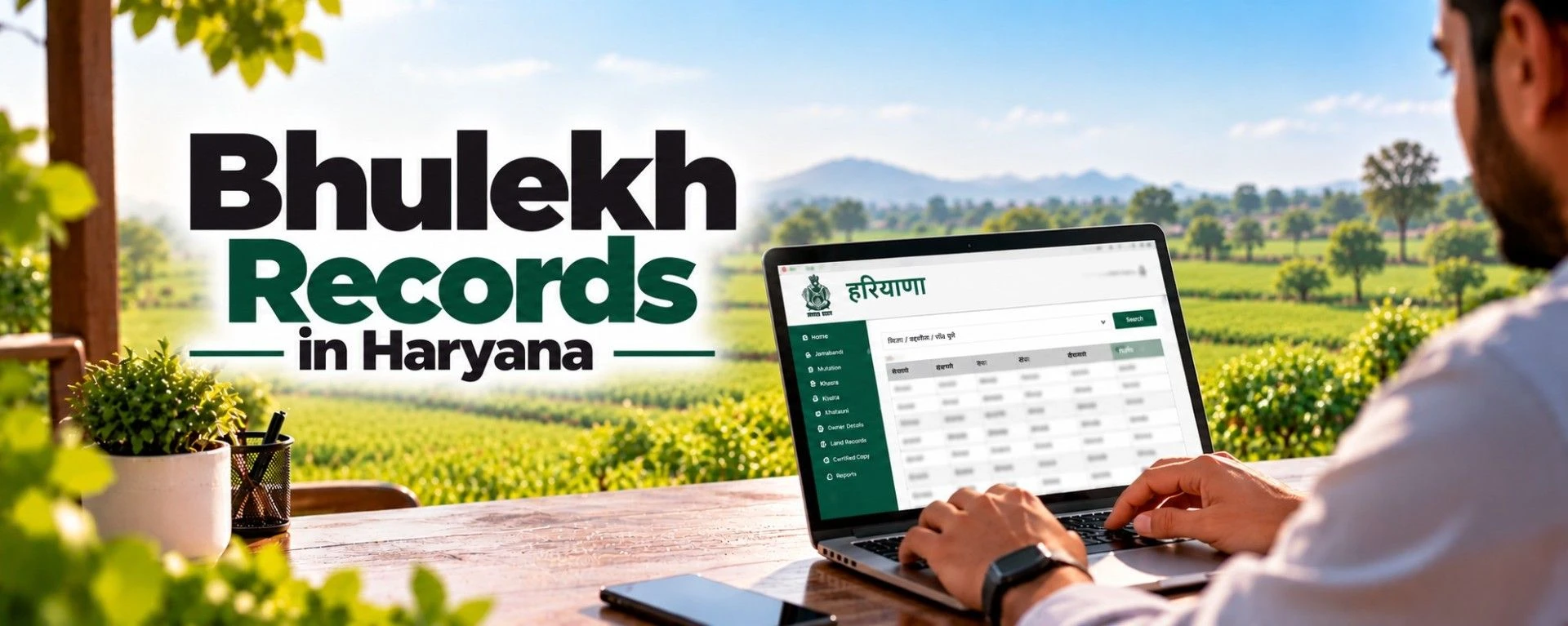
Bhulekh, a term used broadly across India for digital land records, refers in Haryana to the combined system of Jamabandi, mutation, and cadastral map data maintained by the Revenue Department. It matters because it's the single place where a buyer, lender, or heir can confirm who owns a piece of land, what it's classified as, and whether any transfer is pending. This guide explains how to check haryana land records online, what the system covers, and how to read the results correctly. Whether you're verifying a plot before purchase, applying for a loan, or settling a family matter, this is the digital record system you'll rely on first.
Section 1 — What is Bhulekh in Haryana?
Before diving into records, it helps to see the plots themselves — browse agriculture land for sale in Haryana on the 2Bigha map to shortlist properties before running a formal land-record check on any specific one.
Definition: Bhulekh in Haryana refers to the state's digitised land record ecosystem — combining Jamabandi (ownership record), mutation history, and cadastral mapping — accessible through the jamabandi.nic.in portal, also known as WEB-HALRIS.
While many states use "Bhulekh" as the official portal name, Haryana instead calls its system Jamabandi/HALRIS, but the underlying purpose is identical: a digital, searchable version of the physical land registers once kept only with the Patwari. A buyer needs to check these records specifically because they show real-time ownership status, recent mutations, and land classification — details that a broker's verbal claim or an old paper copy simply can't guarantee are current.
State-specific note: In Haryana, land record data is now also integrated with schemes like Meri Fasal Mera Byora, so the Jamabandi portal can reflect farming-related registrations alongside standard ownership data for agricultural plots.
Expert Tip: Always select the most recent Jamabandi year available for the village rather than an older cached one — Haryana's records update every four years through settlement, and choosing an outdated year can show ownership details that no longer match the current position.
Section 2 — How to Check Bhulekh Records in Haryana?
Method | Cost | Time | Legally valid for registration? |
Online (unsigned view copy) | Free | Instant | For reference/verification only |
Online (digitally signed copy) | Nominal fee | Instant to same day | Yes, full legal standing |
Offline (Patwari/Tehsildar office) | Nominal fee | Same day to a few days | Yes |
Visit jamabandi.nic.in — This is the only official portal for Haryana land records; no login is required for basic viewing.
Select district, tehsil, and village — Narrow your search down to the exact location of the land.
Choose your search method — Search by owner name, khewat number, khasra/survey number, or date of mutation.
Select the Jamabandi year — Pick the most recent available year to see current ownership status.
View and download the record — The Jamabandi Nakal appears on screen; download the PDF, and request a digitally signed copy if needed for formal use.
Visit the Patwari or Tehsildar office — Go to the office covering the relevant village.
Provide land details — Share the khewat/khasra number or owner's name for the record search.
Request a certified copy — Ask specifically for a stamped, certified Jamabandi Nakal.
Pay the fee and collect — Once processed, collect the physical certified copy from the office.
Offline requests are usually completed the same day if the record is readily available, or within a few days for older or physically archived entries. Before relying on the copy, check the Jamabandi year, khasra number, and owner name for accuracy, and confirm no pending mutation is missing from the record.
Section 3 — What Does the Bhulekh Record Contain?
A typical haryana land record online entry is structured and consistent across villages, which makes it easy to check systematically.
Field | What it means | What to check |
Owner's name and khewat number | Current recorded owner of the land | Matches the seller's ID and claimed ownership |
Khasra number and area | Specific plot identifier and its size | Consistent with the Shajra map and sale documents |
Land classification | Agricultural, non-agricultural, or other category | Matches your intended use of the land |
Mutation history | Record of ownership transfers over time | No unexplained gaps or pending mutations |
Good sign: A trouble-free Bhulekh/Jamabandi record shows the current owner's name matching all other documents, a clean mutation history with no pending or contested entries, and a land classification that aligns with what the seller or broker has described.
Section 4 — Common Issues & How to Fix Them?
Record shows an old owner's name – Recent sale hasn't been mutated yet – Fix: Check the mutation (Intkal) status separately and confirm with the Tehsildar's office on processing timelines.
Portal running slowly or unavailable – High traffic or scheduled maintenance – Fix: Try during off-peak hours, typically early morning, or check back later in the day.
Village or khasra number not found – Data entry error or incomplete digitisation – Fix: Double-check spelling and numbers, or visit the local Patwari office to confirm the correct details.
Digitally signed copy request delayed – High request volume or verification backlog – Fix: Follow up using your request reference number through the portal's tracking option.
Discrepancy between online record and physical document – Data sync issue between systems – Fix: Request a certified physical copy from the Tehsil office to resolve the discrepancy definitively.
Land classification unclear or outdated – Record hasn't been updated after a CLU approval – Fix: Cross-check with the DTCP portal (tcpharyana.gov.in) for the current, approved land-use status.
Section 5 — Recent Changes in 2026
Haryana's WEB-HALRIS system has continued integrating land record data with allied schemes like Meri Fasal Mera Byora, improving the accuracy of agricultural land classification shown alongside ownership details. No major structural changes have been reported as of August 2026 beyond this ongoing data integration.
Section 6 — Why Bhulekh Records Matter for Land Buyers?
Confirms real-time, current ownership before you commit to a purchase
Reveals mutation history that shows how the land has changed hands over time
Helps identify pending disputes or transfers before they become your problem
Supports loan applications where lenders require verified ownership records
Cross-checks against the Shajra map to confirm boundaries match written records
Saves time compared to relying solely on physical document verification at the Tehsil office
Section 7 — Bhulekh (Jamabandi) vs. Mutation Records
Aspect | Bhulekh / Jamabandi | Mutation (Intkal) Records |
What it shows | Current, consolidated ownership and land details | The specific transaction history of ownership changes |
Update frequency | Full settlement every 4 years, with in-between mutation updates | Updated each time a transfer is registered |
Main use | Snapshot of current status | Tracing how and when ownership changed |
Checking both together gives a fuller picture: the Jamabandi shows where things stand today, while the mutation history explains how the land got there. Before you commit to agriculture land for sale in Haryana, review both, and only proceed toward listing on a land buying website once your own records are fully consistent.
Section 8 — Related Documents
Mutation process in Haryana
Shajra Map Haryana — cadastral boundary records
Title Deed Haryana
How to Register Land in Haryana
Land Conversion (CLU) rules in Haryana
