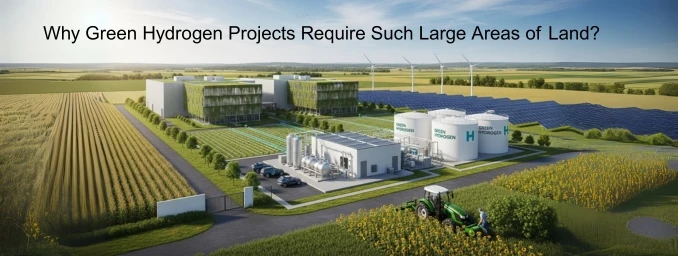
With the global transition towards clean energy, green hydrogen is rapidly becoming one of the most promising fuels of the future. All over the world, including in India, companies are heavily investing in this sector to reduce carbon emissions and achieve energy independence. However, a question that frequently comes to mind is: Why do green hydrogen projects require such large land banks?
These projects work best when scaled up, with the proper infrastructure in place and a strong support ecosystem created. Green hydrogen manufacturing differs from conventional fuel plants, depending on renewable sources of energy such as solar and wind power, along with large-scale electrolysis plants. All this requires enormous, well-connected land banks.
In this blog, we’ll explore why lands are required for green hydrogen projects, what kind of properties are needed, and how investors can benefit by planning to buy commercial land or invest in strategic land properties.
Understanding Green Hydrogen and Its Land Needs
Green hydrogen is produced by splitting water into hydrogen and oxygen using renewable energy. To make it viable at a commercial level, businesses require:
- Solar and wind farms produce electricity.
- Electrolyzers produce hydrogen.
- Facilities for storage and distribution.
All these elements demand land, not a small piece, but big and well-situated land banks that can support scalability and connectivity.
For instance, a single solar park may take thousands of acres. Coupled with industrial-sized hydrogen factories, the demand for commercial land properties goes into multiple folds.
Why Huge Land Banks Are A Must?
The following are the primary reasons why large land blocks are a must:
- Room for Renewable Power Generation: Hydrogen is no greener than the energy source that is powering it. To reach carbon neutrality, projects incorporate solar panels, wind turbines, or hybrid systems. This demands large land banks that receive consistent sunlight or strong wind flow.
- Industrial-Scale Infrastructure: Electrolyzers, pipelines, storage tanks, and refueling stations require structured commercial land planning. In contrast to small plants, hydrogen projects are medium-heavy industry and are expected to develop over the long term.
- Safety and Buffer Zones: Hydrogen, although clean, has stringent safety measures. Large land holdings provide buffer space between storage tanks, facilities, and surrounding populations.
- Expansion in the Future: Energy ventures are dynamic. By acquiring land banks, businesses can simply expand operations when hydrogen demand increases, without the inconvenience of needing to relocate or broker fragmented land transactions.
Location is Important: Where to Construct Green Hydrogen Ventures
The location and size are equally crucial. Good land banks should:
- Be located within renewable energy areas (such as solar or wind corridors).
- Be near water sources, as electrolysis requires a significant amount of water.
- Be situated near industrial centers and transportation networks for ease of distribution.
- Be within areas with favorable government policies for renewable energy.
In India, explore the aaknd Gujarat, Rajasthan, and Tamil Nadu are becoming leaders in hosting such projects. Investors looking to purchase land in these states can expect early potential for long-term appreciation.
India's Green Hydrogen Mission: The Role of Land Banks
India aims big to make India a global green hydrogen hub. As per the National Hydrogen Mission, India will require:
- Gigawatt-scale renewable power plants.
- Big electrolysis equipment.
- Special hydrogen corridors.
This implies land banks are not mere real estate—they are strategic assets that power the entire clean energy revolution. Government agencies and private sector companies are already finding huge expanses of commercial land properties to establish integrated green hydrogen clusters and opportunities to sell land.
Investment Angle: Why Land Owners Win
For landowners and investors, this trend heralds a new chapter. Here's why:
- Long-term Leases: Green hydrogen companies like to lease large land banks for decades, offering consistent rental returns.
- Appreciation: Land around renewable corridors is experiencing an increase in land appreciation, and it is a good idea to acquire land early.
- Diversification: Commercial land properties related to energy and sustainability to guarantee investment-proofing in the future.
- Partnerships: Landowners tend to partner with developers for joint ventures, and land is assigned a larger role than being a passive asset.
Difficulty in Procuring Large Land Blocks
Though the need is enormous, procuring large contiguous blocks of land is not straightforward. Main issues are:
- Fragmentation: Land is fragmented in most areas into small parcels held by various stakeholders.
- Gaps in infrastructure: Even when available, the absence of roads, water, or grid connection can restrict use.
- Policy obstacles: Unambiguous zoning and industrial categorisation are prerequisites before buying commercial land for such initiatives.
This is where expert real estate sites step in, serving to spot strategic land buildings and streamline the land acquisition process.
The Way Forward for Green Hydrogen and Land Banks
In the future, the intersection between green hydrogen and real estate will only get stronger. Energy players will aggressively battle for land banks with high-value locations, as IT parks transformed real estate two decades ago.
- For businesses and people, this is the time to seek opportunities:
- Look into areas where renewable energy projects are in the pipeline.
- Inspect business land buying options around future industrial corridors.
- Buy land early to profit from long-term appreciation.
Simply put, the future of clean energy will be constructed on the platform of land properties, making land banks one of the most coveted assets in the next few decades.
Conclusion
Green hydrogen is not merely technology, it's land. Without huge strategically positioned land banks, the vision of a green hydrogen economy can never be achieved. From sun farms to hydrogen storage, all segments of the value chain rely on grabbing big pieces of land.
To governments, developers, and investors, the message is simple: acquire land, acquire commercial land, and create solid land portfolios now to fuel tomorrow's green revolution.
And as the clean energy industry keeps expanding, the people who recognize the value of land properties will be the ones in possession of the key to the future.
2Bigha is one of the trusted land marketplaces that connects a wide range of land properties according to requirement. Browse an extensive database of land listings and explore detailed information on each farmland, such as water availability and scenic views to road access, and more. With a focus on reliability, transparency, and sustainable practices, 2Bigha makes finding the right land simpler, smarter, and more secure.