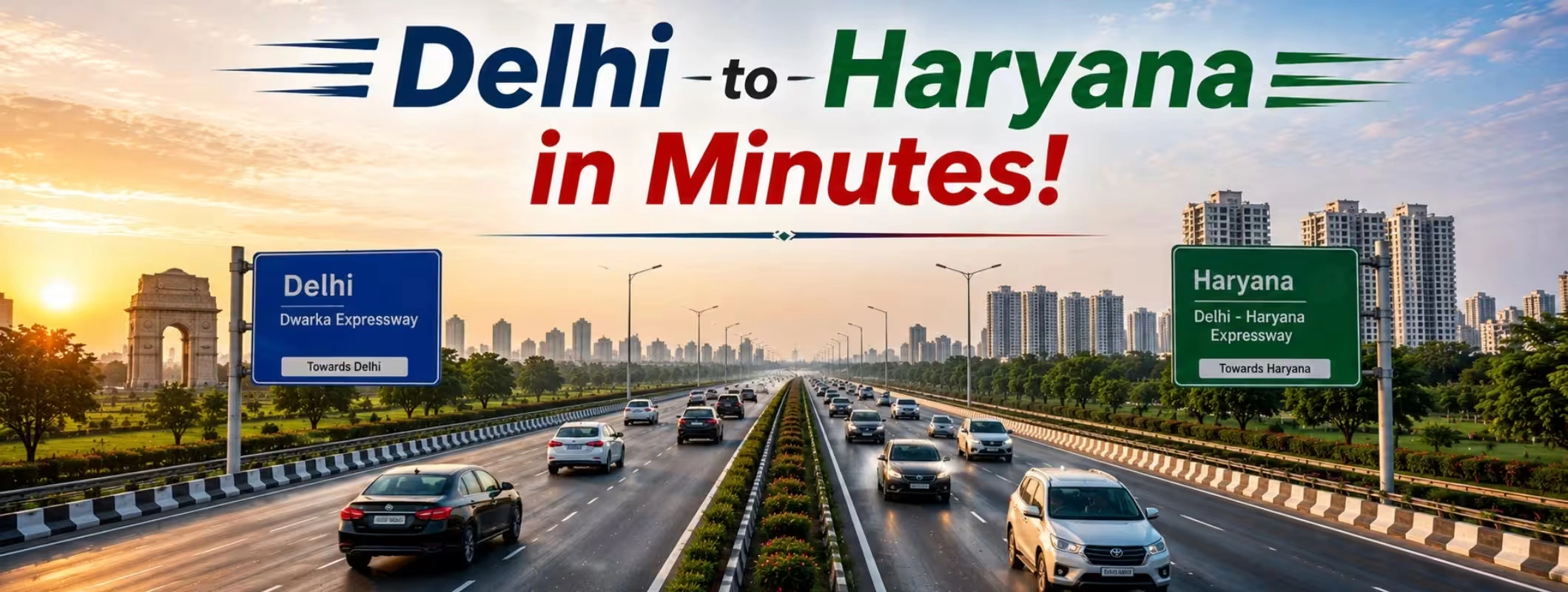
Delhi-NCR is moving towards a two-layer public transport network in which Metro trains will handle frequent local journeys while Namo Bharat trains will cover longer regional distances at much higher speeds. Sonipat, Panipat, Manesar and Palwal sit on some of the most important proposed transport corridors connecting Delhi with Haryana. These connectivity upgrades are also expected to influence land investment in Delhi-NCR and surrounding growth corridors by improving accessibility and reducing travel times.
However, commuters and property buyers need to understand one important point: these cities are not receiving operational Metro and Namo Bharat services immediately or at the same stage.
The approved Red Line extension will take Delhi Metro to Nathupur near Kundli, on the Sonipat border. The Delhi–Panipat–Karnal Namo Bharat corridor has received significant state-level approval and entered pre-construction activity. Manesar is planned on the Delhi–Gurugram–SNB Namo Bharat route, while its direct Metro connection remains a future expansion proposal. Palwal appears in both long-term Metro and Namo Bharat planning, but neither corridor is currently operational there.
Therefore, Metro and Namo Bharat trains co-existence should be understood as an integrated transport strategy rather than a claim that both services will start simultaneously across every Haryana city. For investors evaluating land investment in Delhi and nearby NCR regions, these proposed transport corridors may play a significant role in shaping future growth and development patterns.
Key Takeaways
- Delhi-NCR is planning a combination of local Metro services and high-speed regional Namo Bharat trains.
- The approved Rithala–Narela–Nathupur corridor will extend Delhi Metro’s Red Line to the Kundli area near Sonipat.
- The Delhi Panipat Namo Bharat latest update includes Haryana Cabinet approval, surveying, road preparation and utility-shifting activity.
- The Delhi–Panipat–Karnal corridor is planned to cover approximately 136 kilometres and connect Delhi with Sonipat, Gannaur, Samalkha, Panipat and Karnal.
- Manesar is expected to receive regional connectivity through the Delhi–Gurugram–SNB Namo Bharat corridor.
- The Metro corridor currently under construction in Gurugram connects Millennium City Centre with Cyber City; it does not yet extend to central Manesar.
- The proposed Delhi–Faridabad–Ballabhgarh–Palwal Namo Bharat corridor remains a future-phase project.
- “Delhi to these cities in minutes” describes the long-term mobility ambition, not a currently available journey.
- Property near Namo Bharat corridor stations may attract stronger demand, but official station locations, land-use rules and project approvals must be verified before investing.
- Transport announcements can influence asking prices before construction begins, so buyers should avoid paying speculative premiums based only on proposed routes.
Delhi Metro and Namo Bharat Projects at a Glance
| Feature | Delhi Metro | Namo Bharat |
| Primary role | Urban and suburban travel | Regional travel between major NCR cities |
| Typical station spacing | Shorter | Wider |
| Number of stops | More frequent | Limited regional stops |
| Maximum operating speed | Generally up to around 80 kmph | Up to 160 kmph |
| Best suited for | Daily local movement within a city | Medium- and long-distance NCR commuting |
| Passenger movement | High turnover over short distances | Longer journeys with more seating |
| Network function | Local distribution | Regional transport backbone |
| Example | Rithala to Narela and Kundli | Delhi to Sonipat, Panipat and Karnal |
What Does “Metro and Namo Bharat Trains Will Co-Exist” Actually Mean?
The phrase does not necessarily mean that Metro and Namo Bharat trains will always use the same railway tracks.
There are three possible models of Metro and RRTS connectivity.
1. Shared Infrastructure
Meerut provides the clearest working example. Local Meerut Metro services and regional Namo Bharat trains use common infrastructure between Meerut South and Modipuram.
Namo Bharat trains stop at selected regional stations and serve passengers travelling longer distances. Metro trains stop more frequently and serve local neighbourhoods within Meerut.
This is the most literal form of co-existence.
2. Parallel Transport Corridors
On other routes, Metro and Namo Bharat may run broadly along the same urban or economic corridor but use separate tracks, stations and operating systems.
For example, the Red Line extension will connect Delhi with Narela, Kundli and Nathupur, while the Delhi–Panipat–Karnal Namo Bharat corridor will serve longer-distance travel through the wider Sonipat and Panipat belt.
A passenger travelling from an outer residential area may use a local Metro or feeder service to reach a Namo Bharat station and then continue towards Delhi.
3. Connected Interchange Stations
The third model involves separate networks joined through walkways, foot overbridges, common concourses, buses, parking areas or short feeder connections.
A well-designed Namo Bharat Metro interchange can reduce the time and physical effort required to change trains. This matters because a fast regional train loses much of its advantage when passengers must spend another 30 minutes reaching the station.
The success of the proposed network will therefore depend on station access, bus connectivity, pedestrian routes, parking and feeder services—not merely train speed.
Metro and Namo Bharat: What Is the Difference?
Although both systems use modern electric trains, they serve different travel needs.
| Feature | Delhi Metro | Namo Bharat |
| Primary role | Urban and suburban travel | Regional travel between major NCR cities |
| Typical station spacing | Shorter | Wider |
| Number of stops | More frequent | Limited regional stops |
| Maximum operating speed | Generally up to around 80 kmph | Up to 160 kmph |
| Best suited for | Daily local movement within a city | Medium- and long-distance NCR commuting |
| Passenger movement | High turnover over short distances | Longer journeys with more seating |
| Network function | Local distribution | Regional transport backbone |
| Example | Rithala to Narela and Kundli | Delhi to Sonipat, Panipat and Karnal |
Metro provides accessibility. Namo Bharat provides speed.
Together, they can create a network in which a commuter travels from a neighbourhood to the nearest interchange by Metro and covers the longer regional distance by Namo Bharat.
Also Read: Delhi–Meerut Expressway: Route, Phases & NCR Impact
Delhi to Sonipat: Metro and Namo Bharat Connectivity
The northern Delhi–Sonipat belt is currently the clearest example of dual transport planning.
Rithala–Narela–Nathupur Metro Extension
The Union Cabinet approved a 26.463-kilometre extension of Delhi Metro’s Red Line from Rithala to Narela and Nathupur near Kundli. The elevated corridor is planned with 21 stations and an approved completion cost of ₹6,230 crore.
Its proposed stations include areas such as:
- Rohini
- Barwala
- Bawana Industrial Area
- Sanoth
- Bhorgarh
- Narela
- Kundli
- Nathupur
The project will provide direct Metro access to north-west Delhi and the Haryana border. It will also extend the Red Line corridor that already connects Rithala with Ghaziabad through central and eastern Delhi.
The phrase Delhi Sonipat Metro latest news is frequently used in property advertisements, but buyers should read it carefully. The approved line reaches Nathupur and Kundli near the Sonipat border; it does not currently represent an approved Metro line running through the entire Sonipat city.
Delhi–Panipat–Karnal Namo Bharat Through Sonipat
Sonipat will also benefit from the planned regional corridor connecting Delhi with Panipat and Karnal.
The proposed route starts from Sarai Kale Khan and travels north towards the Sonipat belt before continuing through locations such as Gannaur, Samalkha, Panipat and Karnal.
The regional route is expected to serve major educational, industrial and residential clusters near Kundli, Rai, Murthal and the wider Sonipat region.
This creates two layers of connectivity:
- Metro for local access around Narela, Kundli and nearby areas
- Namo Bharat for faster travel between Delhi, Sonipat, Panipat and Karnal
People searching for the Delhi to Sonipat Metro route map should therefore differentiate between the approved Red Line extension and the separate Namo Bharat alignment.
Delhi to Panipat Namo Bharat Corridor: Latest Status
The Delhi–Panipat corridor has now been expanded in planning terms to Karnal, creating a proposed regional line of approximately 136.3 kilometres.
The Haryana Cabinet approved the project at an estimated cost of ₹33,051 crore, with 11 planned stations in Haryana. Current project information indicates a total of 17 stations across Delhi and Haryana.
The Delhi to Panipat Namo Bharat route is expected to connect important northern NCR locations, including:
- Sarai Kale Khan
- Delhi’s northern urban areas
- Narela
- Kundli
- Sonipat region
- Gannaur
- Samalkha
- Panipat
- Karnal
The final station names and configurations can still change as detailed engineering, land requirements and construction packages move forward.
Has Construction Started?
The most accurate description of the Panipat Namo Bharat construction status is that pre-construction work has started, but the complete civil corridor is not yet under full-scale construction.
The activity includes:
- Topographical and engineering surveys
- Utility identification and relocation
- Shifting of electrical lines and transformers
- Widening and restoration of affected road stretches
- Preparation for future civil packages
- Appointment of technical consultants
Utility-shifting contracts have been awarded for stretches between Narela, Murthal and Panipat. This represents genuine physical progress, but it should not be confused with completed viaducts, stations or train operations.
How Long Will Delhi to Panipat Take?
Earlier project planning has suggested that the high-speed system could substantially reduce the Delhi–Panipat journey. Namo Bharat technology is designed to cover approximately 100 kilometres in around 45 to 50 minutes during limited-stop or non-stop operations.
Actual end-to-end travel time will depend on:
- The final station list
- Stopping patterns
- The Delhi boarding station
- Interchange time
- Train frequency
- Final operating timetable
No public passenger timetable is currently available for the Panipat corridor. Claims promising a guaranteed journey time should be treated as preliminary projections.
Delhi to Manesar: Metro and Namo Bharat Plans
Manesar has become one of Haryana’s most important employment and industrial centres. Its transport demand comes from factory workers, corporate employees, logistics operators, residents and daily commuters travelling between Delhi, Gurugram and the industrial belt.
Namo Bharat Route Through Manesar
The planned Delhi–Gurugram–SNB corridor is expected to begin at Sarai Kale Khan and move through Delhi, Aerocity, Gurugram, Manesar, Panchgaon, Dharuhera and the wider Shahjahanpur–Neemrana–Behror region.
The Delhi Gurugram Manesar Namo Bharat corridor is designed to serve a major concentration of offices, manufacturing units, logistics facilities and residential areas along NH-48.
Preparatory contracts have included electrical utility modification around Cyber City, Honda Chowk, Dharuhera and the SNB side of the corridor.
This confirms continued project preparation, but the full regional corridor has not yet opened for passenger travel.
Is Metro Construction Underway to Manesar?
This is where many online reports create confusion.
The active Gurugram Metro project covers a 28.5-kilometre corridor from Millennium City Centre to Cyber City, including a spur towards the Dwarka Expressway. It is intended to connect Old Gurugram, residential sectors, industrial areas and major employment centres within the city.
That sanctioned corridor does not currently extend to central Manesar.
A direct Metro connection towards Pachgaon and Manesar has appeared in longer-term plans and route studies. However, it should not be presented as an operational or fully awarded extension.
Therefore, the Delhi Manesar Metro project currently consists of two different mobility stories:
- An active Gurugram city Metro corridor that improves local connectivity but stops short of Manesar
- A planned regional Namo Bharat corridor expected to pass through the Manesar–Panchgaon belt
The Namo Bharat route is presently the more direct high-speed regional transport proposal for Manesar.
Delhi to Palwal Metro and Namo Bharat Plans
Palwal lies on the southern NCR growth axis beyond Faridabad and Ballabhgarh. It is connected with Delhi through NH-44, Indian Railways and the wider Faridabad urban belt.
Delhi Metro’s Violet Line currently extends to Raja Nahar Singh station in Ballabhgarh. Extending this corridor towards Palwal has been discussed as part of Haryana’s long-term transport planning.
However, the Delhi Palwal Metro latest update should be described cautiously. A direct operational Metro service to Palwal has not started, and a final construction timetable has not been confirmed.
Proposed Namo Bharat Corridor to Palwal
NCRTC identifies Delhi–Faridabad–Ballabhgarh–Palwal as one of the future regional corridors.
The proposed Delhi Faridabad Palwal rapid rail would provide a faster regional service than a local Metro because it would have fewer stops and wider station spacing.
Its potential role would be to connect:
- Delhi
- South-east Delhi
- Faridabad
- Ballabhgarh
- Prithla and surrounding industrial areas
- Palwal
The Palwal corridor remains behind the Delhi–Panipat–Karnal and Delhi–Gurugram–SNB projects in the implementation sequence. A final opening date, approved station list and construction schedule are not yet available.
Can Passengers Really Reach These Cities “In Minutes”?
Technically, every train journey is measured in minutes. But headlines can make planned travel reductions sound more immediate than they are.
The broader objective of the Delhi NCR rapid transit network is to bring major NCR employment and residential centres within a practical commuting range of Delhi.
Namo Bharat is designed for higher average speeds than Metro because it uses:
- Fewer stations
- Wider station spacing
- Dedicated tracks
- Faster acceleration
- Higher operating speeds
- Regional rather than neighbourhood-level service
The system can potentially cover distances of around 100 kilometres in less than an hour under suitable operating conditions.
That does not mean every passenger will reach central Delhi from Sonipat, Panipat, Manesar or Palwal within 30 minutes. Total door-to-door time will also include:
- Travel from home to the station
- Security and ticketing time
- Waiting time
- Train stoppages
- Interchanges
- Travel from the final station to the destination
The realistic benefit is not a magical journey. It is a more predictable, comfortable and faster alternative to congested highway travel.
Why Delhi-NCR Needs Both Systems
Delhi-NCR cannot solve its transport pressure through highways alone. Every new road eventually attracts more vehicles, especially when employment remains concentrated in a few urban centres.
A combined Metro and Namo Bharat system can address different parts of the journey.
Namo Bharat Handles the Regional Distance
A commuter travelling from Panipat to Delhi does not need a train stopping every two kilometres. The regional system can move the passenger quickly across the longer section.
Metro Handles Local Distribution
After reaching Delhi or Gurugram, the same passenger may need local access to an office, hospital, college or market. Metro provides the denser station network needed for that final urban movement.
Interchanges Reduce Private Vehicle Dependence
Effective multimodal transit integration can allow passengers to change between Namo Bharat, Metro, buses, railways, autos and feeder vehicles without unnecessary walking or road crossings.
Regional Jobs Become More Accessible
People living outside Delhi may gain access to more employment opportunities without relocating immediately. Employers may also recruit from a wider area.
Cities Can Grow Around Public Transport
Well-planned transit-oriented development in NCR can concentrate homes, offices, shops and public facilities around major stations instead of spreading development across disconnected agricultural land.
How These Corridors May Affect NCR Real Estate
Transport infrastructure can reshape property demand, but the effect varies significantly by location.
A station near an existing industrial area can influence land differently from a station surrounded by unapproved plotting. Similarly, an approved Metro line generally creates more immediate confidence than a corridor that remains part of a long-term regional plan.
The biggest real estate impact is likely to appear around locations that combine:
- Confirmed station access
- Existing employment
- Approved development
- Good road connections
- Clear ownership
- Public utilities
- Established residential or industrial demand
Sonipat, Kundli and Rai: Potential Property Impact
Kundli and the northern Sonipat belt already benefit from proximity to Delhi, NH-44, educational institutions, industrial estates and the Kundli–Manesar–Palwal Expressway.
The approved Red Line extension can improve local confidence around Kundli and Nathupur. The future Namo Bharat corridor may provide another layer of regional access.
Potentially stronger locations may include:
- Kundli
- Nathupur
- Rai
- Murthal
- Areas near established educational institutions
- Locations with access to NH-44
- Approved residential and industrial developments
Demand for land for sale near Sonipat Metro may rise as construction activity becomes more visible. However, advertisements may use “Metro-facing” or “Metro-connected” even when a property lies several kilometres from the approved station.
Buyers should ask for the exact distance by road, not an aerial distance or an estimated future shortcut.
Panipat and Samalkha: Potential Property Impact
Panipat has a diverse economic base covering textiles, manufacturing, refining, warehousing, agriculture and regional trade. Faster transport to Delhi can support business movement and make organised employment centres more accessible.
Areas near confirmed Namo Bharat stations could attract:
- Rental housing
- Small commercial spaces
- Warehousing
- Hotels and food outlets
- Office space
- Worker accommodation
- Organised plotted development
Interest in property for sale near Panipat Namo Bharat may grow before the main civil construction reaches the city.
This early stage creates both opportunity and risk. Buyers entering before completion may secure land at a lower rate, but they also face uncertainty relating to station locations, construction timelines and market liquidity.
Samalkha may gain importance because it lies between Sonipat and Panipat and already has access to NH-44. Its future performance will depend on the final station position and local development controls.
Manesar and Pachgaon: Potential Property Impact
Manesar already has strong demand generated by IMT Manesar, automotive manufacturing, warehousing, logistics and its location on NH-48.
The planned Namo Bharat corridor could strengthen Manesar’s connection with Delhi, Gurugram, Dharuhera, Bawal and the Rajasthan industrial belt.
Pachgaon is strategically important because it lies near the KMP Expressway and has been discussed as a multimodal interchange area.
Possible opportunities may emerge in:
- IMT Manesar
- Pachgaon
- Kherki Daula
- New Gurugram sectors
- Areas near NH-48
- Logistics pockets near KMP
- Approved industrial and commercial zones
Demand for land for sale near IMT Manesar already exists independently of Namo Bharat. This makes Manesar different from a purely speculative location.
However, industrial growth does not make every nearby agricultural parcel suitable for warehouses, factories or commercial development. Buyers must verify land use, access, environmental restrictions and change-of-land-use requirements.
Palwal, Prithla and the Ballabhgarh Growth Belt
Palwal is relatively more affordable than central Faridabad and Gurugram, which attracts buyers looking for agricultural land, plotted developments and long-term investment opportunities.
Future Metro or Namo Bharat connectivity could improve the market, especially around:
- Palwal city
- Prithla industrial belt
- Locations along NH-44
- Approved colonies
- Existing railway and road connections
- Areas with access to Ballabhgarh and Faridabad
Searches for plots for sale near Palwal Metro may increase even though the Metro extension remains proposed.
Buyers should not pay a “Metro premium” until they verify:
- Government approval
- Final alignment
- Station location
- Funding
- Tender status
- Construction activity
A proposed line may change route, lose stations or remain pending for several years.
Which Property Types Could Benefit?
Residential Property
Residential demand may improve near stations that provide dependable access to employment centres. This is particularly relevant for Sonipat, New Gurugram and parts of Faridabad–Palwal.
Rental Housing
Workers and students may prefer affordable housing near stations, especially in Panipat, Sonipat and Manesar.
Commercial Property
Retail shops, food outlets, offices and service businesses may benefit from passenger footfall. The strongest demand usually appears close to station entrances and feeder routes rather than anywhere along the rail alignment.
Warehousing and Industrial Land
Panipat, Manesar, Samalkha and Prithla may attract logistics interest, but railway connectivity is only one factor. Trucks still require wide roads, turning space, loading yards and highway access.
Agricultural Land
Agricultural parcels near expanding cities may attract investors, but railway announcements do not automatically permit residential, commercial or industrial construction.
Will Namo Bharat and Metro Increase Land Prices?
Transport projects can support price appreciation, but they do not guarantee it.
Prices are most likely to strengthen when a project moves through these stages:
- Government approval
- Funding confirmation
- Final alignment
- Land acquisition
- Tender awards
- Visible construction
- Trial operations
- Passenger opening
- Development around stations
The price impact can weaken when:
- A station is relocated
- Construction is delayed
- Access roads remain poor
- The property falls inside acquisition limits
- The land cannot legally support the proposed use
- Too many speculative plots enter the market
- Asking prices rise faster than actual buyer demand
Buyers exploring investment opportunities near Namo Bharat stations should compare registered transactions, not only online asking prices.
Risks of Buying Land Near a Proposed Transport Corridor
Alignment Risk
The final line may not follow the route shown in an unofficial property brochure.
Station-Location Risk
A proposed station may be shifted during engineering or approval.
Acquisition Risk
Land close to the line may be acquired for tracks, stations, depots, roads, parking or utility work.
Access Risk
A plot may appear to face the corridor but lack a legal approach road. Rail lines, drains and restricted-access roads can reduce practical access.
Land-Use Risk
Agricultural land does not automatically become commercial land because a station is planned nearby.
Timeline Risk
Large regional projects can take years to move from approval to operation.
Speculative Pricing
Sellers may increase prices after an announcement even when the project remains at an early stage.
Unauthorised Development
Unapproved colonies and informal plotting can create registration, construction, financing and resale problems.
Property Buyer Checklist
Before purchasing land near upcoming Metro stations or a Namo Bharat corridor, verify the following:
- Confirm the exact project and corridor name.
- Check whether the project is approved, tendered, under construction or merely proposed.
- Obtain the latest official alignment where available.
- Measure the actual road distance from the property to the proposed station.
- Verify ownership through current revenue records.
- Check mutation and inheritance history.
- Match the khasra number with the site location.
- Conduct a physical boundary survey.
- Search for acquisition notifications.
- Check whether the property is affected by a depot, parking area, access road or utility corridor.
- Confirm the legal approach road.
- Verify permitted land use.
- Check whether change-of-land-use permission is required.
- Verify approval for any plotted colony.
- Review mortgage, litigation and family-ownership issues.
- Inspect the area during peak traffic and monsoon conditions.
- Compare recent registered transactions.
- Avoid paying a non-refundable token based only on a broker’s proposed route map.
- Consult an independent property lawyer before registration.
What Sellers Should Do
Landowners near the proposed corridors can improve buyer trust by preparing complete and accurate property information.
A strong listing should include:
- Exact location on a map
- Total area and dimensions
- Khasra and ownership details
- Existing road width
- Current land use
- Distance from the nearest confirmed transport point
- Clear photographs and video
- Electricity and water availability
- Nearby industries, markets and settlements
- Realistic pricing
- Disclosure of acquisition or planning risks
Sellers should avoid claims such as “guaranteed double return”, “confirmed station outside the plot” or “Metro starting next year” unless supported by an official document.
Explore Land Opportunities Through 2Bigha
Buyers researching Sonipat, Panipat, Manesar and Palwal can use 2Bigha to explore agricultural and investment land listings, compare locations and understand the surrounding road network before planning a site visit.
Map-based property discovery can help users distinguish land near an actual transport corridor from a listing that uses a city name only for marketing.
Landowners, agents and sellers can also explore 2Bigha’s subscription plan and property management service for additional listing visibility and property support.
A digital platform can simplify property discovery, but it cannot replace legal verification. Buyers should independently confirm title, boundaries, land use, access and acquisition status before making a payment.
Which Corridor Offers the Strongest Near-Term Real Estate Signal?
1. Kundli–Nathupur–Narela
The Metro corridor has central approval, identified stations and active procurement. It offers a relatively clearer near-term infrastructure signal.
2. Sonipat–Panipat–Karnal Belt
The Namo Bharat corridor has received major state approval and entered pre-construction work. Its real estate impact may develop gradually as civil contracts and stations become visible.
3. Manesar–Pachgaon
Manesar already has industrial demand. Namo Bharat could enhance a market that does not depend entirely on the new train.
4. Palwal
Palwal offers long-term potential, but its proposed Metro and Namo Bharat projects remain at an earlier stage. Buyers should base decisions on existing connectivity and land utility rather than an assumed opening date.
What Developments Should Investors Monitor?
Anyone tracking the Delhi NCR Metro latest update should watch for:
- Civil contract awards for the Red Line extension
- Utility relocation and road-diversion work
- Confirmed station access plans in Kundli and Nathupur
- Central-level financial approval for regional corridors
- Major viaduct and station contracts for Delhi–Panipat–Karnal
- Final approval for the Delhi–Gurugram–SNB corridor
- Civil construction around Manesar and Pachgaon
- A formal DPR for the Ballabhgarh–Palwal Metro extension
- Detailed progress on the Delhi–Faridabad–Palwal regional corridor
- Official transit-oriented development notifications
- Land-acquisition notices near stations and depots
- Feeder-bus and parking plans
The strongest confirmation of progress is not a political announcement or property advertisement. It is the combination of approved funding, awarded contracts, acquired land and continuous construction.
Final Outlook
The proposed Delhi NCR Metro expansion and Namo Bharat network can fundamentally change how people live and work across the National Capital Region.
Sonipat and Kundli are moving towards a combination of Red Line access and regional rapid transit. Panipat is positioned on a major high-speed corridor extending to Karnal. Manesar can gain stronger regional access through the Delhi–Gurugram–SNB route. Palwal remains an important future corridor beyond the existing Metro terminus at Ballabhgarh.
The strategy makes sense. Metro trains can provide frequent local stops, while the Namo Bharat Regional Rapid Transit System can cover longer distances at higher speeds. Properly integrated, the two systems can reduce highway dependence and make outer NCR cities more practical for employment, education and residential growth.
But all four cities are not at the same stage.
Kundli’s Metro extension is approved. The Panipat–Karnal Namo Bharat route is entering preparatory execution. Manesar’s regional corridor is advancing through pre-construction work, while a direct city Metro remains a future proposal. Palwal’s projects still require substantially more planning and approval.
For commuters, the long-term direction is positive. For property buyers, the opportunity is real but uneven.
The most sensible investment is not the land with the loudest Metro claim. It is the legally clear property with real access, practical present-day use and a location that can benefit even when the transport project takes longer than expected.
Disclaimer: This article is for informational purposes only and should not be considered investment, legal, financial, or property advice. Real estate regulations, infrastructure plans, market conditions, and government policies may change over time. Readers are advised to verify information with relevant authorities and consult qualified professionals before making any investment or property-related decisions.