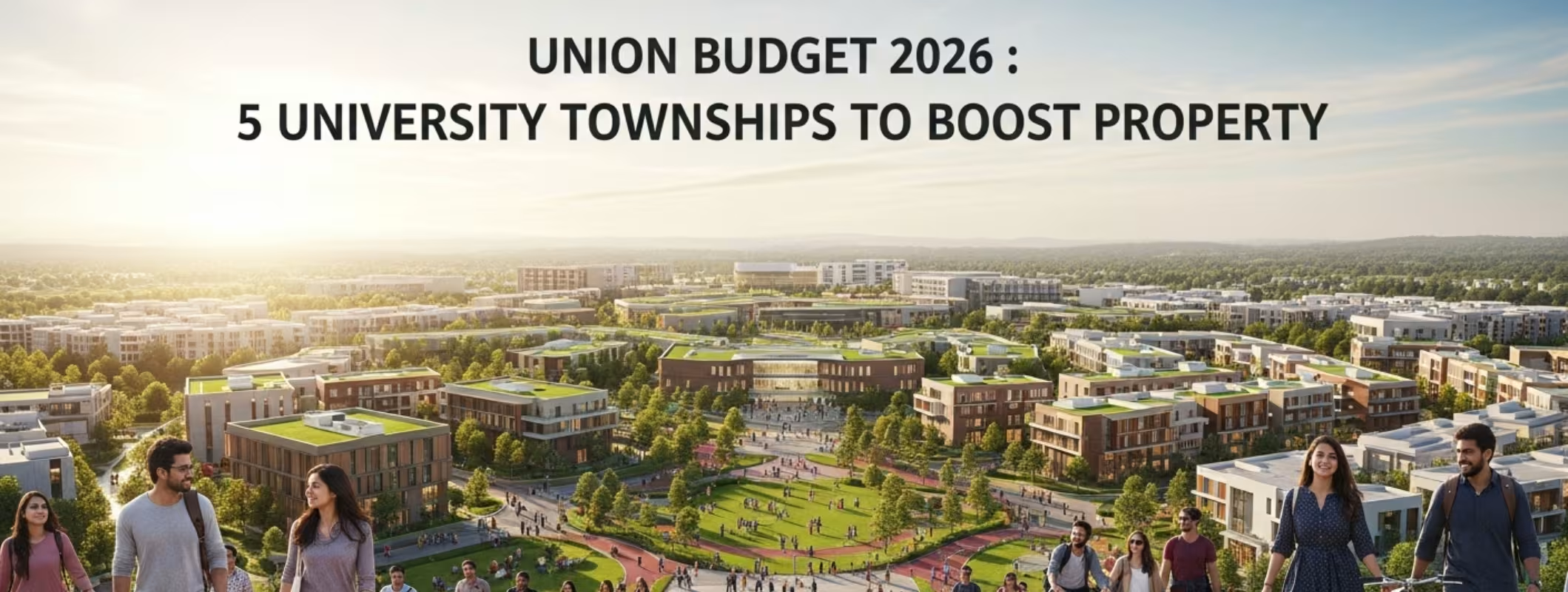
In the Union Budget 2026–27, Finance Minister Nirmala Sitharaman announced that the Centre will support states through a “challenge route” to create five university townships near major industrial and logistics corridors. These aren’t single campuses. The plan is to build clusters that can host multiple universities and colleges, research institutions, skill centres, and residential complexes, all in one ecosystem.
If you’ve watched how real estate moves in India, you already know the pattern: jobs + education + connectivity = housing demand. When those three come together in one planned zone, new micro-markets often emerge. This is why many early movers start exploring opportunities to buy land in India around such corridors, especially for rentals, starter homes, and small commercial spaces.
What Exactly did Budget 2026 Announce?
Here’s what is clearly stated so far:
- 5 university townships to be developed near major industrial & logistics corridors (via a challenge route with states).
- These townships are planned to include universities/colleges + research + skilling + residential infrastructure, meaning people will actually live there, not just study.
- Education allocations also rose, with a report showing the Ministry of Education allocation at ₹1,39,285.95 crore (with separate outlays for school and higher education).
What’s NOT announced yet (as of Feb 2, 2026): the final locations of the 5 townships. So anyone selling you “confirmed township plots” today is either guessing or pushing inventory. Some cities have already started lobbying to be selected, which shows how competitive this could get.
Why “University Townships + Industrial Corridors” can heat up Real Estate?
This combo matters because it creates two demand engines at the same time:
1) Permanent rental demand (not just seasonal)
A university township isn’t only students. You also get:
- faculty, researchers, visiting professionals
- admin staff + service staff
- training partners, labs, startups, incubators
- parents and short-stay visitors
That mix creates year-round rental demand for PGs, co-living, 1BHK/2BHK, and mid-income apartments.
2) Job-linked housing demand next to corridors
Industrial and logistics corridors pull in manufacturing, warehousing, transport, and services. When education and skilling sit right next door, it reduces the “hire-and-relocate” friction. That can strengthen local hiring, which increases local housing absorption over time.
3) Budget’s infra push acts like fuel
Real estate doesn’t move without roads, rail, and utilities. This Budget also raised capital expenditure targets (reported from ₹11.2 lakh crore to ₹12.2 lakh crore for FY 2026–27) and introduced mechanisms like an Infrastructure Risk Guarantee Fund (developer reactions highlighted this angle).
More infra + less execution risk = higher odds that planned zones actually get built.
Where could the Next Property Hotspots Emerge?
Since locations aren’t confirmed yet, the smart move is to track signals instead of chasing rumours.
Step 1: Watch the Corridors that already have momentum
The Budget says “industrial and logistics corridors,” and India already runs multiple industrial corridor programs. The official list includes corridors such as:
- Delhi–Mumbai Industrial Corridor
- Chennai–Bengaluru Industrial Corridor
- Amritsar–Kolkata Industrial Corridor
- Vizag–Chennai Industrial Corridor
- Bengaluru–Mumbai Industrial Corridor
If a township lands near an active corridor node, the “ecosystem effect” becomes more believable.
Step 2: Track 5 early signals before prices jump
Use these signals to shortlist micro-markets:
- State government notifications / tenders (land identification, SPVs, master planning)
- Connectivity upgrades (new highways, rail logistics parks, freight nodes)
- Institution clustering (existing universities + proposed expansions + skilling hubs)
- Rental pressure indicators (PG boom, rising rents, low vacancy near campuses/industries)
- Credible developer entry (tier-1/strong regional developers acquiring land legally and quietly)
If you see 3 out of 5, a locality is worth monitoring.
What Property Types usually Benefit First?
When knowledge hubs grow near job corridors, demand often rises in this order:
1) Student housing + PG + co-living (fastest reaction)
- lowest ticket sizes (investor-friendly)
- quick occupancy if location is right
- but higher wear-and-tear + management dependency
2) 1BHK/2BHK rentals for early-career workforce
- steady tenant pool (students graduating into corridor jobs)
- stronger long-term demand than “pure student markets”
3) Small commercial: daily needs + services
Think: food courts, cafés, clinics, stationery, coaching, printing, basic retail because footfall becomes predictable.
4) Plotted Development (only if approvals are clean)
Plotted land can do well only when:
- zoning is clear
- approvals are complete
- access roads + water + power are confirmed
Otherwise, plotted land becomes the biggest trap segment for buyers.
Timeline: When can Buyers Realistically see Impact?
Be practical: these are large, planned ecosystems. Expect phases:
- Announcement + state proposals (now)
- Site selection + land aggregation (can take time)
- Trunk infra + campus construction
- First intake / operations begin
- Ecosystem matures (rentals stabilize, resale demand grows)
Real estate spikes usually happen in two waves:
- Wave 1: right after credible site confirmation (speculative money enters)
- Wave 2: when institutions + jobs start operating (end-user demand enters)
Don’t Ignore these Risks (they can wipe out returns)
If you’re buying early, these risks are real:
- Fake “inside info” on township locations (common)
- Unapproved plotting near proposed corridors (high risk)
- Land title / mutation / conversion gaps (especially in fringe zones)
- Overpricing before notification (you pay for hype, not fundamentals)
- Execution delays (policy is one thing, delivery is another)
If a broker says “Budget announced it, so rates will double,” treat it as a red flag, not a pitch.
A Simple Action Plan for Buyers (what to do now)
If you want to play this smart:
- Stay liquid until locations are officially clearer (don’t rush into “confirmed” claims)
- Track government + corridor authorities + state notifications
- Shortlist 2–3 cities/nodes with both industry + education base
- Only buy where approvals are boring and complete (RERA where applicable, clean title, clear land-use)
- Prefer rental-first assets (small apartments near credible demand) over raw land speculation
- Run yield math: expected rent ÷ all-in cost (including maintenance + vacancy)
FAQs
1) What is a “University Township” in Budget 2026?
It’s a planned education-and-living cluster meant to host multiple universities/colleges along with research, skilling, and residential complexes, supported by the Centre with states via a challenge route.
2) Are the 5 locations announced?
Not officially yet (as of Feb 2, 2026). Some cities have started pitching themselves publicly, but final locations need formal selection/notification.
3) Will property prices rise near these townships?
They can, but only after credible location confirmation and visible execution (land + infra + institutions). Until then, most “price rise” talk is speculation.
4) What kind of properties are likely to see demand first?
Typically rentals: PG/co-living and 1BHK/2BHK near access roads, transit points, and institutional entrances because occupancy comes before resale.
5) Is it a good idea to buy plots right now?
Only if the plot is fully approved and the location already has strong fundamentals. Buying unapproved plots “hoping” for a township is one of the easiest ways to get stuck.
6) How do I verify if a corridor-linked project is real?
Check if it appears in official corridor listings/updates and whether the state has issued notifications or created project SPVs. The official corridor program listings help you anchor your research.
7) Will this benefit Tier-2 and Tier-3 cities?
That’s a likely direction because corridors often pass through emerging nodes, and the Budget’s broader infra push is also being positioned as a driver of growth beyond metros.
8) What’s the biggest mistake buyers make in such “New Hotspot” stories?
They buy too early in the wrong micro-location—far from access and services—because it’s cheaper. Later they realise tenants and end-users want connectivity + daily convenience, not just “future potential.”
Final Word
Budget 2026’s university townships are a strong signal: India wants education, skilling, and industry to sit together physically, not just on paper. For real estate buyers, the opportunity is real but it’s not automatic. The winners will be people who follow official signals, pick micro-markets with connectivity, and invest in farmland or other land parcels only where paperwork is clean.