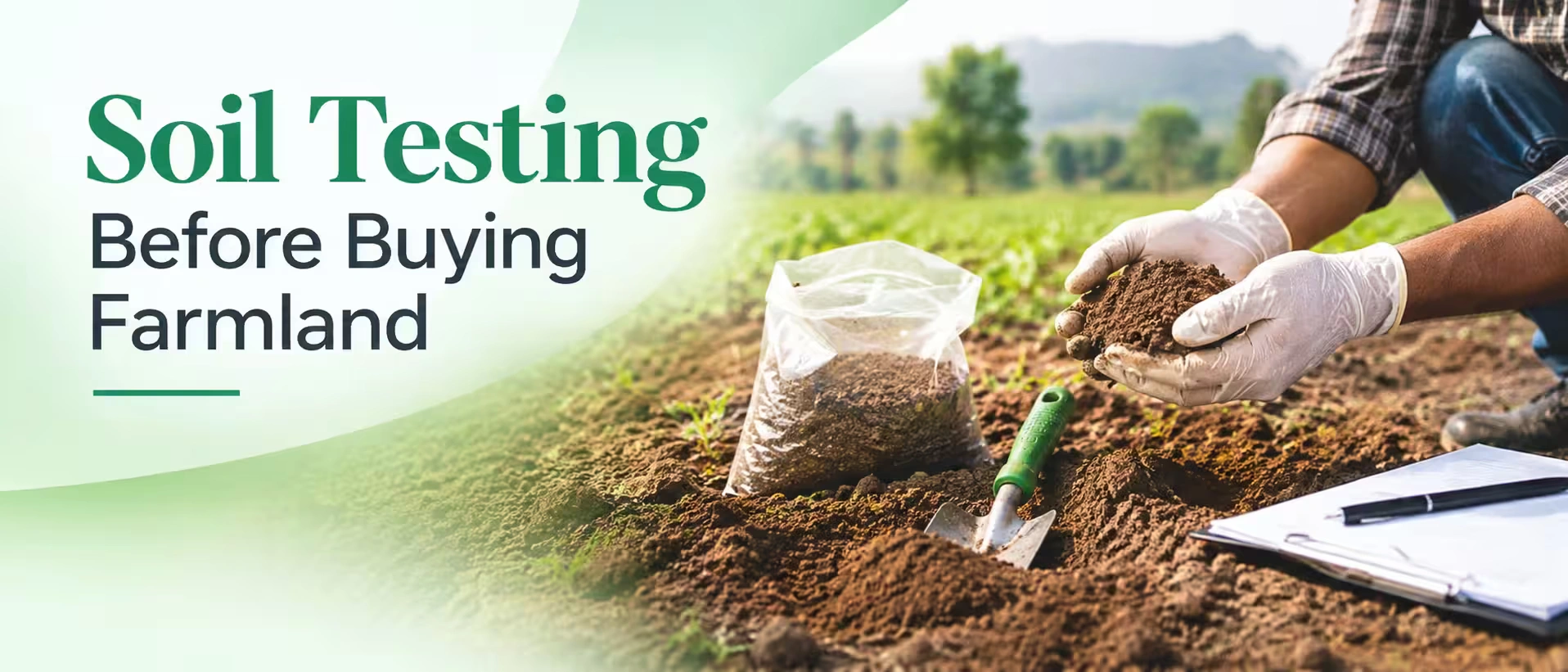
Most people who type farmlands near me into a search bar end up comparing price per acre, road access, and the photos the broker sent on WhatsApp. Soil rarely makes it to the shortlist, which is strange, because a farm that can't grow a decent crop is just expensive open ground. A serious farm search should include a lab report on the soil, and that report costs a tiny fraction of the land itself.
It matters even more when you are scrolling through plots for sale near me, and every listing says "fertile black soil" or "rich red soil". Those words describe colour. Two plots next to each other can have completely different pH, salt levels, and organic carbon, and the seller often has no idea either.
Why Should a Soil Test come before the Token Amount?
Once you pay a token, your bargaining power drops. A soil report in hand before that point gives you something solid to negotiate with, or a clean reason to walk away.
- It tells you which crops the land can realistically support, so your income plan isn't based on guesswork.
- It shows problems you can't see on a site visit, like salinity or low organic matter.
- It lets you estimate input costs for the first two or three seasons (gypsum, lime, compost, zinc).
- It gives you a baseline, so later you can tell whether the land is improving or getting worse under your management.
Most agriculturel land for sale is priced per bigha or per acre with no mention of soil quality, so the report is the only way to compare two similar-looking offers properly.
What to Test?
You don't need every test under the sun. These cover what actually affects buying decisions.
| Test | What it tells you | Needed before buying? |
|---|---|---|
| pH | Whether the soil is acidic, neutral, or alkaline | Yes |
| EC (electrical conductivity) | Salt content in the soil | Yes |
| Organic carbon | Overall soil health and biological activity | Yes |
| Nitrogen, phosphorus, potassium | Main nutrient levels | Yes |
| Sulphur | Needed for oilseeds, pulses, onion, garlic | Good to have |
| Zinc, iron, copper, manganese, boron | Micronutrients that limit yield when low | Good to have |
| Soil texture (sand, silt, clay) | Water holding and drainage | Yes, often a simple field check works |
| Irrigation water (EC, SAR, RSC) | Whether borewell or canal water will harm the soil over time | Yes, if the farm depends on a borewell |
| Heavy metals and residues | Contamination from industry, sewage, or old pesticide use | Only if the land is near a factory, drain, or industrial belt |
Don't skip the water test. A soil that looks fine today can turn saline in five years if the borewell water is poor, and that is one of the most common regrets among first-time buyers.
How to collect a sample that represents the whole plot?
A Soil Quality Checklist is essential because a bad sample yields a bad report, and most problems occur during the sampling process itself rather than in the laboratory.
- Inspect the plot and separate it into zones if there are differences between some areas (colours, slopes, growth of crops, depression areas or high areas). Each zone is sampled separately.
- From each zone, select 8-10 points along a zigzag line. In a plot up to 2.5 acres, this number is sufficient.
- At each point, remove the surface litter and make a V-shaped cut 15 cm deep for field crops. For orchards and plantations, take samples separately from 0-30, 30-60, and 60-90 cm depths.
- Make a thin slice of soil from the wall of the cut and put it in a clean plastic bucket. Iron tools and containers that contained fertilizers should be avoided.
- Mix all the soil thoroughly, place it on a clean sheet of paper, divide it into four equal parts, discard two opposite parts, and mix the remaining soil again (quartering) until 500 grams of soil is obtained.
Stay away from field bunds, tree bases, manure heaps, borewell channels, and wet patches. Also avoid sampling within three months of a fertiliser application, because that inflates the nutrient numbers. If you can, take the sample with the seller present and shoot a short video, so nobody argues later about where the soil came from.
Where to get it tested?
- Agricultural soil-testing labs by state agriculture departments that charge little or no fees, however, may take a number of weeks to produce results.
- Local Krishi Vigyan Kendras (KVK).
- State agricultural universities that frequently collect soil samples from the public.
- Private laboratories accredited by NABL that charge high prices (a complete analysis may cost between a few hundred and a few thousand rupees) but provide more accurate results faster.
To make purchasing decisions, the private laboratory is highly worth it just for the reason of time savings; moreover, if one wants to use the government benchmark as well, one should send a sample to the government laboratory.
How to Read the Soil Report?
The ranges below follow the commonly used Soil Health Card style ratings. Labs and states vary a little, so always check the reference range printed on your own report.
| Parameter | Low or poor | Ideal or medium | High or risky |
|---|---|---|---|
| pH | Below 6.0 (acidic) | 6.5 to 7.5 | Above 8.5 (alkaline or sodic) |
| EC (dS/m) | Not a concern | Below 1.0 | Above 2.0 starts hurting sensitive crops; above 4.0 is saline |
| Organic carbon (%) | Below 0.5 | 0.5 to 0.75 | Above 0.75 is good |
| Available nitrogen (kg/ha) | Below 280 | 280 to 560 | Above 560 |
| Available phosphorus (kg/ha) | Below 10 | 10 to 25 | Above 25 |
| Available potassium (kg/ha) | Below 108 | 108 to 280 | Above 280 |
| Zinc (ppm) | Below 0.6 | Above 0.6 | n/a |
PH will determine how many nutrients a crop will take from the soil. Wheat, paddy, cotton, and vegetables prefer slightly higher pH (neutral pH). Blueberries and tea need acidic soil and no more than 8.5. It is easy to neutralize the low pH with lime and too high with gypsum/ organic substances. But it takes a few years rather than months.
EC is one of the indicators that buyers neglect the most. The number above 4 dS/m means the presence of salinity, and you need good drainage and lots of water to get rid of salts.
Organic carbon is the indicator that changes gradually. The level of organic carbon in many Indian soils is below 0.5%, thus its low level shouldn’t discourage you. But soil that has a high level — 0.8% or above — deserves mention while discussing prices.
Nitrogen, phosphorus, and potassium are among the easiest ones to amend, as their levels change due to different fertilizer bags you use during every planting period. Thus, their low level doesn’t make you think about whether to buy this particular field, but it will affect the purchase price negatively since you have to buy extra inputs in the first year after
Fixable problems versus expensive ones
| Fixable within one or two seasons | Slow, costly or sometimes permanent |
|---|---|
| Low nitrogen, phosphorus or potassium | Saline soil (EC above 4) |
| Low zinc, sulphur or boron | Sodic soil with a hard, crusted surface |
| Mild acidity or mild alkalinity | Heavy clay with waterlogging and no drainage outlet |
| Low organic carbon (improves with compost and green manure) | Very shallow soil over rock or hardpan |
Treat the right-hand column as walk-away territory unless the price reflects the repair bill. The left-hand column is where you negotiate.
Field Checks that back up the Lab Report
The lab will only see what you give them. Allow one hour for your plotting.
- Excavate the hole to a depth of three to four feet. Take into account the stratifications, existence of hardpan and stones, and also the depth of topsoil.
- Check manually by squeezing the sample of moist soil. If it squeezes into a ribbon, there will be a lot of clay in the soil; otherwise, the soil will be sandy.
- Take into account the crop and health of the neighboring lands and their farms. Inquire from people about any case of flooding in the land.
- Visit the land at least once during monsoon. The same dry and healthy plot can become flooded during the monsoon period.
If you are Selling: Use the Report to your Advantage
Soil testing isn't only for buyers. If you plan to sell land, a recent lab report works like a good set of photographs; it makes your claims believable. Buyers shopping through selling property online platforms see dozens of similar listings, and one that comes with a dated soil and water report stands out quickly. A few practical points for anyone handling land selling right now:
- Test before you list, so you know about problems and can price accordingly instead of being surprised during bargaining.
- If the report shows a fixable issue, correct it for a season and test again. A better second report often adds more to the price than it costs.
- When you sell plots in parts, test each parcel separately, since a low corner can drag down the whole deal.
- Keep the report with your ownership papers, so a serious buyer can see it on the first visit.
Sellers who sell land with proof of quality usually close faster and argue less over the final number.
How does 2Bigha help you check land before you commit?
A soil report will give you information about the land, but you must also be assured that the documents are clean and the listing is genuine. 2Bigha is a marketplace for agricultural land and farmland in India, based on verified listings, so you are not relying on the broker alone for the information.
- Search through farm and agricultural land listings with location details from one place.
- Use the land report to verify ownership and important information before making any payments.
- Schedule a visit to the site, and bring along your sampling kit when you do.
- If you have land, you can also list it on the platform to reach potential buyers.
The two processes of soil testing and document verification complement each other. One will tell you if the land is capable of producing something, and the other will tell you if it belongs to you to buy.