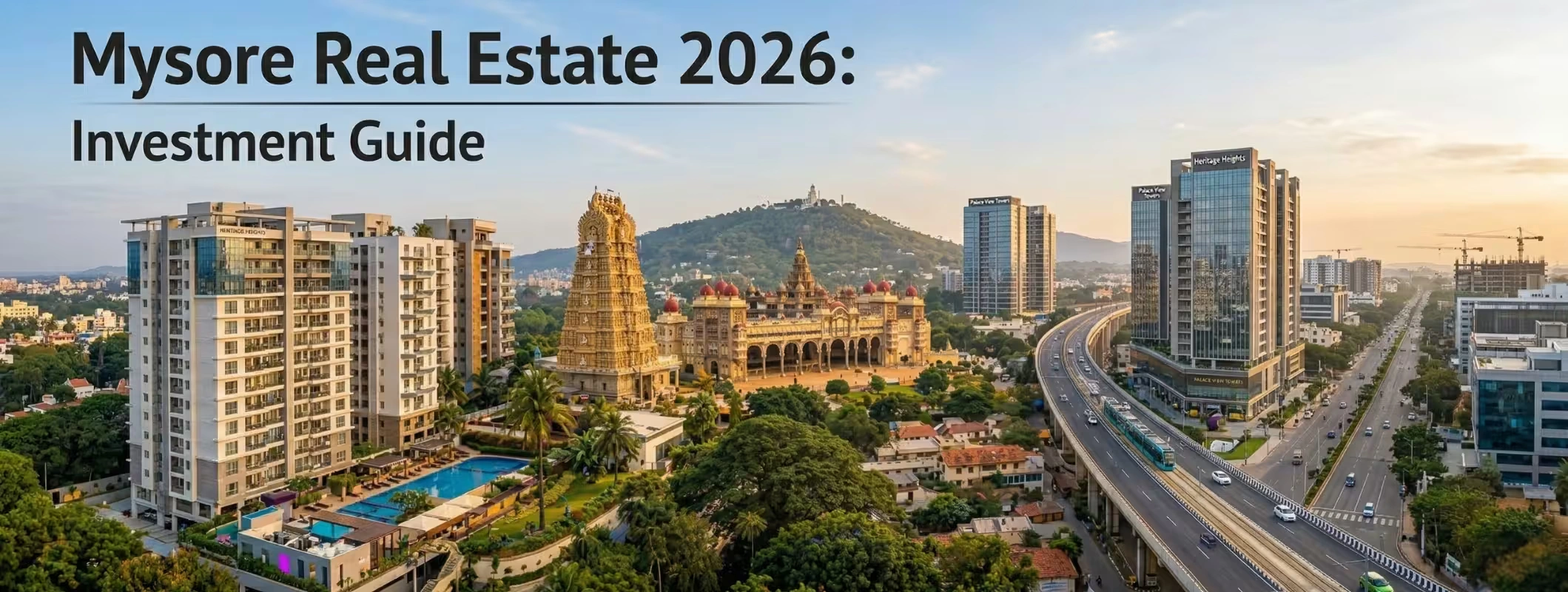
Mysore is no longer just a quiet cultural city that buyers look at after Bengaluru becomes too expensive. In Karnataka’s 2026–27 Budget, the state said more than 30,000 employees are working in 100 companies in Mysore and that Mysore will be developed as Karnataka’s second IT city. That changes the conversation around mysore real estate from lifestyle-led buying to a more serious growth-and-hold story.
Key Takeaways
- Mysore’s 2026 real-estate case is being supported by an official state push to position the city as Karnataka’s second IT city.
- Current portal data shows Mysore is still a micro-market city, not a one-rate city. Prices vary sharply between areas like Belawadi, JP Nagar, Dattagalli, KRS Road, Kuvempunagar, and Vijayanagar.
- For most buyers, plots and plotted developments still offer the clearest entry into property in Mysore, while select established areas remain stronger for ready homes and end-use living. This is an inference based on current asking-rate patterns across localities.
- The upside is real, but so is the caution. Mysuru’s proposed Peripheral Ring Road is still in the DPR and funding stage, so buyers should not pay future prices for infrastructure that is not fully on ground yet.
- Recent city-level upgrades such as the ₹120 crore KSRTC terminal and skill-focused projects like the Youth Impact Centre in Hebbal Industrial Area strengthen the long-term case for mysore real estate investment.
Why Mysore Real Estate looks Stronger in 2026
The biggest shift is not just pricing. It is direction. Karnataka’s 2026 budget does not treat Mysore as a side market; it explicitly positions the city as the state’s next major IT growth node after Bengaluru. The same budget also says plug-and-play LEAP labs will be set up in cities including Mysore to support entrepreneurs in tier-2 and tier-3 locations.
That matters because real estate grows faster when jobs, office demand, talent pipelines, and transport upgrades start moving together. Mysuru has also seen fresh support on the skilling side: a Youth Impact Centre in Hebbal Industrial Area is being set up under K-QUEST with a ₹16 crore allocation and is expected to train 2,000 youth annually.
What are Property Rates in Mysore in 2026?
The clean answer is this: there is no one “Mysore rate.” The city’s portal-level asking prices vary by locality, property type, and stage of development. Housing’s city snapshot for Mysore shows a very broad market, with prices starting around ₹1,625 per sq ft and an average near ₹9,968 per sq ft, which is exactly why area-level data is more useful than one citywide average.
The snapshot below uses current 2026 portal indicators from 99acres and Housing for active Mysore localities. These are useful market signals, but they are still asking-rate indicators, not registered transaction data.
| Area | Best for | Indicative 2026 price snapshot |
| JP Nagar | Balanced end-use plus mid-range plots | Flats around ₹5,900–6,450/sq ft; land around ₹3,550–7,800/sq ft |
| KRS Road | Connectivity-led family buying | Flats around ₹5,850–9,500/sq ft; land around ₹3,850–11,650/sq ft |
| Dattagalli | Established residential demand | Flats around ₹7,250/sq ft; land around ₹6,500–9,900/sq ft |
| Kuvempunagar | Premium established residential pocket | Flats around ₹7,150/sq ft; land around ₹7,900–13,350/sq ft |
| Vijayanagar | Mature neighborhood, strong end-user appeal | Flats around ₹6,500–7,350/sq ft; land around ₹9,150–13,350/sq ft |
| Bogadi | Budget-to-mid segment homes and plots | Flats around ₹5,550–7,100/sq ft; land around ₹3,400–6,800/sq ft |
| Belawadi | Lower-entry plot play | Land around ₹2,650–4,650/sq ft |
Best Areas to Invest in Mysore
If your goal is stable end-use value, areas like Kuvempunagar, Vijayanagar, and Dattagalli look stronger because they already behave like established residential markets rather than pure speculation zones. Their current price bands suggest buyers are paying for settled neighborhoods, not just future promise.
If you want a better balance between entry cost and upside, JP Nagar, KRS Road, and Bogadi are more practical. These belts still offer room for plotted and low-rise residential demand while staying connected to the city’s daily-use ecosystem. That makes them more sensible for buyers asking where to buy property in Mysore without jumping straight into the highest-priced pockets. This is an inference drawn from current locality pricing and the city’s ongoing mobility upgrades.
If the aim is long-hold land accumulation, lower-entry belts such as Belawadi deserve attention. They are not the strongest “move-in-now” addresses, but they can make more sense for buyers focused on land investment in Mysore rather than immediate rental or lifestyle returns.
Mysore Property Market Outlook: What is driving growth?
The strongest demand driver is the city’s economic positioning. This is confirmed by Karnataka's own budget documents, which claim Mysore currently boasts 100 companies and 30,000+ employees in the IT sector, and they wish to leverage this to expand Mysore's technology profile.
Infrastructure development is also underway, though this is still quite uneven. The new ₹120 crore KSRTC terminal at Banni Mantap is currently under construction and scheduled for completion by March 2027, while Mysuru City Corporation has already initiated major road development projects worth ₹250 crore.
This is why the correct approach to taking in the outlook for 2026 is to be cautiously optimistic, yet not irresponsible. Mysore real estate development is certainly an actual phenomenon worth keeping an eye on, especially when it comes to plotted development, residential expansion, and end-user living areas. However, it is still too early for Mysore to be considered a city where city-level hype is more important than area-level choice.
Is Mysore Good for Real Estate Investment in 2026?
Yes, but only if you buy with patience and locality discipline.
Mysore makes sense in 2026 for three kinds of buyers: end users who want a calmer city with improving infrastructure, investors who prefer land-led appreciation over hyper-priced apartment markets, and buyers who want Karnataka exposure without jumping straight into Bengaluru pricing pressure. That is an inference based on Mysore’s current rate bands, the official IT push, and the fact that several infrastructure projects are strengthening the city’s medium-term growth case.
Mysore is less convincing for buyers chasing instant flips based only on announced corridors or unbuilt mega plans. The PRR story is the clearest reminder: future infrastructure can create upside, but until execution is visible, overpaying is a mistake.
Mysore vs Bangalore Real Estate
Bangalore is still the larger and more liquid market. Mysore, however, works better for buyers who want a lower-pressure entry, a more livable city, and more room for land-led strategies. That is why mysore vs bangalore real estate is not a question of better or worse; it is a question of buying style. This is an inference based on Mysore’s current locality bands and Bengaluru’s higher rates in major belts such as Bangalore East and Whitefield.
How 2Bigha fits into the Mysore Story
For buyers who are more interested in plots in Mysore, residential land, or long-hold property decisions, 2Bigha fits naturally into this market. Mysore is a city where land and plotted development still matter, and that makes discovery, comparison, and location research more important than blindly following apartment-launch noise.
So if you want to buy property in Mysore with a land-first mindset, 2Bigha can help you move from broad city interest to smarter locality-level decision-making.
FAQs - Mysore Real Estate 2026
1. Is Mysore good for real estate investment in 2026?
Mysore looks attractive in 2026 because the state has formally positioned it as Karnataka’s second IT city, while local infrastructure and skill-development projects are also moving forward. That said, the best opportunities still depend on buying in the right micro-market instead of assuming the whole city will rise equally.
2. What are property rates in Mysore?
It depends on the area and the asset. In current portal data, flats in JP Nagar are around ₹5,900–6,450/sq ft, KRS Road around ₹5,850–9,500/sq ft, and Vijayanagar around ₹6,500–7,350/sq ft, while plotted land in Belawadi is much lower at roughly ₹2,650–4,650/sq ft.
3. What are the best areas to invest in Mysore?
For steady end-use value, Kuvempunagar, Vijayanagar, and Dattagalli look stronger. For a more balanced entry point, JP Nagar, KRS Road, and Bogadi are practical options. For lower-entry land bets, Belawadi is worth watching. This is an inference from current locality-level price patterns, not an official ranking.
4. Where should I buy plots in Mysore?
That depends on your time horizon. If you want stronger current-city relevance, look at JP Nagar, KRS Road, or Bogadi. If your focus is long-hold appreciation and lower entry cost, peripheral belts like Belawadi can be more interesting.
5. Is Mysore property a good investment for rental income?
Mysore is generally a better fit for end-use and medium-term appreciation than aggressive rental-yield chasing. The city’s growth story is improving, but the strongest case today is still around better livability, plotted expansion, and selective residential demand rather than high-rental-turnover investing. This is an inference based on the city’s current development phase and locality structure.