Key Takeaways
- Mathura and Vrindavan both offer strong land-buying opportunities in the Braj region, but the right choice depends on your investment goal.
- Choose Mathura if you want better city infrastructure, wider land availability, stronger transport connectivity, and more practical options for residential, commercial, and long-term land appreciation.
- Choose Vrindavan if your investment focus is spiritual tourism, farmhouse land, guest house potential, second-home demand, rental income, and plots near high-demand religious zones.
- For most land buyers in 2026, Mathura is better for balanced and budget-sensitive investment, while Vrindavan is better for premium, tourism-led, and emotion-driven real estate demand.
- Both markets are benefiting from religious tourism, infrastructure upgrades, Yamuna Expressway connectivity, and the growing popularity of pilgrimage-based real estate in India. Uttar Pradesh has seen strong tourism momentum, with Mathura-Vrindavan emerging as major religious tourism hubs.
Why Mathura vs Vrindavan Has Become a Serious Real Estate Question
For years, Mathura and Vrindavan were mainly seen as sacred destinations. Families visited for darshan, festivals, parikrama, and spiritual retreats. But now, the market has changed.
Land buyers, NRIs, retired professionals, farmhouse seekers, and long-term investors are actively comparing Mathura vs Vrindavan before buying land. The reason is simple: religious tourism is no longer seasonal. It is becoming a year-round economic driver.
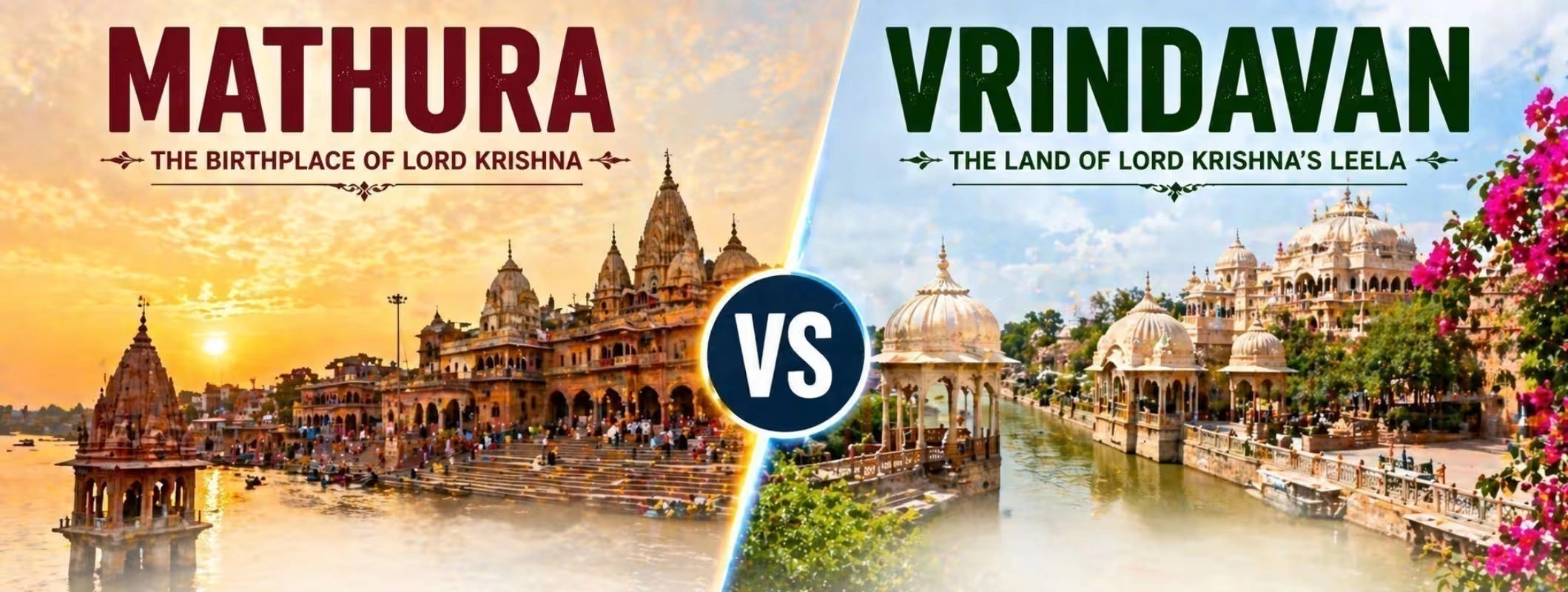
Vrindavan attracts people emotionally because of Banke Bihari Temple, ISKCON, Prem Mandir, Radha Raman Temple, and the overall spiritual lifestyle. Mathura attracts buyers because it is a larger city with better administrative facilities, railway connectivity, hospitals, schools, commercial activity, and more land supply.
So the real question is not only which is better Mathura or Vrindavan for investment. The better question is:
Which location matches your budget, purpose, risk level, and future use of the land?
This blog gives you a practical property comparison of Mathura Vrindavan for land buyers, farmhouse investors, plot buyers, and people looking for long-term appreciation in the Braj region.
Mathura vs Vrindavan Real Estate Comparison
Factor | Mathura | Vrindavan |
Best For | Residential plots, commercial land, agricultural land, mixed-use investment | Spiritual tourism property, farmhouse land, second homes, guest house potential |
Buyer Demand | Local families, traders, investors, developers, long-term land buyers | Devotees, NRIs, retirees, spiritual lifestyle buyers, hospitality investors |
Price Positioning | Comparatively more flexible depending on area | Often premium in temple-connected and tourist-heavy zones |
Land Availability | Better availability around outskirts and connecting roads | Limited in prime areas; demand is high near spiritual and tourist zones |
Growth Driver | City expansion, transport connectivity, commercial use, Yamuna Expressway influence | Religious tourism, temple footfall, spiritual lifestyle, hospitality demand |
Rental Potential | Moderate to strong in city and commercial pockets | Strong in guest stay, homestay, serviced apartments, and spiritual tourism zones |
Farmhouse Potential | Strong near outskirts and road-connected villages | Strong near Vrindavan outskirts, but premium near high-demand religious belts |
Risk Level | Moderate, depending on title and zoning | Higher in unverified or disputed land pockets due to high demand pressure |
Better For First-Time Land Buyers | Yes, because options are broader | Yes, but only with stronger due diligence |
Long-Term Outlook | Stable and practical | Premium and tourism-led |
Understanding the Real Estate Growth in the Braj Region
The Braj region is not growing only because of land speculation. It is growing because of three strong demand pillars:
First, religious tourism is expanding. Families from Delhi NCR, Rajasthan, Haryana, Madhya Pradesh, Gujarat, and other states visit Mathura-Vrindavan regularly. India Today reported that Mathura-Vrindavan was likely to see over one crore tourists in December 2025 alone, showing how strong religious travel demand has become during peak seasons.
Second, infrastructure development is improving access. Better roads, expressway connectivity, urban planning, and regional development plans are increasing investor confidence. The Mathura-Vrindavan Development Authority also publishes master planning information for different development areas, which matters for buyers checking future land use and planning direction.
Third, buyers are shifting from only “home buying” to “land banking.” Many investors now want plots, farmhouse land, agricultural land, and resale property in religious cities because land feels more flexible than built property.
This combination makes real estate in Mathura and Vrindavan attractive, but buyers must avoid emotional decisions. Sacred location does not automatically mean safe land. You still need title checks, zoning clarity, mutation records, registry verification, road access, and local authority confirmation.
Why Mathura is Attractive for Land Buyers
Mathura serves as the headquarters of the area and provides greater urban support than Vrindavan. Buyers looking for options for acquiring property in Mathura have greater chances than those in Vrindavan due to the availability of different possibilities.
In cases where buyers are looking for an investment that combines growth potential with other factors rather than just relying on tourism, Mathura is a good choice since it has rail connectivity, markets, educational institutions, health facilities, local enterprises, and superior civic amenities than many small pilgrim towns.
For those who want to invest in buying property near Mathura, the most suitable places include the outskirts of Mathura, village areas linked by roads, areas heading towards development, and highway or major road connected locations.
Main Advantages of Buying Land in Mathura
Mathura gives buyers more variety. You may find residential plots, agricultural land, highway-side land, commercial plots, and resale properties depending on the location and budget.
It is also more suitable for people who may want to use the land later for a home, rental building, warehouse, small commercial setup, or mixed-use development, subject to local land-use rules.
Another advantage is price flexibility. Compared to prime Vrindavan zones, Mathura often gives buyers a wider entry range. This does not mean Mathura is “cheap,” but it may provide more options for buyers who want land without paying a strong spiritual-premium price.
Where Mathura Performs Better
Mathura is better when the buyer wants:
- A practical city-linked investment
- A wider choice of land parcels
- More affordable entry options compared to premium Vrindavan pockets
- Better access to daily-use infrastructure
- A long-term plot or land banking opportunity
- Commercial potential near developing roads and transit points
For investors who want stable appreciation with manageable risk, Mathura can be a stronger choice.
Why Vrindavan is Attractive for Land Buyers
Vrindavan has a different type of real estate demand. It is not just a town; it is an emotion-driven spiritual destination.
People do not buy land near Vrindavan only because of future price growth. Many buyers want a spiritual lifestyle, a retirement home, a weekend farmhouse, a guest house, a small ashram-style property, or a second home near Krishna temples.
This is why Vrindavan property investment 2026 remains a high-interest topic. Religious tourism, temple visits, spiritual retreats, and hospitality demand continue to create pressure on land and plotted developments.
Vrindavan’s appeal is strongest near temple-connected corridors, main access roads, residential pockets with good connectivity, and outskirts where farmhouse-style developments are possible.
Main Advantages of Buying Land in Vrindavan
Vrindavan has strong emotional demand. This is important in real estate because emotional demand often supports resale interest.
A plot near a respected spiritual destination may attract buyers from different states. Many families want to stay close to temples during festivals, retirement years, or frequent religious visits.
Vrindavan also has potential for hospitality-linked real estate. Guest houses, homestays, serviced apartments, small retreat spaces, and spiritual tourism accommodations may perform well in the right zone, subject to permissions and land-use compliance.
Where Vrindavan Performs Better
Vrindavan is better when the buyer wants:
- Spiritual tourism-linked investment
- A second home or retirement-focused plot
- Farmhouse land near Vrindavan outskirts
- Rental income from pilgrims or visitors
- Long-term premium appreciation in limited-supply areas
- Property near religious demand centers
If your goal is to buy land where emotional and devotional value supports demand, Vrindavan has a clear edge.
Land Rates in Mathura vs Vrindavan: What Buyers Should Understand
Most potential clients are curious about the rates of land in Mathura versus Vrindavan; however, prices may vary considerably depending on factors like road size, land usage, proximity to religious sites, registration process, government permission, and more.
Normally, due to their premium locations in Vrindavan and high demand for them, lands are expected to sell at a premium, since they will never have enough supply. Mathura, meanwhile, offers more varied prices, covering city belts, semi-urban areas, farming lands, and highways.
According to private information sources, there is significant demand for land plots in Vrindavan in 2026 because of tourism, religion, and infrastructure needs; however, all price quotes must be locally verified.
Practical Price Logic
Vrindavan may cost more when the plot is close to temples, tourist roads, or branded plotted developments.
Mathura may offer better value when the buyer is willing to look at emerging areas, outskirts, agricultural belts, or locations with future connectivity potential.
For a safe decision, do not judge price only by per square yard or per bigha rate. Check:
- Road access
- Land title
- Registry history
- Mutation status
- Land use category
- Flood or low-lying risk
- Distance from main road
- Authority approvals
- Nearby development activity
- Resale demand
A lower-priced plot with unclear documents can become more expensive than a premium verified plot.
Mathura vs Vrindavan: Which is Better for Investment?
The answer depends on the buyer profile.
For Long-Term Land Appreciation
Mathura may be better for steady appreciation because it has more urban expansion potential, civic infrastructure, and practical land-use demand.
Vrindavan may deliver stronger appreciation in selected pockets because of limited land supply and spiritual tourism pressure. However, entry prices may already be high in prime areas.
For Farmhouse Buyers
Farmhouse owners will be attracted to the outskirts of Vrindavan, which offers a serene, spiritual, and lifestyle-oriented environment. Individuals looking for the best site for farmhouse in Vrindavan should consider areas that are less congested by temples and those with legal clarity.
Outskirts of Mathura are also ideal for farmhouse, particularly when the parcels of lands are large and there is a good road connectivity.
For Rental Income
Vrindavan has a stronger tourism rental angle. Guest stays, short-term accommodation, and spiritual tourism-related usage can create better income opportunities, subject to local permissions.
Mathura may perform better for long-term residential rental, student housing, local commercial use, or city-based rental demand.
For Budget Buyers
Mathura usually offers more practical entry points. Buyers with limited budgets may find more options around developing pockets near Mathura than in premium Vrindavan areas.
For NRI and Spiritual Buyers
Vrindavan may feel more attractive because the emotional value is higher. Many buyers prefer Vrindavan because they connect it directly with devotion, temple visits, and retirement living.
Best Areas to Buy Land in Vrindavan
The best areas depend on budget and purpose. A buyer looking for a second home will think differently from someone buying land for a guest house or farmhouse.
Generally, buyers should evaluate:
- Temple-connected zones with high visitor movement
- Road-connected outskirts with farmhouse potential
- Planned plotted developments with clear approvals
- Locations with access to Mathura, Chhatikara, and Yamuna Expressway routes
- Areas away from heavy congestion but still connected to spiritual destinations
For investment property near Banke Bihari Temple area, buyers must be extra careful. High demand often attracts inflated pricing, unclear claims, and aggressive brokerage. Check ownership, map approval, registry status, and land-use rules before paying any token amount.
Best Areas to Buy Land Near Mathura
Mathura offers better diversity for land buyers. Depending on your purpose, you can explore city-edge locations, highway-connected belts, agricultural land pockets, and emerging residential zones.
Buyers often prefer Mathura for:
- Residential plots near developing colonies
- Commercial land near active roads
- Agricultural land near village belts
- Farmhouse land with better parcel size
- Long-term land banking near future infrastructure growth
If you want to buy plot in Mathura Vrindavan for practical use, Mathura may give you more choices. If you want spiritual positioning, Vrindavan may give you stronger emotional resale appeal.
Yamuna Expressway Property Trends and Their Impact
Connectivity provided by Yamuna Expressway has altered the perception of buyers towards western Uttar Pradesh. This provides improved connectivity among the areas of Delhi NCR, Noida, Greater Noida, Agra, and other investment corridors.
This is important for buyers interested in acquiring property in Mathura/Vrindavan region as connectivity will provide increased weekend commuting, spiritual tourism, purchase of secondary homes, and flow of investors.
Master Plan 2041 of YEIDA (Yamuna Expressway Industrial Development Authority) emphasizes the aspects of planned development and industrialization in the Yamuna Expressway region.
However, buyers should not blindly buy any land just because a broker says “near Yamuna Expressway.” Distance, access road, legal title, zoning, and actual development status matter more than marketing claims.
Religious Tourism Property Demand: Why It Matters
Religious tourism creates a unique real estate market. Unlike purely industrial or corporate cities, pilgrimage cities attract repeat visitors.
Families may visit during Janmashtami, Holi, Kartik month, weekends, vacations, and special temple events. This creates demand for rooms, homestays, food businesses, parking, local transport, serviced stays, and second homes.
That is why plot investment near Krishna temples has become attractive for many buyers. But the closer you go to temple-heavy zones, the more important due diligence becomes.
You should check whether the land is actually usable for your intended purpose. Not every land parcel can be converted into a hotel, guest house, farmhouse, or commercial project. Local approvals matter.
Infrastructure Development in Mathura Vrindavan
Infrastructure is one of the biggest reasons behind growing land interest in the Braj region. Road widening, better connectivity, tourism facilities, planning zones, and regional development initiatives can improve real estate demand over time.
The Uttar Pradesh Braj Teerth Vikas Parishad provides a Braj Development Plan framework, including maps and planning documents for the region. This indicates that the region is being looked at from a long-term religious, cultural, and tourism development perspective.
For land buyers, this is positive, but it also means you must understand planning restrictions. Development plans can increase future value in some areas, but they can also restrict certain land uses in heritage-sensitive, green, riverbed, or regulated zones.
Residential vs Agricultural Land in Vrindavan
One common confusion among buyers is whether to buy residential or agricultural land near Vrindavan.
Residential plots are easier for home construction when they are part of approved layouts and have proper permissions. They may cost more, but the legal use is clearer.
Agricultural land may look attractive because of larger size and lower per-unit pricing, but it comes with restrictions. If you want to build a farmhouse, resort, guest house, or commercial structure, you must check land conversion rules, local permissions, and development authority guidelines.
Residential Land May Suit You If:
- You want to build a home
- You want easier resale
- You prefer approved layouts
- You want clearer development permission
- You want access to roads, electricity, and basic infrastructure
Agricultural Land May Suit You If:
- You want larger land area
- You want farmhouse-style use
- You want long-term land banking
- You understand conversion and land-use rules
- You are ready for deeper legal verification
For purchasing agricultural land near Vrindavan, do not rely only on seller statements. Ask for revenue records, khasra-khatauni details, mutation status, land classification, approach road proof, and legal opinion.
Also Read: Ayodhya vs Vrindavan: Which Real Estate Market Is Better for Land Investment?
Legal Land Buying in Braj Region: What to Check Before Payment
Land buying in Mathura Vrindavan can be profitable, but only when documents are clean. Many buyers make the mistake of trusting verbal promises because the location feels spiritual or emotionally safe.
That is risky.
Before you buy land in Mathura or Vrindavan, verify:
- Title ownership: Check whether the seller has clear ownership rights.
- Sale deed chain: Review previous sale deeds to confirm the ownership history.
- Mutation record: Mutation should reflect the current owner in revenue or municipal records.
- Khasra and khatauni details: For agricultural land, these records help verify land identity and ownership.
- Land use category: Confirm whether the land is agricultural, residential, commercial, institutional, or under any restriction.
- Authority approval: If you are buying a plotted development, check layout approval from the relevant authority.
- RERA registration: For applicable real estate projects, check whether the project is registered.
- Road access: A plot without legal access can create major resale and development problems.
- Encumbrance check: Check if the land has loans, disputes, court cases, or family claims.
- Local zoning restrictions: This is very important near religious, river, heritage, and regulated zones.
Never buy land only on the basis of location hype. Buy only after legal verification.
Mathura vs Vrindavan: Buyer-Wise Recommendation
Buyer Type | Better Option | Reason |
First-time land buyer | Mathura | More options, better price flexibility, practical infrastructure |
Spiritual lifestyle buyer | Vrindavan | Strong devotional value and temple proximity |
Farmhouse buyer | Vrindavan outskirts or Mathura outskirts | Depends on budget, access, and land-use permission |
Rental income investor | Vrindavan | Strong religious tourism and short-stay demand |
Commercial land buyer | Mathura | Better city activity and broader commercial use |
Budget investor | Mathura | More affordable entry pockets |
Premium plot buyer | Vrindavan | Higher emotional and tourism-led demand |
Long-term land banking buyer | Both | Mathura for balanced growth, Vrindavan for premium scarcity |
NRI buyer | Vrindavan | Strong spiritual recall and resale appeal |
Local business investor | Mathura | Better daily economic activity |
Pros and Cons of Buying Land in Mathura
Pros
Mathura offers better land variety, stronger city infrastructure, and wider investment options. It is suitable for residential, commercial, agricultural, and long-term land banking buyers.
The city has a more practical ecosystem for families, businesses, and local services. This makes it easier to plan future construction, rental use, or resale.
Cons
Some areas may not give the same premium emotional appeal as Vrindavan. Also, not every developing pocket will appreciate quickly. Buyers must evaluate actual road access, civic growth, and land-use status.
Pros and Cons of Buying Land in Vrindavan
Pros
Vrindavan has strong spiritual value, limited prime land supply, and high visitor demand. It is attractive for second homes, guest houses, farmhouse plots, spiritual retreats, and tourism-linked investment.
The emotional pull of Vrindavan can support long-term resale demand, especially among devotees, NRIs, and retirement buyers.
Cons
Prime land can be expensive. Some areas may be congested. Unverified land, unclear titles, and overhyped pricing are real risks. Buyers must be careful near temple-heavy and high-demand zones.
Checklist Before Buying Land in Mathura Vrindavan
Use this checklist before finalizing any land deal:
Checklist Point | Why It Matters |
Verify ownership title | Confirms seller has legal right to sell |
Check sale deed chain | Helps identify ownership history |
Confirm mutation | Shows current owner in land records |
Review land use | Prevents wrong-use investment |
Check road access | Critical for resale and construction |
Verify authority approval | Important for plotted developments |
Check RERA if applicable | Adds buyer protection in eligible projects |
Confirm physical boundaries | Prevents boundary disputes |
Check loan or litigation | Avoids legal complications |
Compare local market rates | Helps avoid overpaying |
Take legal opinion | Protects your investment |
Use verified platforms | Reduces fake listing and broker risk |
How 2Bigha Helps Land Buyers in Mathura Vrindavan
Buying land in religious and fast-growing regions like Mathura and Vrindavan requires more than just browsing random listings. You need location clarity, document confidence, verified sellers, and better comparison tools.
This is where 2Bigha can help. 2Bigha is designed for land buyers, sellers, and investors who want a more transparent way to explore land opportunities. Instead of depending only on scattered broker information, buyers can use a more structured platform to search and compare land options.
Why Use 2Bigha for Land Buying?
2Bigha supports map-based land discovery, which helps buyers understand the actual location, nearby roads, surrounding development, and land area more clearly.
For buyers looking for verified plots for sale in Mathura Vrindavan, farmland near Mathura Vrindavan, or farmhouse land for sale near Yamuna Expressway, map-based visibility can reduce confusion.
You can compare listings, shortlist suitable land, and make better decisions before visiting the site.
If you want to sell land in Mathura at the best price or list resale property in the Braj region, 2Bigha can help your land reach serious buyers. A verified and well-presented listing can perform better than word-of-mouth selling.
Subscription Plan Advantage
2Bigha’s subscription plan can help landowners, brokers, agents, and developers list properties more effectively and reach buyers who are actively searching for land. For serious sellers, a subscription-based listing approach can improve visibility and lead quality compared to casual posting.
Whether you want to buy land in Vrindavan for investment, purchase agricultural land near Vrindavan, or sell land near Mathura, 2Bigha gives you a more focused platform for land-related transactions.
Mathura vs Vrindavan: Final Verdict
So, which is better Mathura or Vrindavan for investment?
The honest answer is: both are good, but they serve different buyers.
Mathura is better if you want practical growth, better price flexibility, city infrastructure, larger land availability, commercial possibilities, and long-term balanced appreciation.
Vrindavan is better if you want spiritual value, tourism-led demand, premium plot potential, farmhouse appeal, rental income opportunities, and strong emotional resale demand.
For safe investment, do not buy only because of temple proximity or future hype. Buy after checking documents, location, land use, access road, authority rules, and resale potential.
If you are a first-time buyer, start with a verified search on platforms like 2Bigha, compare Mathura and Vrindavan locations on a map, shortlist only legally clear land, and then proceed with site visits and legal verification.
In 2026, land buying in Mathura Vrindavan can be a smart move if you combine devotion with due diligence and emotion with documentation.
FAQs on Mathura vs Vrindavan Land Investment
1. Which is better for land investment: Mathura or Vrindavan?
Mathura is better for buyers who want practical investment, wider land options, better city infrastructure, and comparatively flexible pricing. Vrindavan is better for buyers who want spiritual tourism demand, second-home appeal, farmhouse potential, and premium appreciation near religious zones.
2. Is Vrindavan good for property investment in 2026?
Yes, Vrindavan is attractive for property investment in 2026 because of religious tourism, temple-driven demand, second-home buyers, and limited prime land supply. However, buyers must verify documents carefully because high-demand areas can also attract overpriced or legally unclear listings.
3. Is Mathura better than Vrindavan for budget land buyers?
In many cases, yes. Mathura usually offers more land variety and better entry options for budget-conscious buyers. Vrindavan can be more expensive in prime areas due to spiritual and tourism-led demand.
4. Where should I buy farmhouse land near Vrindavan?
Farmhouse buyers should look at Vrindavan outskirts, road-connected village belts, and areas with peaceful surroundings but proper legal access. Always check land-use rules, agricultural status, conversion requirements, and local permissions before buying.
5. Are land rates higher in Vrindavan than Mathura?
Prime Vrindavan locations often command higher rates than many Mathura areas because of temple proximity, tourist demand, and limited supply. However, rates vary widely by location, road access, approval status, and land category.
6. Can I buy agricultural land near Mathura Vrindavan?
Yes, agricultural land may be available near Mathura and Vrindavan, but buyers must verify eligibility, land records, khasra-khatauni details, mutation, road access, and land-use restrictions. If you plan to build a farmhouse or commercial project, check conversion rules first.
7. Is land near Banke Bihari Temple a good investment?
Land near Banke Bihari Temple can have strong demand, but it may also be expensive and legally sensitive. Buyers should check ownership, approvals, access, congestion, and local development restrictions before investing.
8. How does Yamuna Expressway impact Mathura Vrindavan real estate?
Yamuna Expressway improves regional connectivity and supports buyer interest from Delhi NCR, Noida, Greater Noida, and Agra. It can improve long-term demand, but buyers should not rely only on “expressway proximity” claims. Actual access and legal status matter.
9. Which location is better for rental income?
Vrindavan may offer stronger short-stay and religious tourism rental potential, especially near visitor-heavy zones. Mathura may be better for long-term residential or local commercial rental demand.
10. How can 2Bigha help me buy land in Mathura Vrindavan?
2Bigha helps buyers explore land through map-based listings, compare locations, check land area visually, and connect with relevant land opportunities. Sellers and agents can also use subscription plans to improve listing visibility and attract serious land buyers.