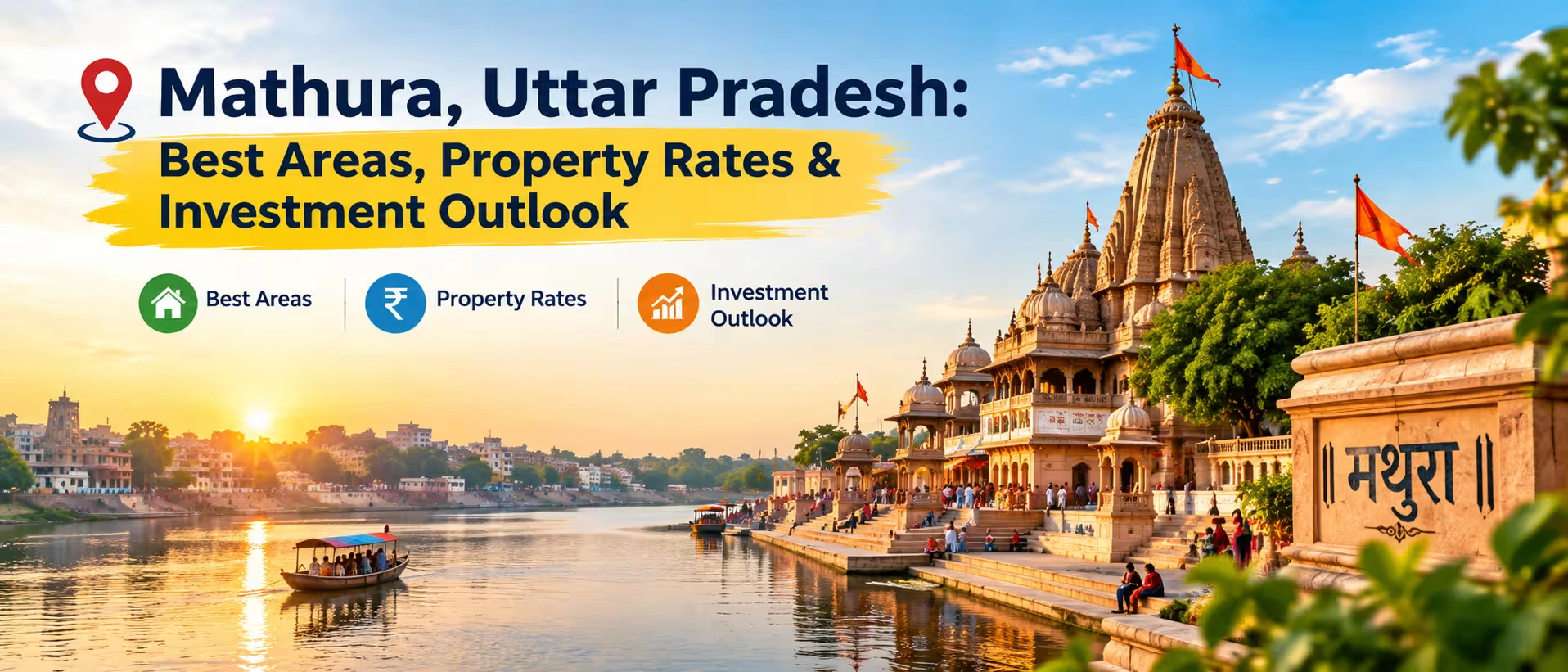
Mathura's property market in 2026 is not one single market. Central Mathura, Vrindavan's premium residential corridors, Govardhan's pilgrimage-led land market and the agricultural belts around Mat and Chhata behave very differently. That distinction matters far more than a city-wide average.
For buyers searching for a plot in mathura, the sensible approach is to first decide whether the objective is self-use, rental income, long-term land appreciation, commercial exposure or agricultural ownership. The location should follow the purpose—not the other way around.
Key Takeaways
- Mathura–Vrindavan continues to benefit from religious tourism, infrastructure spending and planned development under the MVDA Master Plan 2031. The Ministry of Culture also lists Mathura–Vrindavan tourism-circuit and Govardhan infrastructure works among ongoing spiritual-destination initiatives.
- Circle rates were revised upward in late 2025, with several Mathura–Vrindavan locations seeing increases of roughly 10% to 25%. Krishna Nagar, Dampier Nagar and the ISKCON-Vrindavan belt remain among the higher-value zones.
- Vrindavan's residential market is substantially more expensive than peripheral Mathura district land. Housing.com showed an average Vrindavan asking rate of about ₹9,676 per sq ft in 2026, although rates vary sharply by property type and locality.
- Chhatikara Road and Sunrakh Road are among the corridors worth tracking for organised residential development, while Govardhan and Mat are more relevant to land-focused buyers.
- For farmland, road access, revenue records, land classification and development restrictions matter more than a cheap quoted per-bigha rate.
Why is Mathura Real Estate Attracting Investors in 2026?
Mathura has something many tier-2 property markets do not: demand that is not dependent on one industry.
The Mathura–Vrindavan region receives year-round religious visitors, while Govardhan, Barsana and other Braj destinations expand the tourism economy beyond the city centre. Uttar Pradesh remained India's largest domestic tourism market in 2025, with Mathura–Vrindavan identified among its important pilgrimage centres.
At the planning level, the Mathura-Vrindavan Development Authority's Master Plan 2031 covers Mathura, Mathura–Vrindavan, Govardhan-Ral, Kosi-Chhata-Nandgaon-Barsana, Farah and other surrounding belts. That makes development pattern, zoning and proposed roads particularly important when evaluating land in mathura rather than simply buying based on distance from a temple or highway.
There is also a wider connectivity story. Noida International Airport began commercial operations on June 15, 2026, creating another aviation gateway for western Uttar Pradesh and the NCR region. However, buyers should keep expectations realistic: Mathura is not an airport-adjacent micro-market, so Jewar should be considered a supporting regional connectivity factor rather than a reason to pay an inflated local land price.
Also Read: Mathura vs Vrindavan: Which is Better for Land Buyers in 2026
Mathura Property Rates in 2026: What Are Buyers Actually Paying?
There is no useful single "Mathura property rate." A premium Vrindavan apartment, an established Krishna Nagar commercial-residential property and an agricultural parcel near Mat cannot be compared on the same per-square-foot basis.
The following figures are best treated as reference indicators, not guaranteed transaction prices.
| Area | 2026 Price Reference | Market Character | Better Suited For |
|---|---|---|---|
| Krishna Nagar | Circle-rate benchmark around ₹82,000/sq m in Krishna Nagar Bazaar | Established, central, high-value | End-users, commercial exposure |
| Dampier Nagar | Around ₹65,000/sq m circle-rate reference | Mature central locality | Residential/end-use |
| ISKCON vicinity, Vrindavan | Around ₹75,000/sq m circle-rate reference | High religious and visitor demand | Premium investment |
| Chhatikara Road | Apartment asking range about ₹8,056–₹13,235/sq ft; average around ₹10,646/sq ft | Organised growth corridor | Apartments and newer projects |
| Sunrakh Road | Average residential asking rate around ₹9,094/sq ft | Expanding Vrindavan market | Medium- to long-term buyers |
| Govardhan | Current individual plot listings range from roughly ₹543 to ₹3,300+ per sq ft | Highly property-specific | Plot and land investors |
Circle-rate references come from the revised 2025-26 valuation schedule reported for Mathura-Vrindavan, while portal figures reflect advertised inventory rather than registered sale deeds.
That distinction is important. Asking price, negotiated transaction price and government circle rate are three different numbers.
Best Areas to Buy Property in Mathura in 2026
1. Krishna Nagar: Best for Established City Living
Krishna Nagar is one of Mathura's established urban locations and suits buyers who value existing roads, markets, schools, hospitals and everyday convenience more than speculative appreciation.
Its revised circle-rate benchmark reflects that established demand. Housing.com's 2026 Krishna Nagar data also shows relatively high advertised residential values, although its sample is small enough that the average should not be treated as a universal locality rate.
For an end-user family, Krishna Nagar generally makes more sense than buying a cheaper peripheral plot with uncertain development timelines.
Best for: self-use, resale liquidity and central Mathura exposure.
2. Dampier Nagar: Mature and Centrally Positioned
Dampier Nagar offers a different proposition from rapidly developing Vrindavan corridors. It is an established city neighbourhood where value comes largely from location and limited central-city land availability.
The revised circle-rate reference increased from ₹57,000 to ₹65,000 per sq m in late 2025.
Investors should not expect the same speculative percentage gains that sometimes appear in fringe plotted developments. The attraction here is relative stability and established urban infrastructure.
Best for: buyers prioritising location quality over low entry price.
3. Chhatikara Road: One of Vrindavan's Key Growth Corridors
Chhatikara Road connects strongly with the broader Vrindavan development story and attracts organised housing and project-based investment.
Magicbricks reported Q2 2026 multistorey apartment asking rates of approximately ₹8,056–₹13,235 per sq ft, with an average of ₹10,646.
This is not a budget corridor anymore. Buyers should compare project approvals, possession timelines, construction quality and actual access rather than assuming every property carrying a "Vrindavan" label deserves a premium.
Best for: newer residential projects and long-term Vrindavan exposure.
4. Sunrakh Road and Sunrakh Bangar: Strong Development Activity
Sunrakh has become one of the areas investors frequently encounter when comparing newer Vrindavan projects.
Housing.com's Sunrakh Road data showed an average around ₹9,094 per sq ft in 2026, while Sunrakh Bangar displays a much wider spread because apartments, villas, houses and plots are mixed together. Current portal inventory also includes a 1,080 sq ft residential plot advertised around ₹60 lakh, illustrating how plotted prices can differ significantly from apartment averages.
Here, approval status matters. MVDA maintains information on approved, cancelled and blacklisted colonies, making authority verification an essential step before payment.
Best for: buyers comfortable researching projects carefully.
5. Govardhan: Attractive, but Highly Location-Sensitive
Govardhan benefits from pilgrimage activity and continued tourism infrastructure investment. The Union government's July 2026 update specifically identified infrastructure development at Govardhan under Mathura–Vrindavan tourism initiatives.
Yet Govardhan land prices can vary dramatically within a few kilometres.
Recent advertised residential plots ranged from around ₹543 per sq ft for a large parcel to about ₹3,330 per sq ft for a smaller 1,080 sq ft plot. This difference shows why road frontage, land use, proximity to developed settlement, plot size and title status can matter more than the locality name itself.
Best for: patient land investors and buyers familiar with local due diligence.
6. Kosi Kalan and the Northern Mathura Belt: Lower Entry Price
Kosi Kalan sits further from Mathura-Vrindavan's premium core and therefore offers a lower entry point.
Current plotted project inventory on Housing.com included 100 sq yd plots starting around ₹10 lakh, although individual project advertisements should never be interpreted as the prevailing rate for the entire locality.
This area is more appropriate for investors with a longer holding period. Paying a large "future development" premium today defeats the purpose of choosing a peripheral location.
Best for: budget-conscious plotted investment with patience.
What About Farmland and Agricultural Property in Mathura?
Mathura district has an active rural land market around Mat, Govardhan, Chhata and adjoining villages, but farmland pricing is far less standardised than urban housing.
Anyone beginning a farm search in Mathura should compare parcels using price per acre or bigha only after checking the actual local measurement convention, road width, irrigation, ownership records, land classification and usable shape of the site.
For example, current 2Bigha inventory in Panigaon Khader, Mat showed a 100-bigha agricultural parcel advertised at ₹60 lakh per bigha, while other Mathura district listings vary substantially depending on location and scale. These are seller asking prices—not district valuation benchmarks.
Searches for agriculture land for sale in mathura therefore need more ground-level verification than an apartment search. A cheap parcel without legal access or with restricted land status can become expensive very quickly.
Mathura Investment Outlook for 2026–2030
The medium-term outlook is positive, but selective.
Tourism remains a genuine demand driver
Mathura, Vrindavan and Govardhan are not seasonal weekend destinations alone. Religious tourism creates demand for accommodation, retail, hospitality and supporting residential development. Government spending on the Mathura–Vrindavan tourist circuit strengthens this structural advantage.
Master-planned corridors deserve attention
MVDA's Master Plan 2031 provides a better framework for investment decisions than rumours about a proposed road or future township. Investors should identify whether a parcel falls within residential, commercial, agricultural, green or another designated use before calculating appreciation potential.
Rising circle rates indicate stronger official valuations
The late-2025 revision pushed several important Mathura-Vrindavan locations higher, including Krishna Nagar, Dampier Nagar, Mahavidya and the ISKCON vicinity. Rising circle rates can reduce the gap between historically low government valuations and market pricing, but they also increase registration-linked acquisition costs.
Avoid buying only on Future Appreciation
Mathura has enough real demand drivers that investors do not need to depend on exaggerated claims.
A road-touching, legally clear parcel in the correct land-use zone may be a better investment than a cheaper interior parcel marketed using phrases such as "future commercial", "near upcoming project" or "next Vrindavan".
Legal Checklist Before Buying Land in Mathura
Before considering agricultural land for sale in uttar pradesh, especially a large parcel, complete a proper title and revenue review.
The Uttar Pradesh Revenue Code permits transfer of land held with transferable rights subject to statutory restrictions. Section 89 also limits acquisition beyond 5.0586 hectares—about 12.5 acres—without applicable approval, while Section 80 deals with changing agricultural land to non-agricultural use. Specific restrictions can also apply depending on the tenure holder and land category.
A practical buyer checklist should cover:
- Verify khasra, khatauni, ownership and mutation entries.
- Match the revenue-map boundary with the physical site.
- Check previous title deeds and outstanding claims.
- Confirm direct and legally recorded road access.
- Check MVDA Master Plan land use where applicable.
- For plotted projects, verify authority and UP-RERA approvals where legally required.
- Compare the sale consideration with the current circle rate.
- Check whether agricultural-to-residential or commercial conversion is required.
- Use an independent property lawyer rather than relying only on the seller or broker.
For land, documentation is part of the investment—not paperwork to be completed after the price is negotiated.
Using Online Platforms to Search Mathura Land
Large property websites in India are useful for understanding residential inventory and broad asking-price trends, but agricultural land often needs a more map-led approach because buyers think in terms of village, road, frontage, acreage and nearby development rather than apartment configuration.
2Bigha can be useful for comparing farmland and rural plots geographically. Its current public inventory includes agricultural properties across Mathura district, allowing buyers to compare location, land size and quoted pricing before arranging deeper verification.
For owners who want longer-term assistance, 2Bigha also offers a subscription plan and property management service.
Digital discovery should shorten your shortlist. It should never replace title verification or an actual site visit.
Planning to Sell Property in Mathura?
If you want to sell land in Mathura, do not copy the price of the nearest listing and add 20%.
Price the parcel based on land use, access-road width, frontage, ownership clarity, nearby development, circle rate and comparable land of a similar size. Large agricultural parcels usually command a different unit rate from small residential plots even when they are in the same broad location.
Clear documents, accurate dimensions and realistic pricing usually generate better-quality enquiries than an inflated asking rate followed by months of negotiation.
Is Mathura a Good Property Investment in 2026?
Yes—but location selection matters.
For end-use, established Mathura localities such as Krishna Nagar and Dampier Nagar remain practical. For organised residential growth, Chhatikara Road and Sunrakh deserve attention. Govardhan offers a stronger pilgrimage-and-land proposition, while Mat, Chhata and other rural belts suit investors specifically looking at farmland or larger holdings.
Mathura's strongest investment case comes from combining real religious-tourism demand, established Delhi–Agra connectivity, planned urban expansion and relatively diverse land opportunities.
The weakest strategy is buying an unverified peripheral parcel simply because somebody promises it will "double after the next project".
In land investment, the right paperwork and the right road can be worth more than the right sales pitch.
Disclaimer: This article is for informational purposes only and should not be considered investment, legal, financial, or property advice. Real estate regulations, infrastructure plans, market conditions, and government policies may change over time. Readers are advised to verify information with relevant authorities and consult qualified professionals before making any investment or property-related decisions.