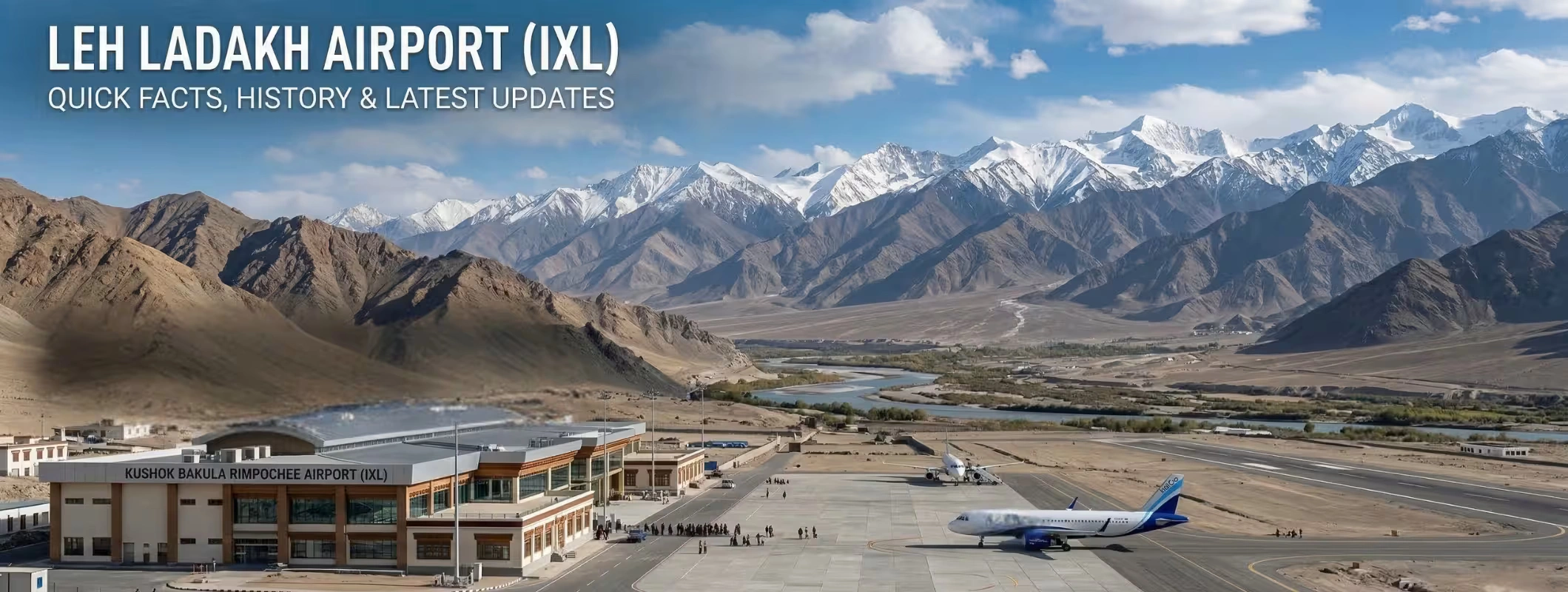
Leh Ladakh Airport, officially known as Kushok Bakula Rimpochee Airport, is not just a travel gateway. It is a strategic, tourism-driven, high-altitude airport that influences connectivity, hospitality demand, and long-term land interest in Ladakh. For land buyers, investors, and property researchers, that matters. Better air access often improves visibility, visitor movement, and commercial activity, but in a place like Leh, smart investing depends on legality, terrain, permitted use, and airport-related restrictions, not hype alone.
Key Takeaways
- Leh Airport (IXL) is India’s highest commercial airport at about 3,256 metres / 10,682 feet above sea level.
- The airport began as a military airstrip in 1961 and later expanded for civilian use, with a separate passenger terminal associated with 1985-era civilian handling.
- A new eco-smart terminal has been under development since the foundation stone was laid in February 2019. Recent 2025–2026 updates point to a stronger sustainability push using geothermal and solar systems.
- Weather still affects operations. In January 2026, heavy snowfall disrupted flights, which shows why airport-linked investment in Leh must be planned with realism.
- Land near an airport is not automatically a winning investment. In Ladakh, title clarity, transferability, land use, height clearance, and local rules matter more than simple proximity to IXL.
Leh Ladakh Airport Quick Facts
| Item | Details |
| Official Name | Kushok Bakula Rimpochee Airport |
| IATA / ICAO | IXL / VILH |
| Location | Leh, Ladakh, India |
| Airport type | Public / Military |
| Operator | Airports Authority of India |
| Elevation | Approx. 3,256 m / 10,682 ft |
| Runway | 07/25 |
| Runway Length | Approx. 2,752 m |
| Why it matters | Tourism gateway, strategic lifeline, high-altitude operations |
Quick-facts summary compiled from airport and aviation references.
What makes Leh Airport so important
Leh is not like a metro airport market where every nearby parcel becomes a quick real-estate story. Here, the airport plays a different role. It is a lifeline asset for tourism, regional mobility, and strategic connectivity in a remote Himalayan region. That is exactly why even modest improvements in terminal capacity, passenger handling, and smoother access can influence nearby hospitality, transport services, tourism-led businesses, and selective land demand.
For travelers, Leh Airport is the point of initial contact with Ladakh. For investors, it is a barometer that reveals much about the changing landscape. As the airport improves, so does the readability of the local economy. Better movement through the airport, greater confidence in the destination, and more defined demand for supporting uses such as boutique accommodations, managed tourism assets, parking-based commercial activity, and service-based land parcels. In Leh, however, this only works when legal usability supports the idea.
A Brief History of Leh Ladakh Airport
The story of Leh Airport begins with strategy before tourism. It began as a military airstrip back in 1961, with the aim of facilitating military operations in the challenging terrain of Ladakh. Later on, the airport was used by civilians as well, and by the mid-1980s, the airport had developed its own terminal to facilitate the travel of domestic passengers. Over the course of its development, the airport had the dual role of military and civil aviation, which is the reason behind its unique operational importance.The airport is named after the revered figure known as Kushok Bakula Rinpoche, who was instrumental in the politics and culture of Ladakh. It is apparent that the identity of the airport is closely related to the politics and culture of the region of Ladakh. That combination of heritage, geography, and national importance is one reason why airport expansion here gets attention beyond ordinary aviation news.
Latest Updates on Leh Airport
The biggest current story is the new terminal project. Prime Minister Narendra Modi laid the foundation stone for the new terminal in February 2019, with the stated aim of improving passenger movement and amenities.
By the end of November 2025, the Lieutenant Governor of the region reviewed the new terminal facility and referred to the same as an eco-smart facility with the inclusion of modern and sustainable technology. The reporting on the facility with respect to the project has pointed to the geothermal and solar components of the facility. Various reports from the 2025-2026 period indicate that the facility is being positioned as one that embodies sustainable aviation infrastructure in the high-altitude region.
The operational reality of the facility is challenging as indicated by reports of disruptions due to weather conditions in January 2026. Heavy snowfall and low visibility resulted in the disruption of flights at Leh airport. This is significant as it points to the reality that the airport is essential and the weather risks are real. Any airport-linked property thesis in Leh must account for both.
Why these Airport updates matter for Land Investment near Leh Airport
Airport-led growth can improve land sentiment, but in Leh the right question is not, “Is it near the airport?” The right question is, “Is it legally usable, accessible, and compatible with local constraints?”
That distinction is critical. In a hill region like Ladakh, airport proximity may support tourism-oriented or service-led demand, but it can also come with height limits, development controls, environmental pressure, and transaction-level complexity. A plot five minutes from the airport is not automatically more valuable than a plot fifteen minutes away with cleaner title, better approach road, clearer use case, and fewer compliance problems.
There is also a broader policy layer. Public reporting on Ladakh’s 2025 regulations noted that while domicile and cultural protections were addressed, the separate demand for restrictions on outsider land ownership was not fully resolved in the same way. That means buyers should not make assumptions based on mainland airport-investment logic alone. Local legal verification is essential.
Before Buying Land near Leh Airport, check these points
- Title and transferability: Verify title, transferability, and any local restrictions or legacy complications.
- Land use and purpose: Agricultural, residential, hospitality, and mixed-use assumptions should never be confirmed without document-level verification.
- Airport height clearance: The NOCAS framework of AAI dictates height clearances for airport locations, and official guidance indicates checks may be involved based on distance, airport type, and height of proposed structures.
- Road access and seasonality: Leh’s climate may impact movement, tourism, and construction viability.
- Actual investment logic: Buy for a clear end use: tourism, holding, second-home concept, managed asset, or long-term appreciation. Do not buy only because a broker says “airport side property.”
Is Buying Land near Leh Airport a good investment?
It can be, but only in selective cases.
If the parcel has strong documentation, practical access, realistic land use, and a demand driver linked to tourism or support infrastructure, then airport-side positioning can add value over time. But Leh is not a quick-flip market where every airport-near plot becomes premium. Some buyers overpay for the “near airport” label without checking whether the land can actually support the intended project. That is where mistakes happen.
A sensible investor should think in three layers:
- Connectivity value – does airport access improve this parcel’s attractiveness?
- Usability value – can the land legally and physically support the intended use?
- Exit value – will a future buyer understand and trust the same story?
If even one of these is weak, the investment case weakens.
At the same time, investors should not ignore the cost side of the transaction. Understanding Stamp Duty and Property Registration Charges in Ladakh is equally important, as it directly impacts your total investment outlay and final returns. These charges vary based on property value, buyer category, and local regulations, so factoring them in early helps avoid budget surprises.
What is 2Bigha, and how does it help in land investment
2Bigha is a land-focused platform built to make land discovery and decision-making easier for buyers in India. Its public-facing platform highlights current land prices, property insights, map-based search, verified listings, digital Khasra maps, and location insights. It also presents itself as a land marketplace designed around trust, transparency, and easier transactions.
For airport-near land investment, that matters because buyers usually fail at the basics: they shortlist on emotion, not on verification. 2Bigha can help reduce that gap by making it easier to compare locations, assess map context, study listing-level details, and focus on more credible land opportunities instead of random broker claims. Its investment-facing proposition also points to curated real-estate participation models for buyers who do not want the burden of handling everything alone.
In practical terms, 2Bigha is useful near an airport like Leh because it can help buyers move from “This area sounds promising” to “This exact parcel deserves due diligence”. That is a far better way to invest.
Final verdict
Leh Ladakh Airport is one of India’s most distinctive aviation assets. Its altitude, strategic role, tourism pull, and eco-smart terminal expansion make it highly relevant for anyone tracking Ladakh’s growth story. But when it comes to real estate, especially land near the airport, the winning strategy is not speculation. It is verification.
The real opportunity is not just near IXL. The real opportunity is in finding land that is clear, compliant, practical, and positioned for the right use case. That is exactly where a platform like 2Bigha becomes useful: it helps buyers look beyond location hype and invest with more clarity.
FAQs - Leh Ladakh Airport (IXL)
1. What is the airport code for Leh Ladakh Airport?
The IATA code is IXL, and the ICAO code is VILH.
2. Why is Leh Airport considered special?
It is India’s highest commercial airport, situated at an altitude of around 3,256 metres / 10,682 feet, and it serves one of the toughest environments in the country.
3. What is the latest update on Leh Airport?
The big change is the development of the new eco-smart terminal, with 2025-26 reports focusing on sustainable features such as geothermal and solar power integration.
4. Is land near Leh Airport good for investment?
It can be, but only when title, permitted use, access, transferability, and airport-related compliance are checked properly. Airport proximity alone is not enough.
5. How can 2Bigha help with airport-near land investment?
2Bigha helps buyers explore verified land listings, map-based search, digital Khasra maps, land-price insights, and location intelligence, which can make early-stage shortlisting and due diligence more practical.