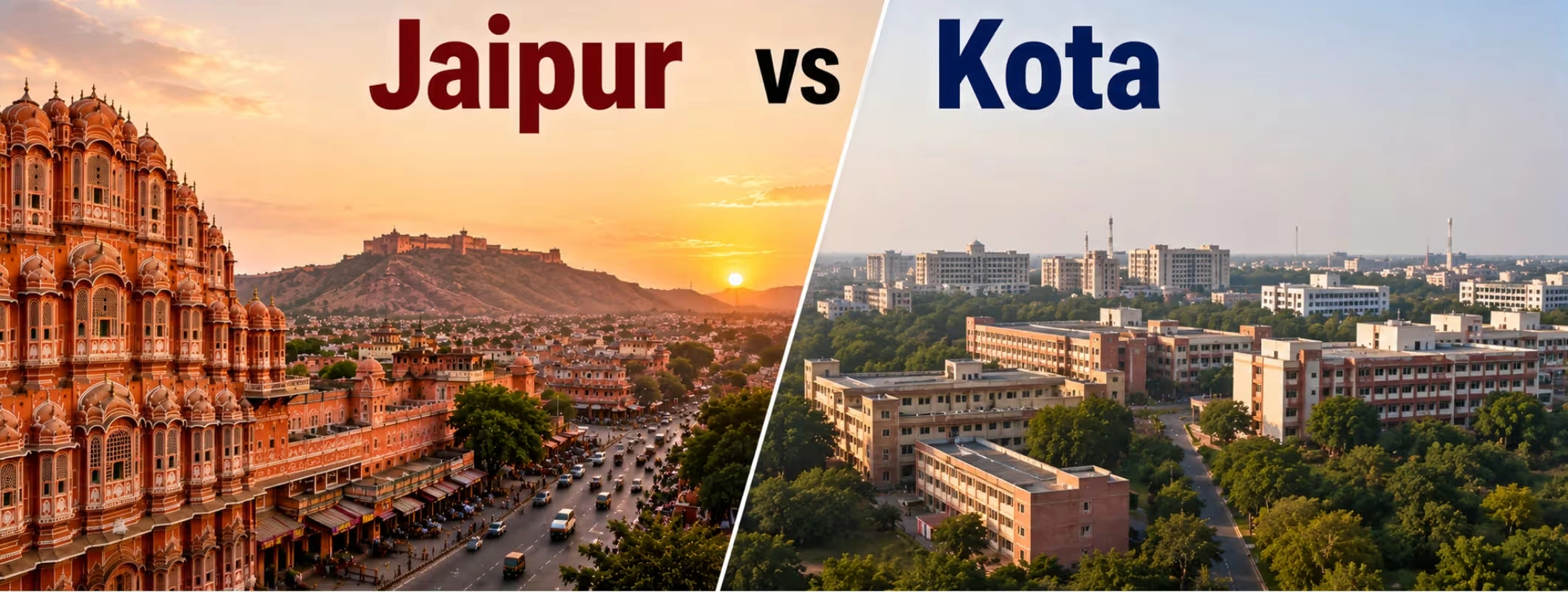
If you're weighing where to put your money in Rajasthan real estate, you've probably already narrowed it down to these two. Jaipur, the capital with the smart city tag and metro lines going up. Kota, the coaching capital that quietly runs one of India's most reliable rental economies. Both are genuinely good options. But they're good for very different reasons, and picking the wrong one for your goals can mean years of underwhelming returns. Let's actually break this down instead of just saying "both are great" and leaving you to figure out the rest.
Two Very Different Growth Stories
Jaipur's growth is driven by major infrastructure projects such as the Metro expansion, Ring Road, the Delhi-Mumbai Expressway, and Smart City initiatives. Rising land values have also created better opportunities for owners looking to sell agricultural land in India, as demand for strategically located and verified land continues to increase.
Kota's growth follows a different path, with its real estate market supported by the city's large student population and year-round rental demand. This consistent occupancy makes Kota a stable investment destination, offering dependable rental returns even when broader property markets experience slower growth.
Entry Prices: Which City Costs Less to Get Into?
Here's where things get interesting for anyone doing land/plot searching on a budget.
| City | Entry-Level Pricing | Prime Area Pricing |
| Jaipur | Roughly ₹4,000–7,000 per sq ft in emerging corridors | ₹8,000–20,000 per sq ft in prime locations |
| Kota | Plots starting around ₹10 lakh, apartments from about ₹22.75 lakh | Independent houses up to ₹1.3 crore in premium pockets like Shrinath Puram |
Kota generally offers a lower absolute entry point, especially for smaller residential units. Jaipur's entry pricing is higher per square foot, but the city's overall appreciation ceiling is significantly higher given its scale and infrastructure pipeline.
Rental Income: Where Kota Actually Wins?
If your main goal is steady rental income rather than long-term capital appreciation, Kota has a real edge that's hard to ignore. Areas like Mahaveer Nagar, Talwandi, and Kunhadi, all clustered around major coaching institutes, deliver rental yields in the range of 7 to 9% annually. That's meaningfully higher than what most Jaipur residential pockets typically offer. The reason is simple. Kota's rental demand isn't tied to job markets or economic cycles the way most cities are. It's tied to exam season, which happens every single year regardless of what's going on elsewhere.
Jaipur does offer rental income too, particularly in areas near IT hubs, educational institutions, and the airport corridor. But it's a more conventional rental market, with tenant turnover, job-linked demand, and yields that are respectable but not extraordinary.
Capital Appreciation: Where Jaipur Pulls Ahead?
If you're after long-term wealth building rather than monthly rental checks, Jaipur is the stronger pick. The scale of infrastructure investment happening right now- metro, ring road, expressway connectivity, and Mahindra World City's SEZ development- is the kind of multi-project momentum that tends to compound land value over years, not just months.
Jaipur has maintained an accelerating appreciation rate of around 20 to 25% annually since 2020 in several growth corridors. That's a different growth curve compared to Kota, where property values rise steadily but rarely see the sharp jumps that infrastructure-triggered markets experience. For someone specifically focused on land investment in Jaipur, particularly in corridors like Ajmer Road, Jagatpura, and areas near the ring road, the underlying logic is straightforward: infrastructure completion tends to pull prices up faster than organic demand alone ever could.
Comparing the Two Side by Side
| Factor | Jaipur | Kota |
| Primary growth driver | Infrastructure (metro, ring road, expressway) | Education sector (coaching industry) |
| Typical rental yield | Moderate, job and IT-driven | High, 7–9% in coaching hub zones |
| Entry cost | Higher per sq ft in prime areas | Lower absolute entry price |
| Demand stability | Tied to economic and urban growth cycles | Cyclical but highly predictable (exam seasons) |
| Best suited for | Long-term capital appreciation | Steady rental income |
| Risk profile | Moderate, infrastructure timelines can shift | Lower volatility, demand rarely dips |
Which Should You Actually Choose?
This really comes down to what you're optimizing for.
Go with Jaipur if:
- You're looking for long-term land investment in Jaipur with strong appreciation potential
- You can hold the asset for several years while infrastructure projects mature
- You want exposure to a city with SEZ development, metro connectivity, and expressway access all developing simultaneously
Go with Kota if:
- You want dependable, higher rental yields sooner rather than later
- You prefer lower entry costs with lower volatility
- You're comfortable with a niche, education-driven market rather than a broad urban growth story
Some investors actually do both, treating Jaipur as their long-term appreciation play and Kota as a rental income generator that keeps cash flowing in the meantime.
What About Agricultural and Peripheral Land?
Both cities have solid options outside their core urban zones. Jaipur's peripheral belts along Ajmer Road and Sikar Road still have farmland for sale at accessible prices, appealing to rural land buyers looking for future appreciation as the city expands outward. Kota, meanwhile, sits along the broader Delhi-Mumbai Industrial Corridor route, which has been pulling in industrial and residential demand to areas surrounding the city, including agricultural land for sale on its outskirts. If you're a buyer thinking beyond just city-center apartments, both markets offer this quieter, lower-cost entry route.
Where does 2Bigha help with either city?
Whichever city you lean toward, the due diligence part stays the same, and honestly, this is where most first-time investors get stuck. Verifying title status, checking land conversion records, and confirming the seller actually owns clear rights to the property. 2Bigha is built specifically for this kind of transaction—agricultural land and farmland across India, with verified land listings that take a lot of the guesswork out of buying from a distance. If you're exploring options to buy land in Jaipur's outer corridors or looking at Kota's peripheral belt, having verified listings means you're not relying purely on a local agent's word. And if you're on the other side of the table trying to sell agricultural land online, it puts your listing in front of buyers who are actually searching with intent, not just browsing.
Conclusion
There isn't a single city that's the right choice for every investor—it depends on your investment goals. If you're looking to buy land in Jaipur, the city offers strong long-term appreciation potential backed by expanding infrastructure, growing commercial hubs, and continuous urban development. In contrast, Kota is better suited for investors seeking relatively stable rental income, largely supported by its well-established education sector. Ultimately, the better investment depends on whether your priority is long-term capital growth or predictable rental returns, as well as your investment timeline.
Disclaimer: This article is for informational purposes only and does not constitute legal, financial, investment, tax, or real estate advice. Information, including market trends, property prices, infrastructure developments, and government policies, may change over time. Readers should verify all details through official sources and consult qualified professionals before making any property-related decision.