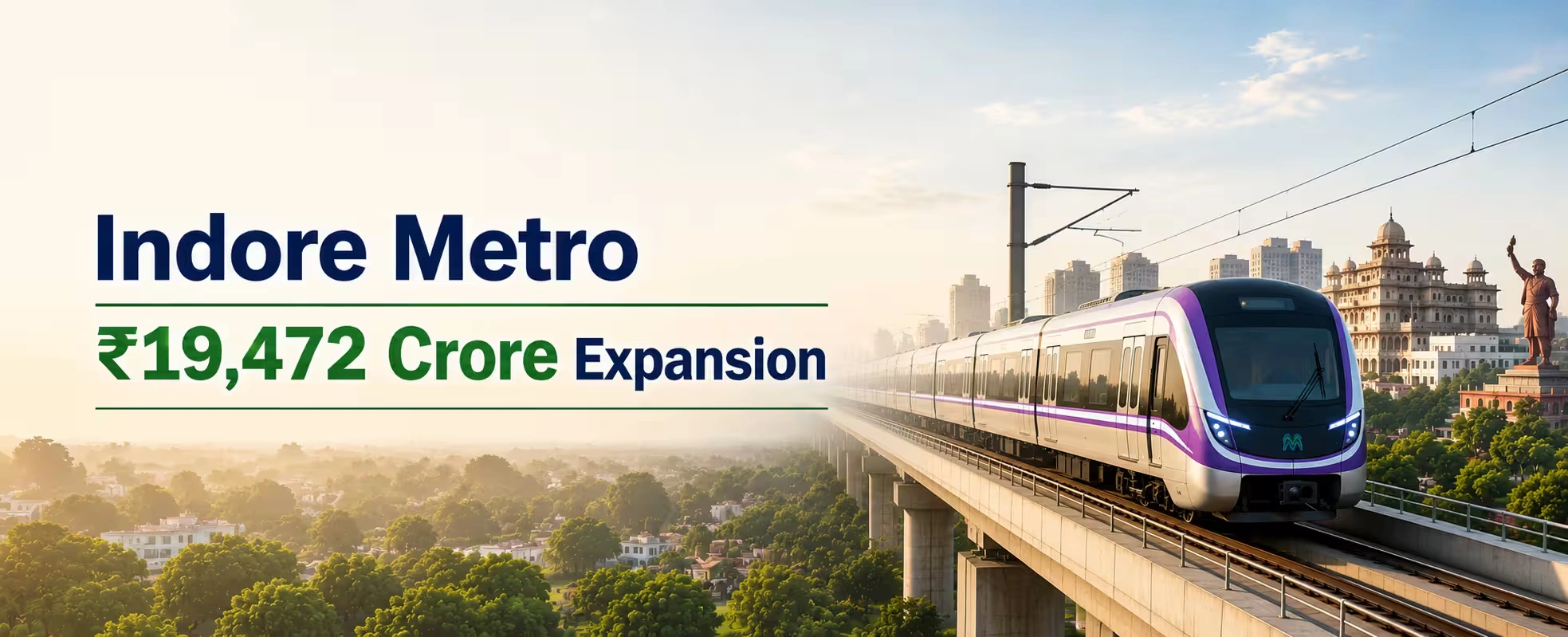
Indore’s metro story has entered a decisive new phase. In June 2026, the Madhya Pradesh Cabinet approved a revised financial package of ₹19,472.29 crore for the city’s metro rail project, significantly higher than the ₹7,500.80 crore sanctioned by the Union Cabinet in 2018.
The approval has renewed interest in the Indore Metro expansion, particularly among homebuyers, land investors, business owners and developers tracking the Super Corridor, MR-10, Vijay Nagar and Radisson Square belt.
However, the headline figure requires careful interpretation. The revised amount does not represent the cost of one newly announced corridor alone. It covers the revised base project cost, additional government equity, taxes, financing liabilities, internal loans, interest during construction and other project-related components.
For rural land buyers, the larger question is more practical: will the expanded metro meaningfully improve connectivity, rental demand and long-term property values in Indore?
The answer is yes—but the gains will not be uniform. Established locations such as Vijay Nagar may benefit through stronger accessibility and commercial demand, while the Super Corridor may experience a more gradual transformation driven by metro connectivity, employment growth and supporting infrastructure.
Key Takeaways
- The Madhya Pradesh Cabinet has approved a revised ₹19,472.29 crore financial package for the Indore Metro project.
- The original project approved in 2018 had an estimated cost of ₹7,500.80 crore.
- The first commercial metro section between Gandhi Nagar and Super Corridor-03 has already opened.
- The extended priority corridor toward MR-10, Vijay Nagar, Radisson Square and Malviya Nagar has undergone testing and safety inspections.
- A final, dependable public opening date for the entire extended corridor should be confirmed through official announcements rather than broker projections.
- Super Corridor could benefit through improved access, development activity and long-term land demand.
- Vijay Nagar may receive more immediate advantages because it already has offices, retail centres, established housing and active rental demand.
- Metro proximity alone does not guarantee appreciation. Legal approval, road access, neighbourhood quality, utilities and last-mile connectivity remain equally important.
- Buyers should compare actual station access rather than relying on advertisements that loosely use the phrase “metro-connected property.”
What Is the ₹19,472 Crore Indore Metro Approval?
The Indore Metro Rs 19,472 crore project refers to the revised financial package approved by the Madhya Pradesh Cabinet in June 2026.
The original Indore Metro Rail Project received Union Cabinet approval in October 2018. At that time, the project was planned as a 31.55-kilometre ring line with 30 stations, connecting Bengali Square, Vijay Nagar, Bhawarsala, the airport, Palasia and other important urban areas.
Its original estimated cost was ₹7,500.80 crore.
As the project moved from planning to execution, its financial requirements changed. Route realignments, underground construction, taxes, financing costs, interest during construction, infrastructure improvements and other implementation requirements increased the overall funding need.
The revised approval can broadly be understood as follows:
| Financial component | Approved amount |
| Revised base cost of Indore Metro | ₹12,889.38 crore |
| PPP components and internal debt liabilities | ₹6,582.91 crore |
| Total revised financial package | ₹19,472.29 crore |
The base cost itself increased by approximately ₹5,388.58 crore over the original ₹7,500.80 crore estimate.
This distinction matters because many reports describe the entire amount as an “expansion cost.” In reality, the package includes both revised construction expenditure and financing-related components.
Why Has the Indore Metro Project Cost Increased?
The Indore Metro revised project cost reflects several changes that commonly affect large urban infrastructure projects.
Route and Design Revisions
Metro alignments often change after detailed surveys, traffic studies, public consultations and on-ground engineering assessments. In dense urban areas, authorities may need to modify station locations, entry points, viaduct designs or underground sections.
Such modifications can increase civil construction, land, engineering and utility-shifting costs.
Underground Construction Requirements
Elevated metro construction is generally less complicated than underground work. Underground sections require tunnelling, ventilation, fire-safety systems, utility relocation, groundwater management, emergency access and more complex station construction.
Even a limited underground realignment can create a substantial increase in the overall project budget.
Higher Construction and Material Costs
The project has been under development for several years. During that period, the prices of cement, steel, electrical systems, signalling equipment, labour, energy and specialised metro components have changed.
Metro projects also require imported or highly specialised systems that may be affected by currency movements and supply-chain conditions.
Taxes and Interest During Construction
Large projects do not only carry civil construction costs. They also involve state taxes, central taxes, debt servicing, interest during construction and financing arrangements.
These financial obligations form part of the revised package.
Additional Infrastructure and Passenger Systems
Stations require escalators, lifts, accessibility infrastructure, parking facilities, security systems, signalling, telecommunications, power supply, ticketing equipment and passenger-management systems.
A station that appears structurally complete may still require months of testing and systems integration before public operations can begin.
Also Read: Indore vs Bhopal for Land Investment: Price, Growth & ROI Comparison
Is the Entire Indore Metro Network Operational?
No. The complete network is not yet open for public travel.
The first commercial section began operating on May 31, 2025. This initial stretch connects Gandhi Nagar with Super Corridor-03 and covers approximately six kilometres through five stations.
The operational stations include:
- Gandhi Nagar
- Super Corridor-06
- Super Corridor-05
- Super Corridor-04
- Super Corridor-03
This initial section gave Indore its first functioning metro service, but it primarily serves a developing part of the city. Its ability to attract large daily ridership remains limited until services reach denser residential and commercial areas.
That is why the extension toward MR-10, Vijay Nagar, Radisson Square and Malviya Nagar is far more important for regular commuters.
What Is the Status of the Extended Priority Corridor?
The extended priority corridor is planned to connect the existing Gandhi Nagar–Super Corridor section with more populated and commercially active locations.
The larger corridor extends toward locations such as:
- Bhawarsala
- MR-10
- ISBT
- Chandragupta Square
- Hira Nagar
- Bapat Square
- Meghdoot Garden
- Vijay Nagar
- Radisson Square
- Malviya Nagar
Testing has taken place across the wider corridor, including high-speed safety trials between the Super Corridor and Radisson Square. Stations at Meghdoot Garden, Vijay Nagar and Radisson Square have also undergone safety-related inspections.
However, testing does not automatically mean a route is open to the public.
Before commercial operations begin, the corridor needs the required safety clearance, completed systems integration and an official public launch announcement.
Therefore, buyers searching for the Indore Metro expansion completion date should avoid relying on an unverified date given by a seller, broker or project advertisement. Infrastructure opening dates can change because of safety approvals, technical observations and commissioning requirements.
Is This an Entirely New Metro Route?
Not exactly.
What many buyers call the Indore Metro new route is largely the phased completion and operational extension of the Yellow Line corridor already approved as part of the original metro plan.
The revised funding supports the broader implementation of the project, including sections that remain under construction, require design changes or involve underground work.
This does not mean every proposed route in Indore will become operational immediately. Different packages can remain at different stages, including planning, tendering, civil construction, systems installation, inspection and commercial launch.
Buyers should separate four different terms:
- Approved route
- Under-construction route
- Tested route
- Operational route
A route may be approved and under construction for years before passengers can use it.
How Will the Super Corridor Benefit from Indore Metro?
The Super Corridor Indore Metro connection could become one of the most influential factors shaping the city’s south-western growth.
The Super Corridor was already emerging as a development belt before metro operations began. Its proximity to the airport, educational institutions, technology campuses, office developments and major roads had created interest among investors and developers.
The metro adds another layer to this growth story.
Better Access to Employment Areas
A metro connection can make the Super Corridor more accessible to workers living in established parts of Indore. Employees may no longer need to depend entirely on private vehicles, company transport or road-based public transport.
As connectivity improves, employers may find it easier to attract workers from a wider catchment.
This can gradually strengthen demand for housing near offices and transport nodes.
Stronger Residential Development Potential
The corridor consists of developed projects, ongoing construction sites, planned developments, and undeveloped lots.
Better transportation will make more end-users think of the possibility of living there if they are accompanied by schools, marketplaces, health facilities, and other necessities of life.
Yet a metro station cannot make up for an isolated project without adequate road access or any facilities.
Potential for Commercial Activity
Retail and service businesses generally follow residential and employment density. As commuter movement increases, areas around accessible stations may attract cafés, convenience retail, coworking spaces, clinics, rental accommodation and small offices.
The strongest commercial opportunities will likely emerge around stations with good road frontage, pedestrian access and nearby employment or residential demand.
Improved Investor Confidence
Infrastructure visibility often improves market confidence. Buyers feel more comfortable considering a developing area when they can see completed stations, roads and functioning transport.
This does not mean every plot will appreciate at the same rate. Properties with clear titles, approved layouts, usable access and proximity to active development will remain better positioned.
Longer-Term Land Value Potential
Demand for land for sale near the Super Corridor may remain strong among investors who can hold for several years.
Land investment here should be viewed as a medium- to long-term decision rather than a quick resale opportunity. The development of roads, offices, utilities and social infrastructure will influence returns as much as the metro itself.
Will Vijay Nagar Benefit from Indore Metro?
Yes. In many ways, Vijay Nagar could experience a more immediate and visible impact than the early sections of the Super Corridor.
The Vijay Nagar Indore Metro connection enters an already established commercial and residential market. Vijay Nagar has offices, hotels, shopping centres, restaurants, healthcare facilities, educational institutions and mature residential neighbourhoods.
This existing activity gives the metro a ready base of potential users.
Increased Office Accessibility
Vijay Nagar attracts professionals from across Indore. Metro connectivity can make daily travel easier for employees commuting from the Super Corridor, MR-10, Gandhi Nagar and connected neighbourhoods.
Businesses may benefit from a wider employee catchment, while workers may gain a more predictable alternative to congested road travel.
Stronger Rental Demand
Rental demand around Vijay Nagar already comes from professionals, students, business travellers and families.
Improved metro access may strengthen demand for apartments that offer practical access to a station. The benefit will be stronger for properties that combine metro connectivity with walkable roads, markets, offices and public transport.
A flat that is technically within two kilometres of a station but requires an inconvenient or unsafe route may not receive the same advantage as a property with direct access.
Commercial Property Advantages
The commercial property in the Super Corridor market may depend on future development, but Vijay Nagar already has an active commercial ecosystem.
Metro access could improve footfall for selected retail locations and strengthen the attractiveness of offices near major stations. It may also improve connections between Vijay Nagar and developing employment areas toward the Super Corridor.
Better Resale Liquidity
Established localities usually offer better resale depth because buyers understand the neighbourhood, amenities and rental demand.
Metro connectivity may reinforce this advantage. It may not produce sudden price jumps, but it can support long-term marketability.
Pressure on Traffic and Parking
The metro may eventually reduce some dependence on private vehicles, but stations can also create local congestion when feeder transport, auto stands, parking and pedestrian movement are poorly managed.
The quality of station-area planning will determine whether the metro improves local movement or merely shifts congestion from one junction to another.
Super Corridor vs Vijay Nagar: Which Could Benefit More?
Both locations can benefit, but they represent different investment profiles.
| Factor | Super Corridor | Vijay Nagar |
| Market stage | Developing growth corridor | Established commercial-residential hub |
| Metro impact | Long-term development catalyst | Immediate connectivity improvement |
| Typical opportunity | Plots, new apartments and emerging commercial projects | Apartments, offices, retail and rental properties |
| Rental demand | Growing but uneven across pockets | Established and comparatively deeper |
| Social infrastructure | Developing in several sections | Mature and widely available |
| Investment horizon | Usually medium to long term | Suitable for both end use and investment |
| Main advantage | Future growth and larger development potential | Existing demand, convenience and resale liquidity |
| Main risk | Delayed development outside active pockets | Higher entry prices and traffic pressure |
| Suitable for | Patient investors and future homebuyers | End users, rental investors and commercial buyers |
There is no universal winner.
Choose Super Corridor when you are comfortable with a longer holding period and have carefully verified the exact location, development permissions and surrounding infrastructure.
Choose Vijay Nagar when you prioritise established amenities, rental demand, commercial activity and stronger resale visibility.
Which Other Indore Areas Could Benefit?
The metro’s influence will not remain limited to two locations.
MR-10
The MR-10 Indore Metro section has strategic importance because MR-10 functions as a major movement corridor and connects several residential, transport and commercial zones.
Improved connectivity could support housing demand around accessible parts of MR-10, especially where road infrastructure and public transport links already exist.
Radisson Square and Malviya Nagar
The Radisson Square Metro connection is important because it brings the metro closer to dense urban activity.
This section can attract significantly more daily commuters than the initial low-density corridor. It also improves connectivity between eastern Indore, Vijay Nagar and the Super Corridor side.
Gandhi Nagar
The Gandhi Nagar Metro route already provides access to the operational section and the metro depot area.
Its long-term real-estate impact will depend on surrounding residential development, road access, airport-side connectivity and the frequency of metro services.
Hira Nagar, Bapat Square and Meghdoot Garden
These locations have established housing and regular movement demand. Metro access can support end users who travel toward Vijay Nagar, MR-10 or the Super Corridor.
Properties within these areas may benefit more through improved convenience than through speculative land appreciation.
Airport-Facing Areas
The original ring-line concept includes airport connectivity. Once the relevant sections become operational, areas with practical airport and metro access may attract professionals, business travellers and rental users.
Investors should still verify the exact operational route and station distance instead of assuming every airport-side property is metro-connected.
Will Indore Metro Increase Property Prices?
The Indore Metro real estate impact will be positive in selected locations, but buyers should not expect uniform price appreciation across the city.
Metro infrastructure generally supports property markets by:
- Reducing travel friction
- Improving access to employment centres
- Expanding the buyer and tenant catchment
- Encouraging commercial activity
- Improving the visibility of developing areas
- Supporting organised urban growth
However, these benefits depend on actual use.
A station surrounded by active offices, housing and feeder transport can influence demand more strongly than a station located in a low-density area with weak last-mile connectivity.
Property values can also rise before a corridor becomes operational because sellers price in future expectations. By the time services begin, some of the anticipated benefits may already be included in asking prices.
Therefore, buyers should not pay an unreasonable premium only because a project is marketed as property near Indore Metro.
Metro Connectivity Does Not Guarantee Investment Returns
Infrastructure improves a location’s potential, but it cannot correct fundamental property problems.
A legally disputed plot will not become safe because a metro station opens nearby. An unapproved layout will not become approved because demand increases. A project with poor construction quality will not become suitable for families simply because commute time falls.
Before considering an Indore Metro property investment, assess the complete property rather than a single marketing point.
The most important questions are:
- Is the ownership clear?
- Is the layout legally approved?
- Does the property have a usable approach road?
- Are water, drainage and electricity available?
- Is the neighbourhood occupied or mostly vacant?
- Can a commuter realistically reach the metro station?
- Is the property suitable for an end user, tenant or only another investor?
- Is the asking price supported by recent transactions?
- Has the seller already added an excessive “metro premium”?
How Far from a Metro Station Is Still Valuable?
There is no fixed distance that works in every Indian city.
A property within 500 metres may appear ideal, but noise, traffic, station parking and commercial congestion can reduce residential comfort.
A home one to three kilometres away may offer a better living environment when residents can reach the station through a direct road or feeder service.
For practical evaluation, buyers should consider:
Walking Distance
A walkable property should have a continuous, reasonably safe route. A short aerial distance is meaningless when railway lines, vacant land, drains, highways or restricted campuses block access.
Driving and Feeder Time
Measure the actual time required during morning and evening traffic. A property advertised as “five minutes from metro” may take much longer during peak hours.
Station Entry Location
Large stations can have entry gates on different sides of a road or junction. A property may be close to the station structure but far from the usable entrance.
Parking and Auto Availability
End users may rely on two-wheelers, shared autos, e-rickshaws or feeder buses. A station with organised last-mile options creates a wider impact area.
Should You Buy a Plot on the Super Corridor?
Buyers looking to buy and sell plots near Super Corridor Indore should evaluate the purchase as a land investment, not simply as a metro investment.
A well-located approved plot can benefit from:
- Improved regional connectivity
- Nearby office and institutional development
- Airport access
- Future housing demand
- Metro visibility
- Wider road infrastructure
But land carries specific risks. Boundaries may be unclear, access roads may exist only on paper and nearby development may take longer than expected.
Before paying a booking or token amount, verify:
- Registered ownership documents
- Chain of title
- Encumbrance status
- Diversion and permitted land use
- Approved layout and plot dimensions
- Physical demarcation
- Road access mentioned in official records
- Applicable development authority permissions
- Tax and revenue records
- Any acquisition, reservation or road-widening proposal
- Actual distance from the planned or operational station
Do not rely only on statements made by a property consultant in the Super Corridor. Ask a qualified legal professional to verify the documents independently.
Should You Buy a Flat Near Vijay Nagar Metro?
Demand for flats for sale in Vijay Nagar Indore may remain resilient because the area already supports employment, retail and lifestyle needs.
For an end user, a Vijay Nagar property can provide:
- Better access to offices
- Established markets and services
- Healthcare and educational facilities
- Rental potential
- Easier resale
- Future metro convenience
However, buyers should assess traffic, parking availability, building age, maintenance charges and actual station access.
Older apartments in good locations may offer strong rental potential but require higher maintenance. New projects may provide better amenities but come at a premium.
The correct decision depends on whether the buyer prioritises rental income, self-use, appreciation or long-term convenience.
Residential, Commercial or Land: Which Investment May Work Better?
Residential Property
Residential demand usually grows where metro access connects homes with employment, education and daily services.
Apartments near Vijay Nagar, Hira Nagar, Bapat Square and MR-10 may appeal to commuters once the extended corridor becomes fully operational.
Commercial Property
Commercial properties can benefit from improved employee access and customer movement. However, commercial returns depend heavily on frontage, tenant demand, parking and surrounding business activity.
A shop near a station is not automatically profitable. Passenger movement must pass the property rather than bypass it through station exits, skywalks or service roads.
Plotted Land
Land near the Super Corridor may offer higher appreciation potential, but it also requires patience and careful due diligence.
Plots usually do not generate immediate rental income. Their returns depend on broader development and the availability of future buyers.
What Type of Buyer Should Consider Each Location?
End Users
Families should prioritise neighbourhood quality, schools, healthcare, road access, safety and water availability. Metro access should improve an already liveable location rather than replace essential amenities.
Rental Investors
Rental investors should focus on tenant demand, unit size, maintenance costs, office proximity and realistic rent.
Vijay Nagar and established nearby areas may offer stronger current rental visibility than undeveloped sections of the Super Corridor.
Long-Term Land Investors
Patient land investors may consider approved opportunities on or near the Super Corridor, particularly where employment, roads and occupied developments are progressing together.
Commercial Investors
Commercial buyers should study pedestrian flow, road visibility, office occupancy and actual station entry points. Buying only on the basis of a proposed station can be risky.
Practical Property-Buying Checklist for the Indore Metro Corridor
Use this checklist before buying property marketed around metro connectivity:
- Confirm whether the nearest station is operational, under construction or only proposed.
- Measure the distance using the actual road route.
- Visit the location during peak traffic hours.
- Check whether the property has direct legal road access.
- Verify ownership, approvals and encumbrances.
- Compare asking prices with recent registered transactions.
- Examine water supply, drainage, electricity and street lighting.
- Check nearby schools, hospitals, offices and markets.
- Study existing occupancy rather than only future promises.
- Calculate realistic rent instead of accepting projected returns.
- Review maintenance charges for apartments and commercial units.
- Inspect the site during monsoon conditions where possible.
- Avoid paying a large premium based only on metro branding.
- Verify every verbal claim through official records.
- Speak to residents or businesses already operating nearby.
Property Price Growth and Collector Guideline Rates Are Not the Same
Buyers often confuse collector guideline rates with actual market prices.
Collector guideline rates determine the minimum valuation used for registration and stamp-duty purposes. Market value reflects what buyers and sellers are willing to transact at.
For the 2026–27 financial year, guideline rates were increased across a large number of locations in Indore. Vijay Nagar, Dewas Naka, Super Corridor and Airport Road were among the broader areas affected.
This may increase registration expenses even when a seller’s asking price remains unchanged.
It does not prove that every property is appreciated by the same percentage.
When studying Indore Metro property prices, compare three separate numbers:
- Collector guideline value
- Seller’s asking price
- Recent registered transaction value
The registered transaction value is generally more useful than an advertisement because advertisements often include negotiation margins and speculative premiums.
What Are the Main Risks for Buyers?
Delayed Commercial Operations
Metro construction and testing can progress while the public opening is delayed. Buyers should not structure short-term investment plans around an unofficial inauguration date.
Overpricing around Proposed Stations
Sellers may increase prices as soon as a station is announced. In some cases, the increase may exceed the realistic benefit.
Weak Last-Mile Connectivity
A metro corridor cannot serve a large residential catchment effectively without feeder transport, footpaths and safe road crossings.
Uneven Development
One section of the Super Corridor may have occupied offices and housing, while another remains largely vacant. Broad locality names can hide major differences between micro-markets.
Speculative Plotting
Rapid infrastructure development can attract unapproved plotting and unclear land transactions. Buyers must verify legal status rather than depending on brochures.
Construction Disruption
Properties close to active construction may experience dust, diversions, noise and temporary access problems before receiving long-term benefits.
High Registration Costs
Revised guideline rates can increase stamp duty and the overall acquisition cost. Buyers must include these expenses when calculating returns.
How to Identify the Best Property Locations near Indore Metro
The best property locations near Indore Metro will not necessarily be the closest properties to a station.
A strong location usually combines five factors:
1. Operational or Credible Connectivity
An operational station offers greater certainty than a distant proposal.
2. Existing Demand
Areas with offices, colleges, hospitals or active housing can create immediate ridership and rental demand.
3. Good Approach Roads
A metro station works better when commuters can reach it safely and quickly.
4. Liveable Social Infrastructure
Markets, schools, healthcare and public spaces matter more to families than an isolated transport facility.
5. Reasonable Entry Price
Even an excellent location can become a poor investment when the purchase price already assumes unrealistic future growth.
Based on these factors, Vijay Nagar may suit buyers seeking established demand, while the Super Corridor may suit investors seeking a longer-term growth opportunity.
MR-10, Hira Nagar, Bapat Square, Meghdoot Garden and Radisson Square may also attract demand depending on station access, property quality and entry pricing.
How 2Bigha Can Support Land Buyers and Owners
Infrastructure-led development creates opportunities, but it also makes land searches more confusing. Buyers may encounter repeated listings, unclear locations, exaggerated distance claims and incomplete ownership information.
2Bigha helps users explore land opportunities through a map-led property discovery experience, compare locations and connect with sellers more efficiently. For buyers studying Indore’s growth corridors, this can make it easier to evaluate the relationship between a property, nearby roads and major infrastructure.
Property owners can also explore 2Bigha’s subscription plan and property management service for continued assistance based on their requirements.
Technology can simplify property discovery, but buyers should still complete independent legal, physical and financial verification before purchasing land.
Final Verdict: Will Super Corridor and Vijay Nagar Benefit?
Yes, both locations are positioned to benefit from improved Indore Metro connectivity, but the nature and timing of those benefits will differ.
Vijay Nagar has the stronger near-term case. It already has dense commercial activity, established housing, retail destinations and rental demand. Once regular metro services connect it more effectively with MR-10, the Super Corridor and Gandhi Nagar, commuters will gain a useful alternative to road travel.
The Super Corridor presents a longer-term development opportunity. Its future depends on the combined progress of metro services, office occupancy, residential development, roads and social infrastructure. Well-selected properties may gain from this transformation, but poorly located or legally unclear plots will remain risky.
The ₹19,472.29 crore approval is a major financial commitment to Indore’s urban mobility. It improves the project’s ability to move forward, but buyers must not treat the funding approval as proof that every corridor is complete or that every nearby property will rise sharply in value.
The most sensible strategy is simple: buy a legally sound property in a usable location at a reasonable price. Let metro connectivity strengthen the investment rather than become the only reason for making it.
Disclaimer: This article is for informational purposes only and should not be considered investment, legal, financial, or property advice. Real estate regulations, infrastructure plans, market conditions, and government policies may change over time. Readers are advised to verify information with relevant authorities and consult qualified professionals before making any investment or property-related decisions.