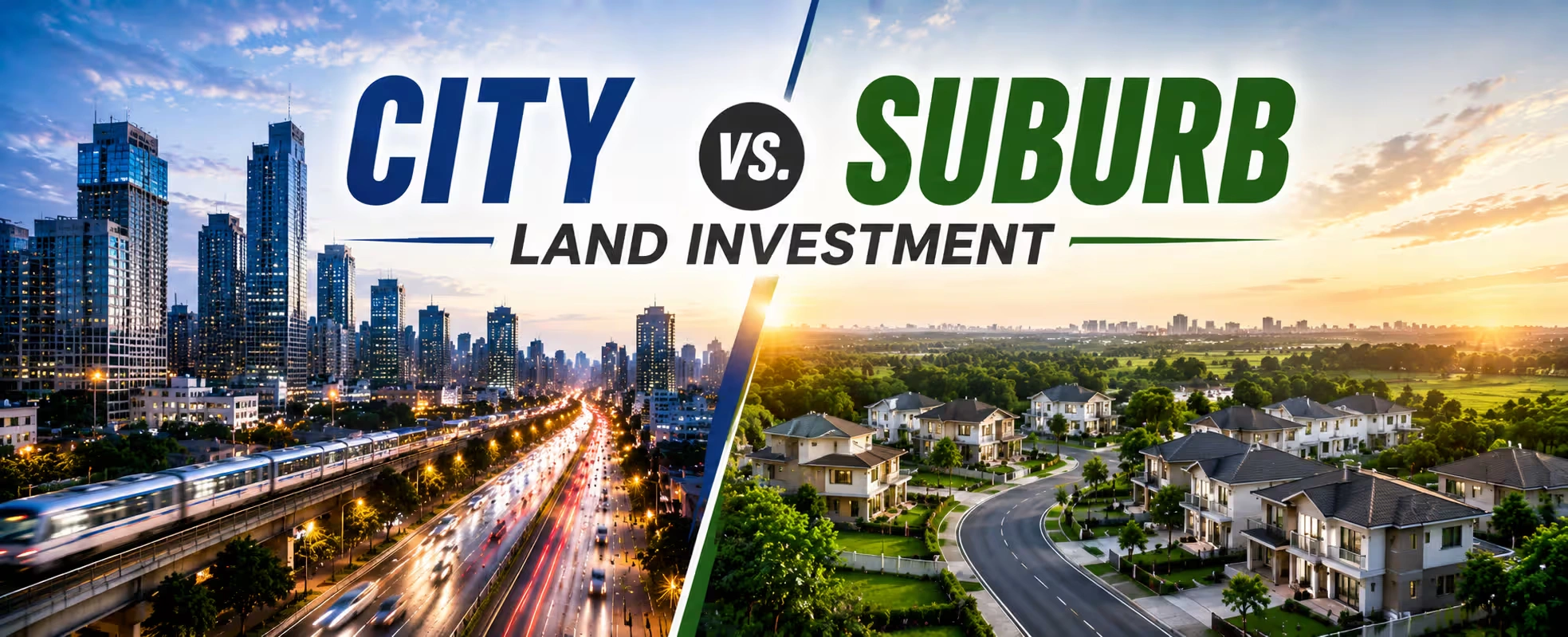
Land has long remained a preferred investment option in India. It is a tangible asset, its supply is limited, and a well-selected plot can generate significant appreciation over time. Most buyers ask one common question: Should they invest in expensive city land or buy affordable land in a developing suburb?
The right answer depends on your budget, investment period, purpose and ability to handle risk. City land generally offers established infrastructure, stronger demand and easier resale. Suburban land provides larger lands at comparatively lower prices and may deliver stronger appreciation when development expands towards the area.
The best land investment is not automatically the cheapest land or the most central one. It is a legally clear property with proper access, suitable land use and genuine future demand.
City Land vs. Suburban Land: Quick Comparison
| Factor | City Land | Suburban Land |
| Purchase cost | Usually high | Comparatively affordable |
| Plot size | Mostly smaller | Larger options available |
| Infrastructure | Well established | Developing |
| Appreciation | Stable and predictable | Potentially higher but uncertain |
| Resale potential | Generally stronger | May take longer |
| Development risk | Lower | Comparatively higher |
| Best suited for | Stability and near-term use | Long-term growth |
What Is City Land Investment?
Urban or City lands are the city or main area of the location like market, school, or near flats/houses, roads, public transport, electricity, water supply, schools, hospitals, offices and shopping centres nearby. Land like residential, agricultural, commercial are in City or mixed-use lands within established urban areas. The advantage of investing in city or urban land is already in demand or ongoing infrastructure. People already live, work, run businesses, and use the metro (if available) in these locations. A legally clear land near an established residential neighbourhood, commercial district, metro station or major road may continue attracting buyers even during a slower property market.
City land also offers better price visibility. Investors can examine recent transactions, nearby property rates, rental demand and ongoing construction before making a decision. Depending on local development rules, the land may also support rental housing, shops, clinics, offices or other income-generating uses.
However, city land is expensive. Investors often pay a large amount for a relatively small parcel of land because the price already includes the value of connectivity, infrastructure and location.
In mature urban areas, appreciation may remain steady instead of exceptionally high because much of the area’s development potential is already reflected in the current price.
City land is generally suitable for buyers who have a higher budget and prefer established infrastructure, easier resale and lower location-related uncertainty.
What Is Suburban Land Investment?
Suburban land is located outside the main city centre but within its wider expansion zone. It may be situated near ring roads, check mega expressways, industrial corridors, upcoming airports, universities, logistics parks or developing residential areas.
Affordability is its biggest advantage. A buyer may be able to purchase a much larger suburban plot for the cost of a small city property. This makes suburban land suitable for future home construction, rental housing, warehouses, weekend homes, plotted development or long-term land banking.
Suburban land may also deliver higher percentage appreciation when infrastructure improves connectivity and attracts employment, housing and commercial activity.
However, investors should not purchase land only because a broker claims that a highway, metro line or industrial project is “coming soon.” Proposed infrastructure can face delays, route changes or cancellation.
Look for visible signs of development, such as:
- Roads or infrastructure already under construction
- Approved housing and commercial projects
- New schools, hospitals and retail centres
- Factories, offices or logistics facilities nearby
- Regular public transport
- Growing end-user demand
Real estate prices rise sustainably when people have a genuine reason to live, work or build in a location.
Cost Comparison: Where Does Your Budget Go Further?
City land requires considerably more capital. Buyers pay for limited supply, established services, connectivity and access to employment centres. A high purchase price may also reduce the size of the plot that an investor can afford.
Suburban land offers more space for the same budget. This makes it attractive for first-time land investors and buyers with a long-term investment horizon.
However, a low quoted price can hide additional costs. Buyers may need to spend money on:
- Stamp duty and registration
- Brokerage and legal fees
- Land conversion charges
- Fencing and security
- Land levelling
- Road development
- Electricity and water connections
- Property taxes and maintenance
Always compare the total acquisition cost rather than looking only at the sale price.
A cheap plot is not a good investment when it has unclear boundaries, no legally recorded access road or restrictions on construction.
Growth and Appreciation Potential
City land usually appreciates because demand remains consistent while the supply of vacant plots continues to decrease. Growth may be gradual, but established urban locations generally provide better liquidity and more predictable pricing.
Suburban land depends more heavily on future development. Its growth potential may be higher, but so is the uncertainty.
Suburban areas near employment hubs, industrial zones, expressways, metro corridors and expanding residential clusters usually have better prospects than isolated plots sold mainly through speculative marketing.
Before investing, study whether people are genuinely moving into the area. Check new construction, road traffic, housing occupancy, commercial activity and nearby employment opportunities.
Avoid buying in a location where prices are rising only because investors are repeatedly selling plots to other investors. Sustainable appreciation requires actual end-user demand.
ROI: City Stability vs. Suburban Growth
Land investment generally generates returns through capital appreciation. Unlike a completed apartment or commercial property, vacant land may not provide regular rental income.
City land may offer more dependable returns because infrastructure and buyer demand already exist. It may also provide earlier opportunities for construction or rental development. However, its high entry price may limit the percentage return.
Suburban land can produce higher percentage gains when purchased before an area becomes fully developed. The trade-off is a longer holding period, uncertain development timelines and potentially slower resale.
Investors should calculate return on investment using the total amount spent:
ROI = Net Gain ÷ Total Investment × 100
Total investment should include the purchase price, registration, legal verification, fencing, maintenance, taxes, loan interest and other holding costs.
A plot showing strong appreciation on paper may still be a weak investment if finding a genuine buyer takes several years.
Is Agriculture Farmland a Good Investment?
Agriculture farmland can be an attractive option for buyers looking for larger land parcels, farming income, farmhouse development, weekend use or long-term appreciation.
Farmland near a growing city may benefit from improved roads, increasing population and demand for agricultural estates or farmhouse communities.
However, agricultural land is different from residential land. Purchase eligibility, construction permissions, conversion requirements and permitted uses vary between Indian states.
Before buying agriculture farmland, verify:
- Legal ownership and title history
- Agricultural land classification
- Eligibility to purchase the land
- Road access and boundaries
- Water and irrigation availability
- Soil condition
- Flood or waterlogging risk
- Electricity connection
- Tenancy or cultivation rights
- Rules for non-agricultural conversion
Never assume that agricultural land can automatically be converted into residential or commercial land. Consult a local property lawyer and the relevant revenue authority before making any payment.
Legal Checks You Should Never Skip
Whether you buy city land, suburban land or agriculture farmland, proper legal verification is essential.
Ask an independent property lawyer to examine:
- Title deed and ownership history
- Encumbrance records
- Mutation and revenue records
- Property tax receipts
- Survey number and measurements
- Approved layout
- Land-use classification
- Development permissions
- Government acquisition notices
- Legally recorded access road
City or Suburb: Which One Should You Choose?
Choose city land when you have a higher budget, want established infrastructure, prefer easier resale and plan to develop the property relatively soon.
Choose suburban land when you want a land, can hold the property for several years and are comfortable researching future infrastructure and growth.
Choose agricultural farmland when your objective includes farming, farmhouse use, managed cultivation or long-term land banking, provided local laws allow the purchase and intended use.
Explore the 2Bigha Map and check the land price and city insight. Also compare the land price of urban and suburban areas and then make decisions wisely. If you are planning to buy land in India, Check all the land details and records on 2Bigha.
Final Verdict
City land offers better infrastructure, stability and resale demand, but it requires a larger investment. Suburban land offers affordability and potentially stronger appreciation, but it carries greater development and long term investment.
A legally clear suburban land near real infrastructure may outperform a poorly located city land. Similarly, city land in a high-demand neighbourhood may remain safer than cheap land in an unplanned outer area but it'll give you a high return in 5 to 8 years if there is an expressway or factory.
2Bigha is a land marketplace platform where buyers and sellers can connect directly. Buyer can direct calls and whatsapp to sellers. Here buyers get the exact location of the property, its 2Bigha Map based listing that shows the real lands and locations where you're searching with road access, soil types, nearby localities, etc. Different land, requirements,and use but all gets under one roof.
Make your decision based on ownership documents, legal access, land use, infrastructure and actual demand. Do not invest only because the price appears low or someone promises rapid appreciation.
Disclaimer: This article is for informational purposes only and should not be considered investment, legal, financial, or property advice. Real estate regulations, infrastructure plans, market conditions, and government policies may change over time. Readers are advised to verify information with relevant authorities and consult qualified professionals before making any investment or property-related decisions.