If you're selling, buying, or cultivating, knowing the exact dimensions of the farmland you own is vital. A precise agriculture land area calculation is the basis of planning your land budgeting, planning, irrigation, and other legal documents. In the past, measuring land was based on manual techniques and agricultural land measurement units. However, the age of technology has introduced powerful tools such as an Agricultural Land area Calculator, making precise measurements of land accessible and easy.
Why Accurate Land Measurement Matters?
Before examining the best ways to use an agricultural land area calculator, it is important to know the reasons why a precise agricultural land area calculation is crucial.
- Land Valuation: The dimensions of your property directly affect the market value.
- Measurement: Measurement of the crop will help you determine how much fertilizer, seeds, and water are needed.
- Legal Documentation: Government Records and land registrations depend on the right zone.
- Grants and Subsidies: The majority of banks and agricultural subsidy schemes require verification of the size of the land.
With the growing demand for precision and transparency, traditional tape measures and manual surveying aren't sufficient. This is where tools such as those of the agricultural land area calculator step into the picture.
Understanding Agricultural Land Measurement Units
Land measurement differs between regions. In India alone, you may encounter units such as bigha, biswa, guntha, acre, or hectare, depending according to the region. Therefore, a calculator for land area with access to an accurate land conversion table becomes indispensable.
Here's a quick overview of the most commonly utilized agricultural land measurement units:
- Acre - Most often used in the world.
- Hectare - Is a preferred choice for large-scale agricultural use.
- Bigha/Biswa: Regional units that are used to operate in the northern part of India.
- Guntha - Common in Maharashtra and Karnataka.
- Katha/Dhur - Often used in eastern states such as Bihar as well as Jharkhand.
A reliable agricultural land area calculator will let you enter land dimensions and choose from a range of agriculture land measurement units to obtain exact results.
What Is an Agricultural Land Area Calculator?
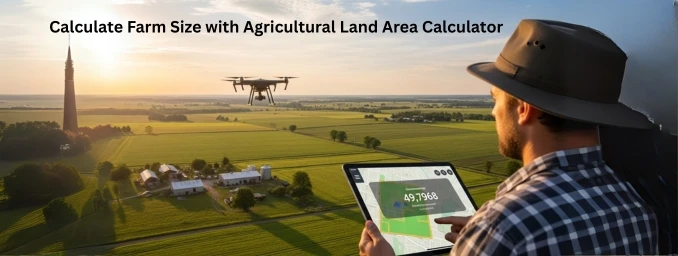
The Agricultural Land Area Calculator is a digital tool created to ease the process of measuring the land. It utilizes user-supplied dimensions, such as width and length, to calculate the area with embedded algorithms, as well as a land conversion table. No matter if your land is triangular, rectangular, or has a shape that is an irregular shape, an agriculture land calculator can give you the results that are in the unit you prefer. Advanced calculators can also permit users to sell agriculture land.
- Switch between different units (e.g., bigha to acre or to guntha)
- Utilize GPS or other mapping-based tools for live agriculture land area calculation
- Keep historical data as documentation
- Print or download reports
The calculators are available online or via mobile applications and are extremely user-friendly.
Step-by-Step Guide to Calculating the Farm's Size Using the Help of an Agricultural Land Area Calculator
Step 1: Gather Land Details
Before you start using a calculator, collect the required details:
- Length and width of terrain (in feet, meters, yards, or feet)
- The plot's shape (rectangular or triangular, or irregular)
- Existing documents containing the local agriculture land measurement units
Step 2: Choose a Reliable Calculator
Choose one of the agricultural land area calculators that provides:
- Multiple input unit choices
- A complete land conversion table
- Options to transform results into regional units
- GPS assistance (if required)
Step 3: Input Land Dimensions
Input the values you have measured in the calculation. If your land isn't in the right shape, many tools offer the option of drawing polygons using the satellite map interface.
Step 4: Select the Preferred Measurement Unit
Choose the unit that you'd like to view your results in, whether it's an acre, bigha, hectare, or another. The calculator for agricultural land instantly converts and displays results according to a table that is internal to the land conversion table.
Step 5: Review and Save Results
After you have received the output, look over the breakdown. Certain calculators will also display the equivalent area of multiple units, which can be helpful when dealing with officials or buyers with different standards.
Advantages of Using an Agriculture Land Area Calculator
Utilizing a digital agriculture land calculator doesn't just save time but also increases accuracy. The reasons to consider making use of one:
- Accuracy: Eliminates human error.
- Time-Saving: Calculates complex plots in a matter of minutes.
- Flexibility: It supports a wide selection of agriculture land measurement units.
- Convenience: Most are mobile-friendly and can work offline.
- Documentation: Helps in creating verifiable records for government use.
For instance, farmers who plan to sell a part of a larger plot may make use of the agricultural land area calculator to precisely divide a parcel into bighas, while also cross-verifying the acres or hectares.
Tips to Ensure Correct Agriculture Land Area Calculation
- Double-check Measurements, and make use of GPS or professional surveyors if you're not sure.
- Know Local Units - Know about the locale's agricultural land measurement units and their conversions.
- Make sure to use updated calculators - Ensure that the calculator is using current conversion rates for its land conversion table.
- Cross-Verify with Maps - Check with land records of the government or satellite maps to confirm.
- Keep digital Copies - Keep those results from your land calculator for later use.
Conclusion
The calculation of the size of your farmland isn't an arduous or difficult process for you. With a quality Agricultural Land Calculator from 2Bigha, you can carry out exact agriculture land area calculations in just a couple of steps. Through a thorough understanding of the regional agricultural land measurement units, by using an accurate land conversion table, and using smart tools such as the calculator for agricultural land owners and farmers, they can make informed decisions about cultivation and sale, or investment.
As technologies continue to improve, adopting them will keep you up-to-date, precise, and productive.