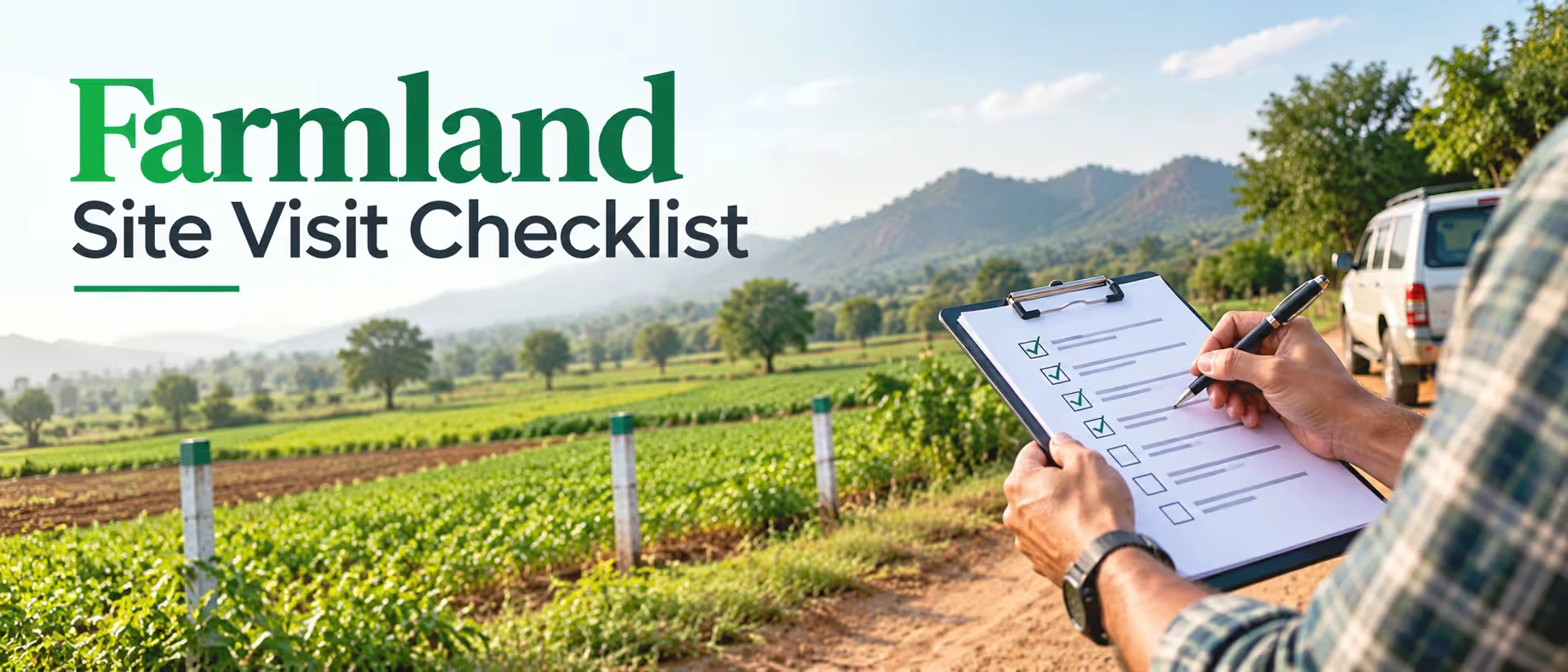
The site visit is the only thing in the process of buying land that cannot be replaced by any documents. You may spend an hour looking at the khasra number, but you might not know that the piece of land is two feet below the road level and floods every August. Typically, most people start their search by typing something like farmlands near me, select two plots after looking at the pictures, and then come for a quick visit where the agent talks all the time. This is where things go wrong. Below you will find 15 points that you should check while visiting a plot, and water will have its own place down below since it can determine whether the land will be a good farm or not.
Before leaving for a visit, define your goal. A good search is not about enjoying the scenery but about proving that what is written in the description coincides with what you see on the ground. Take your notebook, a good phone with a camera, a tape measure, a spade, and printouts of all the documents provided by the seller.
The 15 Things to Check
1. Walk the full boundary
Do not stop at the front gate. Inspect all four sides with a hard copy of the revenue map or sketch and verify that there are no stones, fences, or bunds in places other than those indicated in the map. If the broker says "it goes up to that tree", find out if anyone other than the broker knows about it.
2. Verify road access
Check if the road leads up to your plot or ends in the middle of a neighbour's field. A track through some other person's field does not constitute a right of way unless it is documented somewhere. Most plots which are indicated as agricultural land for sale near me end up being near a town but nowhere near a road, so check how you would really bring in a tractor or a truck. If possible, visit once after rains, as a kachcha road is entirely different in July.
3. Meet the actual owner
Match the identification details of the person with the name in the record. In case of inherited land, find out if all heirs agree to sell the land, as one absent brother/sister is sufficient to delay the registry process for months.
4. Match the papers to the ground
Obtain the survey or khasra number, confirm the same with your neighbor or patwari, and do a rough pacing of the land. If there’s a huge variation between the size on the plan and the measurement on the ground, find out the reason behind it first.
5. Examine the soil
Dig up a pit that is three feet deep. Observe the depth of the topsoil, the point of color change, presence of stones or hard layer, etc. Farmland with just six inches of good quality soil above the murram soil is a totally different thing to buy from the one with two feet of good loam soil, despite the fact that both may be classified as fertile soil. Also take a sample for laboratory testing, since it won’t reveal the pH value or the salinity by merely looking at it.
6. Analyze the water resources
Since each source has different questions to be asked, this item requires a separate section below.
7. Identify drainage and flood marks
The silty marks on the trunks of the trees, water marks on the pump room walls, and cracked dry mud in the lowest parts all indicate the places where the water remains during rains.
Read More: Water Availability Checklist for Farmland Buyers
8. Check electricity
Go to the nearest pole and transformer, and find out if the plot has an agricultural link already. There can be pending bills, which can remain with the connection instead of the individual, so ask for the latest paid receipt.
9. Find out who is in possession
Who is cultivating the plot right now? There could be a tenant or sharecropper who will have rights, or may just have a standing crop on the land that you have to put up with. Ask the seller, and also ask the neighboring property owner separately to see if their answers tally.
10. Check out the surroundings
Brick kilns, factories, open drains, dumping grounds, quarries, and high-tension lines all influence crops and resale. Also check out if there is any planned road, canal, or acquisition order that will make you lose a portion of your land in the future.
11. Check slope and levels
Stand on the highest point and watch. If the land is hilly, it will erode its topsoil due to rain, and if it is below the road, water will accumulate in it. Leveling is possible but will cost you money.
12. Count the number of trees and buildings
Cutting of some trees requires permission in most states, so check before taking any action. Buildings like sheds, pump houses, and fencing must be legal, and the price must clearly mention whether they are included or not.
13. Check the distance to markets
Time the journey to the nearest mandi, cold storage, input store, and hospital. Also find out the source of labor during harvesting because a distant land without any labor nearby becomes costly.
14. Speak to neighbors separately
Talk to at least two of them without the presence of the broker. Discuss boundary disputes, court cases, and why the land was offered to others and did not sell.
15. Visit twice and photograph everything
One visit tells you what the land looks like on one day. A second visit, at a different time of day or season, shows what changed. If you are comparing several listings of agriculture land for sale near me, take the same set of photos at each, with a timestamp, so you can line them up at home.
Water Availability Checklist for Farmland Buyers
Water decides what you can grow, how many crops a year you get, and in the end what the land is worth. Ask about each source separately, and treat the seller's word as a starting point, not an answer.
| Water source | What to check | Warning sign |
|---|---|---|
| Borewell | Depth, year drilled, pump capacity, yield. Ask to run it for an hour. | Output drops fast, water turns muddy, or the owner won't switch the pump on. |
| Open well | Current water level and the marks left in summer. | Dry by April, caved or cracked sides. |
| Canal or distributary | Outlet near the plot, supply schedule, charges, any pending dues. | Plot sits at the tail end, supply irregular. |
| Rain only | Rainfall pattern in the last few years, number of crops possible. | Only one crop a year and no way to store water. |
| Pond or river | Seasonal flow and whether you have legal rights to draw. | Dry for half the year, no written permission. |
Summer matters more than monsoon here. Water levels are lowest between April and June, so a visit in that window shows the worst case. If you can only come in the rains, ask neighbours what happens in May. Also look at the water itself. A white salt crust on the soil, a bitter taste, or yellowish stains on pipes can mean poor quality, and a small lab test on EC will tell you if the water might harm the soil over the years.
Shortlist Smarter with 2Bigha
Visits cost time and fuel, so cut your list down before you go. 2Bigha is a marketplace for agricultural land and farmland in India. It has verified listings, a land report that helps you check key details beforehand, and an option to book a visit once you have narrowed things down. If you are the one selling property online, you can list your land there too and reach people who are actively searching for it. Either way, the platform helps you arrive at the site with fewer unknowns, though the on-ground checks above are still yours to do.
Disclaimer: This article is for informational purposes only and should not be considered investment, legal, financial, or property advice. Real estate regulations, infrastructure plans, market conditions, and government policies may change over time. Readers are advised to verify information with relevant authorities and consult qualified professionals before making any investment or property-related decisions.