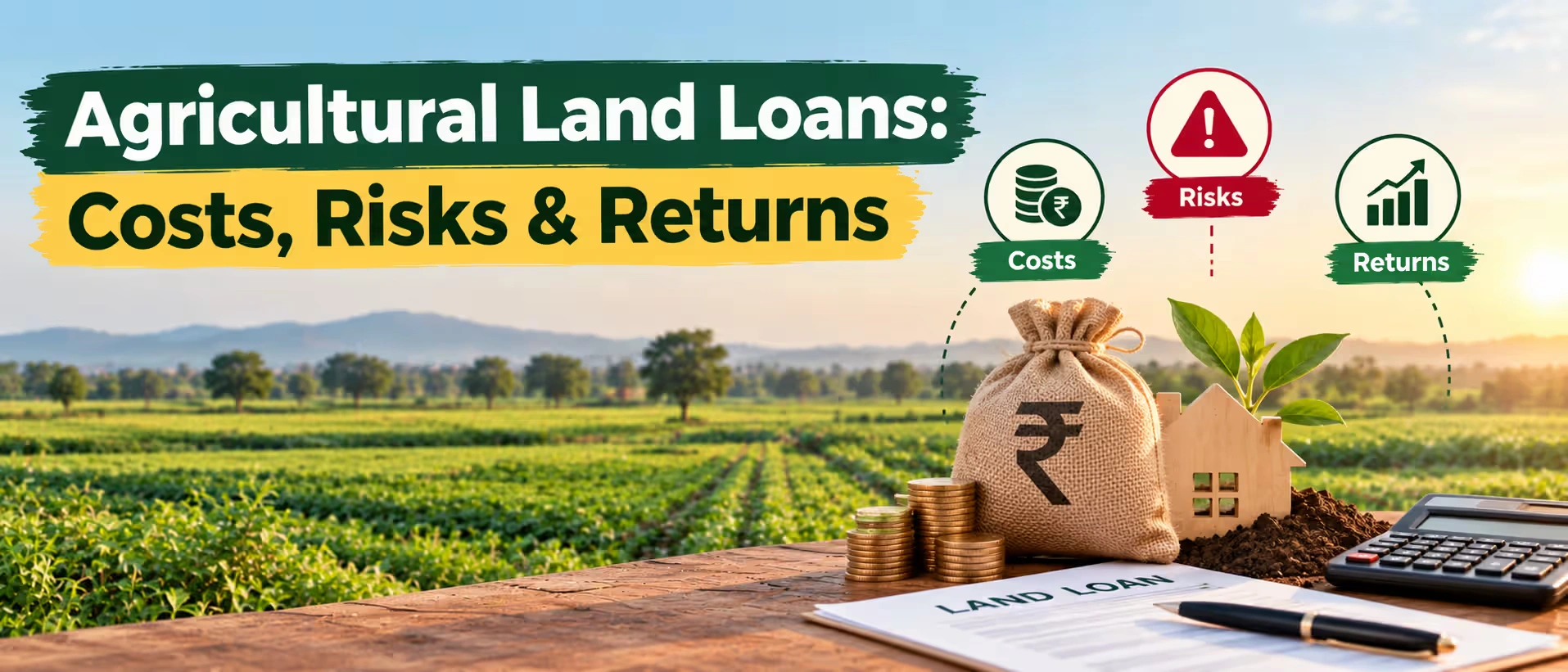
Borrowing to buy agricultural farmland can work, but only when the land earns enough, or rises in value enough, to cover the interest and the lock-in. In most cases, it does not earn enough on its own. Farm income from a typical acre is small compared with the price of the land, so a loan EMI usually has to be paid from your salary, business, or other savings, not from the field.
That is what you should know before signing on the dotted line. The rest of this article will discuss who qualifies for such a loan, the increased cost, an illustrative example complete with figures, the dangers, and the instances when taking a loan is more sensible.
Who Can Get a Loan for Agricultural Land?
Farmland lending is not as straightforward as lending for a flat or house plot. There is a standard procedure for lending money for purchasing a house. Farmland lending varies from state to state, has uneven valuation, and the lenders interested in such a venture are relatively few.
Banks and cooperative banks usually provide more support for people who are already farming or are small/marginal farmers/agricultural laborers buying their very first piece of farmland. There are some schemes of this kind offered by some banks; however, the terms of the scheme, eligibility, and the amount of the loan vary from bank to bank. It is better to consult the bank branch for the scheme details instead of following the agent’s advice. For salaried people and investors who are not farmers, farmland may be problematic; moreover, in some states, non-farmers can't buy agricultural land at all. If the state doesn’t permit the person to own the land, there is no lender who would provide financing. And one of the mistakes that people often make - Kisan Credit Card or crop loans to pay for cultivation expenses, not the land.
What the Lender Will Check?
Before approving a loan for a farm land for sale, the bank will want to make sure the land is legally sound and can be used as security if you cannot repay the loan. Here are the main things it will check:
- the ownership document (khatauni or record of rights) along with mutation, if any, in your name
- the encumbrance certificate to confirm that the property is not already mortgaged
- the sale deed registration record
- the valuation done by the bank's own valuer, which may be less than what you have mutually decided with the seller
- your proof of income and capacity to repay
The last one often surprises the buyers. Even if you decide to pay ₹30 lakh for the plot and the bank values it at ₹24 lakh, the loan is based on the latter, and you have to pay the difference out of your pocket.
The Real Cost of Borrowing
The interest rate is only one part. A loan for agricultural land adds several costs on top of the land price:
| Cost | What to expect |
|---|---|
| Down payment | Lenders rarely finance the full price, so you arrange a good share yourself. |
| Interest | Rates differ by lender, scheme, and your profile; ask for the current rate in writing. |
| Stamp duty and registration | Charged by the state and not covered by the loan in many cases. |
| Processing and legal fees | Charged by the bank and by the advocate checking the title. |
| Insurance or other charges | Some lenders add these, so read the sanction letter. |
Land bought on loan also keeps costing money after the purchase. There is land revenue to pay, fencing and some upkeep, and a caretaker if you do not live nearby.
A Worked Example With Numbers
The figures below are assumptions made for the sake of illustration. They are not market data, so replace them with local prices and your bank's actual terms.
| Item | Assumption |
| Land price | ₹30,00,000 for one acre |
| Stamp duty and registration | 6 percent, which is ₹1,80,000 |
| Loan taken | ₹20,00,000 |
| Interest rate | 10 percent a year, fixed for the whole term |
| Loan period | 10 years (120 months) |
| Your own money needed | ₹10,00,000 plus ₹1,80,000, so ₹11,80,000 |
| Monthly EMI | About ₹26,430 |
| Total repaid to the bank | About ₹31,71,600 |
| Interest paid over 10 years | About ₹11,71,600 |
| Assumed farm or lease income | ₹60,000 a year |
Now let us compare both sides. The sum total of EMIs works out to roughly ₹3,17,000 a year, whereas the land only produces ₹60,000 in a year. Therefore, the land contributes less than one-fifth to the EMIs, and the balance is taken care of by your other income sources.
In ten years' time, you would end up paying ₹11,80,000 out of your pocket and ₹31,71,600 as repayments for a total outflow of ₹43.5 lakh. If we take out ₹6 lakh worth of farm income, the net outflow works out to be approximately ₹37.5 lakh. In order to break even, you need to sell the land for ₹37.5 lakh or slightly above ₹3 lakh in today’s value, and thus the price must rise by about 25 percent in ten years or 2 percent annually. This does not factor in selling costs and interest you could earn on your ₹11.8 lakh if it were invested elsewhere.
Risks People Underestimate
Interest is a known cost. These are the unknown costs that catch buyers unawares:
- Land does not sell easily. In case of urgency, one may be forced to sell at a lower rate, and the EMI would continue accruing all the same.
- Prices do not increase uniformly. Land near roads under construction or industrial development may soar, whereas plots just a few kilometers away remain constant in value for many years.
- Income from farmland is uncertain. Even if there is poor rainfall, or the price of the crop is down, the instalment is not affected.
- Title problems discovered after buying would prevent both sale and repayment. It is for this reason that the process must precede the loan.
- If the interest rate is floating, the EMI could increase during the period.
- Arrears could result in proceedings against the mortgaged land.
Is There a Better Way to Fund It?
There are times when the solution is to acquire the land through self-payment. Buying half an acre without a mortgage is much better than buying one acre using mortgage payment terms. There are those who prepare before the acquisition: save for a year, borrow little or even don’t borrow at all, and then buy additional land afterwards.
Borrowing from individuals as well as lending money from gold or other possessions can be done, but it is expensive and short-term. Therefore, the payments will be heavier compared to the other options. Borrowing from family is cheaper, but make sure you write the loaning contract in writing. You won’t want any family quarrel to become a land issue.
When a Loan Can Make Sense?
A loan is easy to defend in certain conditions. You are a hardworking farmer, extending your farm adjoining a farm that you already have. In this way, you earn from the additional acreage. Alternatively, you have sufficient non-farming income that can easily cover the EMI and are buying a piece of land where there are evident signs of development, like roads, market, or an industry. Or the loan is modest in comparison with your savings and is only a luxury and not a necessity.
A loan is difficult to defend when the EMI is going to be a strain on your pocket, when you are expecting a sharp increase in prices, or when the transaction is based on a promise by the broker.
Steps to Follow Before You Borrow
- Fix your budget first. Decide the most you can pay in EMIs without touching emergency savings.
- Start your farm search with a clear area and purpose, whether income, lease, or long-term holding.
- Compare asking prices with recent registered sales. Looking at farm land for sale on one portal is not enough to know the fair price.
- Get the title checked by an advocate before paying any token amount.
- Ask two or three banks for their written terms, the valuation process, and all fees.
- Calculate the EMI against your income with a cushion for a bad year.
- Sign the loan documents only after the legal and valuation reports are in.
If you are shortlisting plots, 2Bigha lets you browse agricultural land listings across India and compare sizes, locations, and asking prices before you visit, which can help you decide how much you need to borrow. Someone searching for agriculture land for sale near me can then check each plot's papers independently.
Planning to sell later? Lenders and buyers both look at the same documents, so a clean record helps. Anyone selling property online will get faster interest when the khatauni, mutation, and deed history are ready to share.
Disclaimer: This article is for informational purposes only and should not be considered investment, legal, financial, or property advice. Real estate regulations, infrastructure plans, market conditions, and government policies may change over time. Readers are advised to verify information with relevant authorities and consult qualified professionals before making any investment or property-related decisions.