Key Takeaways
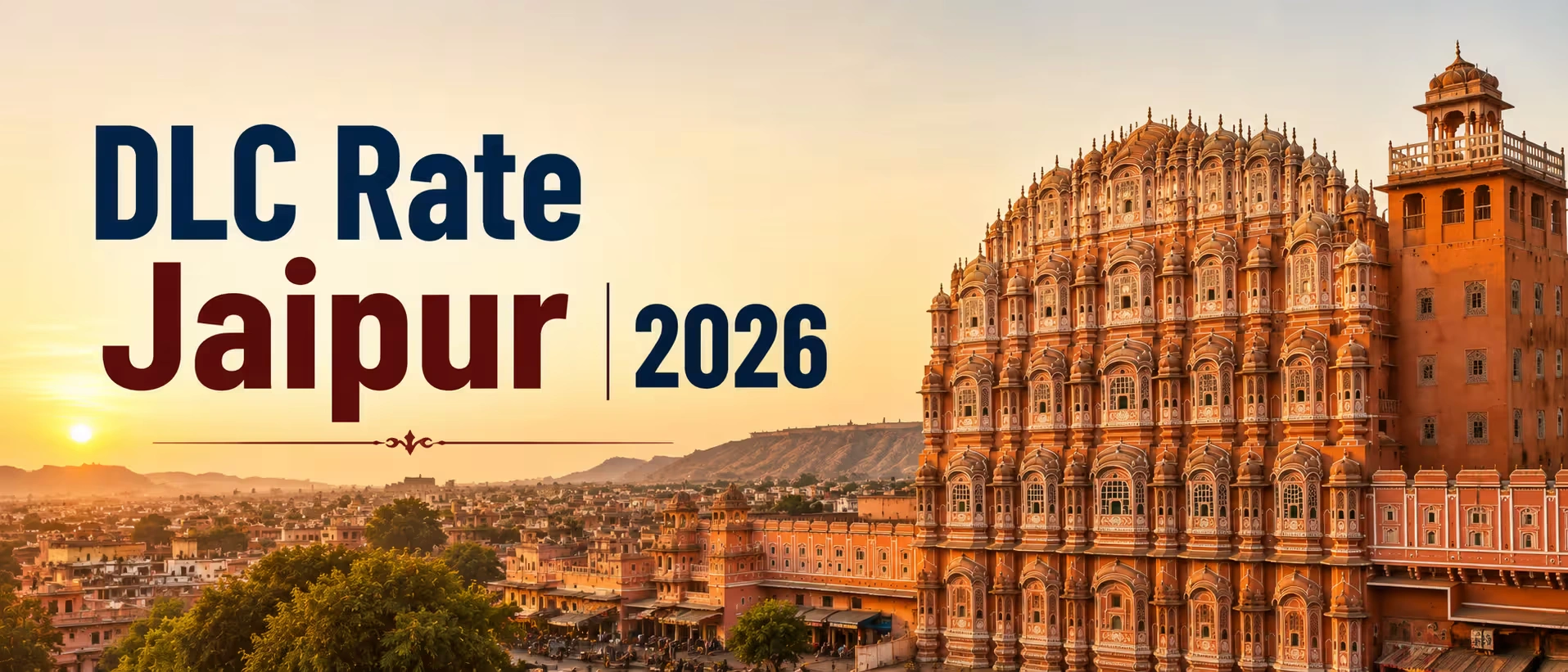
- DLC Rate Jaipur 2026 is the government-prescribed benchmark used for property valuation and registration-related calculations in Rajasthan.
- Jaipur does not have one single DLC rate. The applicable value can vary by locality, property category, road/location characteristics, and whether the property falls under urban or rural classification.
- Rajasthan’s official e-Panjiyan system provides online e-Valuation and DLC-related services, while the state’s GIS system allows users to search DLC information using location and land-type parameters.
- DLC value should not automatically be treated as the same as the actual market price. A property can transact above the government benchmark depending on location, demand, access, development potential and other factors.
- For agricultural land, buyers and sellers should check the specific khasra/location and land classification, rather than relying only on a generic locality rate.
- People looking at agriculture land for sale in Jaipur should compare government valuation with actual asking prices before negotiating.
- For landowners, understanding the DLC rate can help create a more realistic selling strategy when they are planning to sell agricultural land in Jaipur.
What is the DLC Rate in Jaipur?
DLC stands for District Level Committee rate. In simple terms, it is a government-determined benchmark used for valuing immovable property for registration and related purposes.
In Jaipur, the applicable DLC value depends on the property and its location. This is why saying “the Jaipur circle rate is ₹X per square metre” can be misleading. Different areas and property categories can have substantially different values.
The Rajasthan Registration & Stamps Department provides an online e-Panjiyan system that includes e-Valuation, DLC-related information and property valuation facilities. Its citizen services also support property valuation and online registration-related processes.
The government’s GIS-based DLC system goes a step further by allowing users to select parameters such as district, Sub-Registrar area, village or locality and land type. It can also display DLC information associated with a selected khasra. The GIS portal specifically warns that its mapping information is intended for viewing and should not itself be treated as legal evidence.
For a property transaction, this distinction matters.
A buyer may see a land parcel advertised at ₹50 lakh, while the applicable government valuation may be different. Conversely, a highly desirable property may command a market price significantly higher than its government benchmark.
DLC Rate Jaipur 2026: Why It Matters
DLC rates matter because property registration involves more than simply agreeing on a sale price.
The government valuation framework helps determine the value considered for applicable registration and stamp-related calculations. Rajasthan's e-Panjiyan system provides facilities for property valuation, document preparation and calculation of applicable registration-related charges.
For buyers, checking the DLC rate before finalising a transaction can help answer three practical questions:
- What government valuation applies to the property?
- How does that valuation compare with the seller's quoted price?
- What registration-related costs should I budget for?
For sellers, the DLC rate provides a useful reference point when evaluating an asking price.
However, it should not be confused with an independent market valuation.
DLC Rate vs Market Rate
Factor | DLC Rate | Market Rate |
| Set by | Government/authorised valuation framework | Buyers and sellers |
| Primary purpose | Registration and valuation purposes | Actual transaction pricing |
| Location sensitivity | High | Very high |
| Demand impact | Limited compared with market pricing | Significant |
| Road frontage | Can affect applicable classification/rate | Often has a strong impact |
| Development potential | Reflected through applicable classification | Can substantially influence price |
| Negotiability | Government benchmark | Negotiable between parties |
The practical lesson is simple: check both numbers.
If you are purchasing land, do not assume a low DLC rate automatically means the property is cheap. Similarly, if you are selling land, quoting only a high market price without understanding the applicable government valuation can make negotiations unnecessarily difficult.
Area-Wise DLC Rates in Jaipur
There is no single rate that applies to every Jaipur property.
Publicly available summaries of Jaipur DLC data show significant variation between localities and property categories. For example, published 2025–26 rate summaries show different residential and commercial benchmarks for areas such as Vaishali Nagar, Bani Park, Mansarovar, Jagatpura, Sanganer, Tonk Road and Amer.
Some indicative figures reported for major areas include:
Jaipur Area | Residential Exterior* | Residential Interior* | Commercial Exterior* |
| Vaishali Nagar | ₹38,500–₹60,500/sq.m | ₹30,800–₹49,500/sq.m | ₹55,000–₹80,000/sq.m |
| Bani Park | ₹44,000–₹71,500/sq.m | ₹35,200–₹57,200/sq.m | ₹60,000–₹90,000/sq.m |
| Mansarovar | ₹13,200–₹24,200/sq.m | ₹10,450–₹19,800/sq.m | ₹20,000–₹35,000/sq.m |
| Sanganer | ₹8,800–₹15,400/sq.m | ₹7,150–₹12,100/sq.m | ₹14,000–₹22,000/sq.m |
| Tonk Road / Pratap Nagar | ₹9,900–₹17,600/sq.m | ₹8,250–₹14,300/sq.m | ₹16,000–₹26,000/sq.m |
| Amer / Jal Mahal area | ₹13,200–₹46,200/sq.m | ₹11,000–₹38,500/sq.m | ₹12,000–₹42,000/sq.m |
| Kalwar Road / Sirsi Road | ₹4,950–₹8,800/sq.m | ₹4,180–₹7,150/sq.m | ₹8,000–₹14,000/sq.m |
*Indicative figures compiled from publicly available 2025–26 Jaipur DLC summaries. The exact applicable rate should be checked against the current official Rajasthan system for the specific property.
These figures should therefore be used for orientation, not as a substitute for an official property-specific valuation.
For example, a plot near a major road may fall under a different valuation category from a similar-sized plot deeper inside a colony. Similarly, an agricultural parcel outside Jaipur's urban area should not be valued using a residential colony rate simply because the nearest locality has a high residential price.
Also Read: DLC Rate vs Market Price in Rajasthan: Difference Most Buyers Discover Late
What is Interior and Exterior DLC Rate?
One of the most important concepts when checking Jaipur circle rates is the difference between interior and exterior property.
Generally, an exterior property refers to property associated with a major road or specified frontage category, while an interior property is located away from the relevant main-road frontage.
This distinction can have a meaningful impact on valuation.
For example, published Jaipur DLC tables show separate interior and exterior figures for several localities. In some locations, the exterior rate increases according to road width or frontage-related categories.
That means two plots in the same colony may not necessarily have the same applicable DLC value.
What Can Influence the Applicable Rate?
Depending on the property and local classification, relevant factors can include:
- Location
- Property use
- Urban or rural classification
- Land category
- Road access
- Road width
- Frontage
- Colony/locality
- Plot characteristics
- Applicable government classification
This is particularly important for land buyers because a simple locality-level rate may not capture the actual valuation applicable to a specific parcel.
How to Check DLC Rate Jaipur 2026 Online
The safest approach is to use Rajasthan's official e-Panjiyan and related government systems.
The official e-Panjiyan portal identifies e-Valuation as the online DLC Rate & Valuation System.
Step-by-Step Process
Step 1: Open the Rajasthan e-Panjiyan portal
Visit the official Registration & Stamps Department website: Rajasthan e-Panjiyan Portal
Step 2: Go to the valuation/DLC facility
Look for the valuation or DLC-related option available through the portal.
Step 3: Select the property location
Depending on the system, you may need to identify the district, Sub-Registrar area, locality, village or other location information.
Step 4: Select the property/land category
This is particularly important for land transactions. Agricultural, residential and commercial classifications should not be treated as interchangeable.
Step 5: Enter the relevant property details
For a land transaction, keep the property's identifying information ready. The Rajasthan e-Panjiyan documentation indicates that property valuation involves details such as location, khasra number, covered area and construction status where applicable.
Step 6: Review the valuation
Use the displayed information as the government-side valuation reference for your transaction.
Step 7: Cross-check before registration
If the transaction is significant, verify the applicable rate and property classification with the concerned Sub-Registrar office or a qualified property/legal professional before executing the transaction.
DLC Rate for Agricultural Land in Jaipur
Agricultural land needs a different approach from urban residential plots.
If you are searching for agricultural land for sale in Jaipur, the first mistake to avoid is comparing every parcel using residential plot rates.
Agricultural land may be located in Jaipur's urban fringe, Jaipur Rural areas or villages where the relevant land classification and valuation can differ.
The official Rajasthan GIS DLC system allows users to choose Rural or Urban, followed by location and land type parameters. It can provide DLC information associated with a particular khasra.
This is especially useful when evaluating larger parcels.
For example, a buyer considering 20, 50 or 100 bighas should not rely on a generic “Jaipur per-bigha rate” found online. Land measurements, local conversion practices, access roads, land classification and the exact khasra can materially change the analysis.
Agricultural Land vs Farm Land
Searches for farm land for sale in Jaipur often include very different types of properties.
One listing may be genuinely agricultural land intended for cultivation. Another may be marketed for a farmhouse-style lifestyle. A third may have development potential but still carry an agricultural classification.
The marketing description does not change the legal land-use classification.
Before purchasing, check:
- Current land classification
- Khasra details
- Ownership records
- Access road
- Encumbrances
- Existing land-use status
- Conversion requirements, if relevant
- Applicable local planning restrictions
- Government valuation
Rajasthan's land-conversion framework also distinguishes between residential, commercial, industrial and other purposes, with conversion charges linked in certain cases to the DLC rate or purchase price.
That is why buyers should never assume that agricultural land can automatically be used for a commercial or residential purpose.
What About Commercial Land in Jaipur?
Demand for commercial land for sale in Jaipur is closely tied to accessibility, catchment, frontage and future development.
Commercial land near established roads, business districts, major corridors and growth areas can command a substantial premium over land with weaker access.
The DLC rate is useful as a government benchmark, but it is not the entire investment story.
Suppose two parcels have similar government valuations.
Parcel A has:
- Strong road frontage
- Established surrounding development
- High visibility
- Nearby commercial activity
Parcel B has:
- Narrow access
- Limited surrounding development
- Lower visibility
- Uncertain future demand
The market may value them very differently.
This is why investors should compare DLC values with actual market listings and recent transaction evidence wherever reliable data is available.
DLC Rate vs Property Price: Which One Should Buyers Follow?
The answer is: both, but for different purposes.
DLC is a government valuation benchmark.
Market price represents what a buyer is actually willing to pay and what a seller is willing to accept.
Consider a simple example.
Suppose a parcel has a government valuation of ₹60 lakh, but comparable properties in the area are being negotiated around ₹85 lakh.
The ₹60 lakh figure does not automatically mean the seller must sell for ₹60 lakh.
On the other hand, if someone is asking ₹1.5 crore for a property while comparable land nearby is trading substantially lower, the buyer needs to investigate why.
The difference may be justified by:
- Better road frontage
- Larger usable area
- Corner location
- Better access
- Development potential
- Existing infrastructure
- Scarcity
- Better title/documentation
- Future infrastructure expectations
Or it may simply be an aggressive asking price.
This is where market research becomes valuable.
How to Evaluate Land Before Buying in Jaipur
If you are comparing agricultural land for sale in Rajasthan, do not make the decision based only on price per bigha.
Use a broader checklist.
Land-Buying Checklist
1. Confirm the exact location
Do not rely only on a landmark or WhatsApp pin. Match the location with the property documents.
2. Check the khasra
The khasra number is essential for identifying the parcel and checking relevant government information.
3. Check the applicable DLC
Use the official Rajasthan system rather than relying solely on an online blog or broker quote.
4. Understand the land category
Agricultural, residential and commercial land have different implications.
5. Compare market prices
Look at comparable properties with similar location, access, size and land classification.
6. Check road access
A parcel with poor access can be difficult to use or resell even if the headline price looks attractive.
7. Understand development potential
Do not assume that land near a growing highway or city automatically becomes developable.
8. Review documentation
Ownership and transaction documents should be checked professionally before a substantial payment is made.
9. Calculate transaction costs
Do not budget only for the agreed property price. Consider stamp duty, registration and other applicable charges.
10. Think about resale
A property that is difficult to market today may remain difficult to sell later.
How Sellers Can Price Agricultural Land in Jaipur
If you plan to sell agricultural land in Jaipur, start with the government benchmark but do not stop there.
A practical pricing exercise should combine three layers:
Layer 1: Government Benchmark
Check the applicable DLC valuation.
Layer 2: Comparable Market Listings
Study properties with similar:
- Location
- Size
- Land classification
- Road access
- Development context
- Distance from major roads
Layer 3: Property-Specific Premium
Then assess what makes your land different.
For example, a 10-bigha parcel with direct road access may command a premium over a similar parcel located behind another property.
Likewise, land closer to an established urban area may attract a different buyer profile from remote agricultural acreage.
This approach produces a much more defensible asking price than simply adding an arbitrary premium to the DLC value.
Selling Property Online: What Has Changed?
The process of selling property online has become increasingly useful for landowners because buyers can now discover properties beyond their immediate broker network.
But online visibility does not automatically produce a successful transaction.
A strong listing should answer the questions a serious buyer will ask:
- Where exactly is the land?
- How large is it?
- What is the land classification?
- What is the asking price?
- What is the price per bigha or square yard?
- How is the property accessed?
- What are the nearby landmarks?
- What documentation is available?
- Is the property suitable for the buyer's intended use?
- What makes this parcel different from competing properties?
Platforms such as 2Bigha provide a dedicated marketplace environment for agricultural and land listings. Its Jaipur pages currently display properties across different sizes, locations and categories, including agricultural parcels and commercial land.
For landowners, this can make online discovery more structured than depending entirely on offline enquiries.
For buyers, it provides another source for comparing available properties before visiting shortlisted sites.
Real Estate Websites in India: Which One Should You Use?
There are many real estate websites in India, but not every platform is equally useful for every property type.
Large residential portals can be helpful when searching for flats, houses and urban plots.
Land-focused platforms can be more useful when the requirement involves:
- Agricultural land
- Large land parcels
- Farm land
- Rural properties
- Investment land
- Land around expanding city corridors
The right platform depends on the property.
For agricultural land, buyers should look beyond attractive photographs and headline prices. Location data, parcel size, land classification and documentation matter considerably more than presentation.
Agricultural Land on Sale: Questions Buyers Should Ask
If you find agricultural land on sale, ask these questions before discussing a token amount:
Is the seller the legal owner?
Confirm ownership and relevant records.
What is the exact khasra number?
A clear property identity is essential.
What is the land classification?
Do not rely only on the listing description.
Is there legal road access?
Physical access and documented access are both important.
What is the applicable DLC?
Check the government valuation for the specific property.
What is the actual market price?
Compare similar parcels.
Can the intended use be legally carried out?
If you want residential, commercial, industrial or another non-agricultural use, understand whether conversion or additional approvals are required.
Are there disputes or encumbrances?
These should be checked before committing significant funds.
Is DLC Rate the Same as Circle Rate?
In everyday real estate conversations, “DLC rate” and “circle rate” are often used interchangeably to describe the government benchmark used for property valuation.
However, buyers should focus less on terminology and more on the specific government valuation applicable to the property.
For Jaipur, the Rajasthan e-Panjiyan system and its related valuation facilities are the better reference point than an outdated generic circle-rate article. The official portal itself provides valuation and registration-related services.
Common Mistakes When Checking Jaipur DLC Rates
Mistake 1: Using an old rate
Property valuation information can change. Always check the current government system.
Mistake 2: Checking only the locality
A locality name may not be enough to determine the exact applicable rate.
Mistake 3: Ignoring land type
Agricultural and commercial land cannot be evaluated using the same assumptions.
Mistake 4: Confusing DLC with market price
The government benchmark and actual negotiated price serve different purposes.
Mistake 5: Ignoring road frontage
Location within the same area can affect valuation and market demand.
Mistake 6: Trusting an online listing blindly
Online platforms are useful for discovery, but property documents and government records still need to be checked.
Mistake 7: Looking only at price per bigha
Two parcels with the same price per bigha can have very different investment quality.
Final Word
Understanding the DLC Rate Jaipur 2026 is an important first step for anyone buying, selling or registering property in Jaipur.
But the smartest property decisions go beyond one government number.
For buyers, the real question is not simply, “What is the circle rate?” It is:
“What is the applicable government valuation, what is the actual market value, and does this particular property justify the difference?”
For sellers, the same principle applies. A well-priced property is easier to position when the asking price is supported by government valuation, comparable market evidence and property-specific advantages.
This becomes even more important for agricultural land around Jaipur, where parcel size, road connectivity, land classification and future development can create substantial differences between seemingly similar properties.
Use the Rajasthan government’s e-Panjiyan and GIS systems for the official valuation reference, and use property marketplaces such as 2Bigha to research available opportunities and compare the market.
Ultimately, the best land transaction is not the one with the lowest quoted rate. It is the one where location, valuation, documentation, intended use and market price all make sense together.
Disclaimer: This article is for informational purposes only and should not be considered investment, legal, financial, or property advice. Real estate regulations, infrastructure plans, market conditions, and government policies may change over time. Readers are advised to verify information with relevant authorities and consult qualified professionals before making any investment or property-related decisions.