Every year, thousands of families search for land for sale in Rajasthan with big dreams and small budgets. Some want a plot to build a home. Others are looking at agricultural land in Rajasthan as a long-term investment. But somewhere in the middle of paperwork and price talk, a term shows up that confuses almost everyone: DLC rate. Most buyers only understand DLC rate after they've already paid too much stamp duty, or worse, after a deal falls apart because the numbers didn't add up. This article breaks down what DLC rate actually means, how it differs from market price, and why this gap matters so much when you're buying agricultural land for sale in Rajasthan.
What Is DLC Rate in Rajasthan?
DLC stands for District Level Committee. The DLC rate is the minimum value fixed by the government for the land and property of a particular region. It is also called the circle rate in some states. This rate is like the lowest price for a property. No matter what lesser price has been privately agreed upon, the property cannot be registered under a lower value than the one stated by the DLC. The government then uses these rates to calculate stamp duty and registration charges, as well as monitor tax evasion in land deals. All districts in Rajasthan have different rates, and within a district, the rates change according to the tehsil, the village, and the road distance. A plot of land adjacent to a highway will most likely have a higher DLC rate than a similar plot located in a far-off village, even if the two are in the same panchayat.
What Is Market Price?
Market price is simply what a buyer is willing to pay and what a seller is willing to accept. For farm land for sale in Rajasthan, the market price is shaped by real, on-the-ground factors such as location, road connectivity, water availability, nearby infrastructure, future development, and overall buyer demand.
- How close the land is to a city or highway?
- Whether canal or borewell irrigation is available
- Soil quality and crop history
- Nearby infrastructure projects
- Demand from buyers in that specific pocket
Unlike DLC rate, which is revised periodically by the government, market price shifts constantly. It can jump within months if a new expressway is announced nearby, or dip if there's a slowdown in that region.
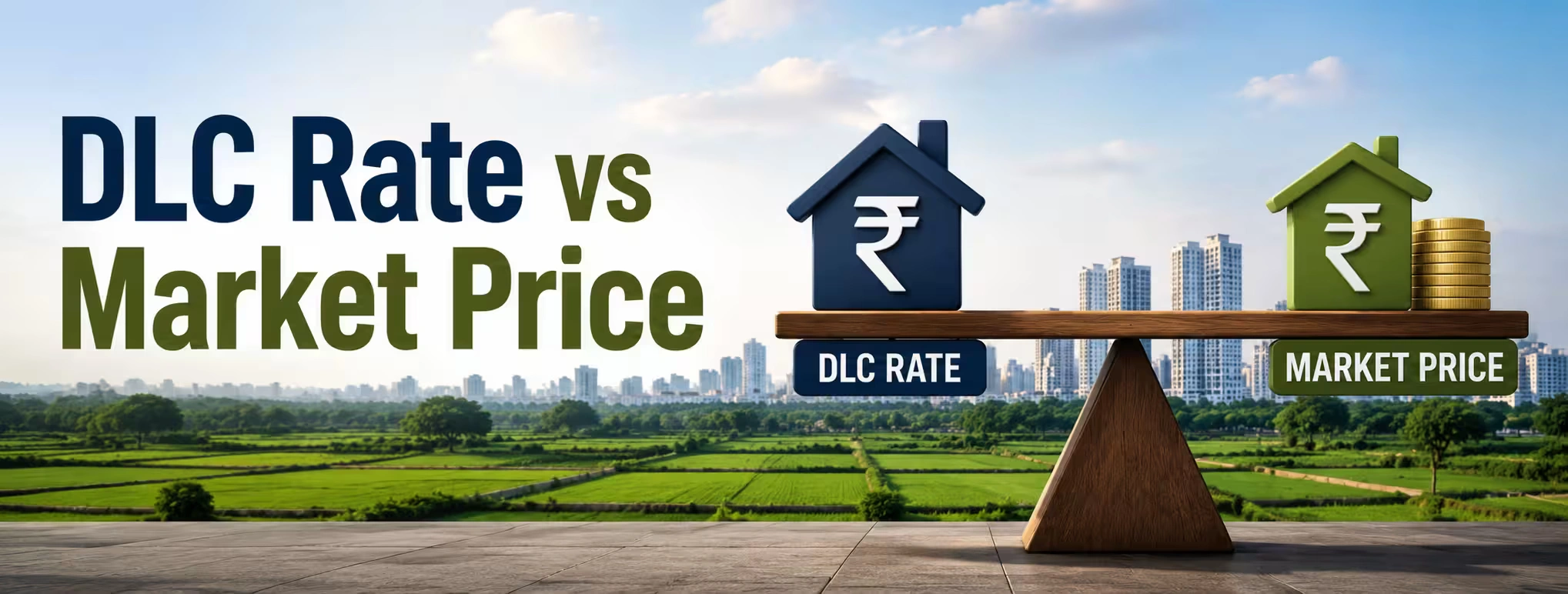
DLC Rate vs Market Price: The Core Difference
Here's a simple table to understand how these two numbers usually compare.
| Factor | DLC Rate | Market Price |
| Set by | Government (District Level Committee) | Buyers and sellers, based on demand |
| Purpose | Calculating stamp duty and registration | Actual transaction value |
| Revision frequency | Periodically, often once a year | Changes continuously |
| Reflects real value? | Not always | Yes, mostly |
| Legal requirement | Minimum registration value | No fixed requirement |
| Common trend in Rajasthan | Usually lower than market price in growth areas | Often 20–50% higher than DLC in prime zones |
In most parts of Rajasthan, especially around fast-growing areas like Jaipur, Udaipur, and Sikar, the market price of farm land for sale in Rajasthan is often much higher than the official DLC rate. However, in some less-developed or low-demand regions, the opposite can happen. DLC rates set years ago may remain unchanged even as actual land prices soften. This gap between the DLC rate and the market value is exactly where many buyers end up making costly mistakes.
Why This Gap Matters When Buying Agricultural Land in Rajasthan?
1. It Affects Your Stamp Duty
Stamp Duty in Rajasthan is calculated on whichever is higher: the DLC rate or the actual sale price mentioned in the agreement. So if a seller undervalues the deal to save on registration costs, the government will still charge stamp duty based on the DLC rate, not the lower figure. This catches many first-time buyers off guard. They agree on a price with the seller, only to find their registration bill is higher than expected because the area's DLC rate pushed the taxable value up.
2. It Impacts Bank Loans
If you're planning to take a loan against agricultural land, banks often use the DLC rate as one reference point for valuation. A big gap between DLC rate and actual market price can complicate loan approval, since the bank's internal valuation may not match what you're actually paying.
3. It Can Signal Overpricing or Underpricing
When you're comparing land for sale in Rajasthan across different sellers, checking the DLC rate for that specific area gives you a baseline. If someone is asking for a price way above both DLC rate and typical market trends in that pocket, it's worth asking why. On the flip side, land priced suspiciously close to or below DLC rate could mean there's a legal or title issue worth investigating further.
How to Check DLC Rate Before Buying?
Rajasthan's revenue department maintains an online portal where DLC rates are published tehsil-wise and village-wise. Before finalizing any deal for agricultural land for sale in Rajasthan, buyers should:
- Search the DLC rate for the exact village or ward, not just the district
- Compare it against at least two or three recent sale deeds in the same area if possible
- Cross-check with a local sub-registrar office if the online data seems outdated
Skipping this step is one of the most common reasons buyers end up overpaying stamp duty without realizing it beforehand.
Don't Forget the Encumbrance Certificate
DLC rate and market price aren't the only things to verify. Before you buy land in Rajasthan, always ask for an Encumbrance Certificate in Rajasthan for the property. This document confirms whether the land is free of loans, mortgages, or legal disputes. A property might look perfectly priced, right in line with market rates, but if it carries an old loan or a pending court case, that "good deal" can turn into a legal headache. Combining DLC rate checks with an Encumbrance Certificate gives you a much clearer, safer picture before you sign anything.
Tips for Buying Agricultural Land the Smart Way
Buying agricultural land is unlike buying a residential plot. Here are a few additional checks one must perform while buying agricultural land:
- Confirm the Jamabandi (the state government’s land record) to cross-verify the ownership of land by the seller
- Ascertain the classification of the land (some agricultural lands are non-conversion ones)
- Visit the land, preferably in person, instead of relying only on pictures
- Check details about the water source
- Compare the DLC (deemed market value) to similar transactions in that area while arriving at a final price
If one is buying farmland in a specific district, it is critical that prior to making an offer one studies the dynamics of the local market and how it is influenced by canal-water availability, highway proximity, etc., because those are the factors that will define pricing better than most others, especially in rural Rajasthan.
The Shift Toward Selling Property Online
The land deals in the past in Rajasthan were mostly done through local middlemen. A lot has changed since then. Now many land sellers are resorting to digital platforms to advertise their property for sale in Rajasthan, giving out information about DLC rate, land area, etc. With this new change in the market comes a lot of benefits for the land buyers. They can view different plots available in different tehsils online, compare the rates, and finalize a few options to view in person. It adds a level of transparency to the process that wasn't there before, when the local brokers had much control.
How Does 2Bigha Make This Easier?
Understanding DLC rate, market price, stamp duty, and legal documents can feel overwhelming, especially for first-time buyers. This is where 2Bigha steps in. 2Bigha is a platform built specifically for buying and selling agricultural land and farmland across India. If you're searching for land for sale in Rajasthan, 2Bigha helps you access verified listings with clear details on pricing, location, and documentation, so you're not relying on guesswork or unverified broker claims.
Whether you want to sell land in Rajasthan or are trying to purchase land in a specific district, the platform focuses on transparency, helping buyers compare real market data against government DLC rates before making a decision. For anyone tired of vague pricing and unclear paperwork, 2Bigha brings a more organized, tech-driven approach to a traditionally unorganized market.
Conclusion
This discrepancy is not an insignificant issue. In fact, it influences the amount of stamp duty payable on the property, the valuation of land by banks, and the question of whether the buyer is being cheated or not. However, the vast majority of buyers find out about this once they have already signed on the dotted line and face an unpleasant surprise when the bill for the registration of land comes or when dealing with the loan documents. If you are planning to buy land in Rajasthan, then spend some time researching the actual DLC rate in the particular village, comparing it with the market prices, and asking for the Encumbrance Certificate.
Disclaimer: This article is for informational purposes only and should not be considered investment, legal, financial, or property advice. Real estate regulations, infrastructure plans, market conditions, and government policies may change over time. Readers are advised to verify information with relevant authorities and consult qualified professionals before making any investment or property-related decisions.