Key Takeaways
- Dholera and Sanand both have strong land investment potential, but they serve different investor mindsets.
- Dholera land investment is better suited for buyers who want long-term growth, early-entry advantage, larger plotted development opportunities, and exposure to a planned smart industrial city.
- Sanand land investment is better for investors who prefer an already active industrial belt, stronger current demand, better Ahmedabad connectivity, and faster commercial or industrial usability.
- For high-risk, high-upside investors, Dholera looks more future-focused. For practical, near-term industrial demand, Sanand is stronger today.
- If your goal is 8–15 year appreciation, Dholera may offer better upside. If your goal is current industrial activity, rental possibility, resale demand, or business setup, Sanand may feel safer.
- The best decision depends on land title, zoning, approach road, NA status, infrastructure access, holding capacity, and whether the land sits inside or outside a recognised growth corridor.
Quick Answer: Dholera or Sanand — Which Is Better for Land Investment?
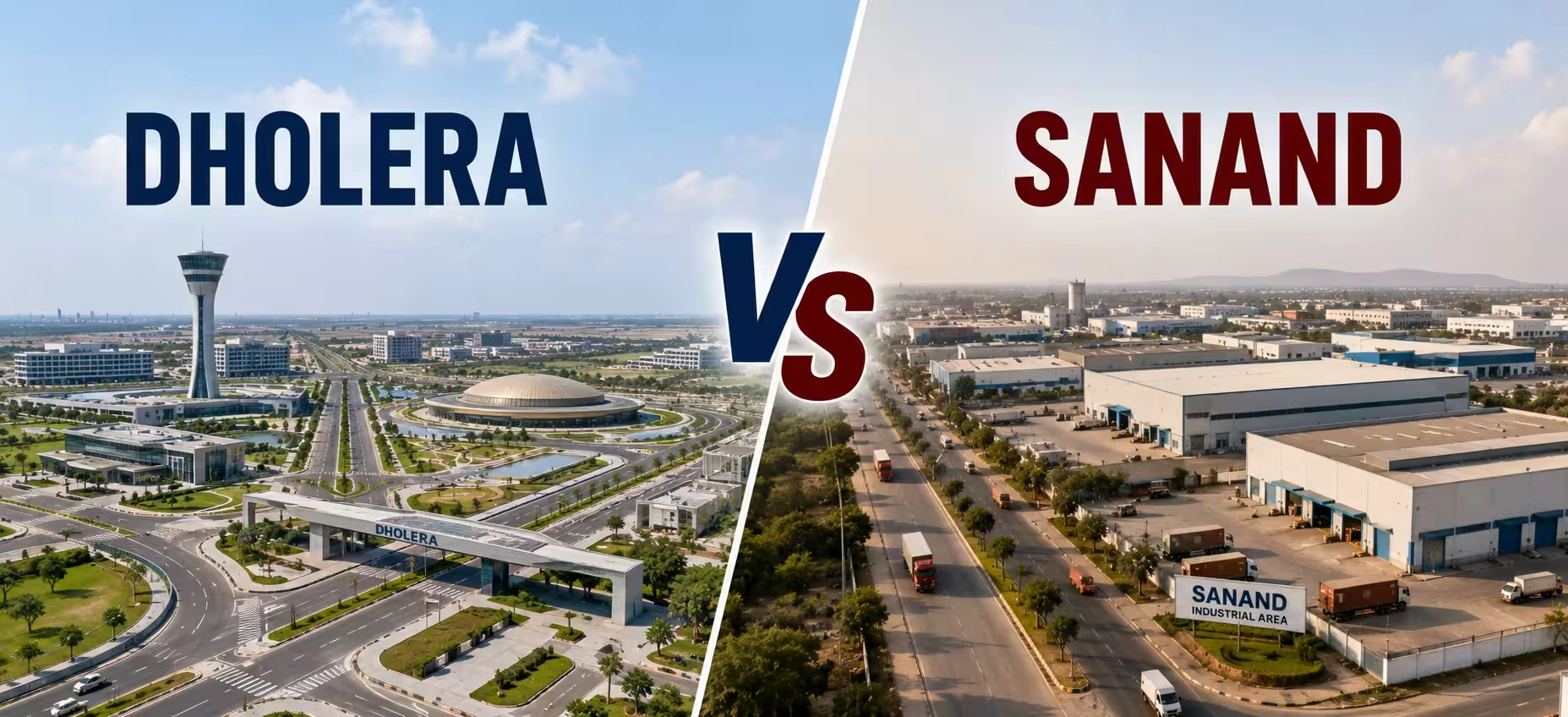
For long-term investors, Dholera vs Sanand land investment comes down to one simple question: do you want to enter a future city early, or do you want to invest in an already-running industrial market?
Dholera is a planned greenfield industrial smart city under the Dholera SIR vision. It has large-scale infrastructure planning, plug-and-play industrial zones, airport-led growth, expressway connectivity, semiconductor focus, and future urban development potential. Official Dholera sources describe the Activation Area as 22.54 sq. km. with trunk infrastructure, utilities, ICT systems, CETP, STP, water, power, gas, and road networks planned for large industries.
Sanand, on the other hand, is not just a future promise. It is already known as a strong manufacturing belt near Ahmedabad. Sanand GIDC has automotive, engineering, electronics, plastic, pharma, vendor, and multinational industrial clusters. GIDC material places Sanand Industrial Estate in Ahmedabad district and shows it as a 2,056-hectare industrial estate with focus sectors such as automobiles and ancillary, plastic engineering, engineering, and electronics.
So the straight answer is this: Dholera is better for future appreciation potential, while Sanand is better for current industrial confidence.
A Real Investor’s Situation: Why This Comparison Matters
Imagine a buyer from Ahmedabad who has saved money for years and now wants to buy rural land in Gujarat. His friends suggest Sanand because factories are already there. A broker suggests Dholera because “future smart city banega.” His family asks one practical question: “Paise safe rahenge na?”
This is exactly where most buyers get stuck.
On paper, both locations look attractive. Dholera has smart city branding, upcoming infrastructure, planned zones, an international airport project, and big-ticket industrial attention. Sanand has existing factories, visible activity, strong road access, and a proven industrial ecosystem.
But land investment is not about hype. It is about timing, location, legal clarity, demand, and exit.
A cheap plot in the wrong village can become dead money for years. A costly plot in the right industrial corridor can still create value. That is why this Dholera vs Sanand comparison should not be seen as “which place is famous?” It should be seen as “which location matches your investment goal?”
Understanding Dholera: A Future-Focused Smart City Bet
Dholera is one of Gujarat’s most talked-about investment destinations because it is not being developed like a normal town expansion. It is planned as a large greenfield industrial city with a structured development model.
The official Dholera planning page says Dholera SIR spans around 920 sq. km. and covers 22 villages of Dholera Taluka. It also states that the Town Planning Schemes 1 to 6 cover 422 sq. km., with Phase I covering 153 sq. km. of TP1 and TP2.
This matters for land buyers because Dholera is not only about buying a random plot. The value depends heavily on whether the land falls near the Activation Area, TP schemes, future industrial zones, logistics routes, airport influence zone, or outer peripheral villages.
Why Investors Are Looking at Dholera
The biggest attraction of Dholera investment potential is future-scale planning. Dholera is being positioned for semiconductors, electronics, clean industries, logistics, renewable energy, and large-format industrial activity. Dholera’s official business page mentions large industrial plots, ready-to-use infrastructure, assured utilities, water and power systems, and a developed internal road network with underground utility corridors.
For investors, this creates a long runway. If industries come, workers come. If workers come, housing demand follows. If business activity grows, commercial plots, service businesses, warehouses, and rental assets can gain traction.
That is the core logic behind Dholera land investment.
But there is also a practical warning. Dholera is still a phased market. Not every plot will rise equally. Land inside or near planned infrastructure may behave differently from far-off agricultural parcels sold only on future promises.
Understanding Sanand: A Mature Industrial Growth Story
Sanand’s investment case is very different. It is not selling only a future dream. Sanand already has industrial gravity.
GIDC’s Sanand Industrial Estate document identifies Sanand as an automobile hub and shows major industrial presence across auto vendors, multinational zones, plastic engineering, commercial, pharma, electronics, medical devices, knowledge park, and engineering zones.
Sanand also benefits from being closer to Ahmedabad. For business owners, this is a big advantage. Labour movement, supplier network, transport, housing, schools, hospitals, and city access are easier compared to a very early-stage location.
Tata Motors has also strengthened Sanand’s industrial confidence. Tata Motors stated that its Sanand facility, acquired from Ford India, is spread across 460 acres and adds manufacturing capacity for ICE and EV models. The facility can unlock 300,000 units per annum, scalable to 420,000 units per annum.
This kind of anchor presence gives Sanand a practical edge. Investors looking for Sanand real estate investment are often not just betting on future master planning; they are betting on an operating industrial economy.
Dholera vs Sanand Comparison Table
| Factor | Dholera | Sanand |
| Investment Nature | Future-growth, planned smart city, long-term appreciation | Mature industrial belt, current business demand |
| Best For | Long-term investors, plotted development buyers, large land holders | Industrial buyers, warehouse users, commercial investors, faster-use cases |
| Main Growth Driver | Dholera Smart City, airport, expressway, semiconductor ecosystem, DMIC influence | Sanand GIDC, auto/EV manufacturing, supplier ecosystem, Ahmedabad proximity |
| Risk Level | Medium to high, depending on exact location and holding period | Moderate, because industrial base already exists |
| Current Activity | Developing in phases | Strong existing industrial activity |
| Time Horizon | 8–15 years is more realistic for major upside | 3–8 years may be more practical for many investors |
| Land Price Behaviour | Varies widely by TP scheme, zone, access road, approval status | Higher in active industrial pockets, stronger current demand |
| Liquidity | Better near planned zones; weaker in far-off speculative land | Generally better in recognised industrial and Ahmedabad-facing locations |
| Buyer Profile | Patient investors, NRIs, developers, strategic land aggregators | Business owners, manufacturers, warehouse investors, local real estate buyers |
| Verdict | Better future upside | Better present confidence |
Land Price View: Dholera vs Sanand
Land price is where many buyers make mistakes. They compare one Dholera plot price with one Sanand plot price and immediately decide. That is not how land valuation works.
Land price depends on land use, title, road width, zoning, distance from active infrastructure, village location, NA status, nearby development, and whether the plot is inside an official planning zone.
Dholera Land Price
The official Dholera land pricing page lists revised allotment rates by land use. It mentions ₹4,000 per sq. m. for Industry/Physical Infrastructure and Knowledge & IT, ₹6,000 per sq. m. for Residential and High Access Corridor, ₹8,000 per sq. m. for CBD/City Centre and Tourism/Hospitality, and ₹400 per sq. m. for Solar Energy Park. It also notes that allotment is on a 99-year leasehold basis and rates exclude GST, registration fees, stamp duty, and land filling cost.
This is important because Dholera smart city land price should not be discussed casually. Official allotment pricing, private resale pricing, agricultural land pricing, developer plotted schemes, and peripheral village land rates can all be different.
A buyer searching for land for sale in Dholera must check whether the land is freehold agricultural land, leasehold allotted land, NA plot, developer plot, or a future-conversion parcel. Each category carries different risk and different exit values.
Sanand Land Price
For Sanand, GIDC’s allotment price page for FY 2025–26 shows different official rates, including Sanand (RIDC) at ₹750 per sq. m., Sanand Women Park at ₹2,930 per sq. m., Sanand-II (Bol) at ₹5,270 per sq. m., and Sanand-II (Bol) MSME Park tentative at ₹4,200 per sq. m.
Again, this does not mean every private land deal in Sanand will follow this number. Private land price in Sanand may vary based on location, plot size, access, conversion, industrial permission, road frontage, and distance from GIDC or major factories.
For buyers looking at land for sale in Sanand, the safest approach is to compare the plot against recognised demand drivers: GIDC access, Ahmedabad connectivity, industrial estate proximity, future urban expansion, and commercial usability.
Connectivity: Why Roads and Access Decide Real Land Value
In land investment, road access often matters more than the brochure.
A plot may look cheap, but if it has poor approach, unclear access, no legal road, or seasonal waterlogging, appreciation becomes difficult. Dholera and Sanand both benefit from Gujarat’s larger infrastructure push, but their connectivity stories are different.
Dholera Connectivity
Dholera’s future depends heavily on high-quality infrastructure. Official FAQ content says Dholera is connected through existing national and state highways, and a dedicated four-lane, 109 km Ahmedabad–Dholera expressway is being implemented by NHAI as a greenfield access-controlled expressway. It also mentions freight rail connectivity under implementation and a planned semi-high-speed rail line along the expressway.
The Dholera airport project is another major trigger. India Investment Grid lists the Dholera International Greenfield Airport project with a project start date of 28 July 2022 and a project completion date of 30 September 2026.
For investors, this makes land near Dholera Airport and land near Ahmedabad Dholera Expressway attractive in theory. But buyers should not assume every nearby village will automatically deliver high returns. The exact location, access, zoning, and land title will still decide performance.
Sanand Connectivity
Sanand already enjoys strong practical connectivity because of its proximity to Ahmedabad and its established industrial ecosystem. GIDC’s Sanand document places Ahmedabad airport around 30 km from the estate and shows major connectivity to ports, rail, and nearby cities.
This is why Sanand has stronger near-term usability. A manufacturer, warehouse operator, vendor, or logistics company may prefer Sanand because the ecosystem already works.
From a buyer’s perspective, this gives Sanand land investment better current liquidity in suitable pockets.
Industrial Growth: Dholera’s Future Industries vs Sanand’s Existing Base
Dholera’s industrial narrative is future-heavy but credible because of government-led planning and semiconductor positioning. Dholera official content says the Activation Area targets semiconductors, electronics manufacturing services, photovoltaic cells, and sunrise sectors, and mentions the region as “Semicon City” under Gujarat Semiconductor Policy 2022.
The semiconductor story gained further weight when the Centre notified an SEZ for Tata Semiconductor Manufacturing Private Limited at Dholera. The report mentions a 66.16-hectare SEZ and a proposed ₹91,000 crore investment for India’s first semiconductor fabrication unit, expected to generate around 21,000 jobs.
Sanand also has a powerful industrial story. It already has auto, electronics, engineering, and supplier-network momentum. Tata’s Sanand facility gives it EV and passenger vehicle manufacturing strength, while recent coverage also reported the inauguration of CG Semi’s OSAT facility in Sanand, marking another step in India’s semiconductor manufacturing ecosystem.
This makes the comparison very interesting.
Dholera is being built for next-generation industry at scale. Sanand is already operating as a manufacturing and supplier belt and is now adding EV and semiconductor-linked activity.
So, in industrial terms, Dholera has a bigger long-term canvas. Sanand has better immediate proof.
Future of Dholera Real Estate
The future of Dholera real estate depends on three things: infrastructure delivery, industrial occupancy, and population movement.
If industries start operations at scale, Dholera can move from “investment story” to “real demand story.” This is the turning point every land investor should watch.
The official Dholera FAQ mentions the Activation Area’s 72 km internal road network, underground utility network, water treatment plant, CETP, STP, elevated reservoirs, advanced power substations, ABCD building, ICT ducts, and city integrated operations centre.
That is a strong base. But real estate appreciation does not happen only because roads and utilities exist. It happens when users arrive: factories, workers, vendors, schools, hospitals, hotels, service providers, and residents.
This means buyers should not treat Dholera as a quick flip market unless they are entering a highly strategic parcel with strong demand. For most retail buyers, Dholera is a patient investment.
Dholera residential plots may gain appeal as industrial employment grows, but residential demand will mature after business activity becomes visible. Commercial land may perform well near high-access corridors, business districts, logistics nodes, and institutional zones, but only if the location is properly planned and legally clean.
Future of Sanand Real Estate
The future of Sanand real estate is more grounded in current economic activity. Sanand already has factories, suppliers, workers, transport demand, and business movement. That means real estate demand is not only speculative.
Sanand may benefit from industrial expansion, EV manufacturing, semiconductor supply chains, and Ahmedabad’s outward growth. Recent reporting also highlighted Gujarat’s plan to develop Sanand, Kalol, Savli, Bardoli, and Hirasar as satellite towns connected with key urban centres through a proposed RRTS, aimed at decentralised urban growth.
This gives Sanand a wider real estate angle beyond industrial land. Residential demand, worker housing, rental housing, commercial shops, service centres, warehousing, and logistics may all benefit if urban expansion continues.
For someone looking at plots for sale in Ahmedabad, the advantage is visible demand. But the entry cost in good pockets may already be higher than Dholera’s early-stage opportunities.
Investment Risk: Where Buyers Can Go Wrong
Many investors enter Dholera or Sanand through emotion. They hear “smart city,” “airport,” “GIDC,” “Tata,” or “expressway” and assume every plot is safe. That is not true.
Land investment has three types of risk.
First is title risk. If land ownership, mutation, encumbrance, or revenue record is unclear, stay away. No future project can fix a bad title.
Second is zoning risk. Agricultural land, industrial land, residential plot, commercial plot, and leasehold allotment all have different rules. You cannot buy blindly and assume conversion will happen easily.
Third is liquidity risk. A plot may appreciate on paper, but if there are no buyers when you want to exit, your money gets stuck.
In Dholera, the biggest risk is overpaying for far-off land based only on future promises. In Sanand, the biggest risk is paying a premium for land that does not have proper industrial usability, road access, or clear conversion status.
The safest investor checks documents before price. The risky investor checks the price before documents.
Buyer Checklist Before Investing in Dholera or Sanand
Use this checklist before you buy land in either location.
| Checklist Point | Why It Matters |
| Title search | Confirms ownership and reduces legal disputes |
| Revenue record check | Helps verify land classification and ownership trail |
| Encumbrance check | Shows whether the land has loans, claims, or legal burdens |
| Zoning verification | Confirms whether land use matches your investment plan |
| NA/conversion status | Important for residential, commercial, or industrial development |
| Road access | Legal approach road affects resale and usability |
| Distance from active growth driver | Close to GIDC, expressway, TP scheme, airport, or industrial zone matters |
| Waterlogging/flood check | Especially important for low-lying or peripheral parcels |
| Stamp duty and registration estimate | Helps calculate true acquisition cost |
| Exit demand | Know who will buy from you later: developer, industry, trader, or end user |
This checklist may look simple, but it saves investors from bad deals.
Dholera vs Sanand for Different Buyer Types
1. For Long-Term Investors
Dholera is more attractive if you can hold land for a longer period and tolerate slower early movement. The upside can be strong if the land is well-located and infrastructure-led demand materialises.
Sanand is better if you want a more proven market with visible activity. Appreciation may be steadier, but entry costs in better pockets may already reflect some of that maturity.
2. For Industrial Users
Sanand is stronger for immediate industrial usability. The ecosystem of suppliers, labour, roads, and existing units gives it a working advantage.
Dholera may be better for large-scale industries that need bigger land parcels, planned utilities, and long-term expansion space.
3. For Residential Plot Buyers
Dholera residential investment is more future-facing. Buyers should focus on planned areas, legal status, and realistic holding capacity.
Sanand residential demand is more practical because of Ahmedabad proximity and industrial employment. However, location selection matters because not every Sanand-side plot is ideal for residential use.
4. For Commercial Land Buyers
In Dholera, commercial land should be selected near planned high-access corridors, industrial service zones, and future population nodes.
In Sanand, commercial land near industrial roads, worker housing clusters, factories, and logistics routes may have more immediate business logic.
5. For NRIs
NRIs should be extra careful. Do not buy only through WhatsApp brochures or verbal commitments. Use legal verification, site visit videos, boundary confirmation, revenue document checks, and local due diligence.
A platform like 2Bigha can help buyers compare verified land opportunities more confidently, especially when they want clearer listing information, local support, and better visibility before shortlisting. Landowners can also explore a subscription plan and property management service for managing listed or owned land assets more efficiently.
Which Location Has Better Appreciation Potential?
Dholera may offer higher appreciation potential because it is still developing and has large future triggers. The airport, expressway, semiconductor ecosystem, planned infrastructure, and industrial city model can create long-term value.
But higher potential also means higher patience.
Sanand may offer more stable appreciation because demand is already backed by industry. It may not offer the same early-stage multiplier in every pocket, but good land near active industrial or urban corridors can remain valuable because users already exist.
So the answer is not one-size-fits-all.
Choose Dholera if you want long-term growth and can hold patiently.
Choose Sanand if you want current demand, better present visibility, and practical industrial confidence.
Dholera vs Sanand: Final Verdict
If the question is Dholera or Sanand which is better for land investment, the honest answer is:
Dholera is better for investors who believe in future infrastructure-led growth and can wait for the market to mature.
Sanand is better for investors who want a proven industrial location with current demand, Ahmedabad proximity, and stronger near-term usability.
For a balanced land portfolio, some investors may even consider both: Sanand for stability and Dholera for future upside.
But never buy based only on “smart city” or “GIDC” branding. Buy based on documents, location, access, zoning, and exit potential.
The best land investment in Gujarat is not always the cheapest land. It is the land that has legal clarity, infrastructure relevance, real demand, and a buyer waiting in the future.
Disclaimer: This article is for informational purposes only and should not be considered investment, legal, financial, or property advice. Real estate regulations, infrastructure plans, market conditions, and government policies may change over time. Readers are advised to verify information with relevant authorities and consult qualified professionals before making any investment or property-related decisions.