Key Takeaways
- Pune currently offers stronger, more predictable land appreciation because of its larger employment base, established IT and manufacturing corridors, wider buyer pool, and better resale liquidity.
- Nashik offers better value-entry opportunities and potentially higher percentage returns in selected emerging corridors, but appreciation is more location-specific and may take longer.
- Pune suits investors who prioritise liquidity, rental-linked demand, commercial expansion, and lower exit risk.
- Nashik suits investors seeking larger land parcels, agricultural or farmhouse opportunities, and long-term growth at a comparatively manageable entry cost.
- In either city, appreciation depends more on title clarity, permitted land use, road access, infrastructure execution, and surrounding development than on the city name alone.
- Pune is the stronger all-round market, while Nashik can outperform Pune in percentage terms when an investor enters the right micro-market early and holds the land patiently.
Quick Answer: Pune or Nashik—Which is Better for Land Appreciation?
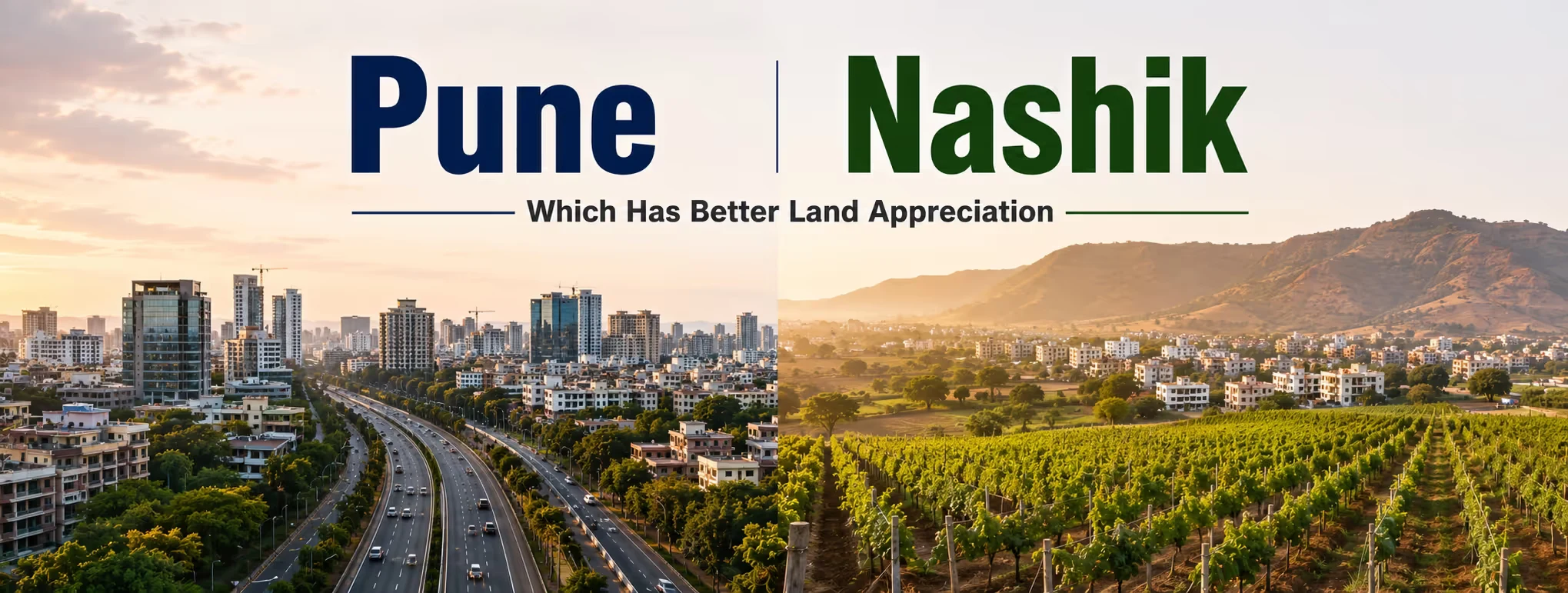
Pune is generally better for consistent and relatively predictable land appreciation. Nashik can be better for affordable entry and long-term percentage growth.
Pune’s land market benefits from sustained demand generated by IT parks, automobile manufacturing, education, logistics, healthcare, business services, and urban migration. Its active Metro network covers 33.1 kilometres with 29 operational stations, while industrial corridors such as Chakan, Talegaon and Ranjangaon continue to support employment-led property demand.
Nashik is not as deep or liquid as Pune, but it is no longer a slow-moving Tier-2 market. Property transactions within Nashik city were estimated at a record ₹17,543 crore during FY 2025–26, compared with ₹13,529 crore in the previous financial year. That sharp increase indicates rising transaction activity, although it should not be interpreted as a citywide land appreciation rate.
The practical conclusion is straightforward:
Choose Pune for stronger liquidity, employment-backed demand and more predictable appreciation. Choose Nashik for lower acquisition costs, larger parcels and higher long-term upside in carefully selected corridors.
Understanding Land Appreciation Before Comparing Pune and Nashik
Land appreciation means an increase in the market value of a plot over time. However, land does not appreciate simply because it is located near a growing city.
A plot usually gains value when one or more of the following changes occur:
- A new road, Metro corridor, industrial estate or logistics hub improves accessibility.
- Agricultural land becomes legally usable for residential, commercial or industrial development.
- Employment opportunities bring more residents and businesses into the area.
- Municipal limits or development zones expand towards the location.
- Water, electricity, drainage and internal roads become available.
- Demand rises while legally developable land remains limited.
- The surrounding area moves from speculative plotting to actual construction and occupation.
Two plots located just five kilometres apart can produce completely different returns. One may sit beside an approved road and residential zone, while the other may have disputed access, agricultural restrictions or no realistic development timeline.
That is why Pune versus Nashik should not be treated as a simple city-level price competition. Investors must compare the actual corridor, land classification, title history, access road, surrounding projects and realistic exit market.
Important Market-Data Note
India does not have a single official, standardised index that measures citywide plotted-land appreciation in Pune and Nashik.
Property portals generally publish asking prices or listing-based rates. These are useful for understanding market direction, but they are not the same as registered transaction values. Registration data measures the value and volume of completed deals, but it does not isolate appreciation by plot type, size or neighbourhood.
For example, Magicbricks reported strong increases in Pune’s overall residential listing rates during 2023–2025. However, those figures cover multiple residential property types and should not be applied directly to every land parcel. Likewise, Nashik’s record registration turnover reflects higher market activity, not a uniform price rise across the entire city.
Investors should therefore use city reports as directional evidence and verify actual local values through recent registered transactions, local ready-reckoner rates, comparable plot sales and professional valuation.
Pune vs Nashik Land Appreciation Comparison
| Comparison Factor | Pune | Nashik | Better Option |
| Current land-entry cost | Generally higher | Usually more accessible | Nashik |
| Resale liquidity | Strong across established corridors | Improving but location-dependent | Pune |
| Employment-driven demand | Strong IT, automobile, manufacturing, and services base | Industrial, agricultural, tourism, and local business demand | Pune |
| Infrastructure depth | Metro, expressway access, ring road projects, and multiple employment hubs | Strong highway connectivity with developing urban infrastructure | Pune |
| Availability of larger parcels | Limited or expensive near established areas | Better availability on peripheral and rural corridors | Nashik |
| Farmhouse and agricultural potential | Strong but increasingly expensive near popular weekend corridors | Wider choice around Trimbak, Dindori, Igatpuri, and Sinnar | Nashik |
| Commercial-land demand | Deep and diversified | Concentrated around selected industrial and urban zones | Pune |
| Appreciation consistency | More consistent in established corridors | Uneven but capable of stronger percentage growth in select areas | Pune |
| Long-term speculative upside | Moderate to high | High in carefully selected emerging corridors | Nashik |
| Exit risk | Comparatively lower | Higher outside active development zones | Pune |
| Suitable holding period | Around 5–8 years | Around 7–10 years or more | Depends on investor goals |
| Overall verdict | Safer, more liquid, and supported by a diversified economy | More affordable with higher upside potential in selected growth corridors | Pune (overall) |
Why Pune Has Delivered Stronger and More Consistent Appreciation
1. Pune Has Multiple Independent Demand Engines
Pune does not depend on one industry. Its property demand comes from information technology, automobile manufacturing, engineering, education, healthcare, logistics, defence-related activity, startups and professional services.
This matters for land investors because diversified employment reduces dependence on a single project or employer. Even when one sector slows, other industries can continue supporting housing, warehousing, retail and commercial demand.
MIDC identifies Pune–Chakan–Talegaon–Satara as a major industrial and investment belt covering sectors such as engineering, automobile components, electronics, logistics and data-related infrastructure.
A person exploring plots for sale in pune is therefore not looking at one uniform market. Pune contains several distinct investment economies:
- IT-led western corridors
- Manufacturing-led northern corridors
- Airport and business-led eastern corridors
- Logistics and industrial corridors towards Ranjangaon
- Weekend-home and lifestyle corridors towards Mulshi and Paud
- Future-growth belts towards Purandar and Saswad
This depth gives Pune a larger resale audience than most Tier-2 cities.
2. Pune Has Better Resale Liquidity
Appreciation on paper has limited value when an investor cannot sell the plot at the expected price.
Pune generally offers a wider pool of buyers, including salaried professionals, business owners, developers, manufacturers, warehouse operators, educational institutions and investors from Mumbai and other Maharashtra cities.
Portal inventory also shows the scale of Pune’s plotted market. Magicbricks recently displayed more than 1,800 residential-plot listings across Pune, with strong search activity in locations such as Hinjawadi, Hadapsar, Wagholi, Kharadi and Baner. Listing counts and asking prices should not be treated as completed transaction evidence, but they show the breadth of market participation.
This does not mean every plot will sell quickly. Poorly connected agricultural land, disputed parcels and unauthorised layouts can remain unsold even during a strong market.
3. Pune’s Infrastructure Already Influences Daily Demand
Pune’s Metro is not merely a future announcement. The official network reports 33.1 kilometres, 30 stations and 29 operational stations. Additional corridors and extensions have also been discussed or approved at different stages.
Operational infrastructure generally creates more reliable property demand than a project that exists only in a proposal.
For land buyers, the strongest opportunities are often not beside a Metro station itself, where values may already be expensive. Better value can emerge in feeder corridors where road access, employment and residential expansion work together.
4. Pune Has Mature Industrial Corridors
Chakan, Talegaon and Ranjangaon are not speculative industrial names. They are established MIDC areas with active manufacturing and land-allotment ecosystems. MIDC’s land records show continuing industrial activity and limited availability in several established phases, which reflects the maturity of these locations.
Investors assessing commercial land for sale in pune should distinguish between:
- Land suitable for retail or offices
- Industrial land governed by MIDC conditions
- Road-facing mixed-use land
- Warehousing and logistics land
- Agricultural land marketed informally for commercial use
A low price does not make land commercially usable. Zoning, access, road width, fire access, development permissions and local planning regulations determine whether the intended activity is legally possible.
5. Pune Has Already Experienced Strong Price Expansion
Magicbricks’ Q3 2025 Pune report showed its combined residential rate indicator rising from ₹7,797 per square foot in Q3 2023 to ₹12,449 per square foot in Q3 2025. The same report linked the movement to economic opportunities, migration and infrastructure development. These are listing-based residential indicators, not a plot-only transaction index, but they demonstrate the strength of Pune’s broader property cycle.
The important investment lesson is not that every Pune plot will repeat this performance. It is that much of Pune’s obvious growth story has already been priced into established corridors.
Future buyers need to be more selective. Paying a premium based only on a proposed Metro line, ring road or airport can significantly reduce future returns.
Where Land Appreciation May Be Stronger Around Pune
Hinjawadi–Marunji–Maan Belt
This corridor benefits from the Hinjawadi employment ecosystem and residential expansion towards Marunji, Maan and nearby villages.
However, investors must separate well-connected, legally developable plots from fragmented agricultural parcels with weak approach roads. In mature pockets, prices may already include expectations around future infrastructure.
Magicbricks’ locality data for April–June 2026 showed different quarterly directions even within nearby plot markets. Maan Road and Hinjawadi recorded quarterly declines in listed residential-plot rates, while Marunji showed an increase. This illustrates why investors should avoid assuming that every locality in one growth corridor moves together.
Wagholi–Nagar Road–Ranjangaon Belt
This belt combines residential expansion, airport-side demand, manufacturing and highway connectivity.
Nagar Road’s listed residential-plot rate showed quarterly growth during April–June 2026, but portal movement should be cross-checked with registered sales.
The area may suit buyers interested in:
- Residential plots near established settlements
- Warehousing and logistics opportunities
- Road-facing commercial plots
- Long-term land near industrial employment zones
Investors should carefully check congestion, water availability, road reservations and actual travel times.
Chakan–Talegaon–Moshi–Alandi Belt
The wider northern Pune belt benefits from manufacturing, warehousing and expanding residential demand.
Industrial employment can support appreciation, but not all surrounding agricultural land automatically becomes industrial or residential. MIDC land, privately owned agricultural land and land within regional planning zones follow different legal and development processes.
Buyers searching for agriculture land for sale in pune should verify the buyer’s legal eligibility, cultivation status, tenancy history, access, water rights and development-zone classification before paying a token amount.
Mulshi–Pirangut–Paud Belt
Mulshi and Paud attract second-home buyers, investors and people looking for scenic land within driving distance of Pune.
The demand is real, but the corridor also carries common risks:
- Steep or irregular terrain
- Restricted access during the monsoon
- Forest or environmentally sensitive surroundings
- Unrecorded access roads
- Hill cutting or construction restrictions
- Marketing based on views rather than legal usability
A buyer considering farm land near pune should visit during both dry and rainy conditions. A road that appears usable in February may become difficult during heavy monsoon rainfall.
Saswad–Purandar Corridor
The Purandar side attracts attention due to long-term infrastructure expectations, warehousing potential and connectivity towards southern and eastern Maharashtra.
This corridor may deliver appreciation, but it is highly sensitive to the exact alignment and execution of major infrastructure projects. Buying solely on broker claims about a future airport boundary or road alignment is risky.
An investor considering farm land for sale in pune in this belt should obtain official planning maps rather than relying on a marked-up brochure or WhatsApp location image.
Also Read: Pune vs Bengaluru Real Estate: IT Growth vs Property Appreciation Compared
Why Nashik Could Produce Higher Percentage Appreciation
1. Nashik Has a Lower Price Base in Many Peripheral Locations
Lower entry cost does not guarantee appreciation, but it can improve the percentage return when actual infrastructure and occupation follow.
Portal inventory illustrates the difference in market positioning. Magicbricks recently reported a median residential-plot asking price of about ₹37.1 lakh in Nashik, compared with approximately ₹50 lakh in Pune. Its average values were much higher and heavily influenced by parcel size and premium listings, so median figures provide a more useful—but still imperfect—comparison.
Investors reviewing plots for sale in Nashik can often find larger parcels than they would obtain for the same budget near Pune. This creates opportunities for farmhouse use, future subdivision where legally permitted, agricultural operations or long-term holding.
2. Nashik’s Transaction Activity Has Accelerated
Nashik city recorded an estimated ₹17,543 crore in property transactions in FY 2025–26, up from ₹13,529 crore in FY 2024–25. The estimate was derived from the Nashik Municipal Corporation’s local-body cess collection.
That increase matters because land appreciation requires real market participation. A growing volume of registered property activity suggests that buyers are committing capital, not merely browsing listings.
At the same time, the increase covers flats, commercial units and other property types. It should not be used to claim that Nashik land prices rose by the same percentage.
3. Nashik’s Urban Growth Is Moving Outward
Panchavati and CIDCO have emerged as major growth zones within Nashik. NMC-linked data reported that these zones account for a substantial portion of new housing and commercial development, with visible expansion along the Adgaon–Mhasrul–Makhmalabad and New Indira Nagar–Pathardi corridors.
This outward movement can support demand for a legally approved land plot for sale in Nashik, especially where the parcel has:
- Direct access to a public road
- Residential zoning or valid non-agricultural use
- Nearby occupied housing
- Water and electricity connections
- A sanctioned layout
- Clear boundaries and survey records
A plot surrounded only by other vacant plots may remain speculative for years, even when the brochure describes the location as “fast developing.”
4. Nashik Has Strong Regional Connectivity
Nashik connects Mumbai, Pune, Ahilyanagar, Chhatrapati Sambhajinagar and northern Maharashtra through major highways. Official state highway information identifies NH 60 between Mumbai, Thane and Nashik, NH 160 through Nashik and Sinnar, and the Samruddhi corridor passing through the wider Nashik region.
Connectivity supports industry, tourism, agriculture, warehousing and weekend travel. However, the value impact is strongest near usable interchanges and active roads—not simply because a highway crosses the district.
5. Nashik Has Industrial Depth Beyond Tourism and Agriculture
Nashik is often viewed only as a wine, pilgrimage or agricultural destination. In reality, Satpur, Ambad and Sinnar form an established industrial network.
MIDC records identify Nashik–Satpur, Nashik–Ambad, Sinnar and additional Nashik industrial areas. Official data also shows very high allotment levels in the established Ambad and Satpur areas, indicating mature industrial occupation rather than purely proposed development.
This can support residential, rental, retail and logistics demand in surrounding locations.
A buyer assessing commercial land for sale in Nashik should focus on actual commercial catchment. Industrial proximity alone is not enough. The plot must have suitable access, permitted use, sufficient road width and realistic demand from businesses.
Promising Nashik Corridors for Land Investors
Pathardi–New Indira Nagar Corridor
Pathardi has become one of Nashik’s active expansion directions. It offers access to established residential areas while retaining plot availability in peripheral pockets.
The best-performing parcels are likely to be those near occupied housing, schools, hospitals and regular transport rather than isolated plotted schemes several kilometres beyond development.
Buyers planning to purchase plot in Nashik should compare the asking price with:
- Recent registered sales in the same survey area
- Road width and ownership
- Sanctioned layout documentation
- Development charges
- Water availability
- Existing construction nearby
Adgaon–Mhasrul–Makhmalabad Belt
This belt forms part of the wider Panchavati growth zone and has seen substantial property expansion.
It may suit buyers seeking residential plots or long-term land close to Nashik’s urban edge. Still, rates vary sharply depending on whether the parcel lies within a sanctioned residential layout, on a main road, inside a village boundary or in an agricultural zone.
Gangapur Road–Trimbak Road Corridor
Gangapur Road is an established premium residential direction, while the wider Trimbak Road corridor offers lifestyle, resort, farmhouse and tourism-linked opportunities.
Buyers searching for farm land near Nashik commonly focus on Trimbakeshwar, Anjaneri and surrounding areas. Scenic value can improve demand, but it should never replace legal verification.
Check:
- Year-round approach
- Water source
- Slope and drainage
- Forest boundaries
- Development restrictions
- Actual distance from the city
- Neighbouring land use
- Suitability for the intended structure
Dindori Corridor
Dindori has agricultural importance and offers relatively larger parcels. It may appeal to buyers interested in farming, vineyards, horticulture or patient long-term investment.
People evaluating agriculture land near Nashik should not assume that future conversion will automatically occur. Agricultural productivity, water, soil quality, crop access and existing farm income may be more relevant than speculative urban conversion.
Sinnar Corridor
Sinnar benefits from industrial activity and regional road connectivity. It can support land demand for housing, worker accommodation, warehousing and industrial-support businesses.
The strongest opportunities are generally near functioning employment zones and active settlements. A distant parcel marketed only as “near MIDC” may be several kilometres from the actual entrance or workforce catchment.
Igatpuri Corridor
Igatpuri attracts second-home, resort and nature-focused investment. Its proximity to the Mumbai–Nashik route strengthens weekend demand.
However, heavy rainfall, slopes, environmental sensitivity and access conditions can directly affect construction feasibility. Investors should obtain a topographical survey and planning opinion before buying hillside property.
Pune vs Nashik by Property Type
Residential Plots
Pune is stronger for residential plots when the objective is resale liquidity, self-construction demand or proximity to large employment centres. However, legally approved plots in established Pune corridors can command a substantial premium.
Nashik offers better entry opportunities for buyers who can wait. A person looking to buy land in Nashik may obtain a larger plot, but the investor must be more selective about actual neighbourhood development.
Better choice: Pune for liquidity; Nashik for value entry.
Agricultural Land
Agricultural land should be evaluated as agricultural land first, not as a guaranteed future residential plot.
Under Maharashtra’s agricultural-land framework, restrictions can apply to transfers involving non-agriculturists, although the legal position can differ based on land use, planning designation, permissions and statutory exceptions. Buyers should obtain a written opinion from a Maharashtra land lawyer before entering the transaction.
A buyer comparing agriculture land for sale in pune with Nashik agricultural land should consider:
- Per-acre acquisition price
- Water availability
- Soil and crop potential
- Labour access
- Electricity
- Road connectivity
- Legal buyer eligibility
- Tenancy or cultivation rights
- Fragmentation restrictions
- Future planning zone
Better choice: Nashik for agricultural use and larger parcels; Pune for urban-edge speculation, but usually at a higher cost and greater pricing risk.
Farmhouse and Weekend-Home Land
Pune has strong weekend demand from its large professional population and proximity to Mumbai. Mulshi, Paud, Panshet, Lonavala-side locations and the Purandar belt attract farmhouse buyers.
Nashik offers alternatives around Trimbak, Dindori, Igatpuri, Gangapur and vineyard-linked belts. The entry price may be lower, and parcels may be larger.
Better choice: Pune for stronger premium demand; Nashik for space, scenic value and lower acquisition cost.
Commercial Land
Pune has a larger and more diversified commercial market. Demand can come from retail, offices, hospitality, warehousing, healthcare, education and industrial-support businesses.
Nashik commercial appreciation is more dependent on exact location. Main-road frontage, industrial access, tourism routes and dense residential catchments matter significantly.
Better choice: Pune overall; Nashik for selected road-facing or industrial-support locations.
Which City Is Better for Different Investors?
Choose Pune When You Want:
- A larger resale market
- Employment-backed demand
- Better commercial depth
- Shorter expected exit time
- Established infrastructure
- Multiple active growth corridors
- A five-to-eight-year investment horizon
- Lower dependence on one proposed project
Pune is usually more suitable for investors who value predictability over bargain pricing.
Choose Nashik When You Want:
- A lower entry price
- A larger parcel
- Agricultural or farmhouse use
- Long-term urban-edge appreciation
- Exposure to an emerging city
- A seven-to-ten-year holding period
- The ability to wait through slower market cycles
- Higher percentage upside with higher location risk
Nashik works best for patient buyers who can personally inspect the property and verify the ground reality.
Appreciation Potential: A Practical Scenario
Consider two investors with similar budgets.
The first investor buys a smaller approved plot near an established Pune employment corridor. The price already reflects current demand, road connectivity and surrounding occupation. Appreciation may be steady, and the owner may find it easier to exit because more buyers understand the location.
The second investor buys a larger plot on Nashik’s urban edge. The acquisition price is lower per square foot, but the location is still developing. If the approach road improves, nearby housing becomes occupied and civic infrastructure arrives, the percentage increase could exceed the Pune investment. If those changes do not occur, the land may remain illiquid.
This is the central difference:
- Pune investors generally pay more for visibility and liquidity.
- Nashik investors accept more uncertainty in exchange for a lower price and potentially higher upside.
How to Identify a Plot With Genuine Appreciation Potential
1. Look for Existing Demand, Not Only Future Promises
A functioning industrial area, occupied housing society, hospital, school or commercial market creates measurable demand.
A proposed road or airport may create opportunity, but it also creates speculation. Investors often overpay after an announcement and then wait years for execution.
2. Check the Last-Mile Road
A plot located two kilometres from a highway can still be a poor investment when the connecting road is narrow, private, disputed or seasonally inaccessible.
Verify the road on official maps and land records. Do not rely only on physical use.
3. Study Actual Construction
Count occupied buildings, not plotted signboards.
Look for:
- Houses under construction
- Electricity connections
- Water lines
- Shops serving residents
- Public transport
- Schools and clinics
- Road widening
- Drainage work
These indicate genuine urbanisation.
4. Understand the Exit Buyer
Before buying, ask: who will purchase this land from me later?
The likely exit buyer could be:
- A family building a house
- A local developer
- A neighbouring farmer
- A warehouse operator
- A resort owner
- A manufacturer
- A commercial business
- Another speculative investor
A plot with no clear end-user depends on continued speculation.
5. Avoid Paying for Unconfirmed Infrastructure
Do not pay a premium merely because a broker says:
- “Metro is coming.”
- “This land will become NA.”
- “The ring road will touch the plot.”
- “A large company is buying nearby.”
- “The airport boundary is close.”
- “The government will acquire this land.”
Ask for official notifications, planning maps and survey details.
Land Due-Diligence Checklist for Pune and Nashik
Before purchasing any plot, agricultural parcel or commercial land, complete the following checks.
Ownership and Title
- Obtain the latest 7/12 extract for rural land.
- Obtain the property card where applicable.
- Verify the seller’s name and ownership share.
- Examine mutation entries.
- Check inheritance, partition and family claims.
- Conduct a title search covering previous transactions.
- Confirm that all co-owners will execute the sale.
- Search for mortgages, charges, litigation and acquisition notices.
Maharashtra Mahabhulekh portal provides online access to 7/12 extracts, 8A extracts and property cards. The Mahabhumi portal also provides access to digitally signed land records and cadastral mapping services.
Land Use and Planning
- Confirm whether the land is agricultural, residential, commercial or industrial.
- Check the development plan or regional plan.
- Verify reservation for roads, public facilities, green zones or utilities.
- Confirm whether subdivision is legally permitted.
- Review applicable development-control regulations.
- Check whether non-agricultural use or other permissions are required.
- Verify whether the intended building can legally be constructed.
Physical Verification
- Conduct a licensed survey.
- Match the boundaries with the official map.
- Verify road access and road ownership.
- Check encroachments.
- Inspect drainage and flood risk.
- Confirm electricity and water availability.
- Visit during the monsoon where possible.
- Speak with neighbouring owners.
Layout and Project Verification
For plotted developments, verify the sanctioned layout, local-authority approvals and MahaRERA registration where applicable. MahaRERA allows buyers to search projects, agents, complaints, lapsed registrations and regulatory actions.
Never accept “RERA applied” as equivalent to a valid registration.
Agricultural-Land Checks
- Confirm buyer eligibility.
- Check the cultivator and tenant columns.
- Review restrictions written in the 7/12 extract.
- Verify land tenure and occupancy class.
- Check ceiling and fragmentation issues.
- Confirm irrigation and water rights.
- Obtain legal advice before paying an advance.
Financial Checks
- Compare recent registered transactions.
- Review the ready-reckoner value.
- Calculate stamp duty and registration expenses.
- Budget for brokerage, legal work and surveying.
- Estimate fencing and security costs.
- Consider annual maintenance and property tax.
- Include the cost of holding the land for several years.
Selling Land in Pune or Nashik
Appreciation becomes real only when the owner completes a sale.
Owners who want to sell land in Nashik should prepare a clear documentation pack containing the latest land record, survey map, title documents, access details, zoning information and recent photographs. Transparent documentation attracts serious buyers and reduces negotiation delays.
The search phrase plot sell in pune is commonly used by owners looking for faster visibility. However, merely publishing a listing rarely produces the best result. Sellers should provide accurate dimensions, road width, ownership type, permitted use, nearby landmarks and a realistic asking price supported by local transactions.
Overpricing land based on one nearby advertisement can keep the property unsold for years. Asking prices are not proof of market value.
How 2Bigha Can Support a More Informed Land Search
Land discovery remains fragmented. Buyers often move between brokers, social-media posts, scattered advertisements and incomplete location details without knowing whether they are comparing similar properties.
2Bigha provides a more focused way to explore land opportunities through map-based discovery and verified property information. Buyers can compare locations, examine the surrounding area and shortlist options based on their actual purpose—residential plotting, agriculture, farmhouse use or long-term investment.
Property owners can also use the platform to improve visibility among relevant land buyers instead of depending only on informal local networks. For buyers or owners who require continued support after the transaction, 2Bigha also offers a subscription plan and property management service.
A digital platform improves discovery, but it does not replace independent legal, technical and financial due diligence. Every buyer should verify documents and inspect the land before making payment.
Pune vs Nashik: Final Investment Verdict
Pune Is Better for Overall Land Appreciation
Pune wins when the comparison includes:
- Appreciation consistency
- Resale demand
- Employment growth
- Commercial depth
- Infrastructure maturity
- Buyer diversity
- Exit liquidity
Its biggest weakness is price. Investors may need to pay a significant premium, and several established corridors already reflect future growth expectations.
Nashik Is Better for Value and Long-Term Upside
Nashik wins when the comparison includes:
- Affordable entry
- Larger land parcels
- Agricultural opportunities
- Farmhouse potential
- Lower-density growth corridors
- Long-horizon percentage upside
Its biggest weakness is uneven appreciation. A good corridor can perform strongly, while a nearby isolated plot may remain stagnant.
The Most Practical Conclusion
For a conservative investor, Pune is the better choice.
For a patient investor with strong local knowledge and a longer holding period, Nashik may offer the better risk-adjusted entry opportunity.
Do not select a city first and then force a plot into the investment plan. Start with your objective, budget, holding period and exit buyer. Then compare individual parcels on legal clarity, road access, surrounding occupation, infrastructure and realistic demand.
A clear-title plot in a good Nashik corridor can outperform a badly selected Pune parcel. Similarly, a legally usable Pune plot near active employment may appreciate more reliably than cheap agricultural land in a remote Nashik village.
Disclaimer: This article is for informational purposes only and should not be considered investment, legal, financial, or property advice. Real estate regulations, infrastructure plans, market conditions, and government policies may change over time. Readers are advised to verify information with relevant authorities and consult qualified professionals before making any investment or property-related decisions.