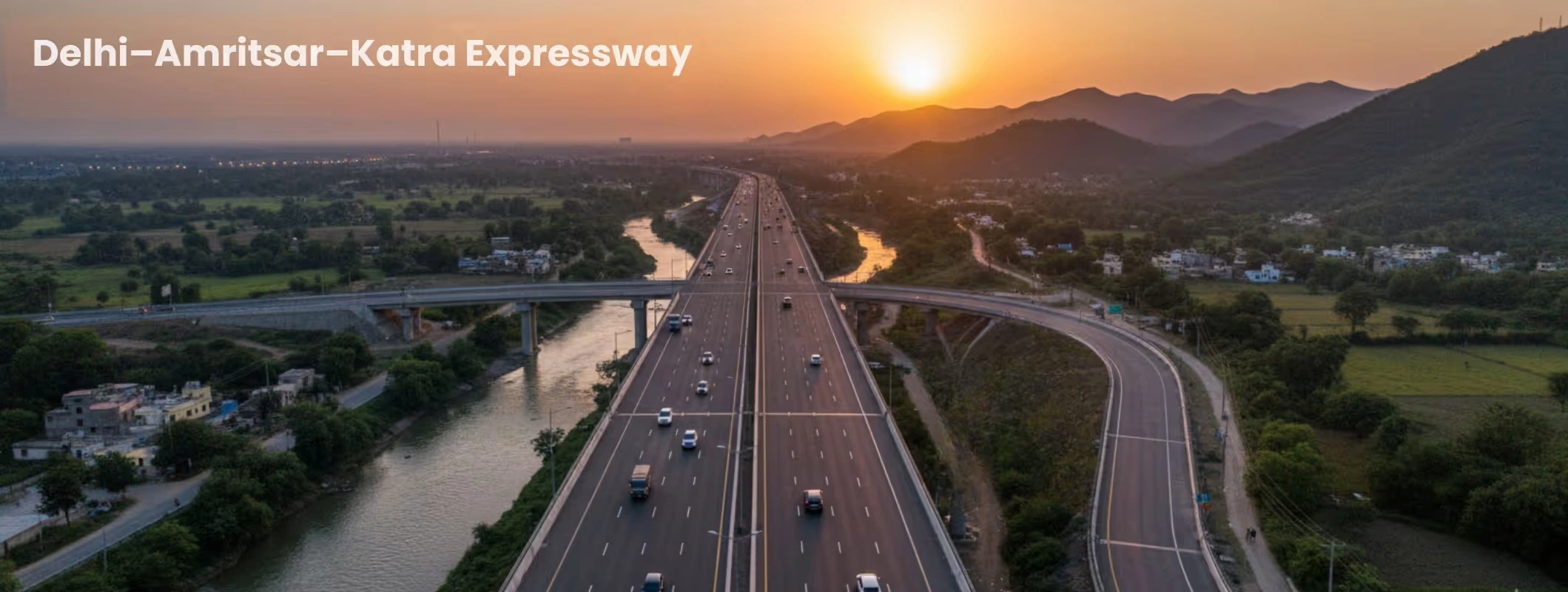
If you’ve ever planned a Vaishno Devi yatra from Delhi, you already know the real pain point isn’t the trek, it’s the road journey. Long hours, unpredictable bottlenecks, and that one stretch that turns a simple trip into an all-day mission.
That’s exactly why the Delhi–Amritsar–Katra Expressway is getting so much attention. Once it’s operational, officials say it can cut Delhi–Katra travel time from roughly 14 hours to about 6 hours, and reduce the distance too.
But here’s the part most people miss: this isn’t only a “pilgrimage corridor” story. It’s also a connectivity + commerce + land value story, especially if you’re tracking land for sale in Delhi (and NCR edges) or scouting Agricultural land along growth corridors.
Let’s break it down in a clean, practical way, without hype.
What is the Delhi–Amritsar–Katra Expressway (and why is it a big deal)?
This is a greenfield, access-controlled expressway planned to connect Delhi to Katra (J&K) via Haryana and Punjab, with connectivity that also supports the Amritsar side through spur links. The total length is widely reported at around 670 km, and it’s being developed under NHAI.
The headline benefit
- Delhi to Katra: expected to drop from ~14 hours to ~6 hours once fully operational.
Why the time savings is realistic (in theory)
Access-controlled expressways work because they remove the “slow killers”:
- signal junctions
- town traffic
- random U-turn merges
- roadside friction (encroachments, local stopping)
So even if your top speed doesn’t stay high throughout, your average speed improves, and travel time collapses.
Current status: Is it open right now?
Not fully, and this matters if you’re making any plans for travel or buying property.
Recent reports quoting NHAI project leadership indicate a completion target around March 2027.
A Parliament document also lists multiple packages under the Delhi–Amritsar–Katra corridor with package-level timelines and progress, and it clearly shows that some sections have faced delays/termination/traffic not commissioned yet.
And yes, Punjab has seen land acquisition and project-delay issues across multiple highway projects, including the DAK corridor spur.
Why pilgrims aren’t the only winners
NHAI officials have described this corridor as significant not just for tourism, but for regional connectivity and even strategic movement because of its proximity to sensitive border areas.
That creates second-order impacts:
- faster movement of goods between NCR ↔ Punjab ↔ J&K belt
- new freight patterns and warehouse clustering
- growth in hospitality and wayside services near interchanges
- stronger weekend/religious tourism economy (Katra + Amritsar circuit.
Real Estate Impact: What typically happens around major expressways
Here’s the usual playbook you’ll see in India (and this corridor will likely follow the same pattern):
1. Land near interchanges gets attention first
Not “road-touch” land. Not “somewhere near the alignment” land.
Interchange-adjacent land is what becomes commercially useful, because access-controlled roads don’t allow random entry/exit.
Tradeoff:
- Access control = faster travel (good for the region)
- But access control = fewer direct access points (bad for roadside plot hype)
So if someone is pitching you “highway-facing plot = huge returns,” ask one question:
"Where is the nearest interchange, and what’s the legal access route?"
2. Warehousing and logistics pull demand outward
As travel time drops, businesses start planning distribution differently:
- NCR warehousing demand can shift/expand toward better highway nodes
- Cold chains and agri-logistics gain importance (Punjab/Haryana belts)
3. Hospitality clusters form but only where stopping is allowed
Expressways usually come with planned wayside amenities and regulated stopping zones.
So unplanned dhaba-style roadside bets are riskier on access-controlled corridors.
What this means for “Land for sale in Delhi”
Let’s be Real: Delhi doesn’t have spare land suddenly appearing. What changes is the value of connectivity.
- logistics users trying to move out of congested nodes
- businesses that want faster access to Punjab/J&K routes
- buyers who prefer edge-of-city connectivity (Delhi border zones / NCR adjacency)
So the strongest property ripple is usually seen in:
- Delhi edge + NCR belt that connects smoothly to the expressway start nodes
- industrial and warehousing zones that benefit from faster line-haul movement
If you’re listing or searching Land for sale in Delhi, this expressway is more likely to influence:
- commercial viability
- rental potential (for logistics-linked uses)
- demand for peripheral land parcels with clean access
Not magical overnight appreciation in central Delhi.
What this means for “Agricultural land” along the corridor
This is where curiosity spikes, and where people make mistakes.
Yes, better roads can raise interest in Agricultural land in Punjab or Haryana belts due to:
- farm-to-market speed
- cold storage viability
- packaging/processing hubs
- warehouse spillover
But agricultural land also comes with hard constraints:
- land-use conversion rules (CLU)
- registry/title complexities
- access road legality (especially when the main corridor is controlled-access)
- acquisition/notification risk if you’re too close to alignment buffers
The smart lens for agricultural land buyers
Instead of asking “How close is it to the expressway?” ask:
- Is it legally accessible from a public road without crossing a restricted ROW?
- Is it outside notified acquisition zones and buffer requirements?
- Does the area have a realistic path to permitted conversion (if conversion is your plan)?
- Is there water + power + drainage practicality, or just a map story?
Blunt truth: Agricultural land is where hype spreads fastest and where due diligence matters most.
Challenges you should factor in (before you trust any “growth corridor” story)
Land acquisition and local resistance
Delays linked to land acquisition and disputes have been reported in Punjab highway projects, including this corridor’s spur sections.
Package-level uncertainty
A Parliament annexure lists multiple DAK packages with progress percentages and timelines, and it shows that some packages have faced serious contract actions (like termination/foreclosure) and commissioning delays.
Weather + terrain risk (especially J&K stretches)
NHAI officials have also talked about disruption from heavy rains/flooding and project execution challenges.
Bottom line: Expect the corridor to deliver long-term value, but don’t base short-term investment decisions purely on projected opening dates.
If you’re buying property because of this expressway, use this checklist
Keep it simple:
- Verify the exact location (not just a pin drop).
- Check master plan / land use (agri vs residential vs industrial).
- Confirm legal approach road (especially near controlled-access segments).
- Avoid “alignment-adjacent” deals unless you’ve checked notifications thoroughly.
- Ask for ownership chain + encumbrance certificate (don’t skip this to save time).
- Model downside: “If the expressway opens 12–24 months late, does this deal still make sense?”
FAQs
1. Will Delhi–Katra really become a 6-hour drive?
That’s the stated expectation once the corridor is fully operational and working as designed.
2) When is the expressway expected to complete?
Recent reporting quoting NHAI project leadership points to a target around March 2027. Package-level timelines also appear in Parliamentary documentation.
3) Will this boost property prices everywhere along the route?
No. The strongest impact typically concentrates near interchanges, logistics nodes, and permitted development zones, not random roadside parcels.
4) Is buying agricultural land near the expressway a good idea?
if you understand conversion rules, access legality, and acquisition risk. If your plan depends on “future conversion,” treat that as uncertain unless verified.
5) Does this affect Land for sale in Delhi directly?
More indirectly through better outward connectivity, shifting warehousing/logistics demand, and faster intercity movement. Central Delhi supply constraints don’t change.
6) What’s the biggest mistake buyers make in corridor investments?
Buying “close to the expressway” without checking legal access and interchange distance.
Final Take
The Delhi–Amritsar–Katra Expressway is one of those projects that can genuinely change travel behavior—especially for Vaishno Devi pilgrims—and it can reshape logistics movement across the North belt.
But for real estate, the opportunity isn’t “everything near the road will rise.” The opportunity is targeted:
- interchange-led micro-markets
- logistics-friendly zones
- agriculture-linked supply chain hubs
- NCR edge parcels with clean access and compliant land use
So whether you’re searching Land for sale or exploring Agricultural land along future growth corridors, keep your approach practical: verify facts, model delays, and buy based on legal usability, not just a headline travel-time number.