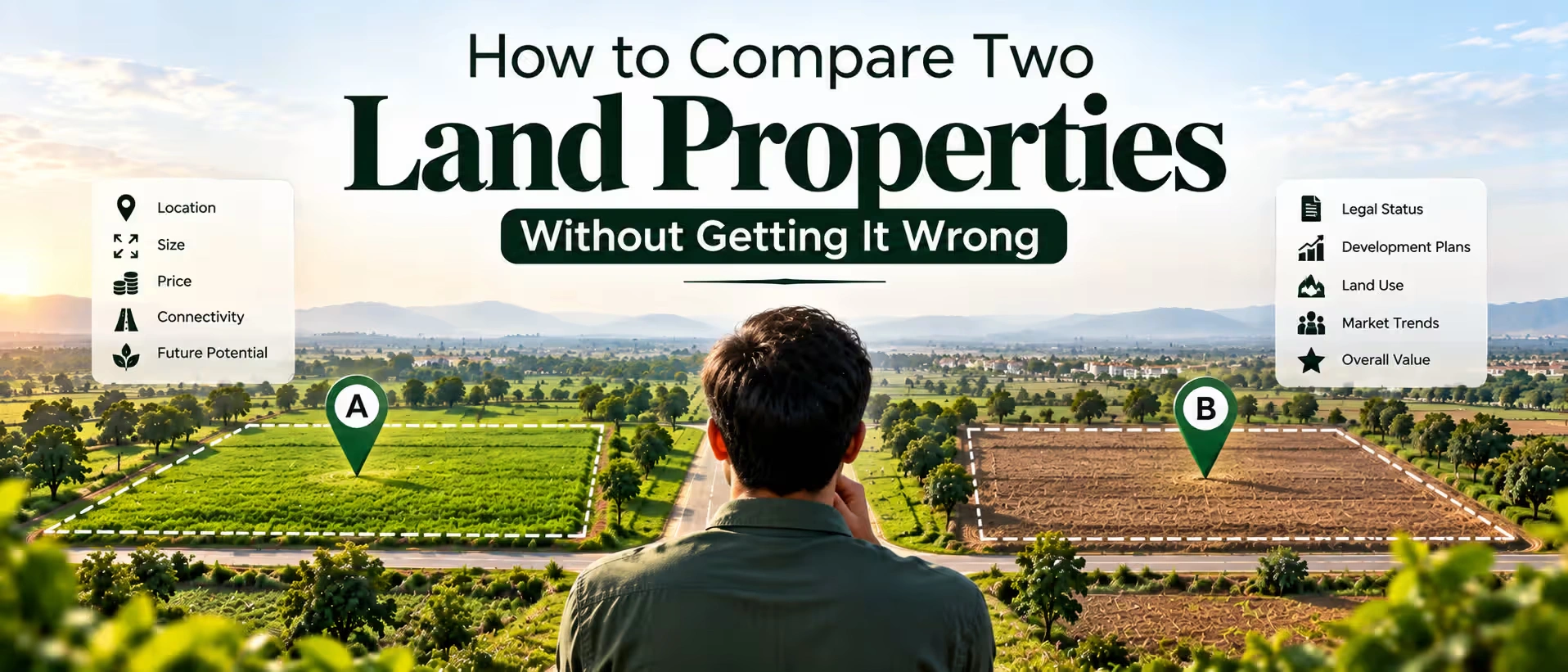
Two individuals who are going to compare two plots will tend to go about this business in the same manner that people will compare two cell phones: cost on one hand and simple information on the other, and a decision made in one afternoon. However, land is not like that, and usually people find themselves making mistakes and realizing this many years after one plot continues to appreciate while the other has drainage problems that they did not notice on their visit.
This article aims to help individuals who are trying to make the right comparison when choosing between two pieces of land by avoiding what is easy to compare and looking for what really counts.
Start With What the Land Is Actually For
Any form of comparison becomes meaningless until the objective is clarified. A plot purchased for agricultural purposes and one purchased strictly for the appreciation of the value of the land are very different animals, and misunderstanding the difference is where a lot of people tend to make mistakes right off the bat.
When it comes to evaluating farmland, factors such as soil quality and water sources become more important than nearly everything else on the list. When making comparisons in terms of an appreciation strategy, connectivity and development plans become more important than whatever is being grown on the land.
The Core Comparison Table
Here's a practical framework most experienced buyers end up using, whether they write it down formally or just carry it in their head during site visits.
| Factor | What to Check | Why It Matters |
|---|---|---|
| Legal title | Clear, marketable title with no encumbrances | A cheap plot with a title dispute isn't actually cheap |
| Soil and water | Soil test results, groundwater depth, irrigation source | Determines usability and productivity for farmland |
| Connectivity | Distance to main road, condition of access road | Affects both resale value and day-to-day usability |
| Zoning and land use | Agricultural, residential, or mixed-use classification | Wrong classification can block future conversion plans |
| Price per unit area | Rate compared to recent transactions nearby | Flags overpricing or a genuine below-market opportunity |
| Development proximity | Upcoming roads, industrial zones, expressways | Long-term appreciation potential |
| Flood or erosion history | Local records, revenue department data, neighbor accounts | Avoids buying into recurring seasonal damage |
| Seller motivation and history | Why they're selling, how long it's been listed | A plot that's lingered on the market often has a reason |
None of these rows are optional if you're serious about the comparison. Skipping even two or three of them is usually how buyers end up regretting a purchase that looked fine on the surface.
Legal Standing Comes Before Everything Else
It may be tempting to go right for price, but first, you have to check on the title; a legal issue can make all other considerations meaningless. Bring up the income statement for each property and make sure the owner’s name checks out against the ownership documentation, and that there are no pending lawsuits, mortgages, or mutations. Just this process alone weeds out more potential comparisons than you would think possible. When one of your two choices has a questionable title, then it just isn’t an option at all, period.
Soil, Water, and Productivity — If Farming Is the Goal
For anyone running a genuine farmland search rather than a pure investment search, this section deserves the most time. Soil testing isn't expensive relative to the size of a land purchase, and it removes guesswork that a visual inspection simply can't replace.
- Request or commission a soil fertility test for both plots if farming is the intended use
- Check groundwater depth and whether borewell access is realistic and affordable
- Ask about the last three to five years of crop history, if the seller has it
- Look at drainage patterns during monsoon; standing water after rain is a red flag that's easy to miss on a dry-season visit
- Compare proximity to canal or river irrigation, where relevant
A plot that's cheaper per acre but requires a much deeper borewell, or has poor drainage, can end up costing more over a five-year horizon than the pricier option next door.
Location and Growth Trajectory
This is where the two-plot comparison often gets genuinely interesting, because the numbers on paper can be deceiving. A plot slightly further from the main road but positioned near an upcoming industrial corridor may outperform a more conveniently located plot with no development plans nearby.
- Check district or state infrastructure announcements for both locations
- Compare how each area's land values have moved over the past three to five years, not just the current asking rate
- Look at what's being built or planned within a five-to-ten kilometer radius
- Ask locally about any pending highway, expressway, or industrial zone approvals that haven't yet hit the news
Buyers who only compare today's price miss this entirely, and it's usually the single biggest factor separating a mediocre purchase from a genuinely good one.
Price Isn't Just the Number, It's the Number in Context
Two plots priced identically per acre are not automatically equal in value. Context changes everything.
| Scenario | Plot A | Plot B |
|---|---|---|
| Price per acre | ₹8 lakh | ₹8 lakh |
| Road access | Paved road frontage | Kutcha road, 500m from main road |
| Title status | Clear, mutation complete | Mutation pending |
| Nearby development | Upcoming expressway link | No planned infrastructure |
| Realistic conclusion | Fair value, low risk | Overpriced relative to risk |
This kind of side-by-side breakdown, even done informally on a notepad during a site visit, tends to expose which plot is genuinely the better deal far more reliably than gut instinct.
Talk to the Seller, Not Just the Listing
Whether you found both options through a broker, a listing site, or word of mouth, it's worth asking direct questions about why the land is being sold. A seller looking to sell land quickly due to relocation or financial pressure may be more flexible on price, while a seller who's tested the market for over a year without movement might be sitting on an overpriced or problematic plot. Neither situation is automatically bad, but knowing which one you're dealing with changes your negotiating position.
Verify Independently, Don't Rely on the Listing Alone
Listings, whether from a broker or a platform showing agricultural land on sale, are marketing material first and factual documents second. Cross-check everything material to your decision:
- Confirm boundary markers physically match the survey map, ideally with a local surveyor
- Verify the plot size against official revenue records, not just what's stated in the listing
- Ask neighboring landowners about water table depth, flooding history, or any disputes they're aware of
- Check recent comparable transactions in the immediate area, not just the district average
A listing that undersells these details isn't necessarily dishonest, but the burden of verification sits with the buyer either way.
Making the Final Call
Once the legal, physical, and financial comparisons are done, the decision usually becomes clearer than expected. The plot that looked slightly more expensive on paper often turns out to be the better long-term hold once title clarity, soil quality, and growth trajectory are factored in properly. The reverse is also true; sometimes the cheaper plot really is just cheaper, with nothing hidden behind it.
If you're managing this process through a platform rather than purely informal channels, 2Bigha (2bigha.ai) makes side-by-side evaluation considerably easier. Listings come with verified documentation and background checks built in, which removes a lot of the guesswork buyers otherwise have to do manually across multiple plots. And for anyone on the other side of the table looking to sell plots themselves, listing on a verified platform tends to attract buyers who are further along in their own due diligence process, which usually means fewer wasted conversations and a faster path to a serious offer.
Disclaimer: This article is for informational purposes only and should not be considered investment, legal, financial, or property advice. Real estate regulations, infrastructure plans, market conditions, and government policies may change over time. Readers are advised to verify information with relevant authorities and consult qualified professionals before making any investment or property-related decisions.