If you are planning to buy land in Chhattisgarh, this is the first thing you need to understand: RERA is your basic legal safety filter. In Chhattisgarh, qualifying real estate projects must be registered before they are advertised or sold, registered agents cannot legally facilitate sales in unregistered qualifying projects, and buyers get a formal complaint and appeal route when builders or agents break the rules.
As of March 2026, CGRERA is not a dead portal sitting online for formality. The official site shows fresh circulars issued in January, February, and March 2026, along with 2,051 registered projects, 948 registered agents, and 3,245 disposed complaints. That tells you one important thing: this regulator is active, and buyers should use it before paying money.
Key Takeaways
- Most commercial and residential real estate projects in Chhattisgarh must register with CGRERA before marketing, booking, or sale. The main exemption threshold is where the land proposed to be developed does not exceed 500 sq. m. or the apartments do not exceed 8, subject to the Act’s conditions.
- A builder cannot collect more than 10% of the apartment, plot, or building cost as advance or application money without first entering into an agreement for sale.
- 70% of buyer collections must be kept in a separate scheduled-bank account and used only for land and construction costs of that project.
- Buyers have the right to see sanctioned plans, project timelines, approvals, and quarterly updates on the CGRERA website.
- If possession is delayed, the allottee can either seek refund with interest and compensation or continue and claim interest for every month of delay, as applicable under the Act and rules.
- Complaint fee before the Authority is ₹1,000, and appeal fee before the Appellate Authority is ₹5,000.
What is Chhattisgarh RERA and Why does it matter in 2026?
Chhattisgarh RERA, or CGRERA, is the state regulator created under the Real Estate (Regulation and Development) Act, 2016. The central Act came into force from 1 May 2017, and Chhattisgarh established CGRERA through notification dated 29 April 2017. Its job is simple in theory but powerful in practice: register projects and agents, force public disclosures, handle complaints, and improve transparency and financial discipline in real estate.
For buyers, this matters because property fraud usually starts with missing information: no clear approval status, no committed possession timeline, no verified registration number, no public record of delays, and no meaningful grievance route. CGRERA tries to fix that by making registered project data public and by giving buyers a formal forum to act when the promoter defaults.
Quick Comparison: Registered project vs Risky non-compliant project
| Issue | Registered / Compliant Position | Buyer Takeaway |
| Project launch | A qualifying project cannot be advertised, marketed, booked, sold, or offered for sale without registration. | Ask for the CGRERA number before any booking payment. |
| Visibility | Registered projects must disclose plans, approvals, timelines, booking status, and quarterly updates on the authority website. | Verify the project on the official portal, not just on brochures or WhatsApp. |
| Advance collection | Builders cannot take more than 10% before a proper agreement for sale. | Do not hand over a large token amount casually. |
| Delay or default | Buyer can seek refund with interest and compensation, or claim monthly interest for delay if staying in the project. | Keep your agreement, receipts, and promised possession date ready. |
| Unregistered qualifying project | Failure to register can attract a penalty up to 10% of project cost, and continued violation can lead to further fine and even imprisonment under the Act. | Treat “RERA under process” as a red flag until verified. |
Which Projects must Register under CGRERA?
In plain language, most commercial and residential real estate projects in Chhattisgarh must register. The key exemptions are limited: projects where land proposed to be developed does not exceed 500 square metres, or apartments do not exceed eight, projects already holding completion certificates before commencement of the Act, and renovation/repair/redevelopment that does not involve new marketing or allotment.
This also means buyers should stop assuming that every listing automatically falls under RERA. Understanding RERA is important here because the law is project-focused, not a universal label for every land transaction. So if you are evaluating plots or land options, first check whether you are buying inside a qualifying real estate project or simply dealing with a standalone land transaction. That difference changes the compliance route. This is a practical inference from the Act’s project-registration framework and exemption structure.
Chhattisgarh RERA Registration Rules you should know
The rules are not just about filing forms. They directly affect buyer safety. A promoter must register before sale, must upload project details publicly, must provide quarterly updates, and must mention the CGRERA website address and registration number in project advertisements or prospectus. The promoter also cannot freely change sanctioned plans and amenities after disclosure without the consent of at least two-thirds of the allottees, excluding the promoter.
The law also builds in financial discipline. Promoters cannot take more than 10% before the agreement for sale, and 70% of collected amounts must go into a separate account used only for that project’s land and construction costs, with withdrawals linked to project progress and certified by professionals.
That is why RERA is more than a certificate. It is a compliance system that tries to reduce diversion of funds, misleading ads, and endless possession delays.
CGRERA Registration Fees in 2026
On the official CGRERA portal, project registration fees are shown broadly as follows: residential development at ₹5/sq. m. up to 1,000 sq. m. and ₹10/sq. m. above 1,000 sq. m. capped at ₹5 lakh; commercial development at ₹20/sq. m. and ₹25/sq. m. capped at ₹10 lakh; mixed development at ₹10/sq. m. and ₹15/sq. m. capped at ₹7 lakh; plotted development categories are separately listed, including residential plot, commercial plot, and mixed plotted categories.
For real estate agents, the official fees shown are ₹10,000 for an individual and ₹50,000 for a non-individual applicant, with renewal fees of ₹5,000 and ₹25,000 respectively.
How to Register a project under Chhattisgarh RERA
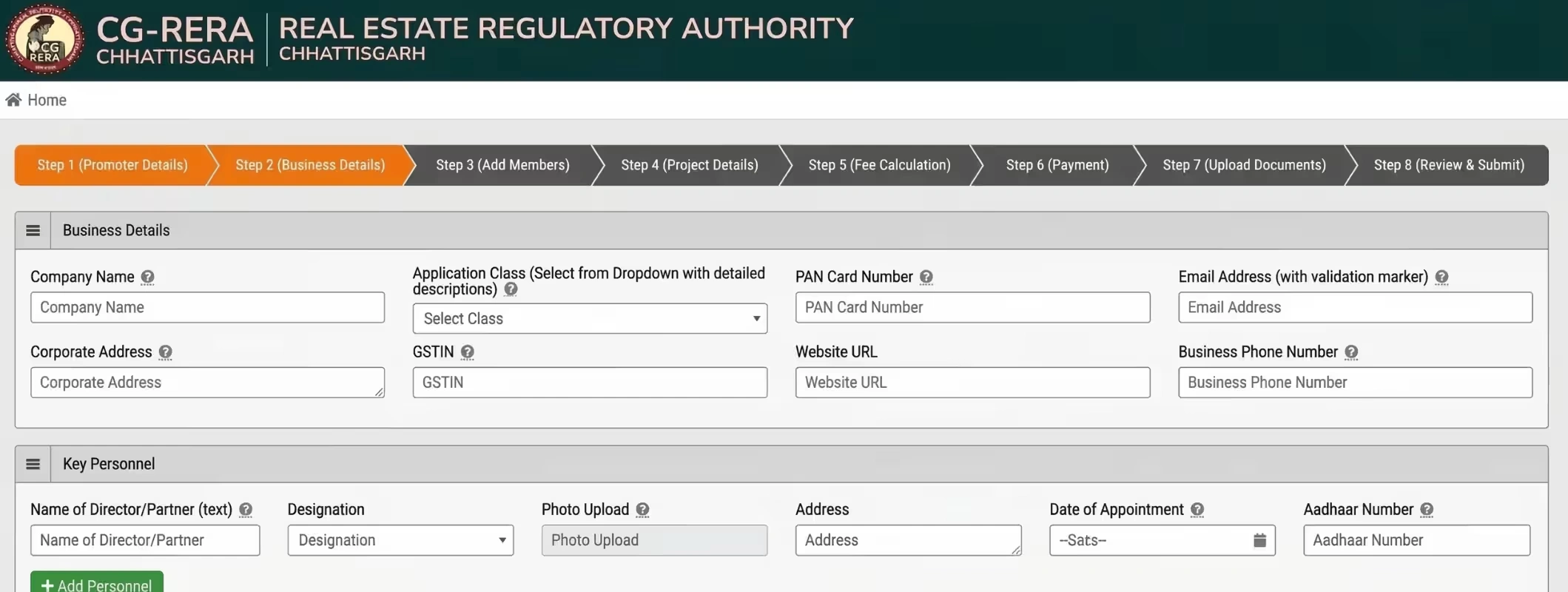
The portal structure makes the process fairly clear. Project registration uses Form A and Form B, and the CGRERA site also publishes a detailed annexure/checklist structure for project registration. These include CA certificates, architect and engineer certificates, project-registration checklist, self-declaration by promoter, past project details, development team details, title search/legal scrutiny report, allotment letter format, fee calculation sheet, and additional construction-cost / development-work-plan submissions.
The official instruction page for project registration says the promoter must submit the application online, pay the applicable fee, and attach key documents such as promoter identity and entity records, audited financials for the previous three financial years, legal title deed or title-right documents, encumbrance certificate details, owner consent and development agreements where relevant, approvals and commencement certificates, sanctioned plans and layout plans, development-work details, project location and boundary details, allotment letter and agreement-for-sale formats, inventory details, parking details, and names of agents and development professionals. The portal instruction also says hard copies of the application set must be submitted within 7 days after online filing.
That document-heavy process is exactly why buyers should prefer projects that already have clean and updated public records instead of trusting verbal assurances.
Real Estate Agent Registration in Chhattisgarh
Agents are not outside the RERA net. The Act says a registered agent cannot facilitate sale or purchase in an unregistered qualifying project, and the official CGRERA portal offers agent registration, renewal, status lookup, and registered-agent lists. The site also shows categories such as registered projects, delayed projects, revoked projects, suspended projects, de-registered projects, and defaulter promoters.
For agent registration, the CGRERA instruction page lists supporting documents such as entity-registration papers, photographs, Aadhaar/PAN details, past income-tax returns, and business-address proof, along with the 7-day hard-copy submission instruction after online filing.
Buyer Rights under Chhattisgarh RERA
This is the section most buyers should actually read twice.
Under the Act, the allottee has the right to obtain sanctioned plans, layout plans, specifications, and other information under the agreement for sale. The allottee is also entitled to know the stage-wise schedule of project completion and amenity delivery, claim possession as per the agreement, seek refund with interest and compensation in qualifying cases, and receive necessary documents and plans after possession.
If the promoter fails to complete the project or fails to hand over possession as agreed, the allottee can withdraw and seek return of the amount with interest and compensation, or remain in the project and claim interest for every month of delay until possession.
If any structural defect, workmanship issue, service defect, or similar promoter obligation issue is reported within five years from handing over possession, the promoter must rectify it within 30 days without extra charge, failing which the allottee can claim compensation.
If the builder’s advertisement or prospectus contains false or misleading statements and the buyer suffers loss, the law also provides a remedy, including refund with interest where applicable.
How to File a Complaint in CGRERA
The official CGRERA portal has a complaint section with Complaint Fees, Form M (Complaint to Regulatory Authority), Form N (Complaint to Adjudicating Officer), complaint-status tracking, user manual access, and order pages. The live complaint page also shows options for new complaint registration, including complaints involving projects not yet registered in RERA.
The fee shown on the official portal is ₹1,000 for complaints before the Authority and ₹5,000 for complaints before the Appellate Authority. Appeals to the Appellate Tribunal are to be filed within 60 days of receiving the order, though delay may be condoned for sufficient cause under the Act.
The portal’s live order pages also show that CGRERA continues to pass orders in 2026, including matters involving not registered projects and complaints under sections such as 13, 17, and 31.
Buyer Checklist before Booking any Property in Chhattisgarh
Before you pay anything, do this:
- Ask for the CGRERA registration number and verify it on the official portal.
- Match the project name, promoter name, location, approvals, and proposed end date with the public record.
- Check whether the project is shown as ongoing, completed, delayed, revoked, suspended, de-registered, or under defaulter listings.
- Do not pay more than 10% until you have a proper agreement for sale.
- Read the possession date, refund clause, delay clause, and carpet-area details carefully.
- Keep every receipt, brochure, screenshot, and WhatsApp commitment. These become evidence if you need to complain.
- If an agent is involved, check whether the agent is registered too.
Where 2Bigha Fits into the Picture
If you are searching to purchase land online, a platform like 2Bigha can help you shortlist opportunities faster, compare location details, and structure your search more intelligently. But do not stop at the listing level. For any project-linked property in Chhattisgarh, your next move should be to cross-check the promoter, project registration number, approvals, and disclosure trail on the official CGRERA portal before paying token money.
That is the smart workflow: discover on a property platform, verify on CGRERA, then pay only after documents align.
Common Mistakes Buyers still make
The biggest mistake is trusting “RERA applied” or “RERA under process” without verification. The second mistake is paying a large token amount before agreement. The third is assuming all plot or land deals automatically enjoy full RERA coverage. And the fourth is waiting too long to organise evidence when delays or misrepresentation start showing up. The law helps buyers, but only when buyers document the transaction properly and act early.
FAQs - Chhattisgarh RERA
Is RERA registration mandatory for every project in Chhattisgarh?
No. Small projects within the statutory exemption threshold, projects that already had completion certificate before commencement of the Act, and certain non-marketed renovation or repair works can fall outside compulsory registration. Most qualifying residential and commercial projects, however, must register before sale.
How can I check whether a project is RERA registered in Chhattisgarh?
Use the official CGRERA portal and verify the project registration number, project name, promoter details, project status, approvals, and updates. The portal also provides categories such as ongoing, completed, delayed, revoked, suspended, and de-registered projects.
Can a builder take 20% booking amount before agreement?
No. The Act says the promoter cannot accept more than 10% of the cost as advance or application fee without first entering into an agreement for sale.
What if possession is delayed?
The buyer can withdraw and seek return of the amount with interest and compensation, or continue in the project and claim interest for every month of delay till possession, depending on the circumstances and relief sought.
Can I complain against an unregistered project?
Yes, the CGRERA FAQ and complaint interface indicate that complaints can be made even against projects/builders that are not registered, where they fall within the RERA ambit.
What is the CGRERA complaint fee?
The official portal shows ₹1,000 for complaints before the Authority and ₹5,000 for complaints before the Appellate Authority.
Final Word
For buyers in 2026, Chhattisgarh RERA is not optional reading. It is the fastest way to separate a documented project from a risky promise. Before you book any flat, shop, or plot in a qualifying development, verify the project, verify the promoter, verify the agent, and verify the possession timeline.
That one habit can save you money, time, and years of stress.