Direct Answer
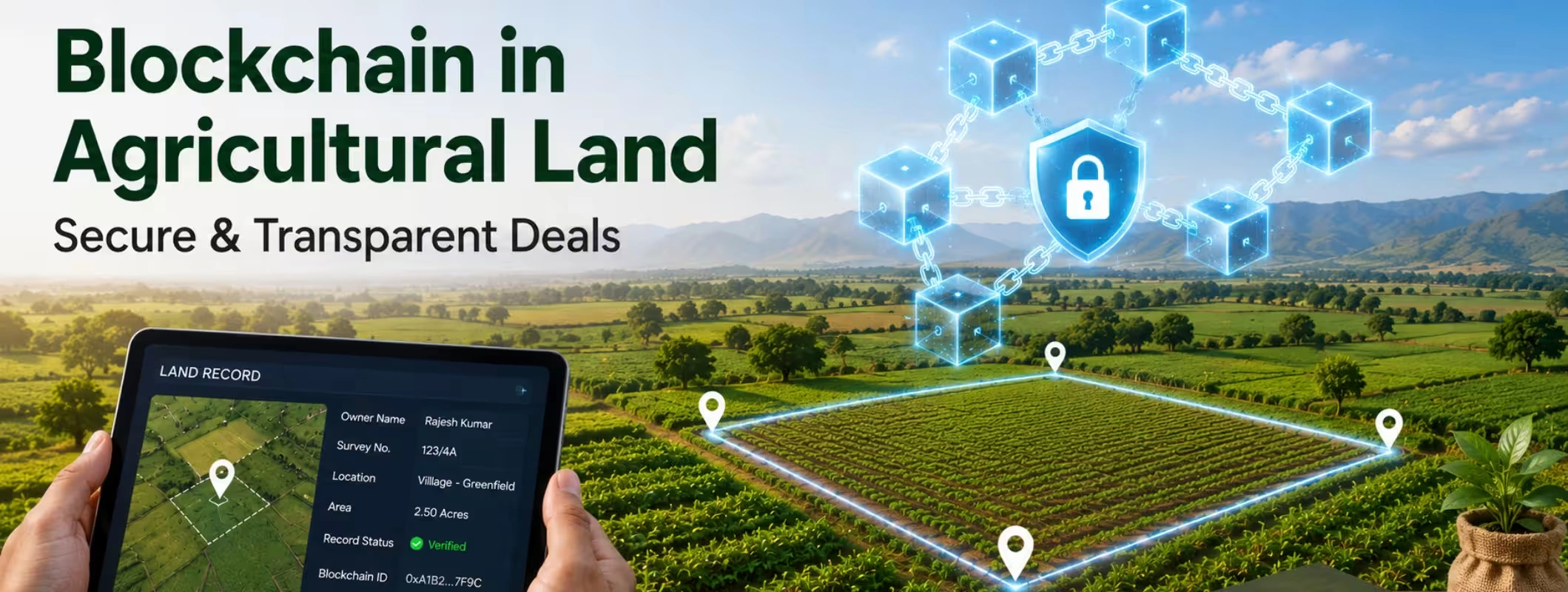
Blockchain can make agricultural land transactions in India more transparent by creating secure, traceable, and tamper-resistant digital records of land ownership, documents, verification steps, and transaction history. For a land-focused platform like 2Bigha, blockchain can strengthen land discovery, ownership checks, due diligence, seller verification, property management records, and buyer confidence before a land deal moves ahead.
Agricultural land buying in India is not only about finding a good location or fair price. The real challenge starts after discovery: Is the seller genuine? Does the title chain match the records? Are there disputes, encumbrances, boundary mismatches, or hidden ownership claims? Blockchain cannot replace legal due diligence, government records, or physical verification, but it can create a stronger digital trust layer that makes every verified step easier to track, audit, and confirm.
That is where 2Bigha can bring a smarter approach to land buying and selling in India.
Introduction: Why Land Transactions in India Need a Stronger Trust Layer
Buying agricultural land in India has always been emotional, financial, and document-heavy. A buyer may find a promising farmland listing near a highway, a growing town, a tourist belt, or a future development corridor. The location may look attractive. The price may seem right. The seller may sound confident. But one question still remains:
Can the buyer trust the land record, the ownership history, and the seller’s right to sell?
This is the pain point that many land buyers, investors, NRIs, farmers, developers, and families face across India. Unlike flat buying in a gated society, agricultural land transactions often involve revenue records, khasra numbers, khatauni details, mutation entries, sale deeds, inheritance records, encumbrance checks, physical boundary inspections, access-road verification, land-use restrictions, and local legal conditions.
Even serious buyers can feel confused because land information is scattered across different documents, local offices, online portals, agents, sellers, and on-ground sources. A small mismatch in survey number, area measurement, ownership name, boundary line, or mutation status can create major risk later.
This is why blockchain in real estate is becoming an important conversation. Not because it sounds futuristic, but because land deals need better transparency. A blockchain-supported land ecosystem can help platforms like 2Bigha organize verified land data, maintain clear ownership histories, reduce fraud risk, and build more confidence among buyers and sellers.
2Bigha already focuses on agricultural land, farmland, land investment, map-based discovery, and land-focused listings. Blockchain can become the next trust-building layer in this journey.
What Is Blockchain in Simple Real Estate Language?
Blockchain is a secure digital record system where information is stored in blocks and connected in a chain. Once verified information is added, it becomes extremely difficult to alter secretly. Every important entry has a time record, a digital trail, and a connection to previous entries.
In simple terms, blockchain works like a permanent digital register.
For agricultural land transactions, this digital register can record important events such as:
- Land parcel identification
- Seller verification
- Ownership document review
- Sale deed reference
- Mutation status
- Encumbrance-related checks
- Survey number or khasra details
- GPS or map-based coordinates
- Legal document verification status
- Transaction progress
- Property management updates
- Future ownership changes
The biggest value of blockchain is not just storage. Its value lies in trust, traceability, and tamper resistance.
If a verified land record, ownership check, or document authentication step is added to a blockchain-based system, future users can check that record without depending only on verbal claims or scattered paperwork. This does not mean blockchain automatically proves that every uploaded document is true. The original verification still matters. But once a verified record enters the system, blockchain helps protect its integrity.
Why Agricultural Land Transactions Are More Complicated Than Normal Property Deals
Agricultural land in India is a high-interest asset. People buy it for farming, long-term investment, farmhouse plans, managed farms, family wealth creation, future development potential, lifestyle use, and sometimes resale gains. Demand is rising in many belts near highways, religious destinations, tourism zones, industrial corridors, and expanding city edges.
But agricultural land also carries risks that many first-time buyers underestimate.
1. Ownership Records Can Be Fragmented
A land parcel may have passed through multiple family members, inheritance transfers, partitions, oral arrangements, sale agreements, or mutation entries. Sometimes, the seller may have possession but not a clean title. Sometimes, one family member is selling, but other legal heirs may still have a claim.
2. Local Names and Official Records May Differ
In rural India, people often identify land through local references: “the farm near the canal,” “the land behind the village road,” or “the plot beside the old well.” But official records depend on khasra number, survey number, khata number, village name, tehsil, district, area, and owner details. Any mismatch can create confusion.
3. Boundaries Can Be Unclear
A buyer may see one boundary during a site visit, while cadastral records show something else. Encroachment, shared access, missing boundary stones, or informal pathways can make the situation more complex.
4. Duplicate or Fraudulent Deals Can Happen
Some land frauds involve forged documents, duplicate sale attempts, wrong power of attorney, fake ownership claims, or hidden disputes. Buyers who do not verify properly may face legal trouble after payment.
5. Due Diligence Takes Time
Traditional verification often requires visits to local offices, lawyers, patwaris, tehsil records, sub-registrar records, revenue portals, and site inspections. This process can delay decisions and create uncertainty.
6. Online Listings Alone Are Not Enough
A property listing can help buyers discover land, compare prices, and shortlist locations. But discovery is not the same as verification. A land listing should be treated as the starting point, not the final proof of ownership.
This is exactly why a platform like 2Bigha can use blockchain as a trust-building layer between land discovery and transaction confidence.
Where 2Bigha Fits in India’s Land Buying Journey
2Bigha is built around agricultural land and farmland discovery. This focus matters because land buyers need a different experience from home buyers. Someone looking for agricultural land in India does not only want photos and price. They want location clarity, land-use understanding, ownership confidence, access-road details, local development context, and verification support.
Most general real estate platforms focus on flats, rental homes, commercial spaces, and residential plots. Land may appear as one category among many. But agricultural land requires deeper handling. Buyers need map-based discovery, area conversion, local land details, legal-document awareness, and seller-side clarity.
2Bigha can position itself as a land-first platform that helps users move through three important stages:
- Discover land through listings, maps, price insights, and location comparison.
- Verify land through document review, ownership checks, seller validation, and on-ground confirmation.
- Manage or transact land through a more transparent workflow supported by digital records.
Blockchain can strengthen the second and third stages most strongly.
It can help 2Bigha move from being only a land discovery platform to becoming a more trusted land transaction ecosystem.
How Blockchain Can Work in the 2Bigha Ecosystem
A blockchain-supported land transaction process does not need to look complicated for users. Buyers and sellers do not need to understand technical terms. The technology can work in the background while the platform shows simple verification statuses and clear records.
Here is how the process can work.
Stage 1: Land Parcel Identification
Every transaction begins with identifying the exact land parcel. This includes:
- Khasra number
- Survey number
- Khata or khatauni details
- Village, tehsil, and district
- Land area
- Map location
- GPS coordinates
- Current ownership details
- Land category
- Access road and surrounding context
This stage is critical because wrong parcel identification can damage the entire verification process. If the land shown on the map is not the same as the land mentioned in the revenue record, the buyer may face a serious issue later.
For 2Bigha, map-based discovery can become more powerful when each listed land parcel is connected with structured identity data. Blockchain can then record the verified identity of the parcel so future users can trace it.
Stage 2: Ownership Record Verification
After the parcel is identified, the platform can support verification of ownership documents. This may include:
- Revenue record checks
- Mutation entries
- Sale deed history
- Inheritance records
- Encumbrance-related checks
- Seller identity checks
- Power of attorney checks, where applicable
- Litigation or dispute flags, where available
- Local authority or legal review notes
Blockchain can record the verification outcome. For example, it can show when a document was reviewed, what type of document was checked, and whether the ownership chain matched the available records.
This creates a stronger audit trail.
Stage 3: Document Authentication
Agricultural land transactions depend heavily on documents. A buyer may need to review sale deeds, revenue records, maps, mutation documents, tax receipts, identity documents, and legal declarations.
Blockchain can help by creating a digital fingerprint of verified documents. This does not mean the full private document must be exposed publicly. Instead, the platform can store a secure proof that confirms whether a document has changed after verification.
This helps reduce the risk of document tampering.
Stage 4: Digital Property Identity
Once the parcel and documents are reviewed, the platform can assign a unique digital property identity. This can act like a permanent digital reference for the land listing.
This identity can connect:
- Land location
- Ownership record status
- Verification history
- Document review status
- Boundary information
- Transaction activity
- Seller profile
- Property management updates
- Future resale records
For buyers, this creates clarity. For sellers, it builds credibility. For 2Bigha, it creates a more organized and trustworthy land data system.
Stage 5: Blockchain Validation
Before any verified record becomes permanent, the system can validate it through predefined rules. For example, the platform may require approval from authorized reviewers, legal partners, field verification teams, or document-checking workflows.
Once approved, the verified event enters the blockchain ledger.
Stage 6: Transaction Traceability
After verification, every important transaction step can be recorded. This may include:
- Buyer interest
- Site visit completion
- Document sharing
- Legal review status
- Token payment record, if applicable
- Agreement milestone
- Registration update
- Mutation follow-up
- Property handover
- Future ownership update
This can make the transaction more transparent and reduce confusion between buyers, sellers, agents, and platform teams.
Blockchain Land Verification Flow for 2Bigha
A simple blockchain-supported land verification flow can look like this:
Land Identification → Ownership Verification → Document Authentication → Digital Property Identity → Blockchain Validation → Verified Record Creation → Future Traceability
This flow helps answer the most important buyer questions:
- Is this the same land shown in the listing?
- Who owns this land according to available records?
- Does the seller have the right to sell?
- Are the documents verified?
- Has the land record changed over time?
- Is there a visible transaction history?
- Can I trust the listing enough to move to legal due diligence?
This type of clarity can make land buying more confident, especially for buyers who are investing from another city or state.
Key Benefits of Blockchain for 2Bigha
1. Better Transparency in Land Deals
Transparency is the biggest need in agricultural land transactions. Buyers do not want vague claims. They want visible proof.
Blockchain can help 2Bigha show verified events in a clear sequence. A buyer can see whether the land parcel has been identified, whether ownership documents were reviewed, whether the seller’s claim was checked, and whether any major issue was flagged.
This reduces information gaps between buyers and sellers.
2. Stronger Ownership History
Land ownership is not only about the current seller. Buyers need to understand the chain of ownership. If the land moved through multiple hands, inherited ownership, family partitions, or legal transfers, the buyer needs clarity.
Blockchain can create a traceable ownership record where each verified ownership event remains connected to the previous one. This makes the land history easier to review.
3. Reduced Fraud Risk
Fraud in land transactions often happens because records are scattered, documents can be manipulated, and buyers do not always know where to verify.
Blockchain reduces this risk by making verified records tamper-resistant. If someone tries to alter a verified document or ownership trail later, the change can become easier to detect.
This can protect buyers, genuine sellers, and platform credibility.
4. Faster Due Diligence
Traditional due diligence can take time because buyers and legal teams must collect information from multiple sources. Blockchain can help by keeping verified information organized in one digital trail.
A buyer’s legal advisor can still conduct independent checks, but the starting point becomes stronger. Instead of asking for every document again from scratch, the buyer can review a structured verification history.
This can reduce delays and improve decision-making.
5. More Confidence for Investors
Agricultural land investors look for long-term value, clear ownership, location growth, and reduced legal risk. They may be NRIs, business owners, professionals, farmers, developers, or families planning future use.
A blockchain-backed verification layer can give investors more confidence because it shows that the platform is not only listing land but also building a transparent record around it.
6. Better Seller Credibility
Genuine landowners often struggle to stand out from doubtful listings. If a seller’s land parcel is properly verified and recorded, the seller can attract more serious buyers.
A verified digital property identity can help sellers build trust faster.
7. Stronger Property Management Records
Many agricultural landowners live away from their land. They need updates on inspection, maintenance, boundary status, caretaker visits, fencing, crop use, or local issues.
Blockchain can support property management by recording important updates in a secure timeline. This can help owners track what happened, when it happened, and who verified it.
For 2Bigha’s property management ecosystem, this can become a powerful trust feature.
How Blockchain Can Improve Land Due Diligence
Due diligence is the heart of any safe land transaction. Without proper due diligence, even a good-looking land deal can become risky.
In agricultural land buying, due diligence usually includes:
- Title verification
- Seller identity verification
- Revenue record check
- Mutation record check
- Encumbrance review
- Litigation check
- Land-use permission check
- Access-road verification
- Boundary verification
- Physical site inspection
- Local inquiry
- Tax and dues check
- Power of attorney validation, if used
- Family ownership or inheritance review
- Government acquisition or restriction check, where applicable
Blockchain can support due diligence by organizing verified steps into a digital audit trail. It can show which checks have been completed and when.
For example, instead of a buyer hearing, “Documents are clear,” the platform can show:
- Parcel identity reviewed
- Seller identity checked
- Revenue record matched
- Mutation status reviewed
- Boundary data added
- Document hash created
- Legal review pending/completed
- Field verification completed
This level of structured visibility makes the buying journey more professional.
Blockchain and GPS-Based Land Mapping
Agricultural land deals need both document verification and physical location verification. A title record may say one thing, but the land on the ground may tell another story.
GPS and mapping systems can help identify:
- Actual land location
- Approximate boundary points
- Road access
- Nearby village or town
- Distance from highway
- Canal, river, or waterbody proximity
- Neighbouring land use
- Possible encroachment concerns
- Difference between mapped and physical boundary
When blockchain integrates with GPS and mapping data, 2Bigha can create a more reliable land identity. The verified land parcel can include both document-based information and location-based information.
This is important because land buyers often ask practical questions:
- Is this land really where the seller says it is?
- Does the boundary match the cadastral map?
- Is the access road private, shared, or public?
- Is there any visible encroachment?
- Is the land close to a highway, village road, or future growth zone?
Blockchain cannot replace licensed survey or government map verification. But it can preserve verified map-related data once collected.
Smart Contracts in Agricultural Land Transactions
Smart contracts are digital rules that automatically trigger an action when predefined conditions are met.
In land transactions, smart contracts can support workflows such as:
- Recording buyer interest after document access
- Triggering mutation follow-up after registration
- Releasing a payment milestone after verification
- Updating transaction status after legal approval
- Sending alerts when required documents are missing
- Recording seller confirmation
- Managing subscription-based seller visibility
- Supporting property management service updates
However, smart contracts must be used carefully in Indian land transactions. Land transfer depends on government registration, legal documents, stamp duty, and state-specific laws. A smart contract cannot replace the legal registration process.
The right role for smart contracts is workflow automation, not legal ownership transfer by itself.
For 2Bigha, smart contracts can improve process discipline. They can make sure that a transaction does not move forward unless certain verification steps are completed.
Why Blockchain Matters for Buyers
A buyer wants confidence before paying money, traveling for a site visit, or entering negotiation. Blockchain can help buyers in several ways.
Clearer Listing Trust
A blockchain-backed verification badge or record can help buyers separate stronger listings from weak listings.
Better Ownership Visibility
The buyer can review whether ownership documents were checked and whether the seller’s claim matches available records.
Reduced Dependency on Verbal Claims
Instead of depending only on an agent or seller’s statement, the buyer gets a structured digital trail.
Easier Legal Review
A lawyer or advisor can review the verification history and identify missing checks faster.
More Confidence for Remote Buyers
NRIs, outstation investors, and busy professionals often cannot visit every shortlisted land parcel. Blockchain-supported records can help them shortlist more confidently before traveling.
Why Blockchain Matters for Sellers
Blockchain does not only help buyers. It also helps genuine sellers.
A seller with clear documents can use verified records as a trust signal. This can reduce repeated questions, attract serious buyers, and improve listing quality.
For sellers, blockchain can help with:
- Verified property identity
- Better listing credibility
- Faster buyer confidence
- Reduced repeated document sharing
- Stronger proof of seller readiness
- Better transaction tracking
- More professional land presentation
In India’s land market, trust is a major selling advantage. A seller who can prove clarity will always stand stronger than a seller who only says, “Sab clear hai.”
Why Blockchain Matters for 2Bigha as a Platform
For 2Bigha, blockchain can become more than a technology feature. It can become a brand trust advantage.
A land-focused platform grows when users believe that the platform helps them avoid confusion. Blockchain can support this positioning by making 2Bigha more transparent, structured, and verification-driven.
2Bigha Can Build a Stronger Trust Framework
A platform that records verified events creates higher confidence than a platform that only publishes listings.
2Bigha Can Improve User Retention
Buyers may return to the platform because they trust the verification process, not only because they found listings.
2Bigha Can Support Serious Sellers
Genuine sellers may prefer a platform where their verified land gets better credibility.
2Bigha Can Build Better Data Intelligence
Over time, verified land records, location data, and transaction histories can help improve land insights, price comparison, and buyer recommendations.
2Bigha Can Stand Apart from Generic Real Estate Platforms
General platforms often compete on listing volume. 2Bigha can compete on land-specific trust, transparency, and verification quality.
Blockchain vs Traditional Land Records: What Changes?
Traditional land records are usually maintained by government departments, revenue offices, registration departments, and local authorities. These systems are essential and legally important. Blockchain should not be seen as a replacement for official records.
Instead, blockchain can act as a supporting layer.
| Area | Traditional Process | Blockchain-Supported Process |
| Ownership review | Documents checked manually | Verified checks recorded in a traceable digital trail |
| Document trust | Depends on copies and manual review | Document fingerprints can show whether files changed |
| Transaction history | Scattered across records | Important verified events can be connected |
| Buyer confidence | Depends on seller, agent, and lawyer | Buyer gets a clearer verification timeline |
| Fraud detection | Often discovered late | Tampering or inconsistency becomes easier to flag |
| Property management | Updates may remain informal | Inspection and maintenance records can be time-stamped |
The future is not “traditional records or blockchain.” The future is traditional legal records plus better digital trust systems.
Important Limitations: Blockchain Is Not Magic
A responsible real estate platform must explain blockchain clearly. It should not oversell the technology.
Blockchain can protect verified data once entered, but it cannot automatically know whether the original input is true. If wrong information enters the system, blockchain may preserve wrong information. This is why proper verification remains essential.
Blockchain Still Needs Good Data
The platform must verify documents, seller identity, land location, and ownership chain before recording anything.
Blockchain Does Not Replace Legal Due Diligence
Buyers should still consult legal experts, check government records, verify encumbrances, conduct site visits, and confirm local regulations.
Blockchain Does Not Replace Government Registration
Land ownership transfer still depends on legal registration and state rules.
Blockchain Must Protect Privacy
Land documents contain sensitive personal and ownership information. A platform must control who can access what.
Blockchain Needs User Education
Many buyers and sellers may not understand blockchain. The platform must show simple terms like “verified record,” “document checked,” “ownership history reviewed,” and “transaction trail available.”
The technology should remain powerful in the background and simple on the screen.
Legal Significance of Blockchain in Land Transactions
Blockchain can have strong legal importance because it creates time-stamped records and audit trails. In disputes, a clear digital trail can help show when a document was reviewed, when a verification step happened, or when a transaction milestone was completed.
This can support:
- Document authentication
- Verification history
- Transaction timeline
- Ownership record trail
- Compliance tracking
- Internal audit
- Dispute review
- Platform accountability
However, legal recognition of blockchain records may vary based on jurisdiction, use case, and applicable law. Therefore, 2Bigha should position blockchain as a supporting verification and record-management tool, not as a replacement for registered legal documents.
A balanced message builds more trust.
Practical Use Cases of Blockchain in 2Bigha
1. Verified Agricultural Land Listings
2Bigha can use blockchain to record listing verification steps. A buyer can see whether the land parcel has basic identity verification, document review, and location confirmation.
2. Ownership History Timeline
The platform can show a simple ownership timeline where verified transfer events are recorded. This helps buyers understand the land’s past.
3. Seller Verification Record
The seller’s right to sell can be checked and recorded. This helps reduce fake listings and unauthorized selling attempts.
4. Document Integrity Check
Important documents can be digitally fingerprinted so users can detect whether a document has changed after verification.
5. Buyer-Seller Transaction Tracking
Once a buyer moves ahead, transaction milestones can be recorded, reducing confusion and improving communication.
6. Legal Review Status
The platform can show whether legal review is pending, completed, or requires further documents.
7. Mutation Follow-Up
After registration, the platform can help track mutation-related follow-up steps as part of the transaction record.
8. Property Management Updates
For absentee landowners, blockchain can record site inspections, maintenance updates, fencing checks, caretaker visits, and boundary observations.
9. NRI Land Confidence
NRIs buying or managing agricultural land in India need extra trust because they cannot always visit. Blockchain-supported records can help them track verified updates remotely.
10. Land Investment Portfolio Records
Investors holding multiple land parcels can use blockchain-backed digital records to monitor ownership, verification, and management history.
How Blockchain Can Support Safer Land Investment in India
Land investment in India is often driven by long-term potential. Buyers look at road connectivity, expressways, industrial zones, religious tourism, urban expansion, water availability, and future resale value. But no investment makes sense if ownership is unclear.
Blockchain can support safer investment by improving the quality of verified information available before decision-making.
A serious investor wants answers like:
- Is the title clean?
- Is the seller genuine?
- Is the land physically identifiable?
- Is the access road usable?
- Is there any known dispute?
- Is the land suitable for intended use?
- Can I review the verification history?
- Can I manage this land after purchase?
2Bigha can use blockchain to bring these answers closer to the buyer in a structured format.
Blockchain and the Future of Agricultural Land Marketplaces
The next generation of real estate platforms will not win only by showing more listings. They will win by solving trust.
For agricultural land, this is even more important. Buyers are no longer satisfied with attractive photos, low prices, or broad location claims. They want proof. They want maps. They want records. They want seller confidence. They want local clarity. They want a safer path from discovery to ownership.
Blockchain can help land platforms move toward:
- Verified digital land identities
- Transparent ownership trails
- Better document security
- Faster due diligence
- Fraud-resistant transaction records
- Integrated land maps
- Smarter property management
- Better buyer education
- Stronger seller accountability
- More professional land investment experiences
This is where 2Bigha can build a future-ready land ecosystem.
Suggested 2Bigha Blockchain Feature Framework
To make blockchain useful for real users, 2Bigha can present it through simple feature names instead of technical jargon.
1. Verified Land Identity
A unique digital profile for each land parcel with basic verified information.
2. Ownership History Trail
A timeline showing verified ownership and transaction-related records.
3. Document Integrity Status
A simple status showing whether key documents have been checked and protected from tampering.
4. Map-Linked Land Record
A land identity connected with GPS, map view, and parcel-level location data.
5. Due Diligence Tracker
A checklist showing what has been verified and what still needs review.
6. Transaction Milestone Record
A timeline showing buyer-seller transaction progress.
7. Property Management Log
A secure record of inspections, maintenance updates, and on-ground reports.
8. Seller Trust Score
A platform-controlled trust signal based on document readiness, identity verification, and listing quality.
9. Buyer Confidence Report
A downloadable or viewable summary of land verification status for serious buyers.
10. Legal Review Dashboard
A professional dashboard for lawyers, buyers, and platform teams to review pending and completed checks.
Example Buyer Journey on a Blockchain-Supported 2Bigha Platform
Imagine a buyer looking for agricultural land near Alwar, Neemrana, Sohna, Jewar, or another growing belt. The buyer opens 2Bigha and explores land listings through a map.
Instead of seeing only price, area, and photos, the buyer also sees verification status.
The listing may show:
- Land identity created
- Map location reviewed
- Seller identity checked
- Ownership document uploaded
- Revenue record review pending
- Boundary verification required
- Legal review available on request
The buyer shortlists the land and asks for more details. The platform shares a structured verification report. The buyer’s lawyer reviews the documents. After the site visit, the field verification update is added. If the buyer moves ahead, transaction milestones are recorded.
This creates a cleaner journey for everyone.
The seller does not have to repeat the same explanation again and again. The buyer does not feel blind. The platform creates accountability. The transaction becomes easier to track.
What Buyers Should Still Check Before Buying Agricultural Land
Even with blockchain support, buyers should follow proper due diligence. Here is a practical checklist.
1. Verify Ownership
Check whether the seller’s name appears correctly in official land records.
2. Check Title Chain
Review previous sale deeds, inheritance records, partition documents, and transfer history.
3. Review Mutation Status
Confirm whether mutation entries reflect the current ownership.
4. Check Encumbrance
Look for loans, mortgages, legal claims, or restrictions.
5. Confirm Land Use
Check whether the land is agricultural, residential, commercial, industrial, or restricted.
6. Verify Boundaries
Match physical boundaries with cadastral maps and survey data.
7. Confirm Access Road
Make sure the land has legal and practical road access.
8. Check Local Restrictions
Some states have rules around who can buy agricultural land. Buyers must understand local eligibility.
9. Conduct Site Visit
Never depend only on online listing photos. Visit the land or appoint a trusted local representative.
10. Consult a Legal Expert
A lawyer should review documents before any major payment or agreement.
Blockchain can support these steps, but it should not replace them.
How 2Bigha Can Communicate Blockchain to Indian Users
Many users may not care about the technical word “blockchain.” They care about safety.
So 2Bigha should explain blockchain in user-friendly language.
Instead of saying:
“Blockchain-enabled decentralized land transaction validation system.”
Say:
“Your land record journey becomes easier to track. Every verified step is recorded in a secure digital trail, so buyers and sellers can make decisions with more confidence.”
Instead of saying:
“Immutable hash-based document authentication.”
Say:
“Once a document is verified, the system can detect if it is changed later.”
Instead of saying:
“Smart contract-based workflow automation.”
Say:
“Important transaction steps move forward only after required checks are completed.”
Indian users respond better to clear benefit-led language. The message should be simple: less confusion, more transparency, safer land decisions.
Why Blockchain Land Records Matter for India
India’s land market is changing. Digital land records, blockchain land records, map-based property discovery, online registration workflows, and land information systems are becoming more important. Buyers are also becoming more aware. They search online before visiting land. They compare locations on maps. They check prices. They ask for verified listings. They want clarity before speaking to sellers.
Searches like these are rising in intent:
- How to verify agricultural land in India?
- How to check land ownership online?
- How to buy farmland safely in India?
- What documents are needed before buying agricultural land?
- What is blockchain in land records?
- Can blockchain reduce land fraud?
- How do I check khasra number and land records?
- What is verified agricultural land?
- Best platform to buy agricultural land in India
- Agricultural land for sale near Delhi
- Farmland investment in India
A platform like 2Bigha can answer these questions through educational content, verification-led features, and land-focused tools.
When a platform educates users, it builds trust before conversion.
Why Buyers Should Use a Land-Focused Platform Like 2Bigha
Buying land through random leads can be risky. You may get incomplete details, unclear seller claims, weak documentation, or exaggerated location benefits. A land-focused platform helps you start with a cleaner search.
2Bigha can help buyers by offering:
- Agricultural land-focused listings
- Map-based land discovery
- Location comparison
- Land price visibility
- Seller-side listing support
- Property insights
- Land investment education
- Verification-led content
- Scope for future blockchain-backed transparency
- Easier shortlisting before site visits
For buyers, the goal is not just to find land. The goal is to find the right land with better clarity.
For sellers, the goal is not just to list land. The goal is to present land professionally to serious buyers.
For investors, the goal is not just to buy cheap land. The goal is to buy land with fewer hidden risks.
That is the real value of a land-first ecosystem.
Future of Blockchain in the 2Bigha Ecosystem
The future of land buying in India will be built around three pillars:
Digital discovery, verified records, and transparent transactions.
2Bigha already works in the discovery layer. With blockchain, it can strengthen the verification and transaction layers.
In the coming years, the platform can evolve toward:
- Digital land identity for every listed parcel
- Verified land document trail
- Ownership history visibility
- Buyer due diligence dashboard
- Seller credibility score
- Secure transaction timeline
- Field verification logs
- Property management records
- NRI land monitoring
- AI-powered land insights connected with verified data
This can create a more complete land ecosystem.
The biggest opportunity is trust. The platform that solves trust will own the buyer’s mind.
Conclusion: Blockchain Can Make Agricultural Land Buying More Transparent, But Verification Still Comes First
Blockchain can play a major role in improving agricultural land transactions in India. It can create tamper-resistant records, transparent ownership trails, secure document references, faster due diligence workflows, and better transaction tracking.
For 2Bigha, blockchain can become a strategic trust layer. It can help the platform move beyond land discovery and become a stronger ecosystem for verified agricultural land, safer buyer decisions, genuine seller visibility, and long-term property management services.
But the message must remain practical.
Blockchain does not remove the need for legal due diligence. It does not replace government land records. It does not automatically prove that every document is correct. Its real power begins after proper verification.
When combined with map-based discovery, document review, GPS validation, legal checks, and platform accountability, blockchain can make land transactions more transparent, organized, and trustworthy.
For Indian land buyers, that is exactly what the market needs.
If you are planning to buy, sell, or explore agricultural land in India, start with better discovery, insist on proper verification, and choose platforms that are building transparency into the land journey. 2Bigha is moving in that direction by combining land-focused search, digital tools, and a future-ready trust framework for agricultural land transactions.