Key Takeaways
- The Ambala to Chandigarh Expressway is one of the most watched highway projects in North India because it promises faster movement between Haryana, Punjab, Chandigarh, Mohali, Dera Bassi and nearby growth corridors.
- The newly reported Ambala Chandigarh expressway speed limits indicate that vehicles may be allowed to move at speeds of up to 100 kmph on selected stretches, depending on vehicle category, road design and traffic rules.
- The Mohali IT City–Kurali section is already open and has reportedly reduced commute time by nearly 45 minutes, while the remaining Ambala-side stretch has seen deadline changes.
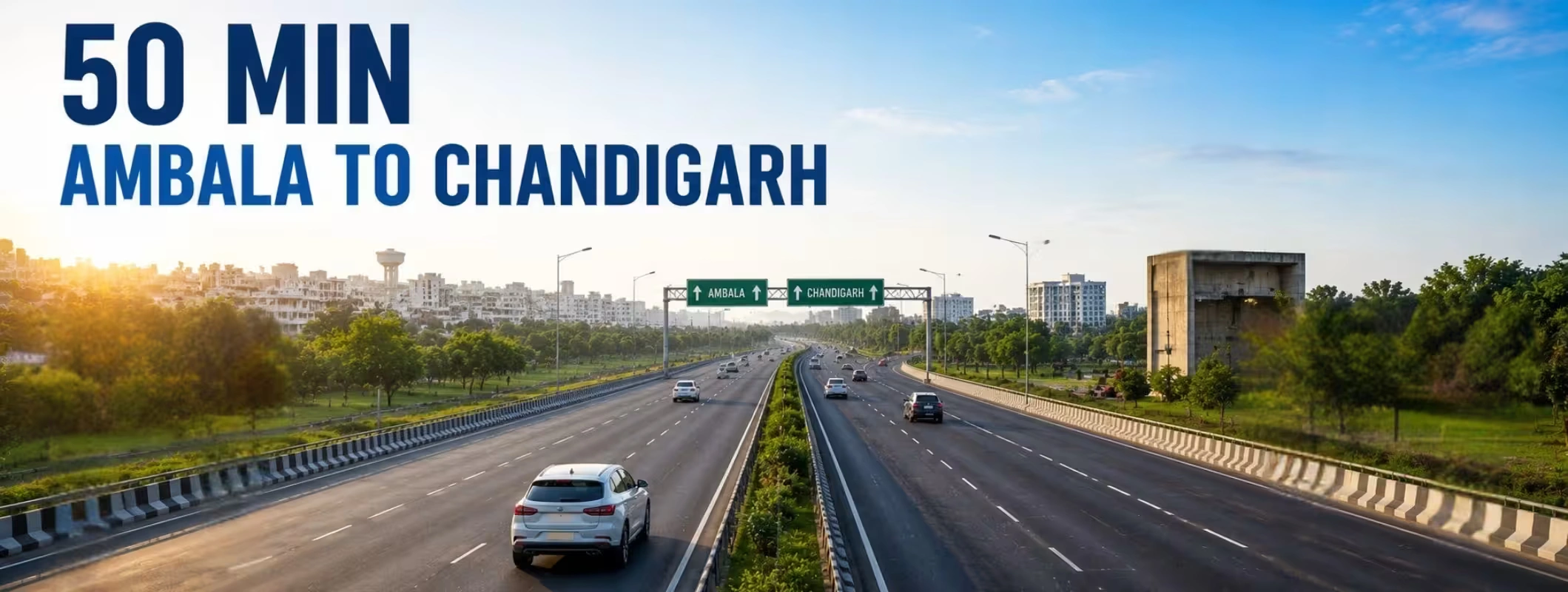
- The “Ambala to Chandigarh 50 minutes route” is realistic only after the full greenfield corridor becomes fully operational and traffic movement remains smooth.
- For real estate buyers, the biggest opportunity is not only speed. The real opportunity lies in verified land, legal access, zoning clarity, road frontage, and long-term development around the expressway belt.
- For sellers, agents and landowners, platforms like 2Bigha can help improve visibility for plots, farmland and highway-connected properties near emerging corridors through verified property presentation and listing packages.
What Is the Ambala to Chandigarh Greenfield Expressway?
Ambala Chandigarh Greenfield Expressway refers to an innovative greenfield expressway project that will help ease commuting between Ambala, Dera Bassi, Mohali, Chandigarh and other directions to reach Punjab, Himachal Pradesh and Jammu & Kashmir.
As opposed to a regular road expansion initiative, a greenfield highway is typically developed in a new route, meaning that this road will bypass many existing sections congested in the cities, markets, signalized junctions, and chokepoints.
That is the reason why people who commute, freight companies, developers, investors, and buyers of the property follow all the latest Ambala Chandigarh expressway news.
The project is believed to decongest existing highway links and facilitate commuter convenience from Haryana to Punjab region-wise. Some sources claim that the project refers to a high-speed corridor that will enhance regional connectivity, with Ambala, Dera Bassi, and Chandigarh being some of the critical connected areas.
- For daily commuters, this means shorter travel time.
- For transporters, it means better logistics movement.
- For landowners, it means more buyer attention.
- For investors, it means a new connectivity-driven real estate corridor.
Ambala to Chandigarh Expressway Speed Limit: What Has Been Notified?
The biggest update is the reported speed-limit notification for the corridor.
According to recent updates, vehicles may be allowed to travel at speeds of up to 100 kmph on selected stretches of the Greenfield Expressway Ambala Chandigarh, subject to road conditions, vehicle type and traffic guidelines.
The already opened Mohali IT City–Kurali six-lane access-controlled section also allows vehicles to travel at speeds of up to 100 kmph, giving a clear idea of how the larger corridor may function once more stretches become operational.
This speed limit matters because travel between Ambala and Chandigarh currently depends on road conditions, local congestion, market traffic, junction delays and peak-hour movement.
A controlled corridor changes the experience.
Instead of stop-and-go movement, commuters get a more predictable driving route.
Instead of sudden traffic jams near urban pockets, vehicles can move through a better-planned highway section.
Instead of long travel uncertainty, businesses can plan movement with better timing.
Is Ambala to Chandigarh in 50 Minutes Really Possible?
Yes, but with one clear condition.
The Greenfield expressway Ambala Chandigarh 50 minutes claim becomes practical only when the fully functional route is open, access points are clear, traffic rules are enforced and the corridor is not interrupted by unfinished work.
Recent reports mention an estimated travel time of around 50 minutes for the Ambala-Chandigarh Greenfield Expressway.
However, users should not assume that the entire corridor is fully open in every section.
The Mohali IT City–Kurali expressway has opened for vehicular movement and has already delivered major time savings, but the remaining Ambala-side section has faced delays. Tribune reported that the remaining Package-1 stretch from Ambala-Hisar Road to IT City was earlier targeted for opening by May 2026, while later reports indicated a revised completion timeline of June 30, 2026 due to delays.
So, the honest answer is this:
The Ambala Chandigarh travel time reduction is real, but the full 50-minute promise depends on complete corridor readiness.
Ambala Chandigarh Expressway Route: What Areas Will Benefit?
The expressway is important because it touches a high-demand movement belt between Haryana, Punjab and Chandigarh.
The larger corridor improves access for:
- Ambala
- Dera Bassi
- Zirakpur
- Mohali
- Chandigarh
- Kurali
- Kharar
- New Chandigarh
- Panchkula
- Airport Road side
- Himachal-bound traffic
- Jammu & Kashmir-bound traffic
The Mohali IT City-Kurali segment is Package-2 in the overall development of six-lane Chandigarh-Ambala expressway. The segment stretches from IT City Chowk in Mohali to Kurali via the Kurali-Siswan road, with the aim of easing traffic in Mohali, Kharar, and Kurali.
A greenfield six-lane connection spur is also in place, linking the NH-205A segment from Ambala to Chandigarh with Zirakpur Bypass.
This makes the entire corridor something more than just an expressway.
It is part of a larger mobility plan for Chandigarh, Mohali, and Panchkula.
Distance Between Ambala and Chandigarh via Expressway
The Ambala Chandigarh expressway distance seems to create some confusion as well due to various reports mentioning different distances.
On one hand, some reports talk about the Ambala-Chandigarh expressway being close to 39 km long, while on the other, various infrastructure projects mention a six-lane Chandigarh-Ambala Greenfield Corridor being 61.23 km long.
For readers, the simple explanation is:
Point | Simple Meaning |
Around 39 km | Commonly discussed Ambala-Chandigarh route distance in commuter updates |
Around 61.23 km | Larger six-lane greenfield corridor package length |
31.23 km | Mohali IT City–Kurali opened section |
Remaining stretch | Ambala-Hisar Road to IT City side, under progress/delayed in updates |
So, when you search for distance from Ambala to Chandigarh via expressway, check which section the report is discussing.
Current Status of Ambala Chandigarh Expressway
Here is the clean status breakdown.
Section / Update | Status |
Mohali IT City–Kurali section | Open for vehicular traffic |
Speed on opened section | Up to 100 kmph |
Travel time impact | Around 45 minutes saved on Mohali-Kurali movement |
Full Ambala-Chandigarh corridor | Still dependent on remaining stretch completion |
Ambala-side Package-1 | Faced delays; revised completion updates reported |
Zirakpur Bypass spur | Approved as part of Tricity Ring Road connectivity |
Toll charges | Final user toll details should be checked before travel |
The opened Mohali IT City–Kurali corridor includes major structures such as bridges, flyovers, underpasses and culverts, and a toll plaza has been established near Bajheri village, although toll collection was not commissioned at the time of the report.
This is important for users searching toll charges Ambala Chandigarh expressway.
Right now, do not depend on WhatsApp forwards or random toll estimates.
Check the latest NHAI/FASTag toll update before planning regular travel.
Why This Expressway Matters for North India
The Punjab Haryana expressway project is not only about saving time.
It is about smoother movement between economic regions.
North India’s growth depends heavily on road connectivity. Chandigarh, Mohali, Panchkula, Ambala, Dera Bassi and Kharar already see heavy residential, commercial, industrial and logistics movement.
When a high-speed corridor improves this belt, several things happen:
- People can live farther from city centres and still commute.
- Businesses can shift warehouses and logistics units closer to highways.
- Land near access points gets more attention.
- Farmhouses and plotted developments become easier to reach.
- Tourism traffic toward Himachal Pradesh can move more smoothly.
- Industrial movement between Haryana and Punjab improves.
The expressway is expected to support travel efficiency, road safety, logistics movement and real estate activity in areas like IT City, New Chandigarh, Kharar and Kurali.
This is why buyers are now searching for land near Ambala Chandigarh expressway, plots near greenfield corridor Haryana Punjab, and commercial plots near Ambala Chandigarh highway.
Real Estate Impact: Why Buyers Are Watching This Corridor
Real estate follows infrastructure.
This is not new.
Whenever a new highway, airport road, ring road or bypass becomes functional, property searches increase around entry-exit points, junctions and upcoming service zones.
The same trend is now visible around the real estate near the expressway development zone between Ambala, Dera Bassi, Mohali, Kurali and Chandigarh.
But here is the practical truth.
Not every land parcel near an expressway becomes a good investment.
Some plots may have poor access.
Some may fall under restricted land-use zones.
Some may have unclear titles.
Some may be too far from actual entry-exit points.
Some may be agricultural land where conversion rules matter.
That is why buyers should not invest only after hearing “a new highway is coming.”
They should study the route, access, land title, zoning, road width, nearby development and exit timeline.
A highway improves potential.
It does not automatically make every property profitable.
Best Property Types Near the Ambala Chandigarh Expressway
The new corridor may create demand for different real estate categories.
1. Agricultural Land Near Highway Corridor
Many Indian investors prefer agricultural land because it usually offers larger parcel size and long-term appreciation potential.
The Ambala-Chandigarh belt may attract interest from buyers looking for farmland investment near highway corridor.
But buyers must verify land classification, ownership record, mutation, access road, water source and state-specific land rules before making payment.
2. Industrial Land Near Expressway Route
Industrial and logistics users prefer highway-connected land because transport time affects cost.
If the corridor improves movement toward Punjab, Haryana, Himachal Pradesh and J&K, demand for warehousing and light industrial land may increase near suitable zones.
Buyers searching industrial land near expressway routes should focus on zoning first.
Do not buy agricultural land assuming it can automatically become industrial land.
3. Commercial Plots Near Highway
Petrol pumps, dhabas, EV charging points, logistics offices, small retail hubs, repair workshops and highway-facing businesses usually follow strong traffic corridors.
But commercial viability depends on entry-exit permissions, service road access, frontage, visibility and local development rules.
4. Residential Plots and Farmhouses
Improved travel time can make outer locations more attractive for weekend homes, farmhouses and plotted development.
This may benefit pockets near Dera Bassi, Lalru, Kurali, Kharar, New Chandigarh and nearby growth belts.
Still, buyers should check civic infrastructure.
A plot with highway connectivity but no water, drainage, security or legal access can become a headache.
Property Buyer Checklist Before Investing Near the Expressway
Use this checklist before buying property near the expressway connectivity zone.
Checklist Point | Why It Matters |
Confirm exact route alignment | Many sellers use “near expressway” loosely |
Check distance from real entry-exit point | Land near the road but far from access may have limited value |
Verify title and ownership | Avoid disputed land |
Check land-use classification | Agricultural, residential, commercial and industrial use rules differ |
Confirm road access | Legal approach road is more important than map distance |
Study future zoning | Master plan and development authority rules matter |
Check flood/drainage risk | Low-lying highway-side land can create problems |
Review nearby demand drivers | Airport, IT City, logistics hubs, institutions, industrial belts |
Compare prices with similar land | Avoid inflated “expressway premium” |
Use trusted platforms | Verified listings reduce confusion and save time |
This is where 2Bigha can help buyers and sellers.
Instead of depending only on brokers, buyers can explore land and property options with better location clarity, while sellers can present their highway-connected properties to serious buyers.
For landowners, agents and developers, 2Bigha can support better digital visibility for farmland, plots and investment properties near emerging corridors.
How 2Bigha Helps Buyers and Sellers Near Highway Corridors
Highway-linked real estate needs transparency.
A buyer does not only want to know the price.
A buyer wants to know:
- Where exactly is the land?
- How far is it from the expressway?
- Is the location accessible?
- Is it farmland, plot, commercial or industrial land?
- Is the seller genuine?
- Is the property suitable for investment or end-use?
2Bigha is built for this kind of property discovery.
For buyers, it helps simplify the search for land, plots, farmland and corridor-linked opportunities.
For sellers, it creates a better way to showcase properties in front of people already searching for land near growth corridors.
For agents and developers, it gives a cleaner way to list inventory and reach serious buyers through a subscription plan.
This matters because expressway-led demand can become noisy.
Many properties get marketed as “near highway” even when they are not practically useful.
A better listing platform helps users compare location, access and property type before taking the next step.
Why Expressway Connectivity Can Push Land Demand
The Greenfield Expressway Ambala Chandigarh may influence real estate demand in five ways.
Faster Daily Movement
When travel time reduces, outer locations become more practical.
A buyer may earlier reject a plot because it felt too far.
After the expressway, the same location may feel reachable.
Better Logistics Value
Warehousing, supply chain and distribution businesses prefer time-saving corridors.
This can create demand for logistics park land investment near suitable locations.
Higher Commercial Visibility
Highway corridors often create demand for fuel stations, food courts, motels, warehouses, repair centres and transport offices.
Improved Tourism Flow
Better highway connectivity toward Himachal Pradesh and nearby hill routes may support travel, hospitality and weekend property interest.
Long-Term Urban Expansion
When the main city gets expensive, buyers move toward connected suburbs and peri-urban areas.
This is already visible in many Indian corridors around Delhi-NCR, Jaipur, Pune, Hyderabad and Bengaluru.
Ambala-Chandigarh can follow a similar pattern, but only in legally suitable and well-connected pockets.
Travel Time Comparison: Before and After Corridor Impact
Travel Factor | Existing Road Experience | Greenfield Corridor Impact |
Travel predictability | Depends on traffic, junctions and city movement | More predictable on access-controlled stretches |
Speed | Slower in congested sections | Up to 100 kmph on selected/opened sections |
Ambala-Chandigarh time | Can vary sharply by traffic | Targeted to come closer to 50 minutes after full readiness |
Logistics movement | Delays near urban pockets | Better movement for regional freight |
Airport side access | Congestion around Mohali/Airport Road | Relief expected through bypass movement |
Property demand | Concentrated in established zones | May expand toward connected highway pockets |
Areas Investors Should Track
Buyers should not rush blindly, but these areas deserve attention:
- Ambala side growth pockets
- Dera Bassi corridor
- Lalru belt
- Zirakpur bypass influence zone
- Mohali IT City side
- Kurali and Kharar belt
- New Chandigarh
- Highway-linked industrial pockets
- Airport connectivity zones
- Villages near legal access points
The strongest locations will usually have three things:
- Clear access
- Legal land title
- Visible demand driver nearby
A cheap land parcel without access is not a smart investment.
A costly plot with inflated highway hype is also risky.
The best investment sits between realistic pricing and genuine future utility.
What Sellers Should Do Now
If you own land near the Ambala Chandigarh expressway route map or nearby growth corridors, this is the right time to organize your property documents.
Do not wait until buyers start asking tough questions.
Prepare:
- Jamabandi / ownership record
- Mutation details
- Khasra number
- Land-use classification
- Approach road details
- Google location
- Photos and videos
- Boundary clarity
- Nearby road and landmark details
- Expected price
- Development potential
A serious buyer will not trust only verbal claims.
- They will ask for documents.
- They will check map distance.
- They will compare nearby prices.
- They will ask if the land has legal access.
If your property is genuine, presenting it properly on 2Bigha can help attract better-quality enquiries.
What Buyers Should Avoid
Do not buy land only because someone says, “Expressway ke paas hai.”
That line is not enough.
Avoid these mistakes:
- Buying without checking route alignment
- Paying token money before title verification
- Ignoring land-use restrictions
- Assuming all highway land will become commercial
- Not checking access road width
- Depending only on broker screenshots
- Ignoring toll/access limitations
- Buying disputed family land
- Not checking government acquisition history
- Overpaying because of future hype
The expressway can create opportunity.
But poor due diligence can destroy returns.
Ambala Chandigarh Expressway and Commercial Growth
The corridor may also support commercial real estate demand.
Why?
Because faster highways create stopping points, service zones and logistics value.
Businesses may look for:
- Warehousing land
- Transport offices
- Cold storage sites
- EV charging land
- Fuel station locations
- Food courts
- Small retail plazas
- Truck parking zones
- Industrial support services
- Farmhouse hospitality projects
But commercial buyers should remember one thing.
Access approval is everything.
A plot may touch the highway but still not get direct entry.
Service road, turning radius, local authority rules and NHAI guidelines can decide whether a commercial project works or fails.
So, before buying commercial plots near Ambala Chandigarh highway, get professional verification.
How This Corridor Supports Freight and Logistics
The expressway is not only useful for private cars.
It can improve freight movement between Haryana, Punjab, Chandigarh, Himachal Pradesh and Jammu & Kashmir.
For businesses, time is money.
If trucks save time, delivery cycles improve.
If logistics movement becomes smoother, warehouse locations near the corridor become more attractive.
If access to industrial belts improves, land demand may rise in selected pockets.
This is why searches like freight corridor route update, logistics route improvement, and industrial corridor connectivity Punjab Haryana are now relevant to the Ambala-Chandigarh belt.
The larger Tricity Ring Road network and the approved NH-205A to Zirakpur Bypass spur are also expected to decongest key urban junctions across Mohali, Chandigarh and Panchkula by diverting through-traffic.
That will matter for freight operators as much as commuters.
Road Safety Rules Expressway Users Should Follow
Higher speed does not mean careless driving.
If the highway speed limit notification India allows up to 100 kmph on a stretch, drivers must still follow lane discipline and traffic guidelines.
Basic expressway rules:
- Stay within the posted speed limit.
- Do not stop randomly on the carriageway.
- Use hazard lights only when needed.
- Keep a safe distance from trucks.
- Avoid overspeeding near entries and exits.
- Do not use the wrong lane.
- Check FASTag balance before toll movement.
- Do not drive sleepy on high-speed roads.
- Follow signboards, not rumours.
The goal of the expressway is faster and safer mobility.
Overspeeding can defeat both.
Will the Expressway Increase Land Prices?
It can increase demand in selected areas, but price appreciation is not automatic.
Infrastructure usually improves market sentiment.
But actual price growth depends on:
- Location
- Legal title
- Access road
- Zoning
- Nearby development
- Distance from entry-exit point
- Demand from end users
- Commercial feasibility
- Government planning
- Holding period
Construction World earlier reported that real estate growth was already being discussed in IT City Mohali, New Chandigarh, Kharar and Kurali due to the corridor’s connectivity impact.
However, smart investors should avoid buying only on emotion.
Look for land that has utility.
A plot near a real access road is better than a cheaper plot hidden behind fields.
A legally clear parcel is better than a disputed “cheap deal.”
A property with future use potential is better than land bought only because of highway news.
Final Verdict: Is the Ambala Chandigarh Expressway a Big Real Estate Trigger?
Yes, it is a major connectivity trigger.
The Ambala to Chandigarh Expressway can reduce travel time, improve logistics, decongest urban roads and strengthen the Haryana-Punjab-Chandigarh movement belt.
The notified speed limits and the opening of Mohali IT City–Kurali section show that the corridor is moving from planning to practical impact.
But investors should stay realistic.
- The full 50-minute Ambala-Chandigarh journey depends on complete operational readiness.
- Toll charges must be checked from official sources before regular travel.
- Property buyers must verify legal details before investing.
- Sellers should prepare documents and list properties transparently.
For buyers, sellers, agents and landowners tracking investment opportunities near highway corridors, 2Bigha can become a useful platform to discover, compare and promote land near emerging infrastructure zones.
The opportunity is real.
But the best returns will go to people who combine early awareness with proper due diligence.