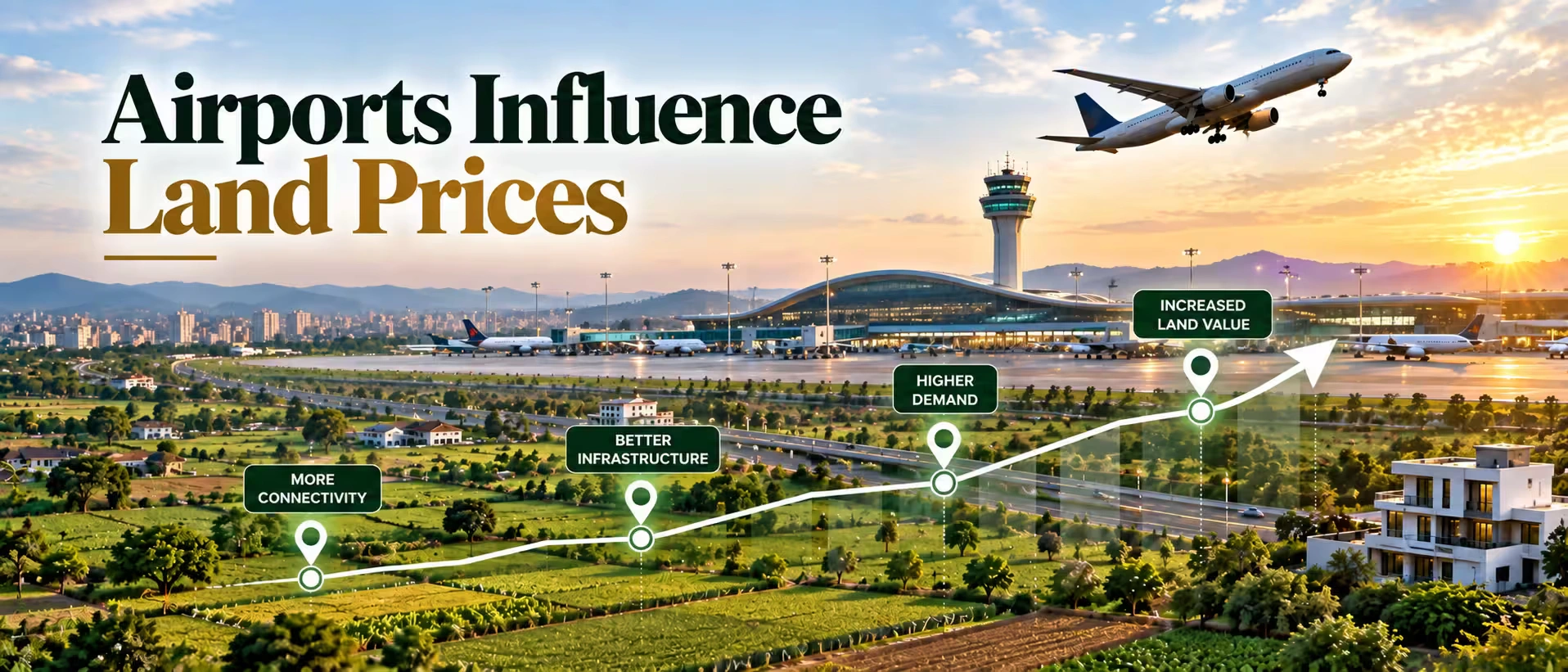
An airport does much more than connect one city to another. A major airport can change how an entire region develops. New roads appear, businesses move closer, logistics activity increases, residential demand expands, and previously overlooked villages or peripheral areas begin attracting investors.
This is why announcements of new airports in India often create immediate interest in nearby land.
However, there is an important difference between airport-driven development and airport speculation. Land does not automatically become a good investment simply because it lies 10 or 20 kilometres from a runway. Accessibility, land use, infrastructure, employment, title clarity and future development plans ultimately determine whether the location can sustain higher land prices.
For anyone considering buying land near an airport, understanding these factors is far more useful than following headlines about the next investment hotspot.
Key Takeaways
- Airports can increase land demand by improving regional connectivity and attracting businesses, housing, logistics and commercial development.
- Land closest to the airport does not necessarily deliver the highest appreciation because noise zones, development restrictions and acquisition risks may apply.
- Expressways, metro links, industrial corridors and employment centres often have as much influence on property values as the airport itself.
- Airport announcements can trigger speculative price increases years before operations begin, so buyers should separate asking prices from actual transaction values.
- Agricultural land requires additional legal checks because permitted use, conversion rules and ownership restrictions vary between states.
- Investors should evaluate title documents, access roads, master plans, infrastructure timelines and surrounding economic activity before purchasing.
Why Do Airports Affect Nearby Land Prices?
Airports influence property markets because they improve what economists generally describe as accessibility. A location that once seemed far from the city can become commercially relevant when an airport, expressway and associated infrastructure reduce travel time and connect it to larger economic centres. The impact normally spreads beyond passenger travel.
Large airports create demand from airlines, hotels, warehouses, logistics companies, restaurants, offices, retail businesses, rental accommodation and supporting services. Employees working across this ecosystem also create residential demand. As this economic activity grows, developers and individual investors start competing for available land. The basic relationship is therefore:
Better connectivity → greater economic activity → higher land demand → potential increase in land value.
But this sequence does not happen equally around every airport.
A successful international airport integrated with highways, industrial development and urban expansion can have a significant effect. A smaller regional airport with limited flights and weak surrounding infrastructure may have a much smaller impact. That distinction matters when evaluating land.
The Airport Announcement Effect: Prices Often Move Before Flights Begin
One of the most interesting characteristics of airport-related real estate is that property prices frequently react long before the first aircraft takes off.
The market typically goes through several stages.
At the announcement stage, investors begin identifying villages and development corridors surrounding the proposed location. Local landowners may immediately increase asking prices, even though construction could still be years away.
Once land acquisition, approvals and construction become visible, confidence increases. Developers enter the market, road projects are announced, and speculative activity often accelerates.
The next major change occurs when connectivity projects start taking shape.
An airport connected through an expressway, metro, rapid rail network or major highway becomes significantly more attractive because passengers, workers and businesses can actually reach it efficiently.
Finally, commercial operations provide something the market did not previously have: evidence.
Noida International Airport illustrates this progression well. The airport officially commenced commercial operations on 15 June 2026 after its March 2026 inauguration.
Long before operations started, however, the Yamuna Expressway region had already experienced substantial property-market activity. A 2026 report cited by Business Standard said apartment prices along the corridor had nearly tripled between 2020 and 2025, while plot values increased by roughly 1.5 times on average, with much stronger growth in some micro-markets.
That does not mean the airport alone caused every rupee of appreciation. Expressway connectivity, industrial development, planned infrastructure and broader Noida expansion also contributed.
That is exactly the point investors should understand.
Airports work as catalysts rather than isolated price engines.
How Airport Development Changes the Local Land Market
1. Connectivity Changes How Buyers View Distance
Land may physically remain 40 kilometres from a major city, but its economic distance can fall dramatically after new infrastructure arrives.
Consider two plots located the same distance from an airport.
Plot A requires travelling through narrow village roads for 45 minutes.
Plot B connects directly to an expressway and reaches the terminal in 20 minutes.
On paper, both are equally close to the airport. In practical terms, their investment potential can be very different.
This is why experienced buyers look at travel time and road quality rather than drawing a simple circle around an airport on Google Maps.
2. Commercial Activity Creates New Land Uses
Airports require a broad ecosystem around them.
Cargo facilities need warehouses. Travellers need hotels. Companies require offices. Airport employees need housing. Logistics businesses want highway-connected industrial land.
Over time, agricultural or low-density areas surrounding these activity zones may face growing development pressure.
Hyderabad provides a mature example.
The corridor south of Hyderabad around Rajiv Gandhi International Airport is connected through NH-44 and the Outer Ring Road. Real estate platforms identify areas such as Shamshabad, Kothur and Shadnagar as part of the broader airport-linked investment corridor, alongside industrial and business activity.
The lesson is not that every parcel around Hyderabad airport became valuable. It is that the airport worked alongside major road infrastructure and economic development to change the region's property market.
Does Land Closest to an Airport Appreciate the Most?
Not necessarily.
This is one of the biggest misconceptions surrounding airport real estate.
Being very close to an airport may sometimes reduce residential attractiveness because of aircraft noise, traffic, environmental regulations, building-height restrictions or land-use controls.
For certain commercial activities, such as logistics and hospitality, close proximity can be extremely valuable.
For residential or farmhouse use, however, buyers may prefer locations slightly farther away that offer better surroundings while retaining convenient airport access.
The ideal distance therefore depends on the property's intended use.
| Location Type | Possible Airport Impact | What Buyers Should Examine |
|---|---|---|
| Immediate airport zone | Strong commercial/logistics potential but greater restrictions | Zoning, noise, height limits, acquisition plans |
| 5–15 km corridor | Potential commercial and residential interest | Road access, approved development, employment |
| 15–30 km growth belt | Often attractive for plotted and long-term development | Expressways, master plans, social infrastructure |
| Distant speculative zone | Lower entry prices but greater uncertainty | Actual connectivity and realistic development timeline |
Rather than asking, “How many kilometres is this plot from the airport?”, a better question is:
“How easily can people, businesses and infrastructure reach this land?”
Real Indian Examples of Airport-Led Property Growth
Noida International Airport and the Yamuna Expressway
The Jewar region has become one of India's most discussed airport-linked land markets.
The reason is broader than the airport.
The area combines Noida International Airport, Yamuna Expressway connectivity, industrial development, planned urban sectors and growing commercial interest.
ANAROCK's 2025 residential market report described the operationalisation of the Jewar airport as an important catalyst for Noida, Greater Noida and Yamuna Expressway property markets.
For someone looking to buy agricultural land somewhere in a broader airport-influenced region, however, this headline growth should not replace due diligence.
A neighbouring village may fall under a development authority plan, acquisition proposal or restricted use category while another nearby village may have a completely different regulatory position.
Land investing operates at parcel level, not headline level.
Navi Mumbai International Airport
Navi Mumbai demonstrates another important principle: airport growth becomes stronger when several infrastructure projects reinforce one another. The new airport is now handling scheduled flights, according to its official flight information service.
Nearby locations such as Ulwe and Panvel have attracted considerable attention because airport connectivity exists alongside established Navi Mumbai development, roads, rail infrastructure and other connectivity projects.
Broader Navi Mumbai data also shows appreciation across several established and developing neighbourhoods.
Again, an investor should not interpret this as proof that every nearby piece of land will appreciate at the same rate. Micro-location remains critical.
Agricultural Land Near Airports: Opportunity Comes With Extra Checks
Airport-led development can generate particular interest in farmland because agricultural parcels in peripheral areas are often larger and initially cheaper than urban plots.
That makes searches for agriculture land for sale common whenever a major infrastructure project is announced.
But agricultural land is also where investors need to be particularly careful.
Land-use rules differ across India. State laws can affect who can purchase agricultural land, how it may be used and whether conversion is required before non-agricultural development.
A parcel advertised as being “near an upcoming airport” tells you almost nothing about its legal suitability.
Before considering the property, examine the ownership chain, revenue records, access road, boundaries, encumbrances, master-plan designation, acquisition notifications and applicable local regulations.
The airport should be one part of your investment thesis—not your substitute for legal verification.
How Should Investors Search for Airport-Corridor Land?
Years ago, most land discovery happened through local brokers, relatives, newspaper advertisements and roadside boards. Those sources still matter because land is extremely local.
However, digital discovery is becoming increasingly useful.
A buyer may begin with a farm search to understand what type of land is available across a broader belt before physically visiting shortlisted properties.
Modern property listing sites can also help investors compare asking prices, parcel sizes and locations across several micro-markets rather than negotiating with the first seller they meet.
Land-focused platforms such as 2Bigha can make this process more relevant for buyers interested specifically in agricultural land, farm plots and other land opportunities. Map-oriented discovery can help buyers understand where a listing sits in relation to highways, cities and developing infrastructure.
Digital research should narrow your choices.
Physical and legal verification should make the final decision.
What Actually Determines Whether Airport-Linked Land Will Appreciate?
Airport proximity receives the headline, but sustainable appreciation usually depends on several supporting factors.
The first is road connectivity. An airport without efficient surface transport has a limited economic radius.
The second is employment creation. Warehousing, manufacturing, offices, tourism and logistics generate real demand instead of purely speculative demand.
The third is government planning. Master plans, economic zones, industrial corridors and approved infrastructure provide more meaningful signals than rumours circulating among local brokers.
The fourth is available social infrastructure.
Schools, hospitals, shops and basic utilities make a region liveable. Without these, residential development can remain slow even when land prices rise temporarily.
Finally, there must be legal clarity.
A cheaply priced parcel with disputed ownership, no registered access road or unclear land-use status may remain difficult to sell regardless of what happens around the airport.
How to Evaluate Land Before Buying Near an Airport
Think beyond the promotional phrase “airport-facing investment opportunity.”
Start by identifying the exact survey number or khasra details and establish where the parcel actually sits. Then compare the location with the development authority's latest master plan and proposed road network. Check whether a planned expressway interchange is genuinely nearby or simply being used as a marketing claim. Look at actual surrounding activity during your site visit. Are warehouses being built? Have roads improved? Are utilities reaching the area? Are companies acquiring land? Is construction visible? Or do you see empty fields and advertisements promising development “coming soon”? These practical observations can tell you considerably more than a glossy brochure. Also compare multiple listings. When buying land, asking prices can differ dramatically between two neighbouring owners. A high online asking price should never be mistaken for the market's actual transaction price.
Airport Land Investment Checklist
Before committing funds, verify title and ownership history, land category, encumbrances, access rights, survey boundaries, applicable development plans, government acquisition notices, road connectivity, and local land-purchase rules.
You should also investigate nearby transaction values instead of depending entirely on quoted prices.
Visit the property more than once where possible, including during different weather conditions. A perfectly accessible site in summer may face waterlogging during the monsoon.
Speak with local residents as well as brokers. People living in the area often know whether a road has genuinely been sanctioned, whether boundaries are disputed, or whether infrastructure announcements have been circulating for years without progress.
If you are an NRI or live far from the property, ongoing land supervision may also become important after purchase. Depending on your requirements, a property management service can help address practical ownership-related needs.
What Sellers Should Know About Airport Announcements
Airport development affects landowners too.
When major infrastructure is announced, sellers often assume they should immediately increase their asking price.
Sometimes the market supports that increase. Sometimes it does not.
The better approach is to examine comparable transactions, location advantages, road frontage, parcel size, title quality, and permitted use.
Anyone considering selling property online should provide precise information rather than relying only on phrases such as “10 minutes from airport” or “future commercial zone.”
Serious buyers increasingly expect map locations, accurate land measurements, photographs, ownership information, and clear access details.
A well-presented and properly documented listing generally creates more confidence than exaggerated appreciation promises.
Platforms such as 2Bigha can support this shift by bringing land discovery into a more structured digital environment where buyers and sellers can evaluate opportunities with greater context.
The Biggest Risk: Buying the Airport Story Instead of the Land
Airport corridors attract investors because the story is easy to understand. A new airport is coming. Development will follow. Therefore, land prices must rise. Real property markets are more complicated. Some locations benefit enormously. Some benefit gradually. Others become overpriced during the speculative phase and take years for actual development to catch up. The strongest investors therefore look for evidence rather than excitement.
For example, Noida International Airport began commercial operations in June 2026, which converts years of airport expectations into actual aviation infrastructure.
That is materially different from buying near an airport project that exists only at the proposal stage. Infrastructure milestones matter. So do entry prices. Even an excellent growth corridor can become a poor investment when someone pays far above the realistic market value.
Airport Development Should Be Viewed as Part of a Larger Growth Corridor
The most valuable insight for land buyers is simple:
Do not invest in an airport. Invest in the economic corridor developing around it. Look for the combination of airport connectivity, highways, industrial activity, employment, planned urbanisation, and strong legal fundamentals. When several of these factors overlap, the location has a more credible basis for long-term demand. This is why the same airport can influence different villages very differently. One village may sit next to an expressway interchange and industrial zone. Another may technically be closer to the airport but have poor road access and restricted development. The first can ultimately prove more valuable. For investors exploring agricultural or farm land across India, digital platforms such as 2Bigha can be useful during the discovery stage because they help bring geographically scattered land options into one searchable environment. But whether you discover a property online or through a local contact, the final principle remains unchanged: Buy the land based on its documents, location, connectivity, and realistic future use—not simply because someone says an airport is coming nearby.
Disclaimer: This article is for general informational purposes only and should not be treated as legal, financial, or investment advice. Land regulations, prices, and development plans can change. Buyers should independently verify property documents, government records, and applicable state laws before making a transaction.