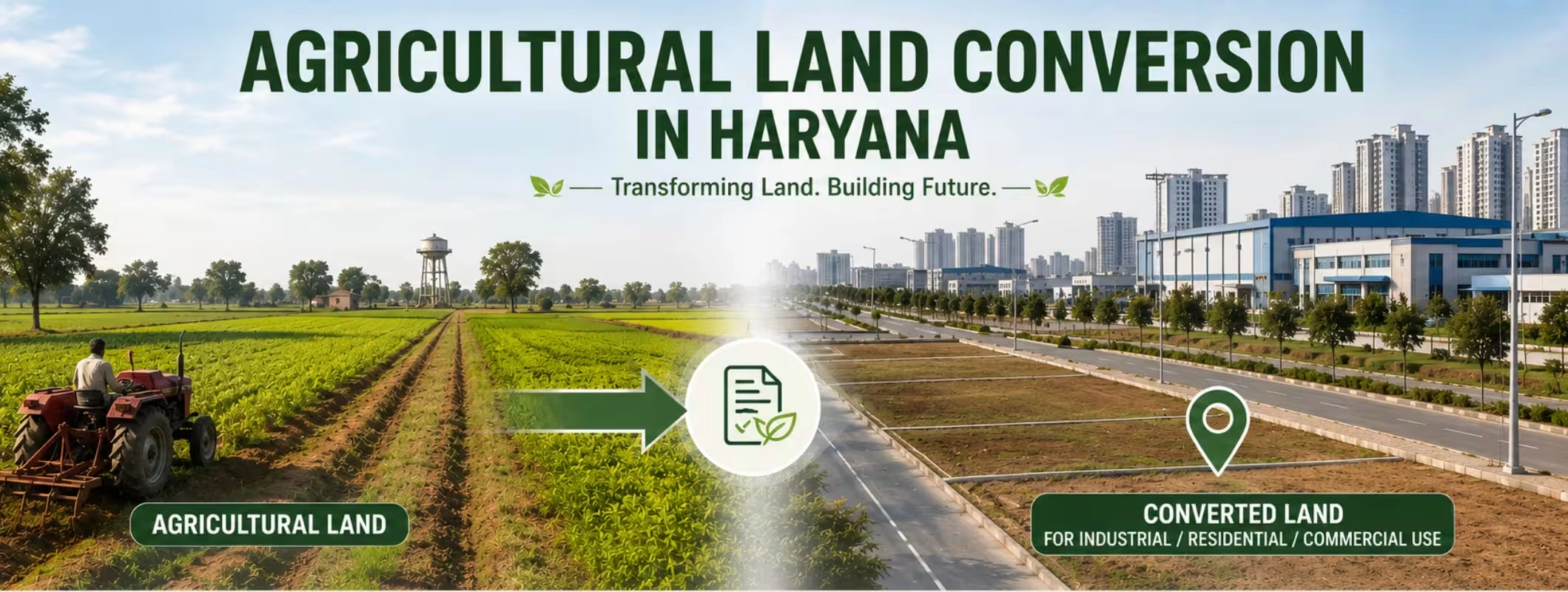
Key Takeaways
- Agricultural land conversion in Haryana means taking official permission to use farmland for a non-agricultural purpose such as residential plotting, commercial activity, warehousing, institutional use, or industrial development.
- In Haryana, this permission is generally known as CLU, or Change of Land Use. For land falling in controlled areas, urban areas, municipal limits, or development-plan zones, you should not start construction or sell plots as residential/commercial land without valid land-use permission.
- The Haryana CLU process is handled through government departments such as the Town and Country Planning Department, Haryana, Urban Local Bodies for municipal areas, and area-specific authorities such as GMDA in Gurugram-notified areas. The TCP Haryana website says the department has launched an online service to file CLU applications and recommends applicants use the online filing system.
- Buyers should always verify zoning, ownership records, mutation, revenue documents, road access, development plan status, and CLU approval before buying converted land in Haryana.
- For sellers, CLU-approved agricultural land can attract better buyer confidence, especially near highways, expanding city edges, logistics corridors, industrial clusters, and residential growth zones.
- 2Bigha helps buyers and sellers explore land with better visibility through map-based listings, verified property details, and subscription plans designed for landowners, agents, and real estate professionals.
Why Agricultural Land Conversion in Haryana Matters?
Haryana has become one of India’s most active land investment markets. Areas around Gurugram, Faridabad, Sonipat, Panipat, Karnal, Rohtak, Jhajjar, Rewari, Manesar, Panchkula, Hisar, and Ambala are seeing strong interest from buyers, developers, warehouse operators, farmhouse land buyers, and long-term land investors.
But one mistake can turn a profitable land deal into a legal problem: buying or developing agricultural land without checking its permitted land use.
Agricultural land cannot automatically be used for residential plots, commercial shops, warehouses, factories, farmhouses, or institutional projects. In many cases, you need official land use change permission from Haryana, commonly called CLU permission.
That is why searches like agricultural land conversion in Haryana, Haryana CLU process, convert agricultural land Haryana, and CLU charges Haryana are increasing among buyers, sellers, developers, and investors.
This guide explains how land conversion works in Haryana, what documents are required, what charges may apply, what buyers should verify, and how 2Bigha can help you find or list land with better transparency.
What Is Agricultural Land Conversion in Haryana?
Agricultural land conversion in Haryana is the legal process of changing the permitted use of farmland from agricultural use to another approved use.
This may include:
- Residential use
- Commercial use
- Industrial use
- Institutional use
- Warehouse or logistics use
- Farmhouse or recreational use, depending on local rules
- Mixed-use or plotted development, where permitted
In simple terms, if the land is recorded or zoned as agricultural land and the owner wants to use it for a non-agricultural purpose, they may need Change of Land Use approval from the competent authority.
The approval is not automatic. The department checks the land location, development plan, zoning rules, road width, access permission, ownership, revenue records, master plan compatibility, and applicable charges.
What Is CLU in Haryana?
CLU stands for Change of Land Use. It is the official permission that allows a land parcel to be used for a purpose different from its existing or recorded land use.
For example:
- Agricultural land to residential use
- Agricultural land to commercial use
- Agricultural land to industrial use
- Agricultural land to warehouse use
- Vacant land to institutional use
The Haryana government’s Town and Country Planning website lists CLU forms, including CLU-I as the application form for Change of Land Use and CLU-III as the form for refusal or grant of permission to change existing land use.
So, when someone says a plot is “CLU approved,” it should mean that the land has received formal permission for a specific non-agricultural use. Buyers must still verify the approval letter, land details, conditions, payment receipts, and whether the use matches the intended purchase.
Why Haryana Land Conversion Is Important for Buyers and Sellers
Haryana sits next to Delhi and connects major industrial, logistics, and urban growth corridors. Because of this, agricultural land near highways, expressways, industrial zones, and city expansion belts often attracts high demand.
However, value depends heavily on legal usability.
A farmland parcel near a highway may look attractive, but if it cannot get CLU approval, the buyer may not be able to legally build a warehouse, showroom, school, residential colony, or commercial complex. On the other hand, land with proper approvals can command better market confidence.
For buyers, CLU reduces legal uncertainty.
For sellers, CLU can improve saleability.
For developers, CLU is often the first step before layout planning, building approval, and project launch.
For investors, CLU status helps compare raw agricultural land with legally usable converted land.
Who Grants CLU Approval in Haryana?
The authority depends on the land location and jurisdiction. In many controlled areas and development-plan areas, the Town and Country Planning Department, Haryana plays a central role. The TCP Haryana portal provides online services, e-governance links, CLU case lists, policy documents, user manuals, and forms related to CLU and planning permissions.
For land inside municipal limits, the Urban Local Bodies department may process CLU permissions. The ULB Haryana page explains that CLU cases within municipal corporation/municipal areas are handled under municipal law provisions, and it lists the checklist for CLU applications.
For Gurugram-notified areas, GMDA provides an e-CLU service where applicants can file CLU applications, make payments, submit documents, and track approval flow for land situated in controlled areas under GMDA.
Because jurisdiction changes by village, sector, municipal boundary, controlled area, and development authority, always verify the competent authority before applying.
When Do You Need CLU Permission in Haryana?
You usually need CLU permission when agricultural land is proposed for a non-agricultural purpose.
Common cases include:
- Converting farmland to residential plots
- Developing commercial land from agricultural land
- Setting up a warehouse or logistics facility
- Using land for industrial activity
- Developing institutions such as schools, colleges, hospitals, or training centers
- Building commercial facilities near highways or urban growth zones
- Selling agricultural land as approved residential or commercial plots
You may also need related approvals such as building plan approval, access permission, environmental clearance, NOC from highways or public works departments, fire NOC, pollution control consent, or RERA registration depending on the project type and scale.
Agricultural Land vs CLU-Approved Land in Haryana
| Factor | Agricultural Land | CLU-Approved Land |
| Legal use | Farming or permitted agricultural activity | Approved non-agricultural use such as residential, commercial, industrial, or institutional |
| Buyer confidence | Depends on title, location, and future conversion potential | Higher if approval is genuine and use is clearly mentioned |
| Development scope | Limited without permission | Development possible as per approval conditions |
| Price range | Usually lower than approved land | Usually higher due to legal usability |
| Risk level | Higher if buyer assumes future conversion | Lower if documents, charges, and approvals are verified |
| Best for | Long-term land banking, agriculture, farm use | Builders, investors, commercial users, industrial buyers |
This comparison does not mean every CLU-approved land parcel is safe. Buyers must check the exact approval, conditions, road access, mutation status, and whether any dues are pending.
Haryana CLU Process: Step-by-Step Guide
The exact process may differ based on jurisdiction, land use category, and authority. Still, most CLU cases follow a practical flow.
1. Check Land Location and Jurisdiction
Start by identifying where the land falls.
- Is it inside a controlled area?
- Is it within municipal limits?
- Is it inside a development plan area?
- Is it under GMDA, HSVP, HSIIDC, municipal authority, or another planning body?
- Is it near a national highway, state highway, scheduled road, canal, forest area, or restricted zone?
This step matters because the wrong authority or wrong application route can delay the file.
2. Verify Current Land Records
Before applying for land use change Haryana, check the ownership and revenue record. Important documents include jamabandi, mutation, intkal, khasra number, khewat, khatauni, sajra map, sale deed, title chain, and encumbrance status.
The ULB Haryana checklist specifically mentions ownership and revenue documents such as Sajra, intikal, jamabandi, and mutation for CLU applications.
3. Check Zoning and Development Plan Compatibility
Every land parcel cannot be converted into every use. For example, a land parcel may fall under agricultural zone, residential zone, industrial zone, green belt, restricted belt, road widening zone, or public utility reservation. If the proposed use does not match the master plan or policy provisions, approval may be refused.
This is where many buyers make mistakes. They buy land thinking “near highway means commercial potential,” but the actual zoning may not allow that use.
4. Prepare Site Plan and Land Utilization Plan
A proper site plan shows the land boundary, dimensions, access, road connectivity, surrounding features, and proposed development. A land utilization plan explains how the site will be used.
The ULB Haryana checklist mentions site plan with dimensions prepared by an architect, land schedule table, and land utilization plan as part of CLU documentation.
5. Apply Online for CLU
Haryana has moved much of the CLU process online. TCP Haryana states that the department has launched an online service for CLU applications and recommends applicants use the online service.
In GMDA-notified areas, the e-CLU system allows applicants to file applications, make payments, submit documents, and receive permission through the online process.
6. Pay Scrutiny Fee and Applicable Charges
The applicant must pay the required scrutiny fee and other applicable charges. Charges can vary depending on use, area, location, department demand, and policy.
For CLU cases under ULB Haryana, the checklist mentions scrutiny fee at Rs. 10 per sq. m. of the site applied, while EDC, conversion charges, and IDC are raised at the Letter of Intent stage, where applicable.
Because charges change by land category and authority, buyers should not rely on random market estimates. Always confirm the current official demand from the concerned department.
7. Department Scrutiny and Site Verification
After submission, the authority reviews ownership, zoning, layout, access, and compliance. Officials may inspect the site or ask for clarification.
If the land touches a national highway, state highway, scheduled road, or other controlled access route, additional NOC may be required. The ULB Haryana checklist mentions NOC for access permission where the site has access from a national highway, state highway, or scheduled road.
8. Letter of Intent and Demand Notice
If the file is acceptable, the authority may issue a Letter of Intent or demand notice. The applicant must pay applicable conversion charges, EDC, IDC, or other charges as required. Do not treat LOI as final CLU permission unless the document clearly says so. Always read the conditions.
9. Final CLU Permission
After compliance and payment, the department may issue final permission. The approval will mention the permitted use and conditions. For example, it may approve commercial use, industrial use, residential use, institutional use, warehouse use, or another specific purpose. The landowner must follow those conditions. Using the land for a different purpose can create legal issues.
10. Mutation and Further Approvals
CLU approval does not always end the process. Depending on the project, the owner may still need mutation updates, building plan approval, layout approval, RERA registration, environmental permissions, fire NOC, pollution consent, or occupancy certificate. For plotted or group housing development, RERA applicability must be checked separately.
Also Read: Complete Guide to Buy Agricultural Land in Haryana: Rules & Eligibility
Documents Required for Haryana Land Conversion
Here is a practical checklist for Haryana CLU applications. Requirements can vary, but these are commonly needed.
| Document | Why It Is Needed |
| CLU application form | Formal request for change of land use |
| Sale deed or lease deed | Proof of ownership or rights |
| Jamabandi | Revenue ownership record |
| Mutation/intkal | Confirms ownership transfer in revenue records |
| Sajra/map | Identifies location and land boundaries |
| Site plan | Shows dimensions, access, and layout |
| Land schedule table | Defines parcel area and khasra details |
| Land utilization plan | Explains proposed use of the site |
| Architect-prepared drawing | Required for technical review |
| NOC for road access | Required if land connects to highway/scheduled road |
| Genuineness certificate | May be required for institutional cases |
| Fee payment receipt | Proof of scrutiny fee/payment |
| Identity and authorization documents | Required for applicant verification |
| Company documents | Needed if applicant is a firm, LLP, trust, or company |
The ULB Haryana checklist includes CLU Form-1, fee and charges, lease/registration deed, ownership and revenue documents, site plan, land schedule table, land utilization plan, access NOC, and genuineness certificate for institutional CLU applications.
CLU Charges Haryana: What Costs Should You Expect?
The cost of land conversion in Haryana is not one fixed amount for every property. It depends on several factors:
- Land area
- Location and zone
- Proposed land use
- Whether the land falls in municipal limits or controlled area
- Development plan category
- Road access
- EDC/IDC applicability
- Conversion charges
- Scrutiny fee
- Any pending dues or compliance cost
For ULB CLU cases, scrutiny fee is listed as Rs. 10 per sq. m. of the site applied, while EDC, conversion charges, and IDC are raised at the LOI stage, if applicable.
So, when someone asks, “What are CLU charges Haryana?” the honest answer is: check the current authority demand for that specific land parcel.
Avoid deals where the seller says, “CLU charges are very low,” but cannot show demand notices, receipts, or official calculation.
Can You Convert Farmland to Residential Land in Haryana?
Yes, farmland can be converted to residential use in Haryana where permitted by zoning, development plans, planning policies, and authority approval. But you cannot assume that every agricultural land parcel can become residential land. Before you convert farmland to residential Haryana, check:
- Whether residential use is allowed in that area
- Whether the land falls in a controlled area
- Whether a license is needed for plotted colony development
- Whether layout approval is required
- Whether RERA applies
- Whether approach road width is acceptable
- Whether any green belt, road reservation, or restricted belt affects the land
- Whether CLU approval alone is enough for your planned use
For individual buyers, CLU-approved residential plots may look attractive, but the buyer should verify whether the seller has legal authority to sell the land as residential plots.
Agricultural to Commercial Land Conversion in Haryana
Commercial land conversion usually faces stricter scrutiny because commercial activity affects traffic, utilities, parking, public access, and local development planning. For agricultural to commercial land conversion Haryana, the department may check:
- Road width and access
- Land use zone
- Parking provision
- Commercial policy eligibility
- Master plan compatibility
- External development charges
- Any NOC from highways or local bodies
- Whether the site creates traffic risk
Commercial CLU-approved land can have strong value, especially near city edges, highways, petrol pump corridors, logistics roads, and urban expansion belts. But it also requires careful due diligence.
Industrial and Warehouse Land Conversion in Haryana
Haryana has strong industrial and logistics demand due to its proximity to Delhi NCR, expressways, ports through western corridors, and manufacturing hubs. Industrial or warehouse CLU may be relevant near:
- Manesar
- Rewari
- Dharuhera
- Bawal
- Jhajjar
- Sonipat
- Panipat
- Kundli
- Karnal
- Faridabad
- Gurugram peripheral areas
For industrial land conversion, authorities may check pollution category, road access, site suitability, industrial policy, and distance from residential or sensitive zones. Industrial buyers should also check HSIIDC areas, controlled area notifications, and any requirement from pollution control authorities.
What Happens If You Build Without CLU in Haryana?
Building or plotting land without valid permission can create serious risk.
Possible issues include:
- Demolition action
- Show-cause notices
- Penalty or compounding issues
- Sale deed complications
- Loan rejection
- RERA or licensing problems
- Buyer disputes
- Difficulty in mutation or approval
- Future resale problems
Recent reporting from Haryana has repeatedly shown action against unauthorized constructions and colonies where development happened without required approvals. In one such enforcement report from Panchkula, officials warned residents not to begin construction or development without mandatory CLU or a valid license. For land investors, this is the point: low-price illegal plots can look profitable at first, but the legal risk can destroy resale value.
Buyer Due Diligence Before Buying Converted Land in Haryana
Before you buy converted land in Haryana, follow this checklist.
Legal Verification Checklist
- Check original sale deed and title chain.
- Verify jamabandi, mutation, khasra, khewat, and khatauni.
- Match land area in revenue records with site measurement.
- Confirm whether land falls in controlled areas or municipal limits.
- Check the development plan and zoning.
- Ask for a CLU approval letter, not just verbal claims.
- Verify CLU use: residential, commercial, industrial, warehouse, or institutional.
- Check if CLU conditions have been fulfilled.
- Ask for payment receipts for conversion charges, EDC, IDC, and scrutiny fee.
- Verify road access and required NOCs.
- Check if any litigation, acquisition notice, or government reservation exists.
- Check whether RERA registration is required for the project.
- Take legal advice before final payment.
A good buyer does not only ask, “Is this land converted?” A smart buyer asks, “Converted for what use, under which approval, with what conditions, and with what pending dues?”
Seller Guide: How CLU Helps You Sell Agricultural Land in Haryana
If you want to sell agricultural land in Haryana CLU approved, documentation can make your listing stronger. A seller with clear land records, updated mutation, zoning clarity, proper access, and CLU permission can attract more serious buyers. This is especially true for developers, farmhouse buyers, warehouse operators, and investors looking for legally usable land.
To improve buyer trust, sellers should keep:
- Clear title documents
- Updated revenue records
- CLU approval copy
- Payment receipts
- Approved site plan
- Land location map
- Approach road details
- Photos and videos of the land
- Nearby infrastructure details
- Any NOC or authority correspondence
On 2Bigha, sellers can present land in a more structured way through map-based listings. This helps buyers understand the location, surroundings, road access, and land area more clearly before contacting the seller.
Raw Agricultural Land vs CLU-Approved Land: Which Is Better for Investment?
| Investment Goal | Better Option | Why |
| Long-term land banking | Agricultural land | Lower entry price and future appreciation potential |
| Immediate development | CLU-approved land | Legal usability is clearer |
| Residential plotting | CLU-approved/residential permitted land | Lower approval uncertainty |
| Warehouse/commercial use | CLU-approved commercial/industrial land | Better compliance and buyer confidence |
| Farmhouse lifestyle | Depends on local rules | Must check zoning and farmhouse norms |
| Resale to developers | Land with clear conversion potential or CLU | Higher buyer interest |
If your goal is low-cost holding, raw agricultural land may work. If your goal is construction, plotting, commercial use, or faster resale, CLU status becomes more important.
Best Locations to Watch for Converted Land in Haryana
Land demand in Haryana often follows infrastructure, highways, industrial belts, and city expansion.
High-interest locations include:
- Gurugram peripheral areas
- Sohna and nearby growth belts
- Manesar and IMT influence zones
- Faridabad and Palwal belt
- Sonipat-Kundli corridor
- Panipat and Karnal highway belt
- Rewari-Dharuhera-Bawal industrial belt
- Jhajjar and Bahadurgarh region
- Panchkula and Ambala belt
- Rohtak development corridor
These areas may attract residential plots after CLU Haryana, commercial land for sale Haryana CLU approved, industrial conversion, and warehouse demand. But every parcel needs its own legal check.
Location creates opportunity. Approval creates usability.
How 2Bigha Helps Buyers and Sellers in Haryana Land Deals
2Bigha is built for land discovery, especially for agricultural land, farm plots, rural parcels, and investment-focused land listings.
For buyers, 2Bigha helps by offering a more visual way to explore land. Instead of only reading a vague location description, users can check land location through map-based listings and understand surrounding roads, nearby development, and land positioning.
For sellers, 2Bigha helps improve visibility among serious buyers looking for farmland, converted land, farmhouse land, and investment land. A well-presented listing with proper details can reduce low-quality enquiries and create better buyer confidence.
Why 2Bigha Fits Haryana Land Buyers
- Map-based land discovery
- Better location understanding
- Useful for farmland and converted land searches
- Helpful for buyers comparing nearby land parcels
- Supports sellers, agents, builders, and landowners
- Subscription plans for better listing visibility and lead generation
If you are selling agricultural land, CLU-approved land, residential plots after CLU, or commercial land in Haryana, a subscription plan on 2Bigha can help you present the property professionally and reach buyers who are already searching for land.
Practical Example: Buying Land Near a Highway in Haryana
Suppose a seller offers 2 acres of agricultural land near a highway and says it is “perfect for commercial use.”
Before buying, ask:
- Is the land actually approved for commercial use?
- Does it have CLU permission?
- Is the road access legal?
- Is highway access NOC required?
- Does the master plan allow commercial use?
- Are EDC, IDC, and conversion charges paid?
- Can the land be used for shops, warehouse, petrol pump, hotel, or showroom?
- Is the approval for the full land area or only part of it?
If these answers are unclear, do not treat the land as commercial land. Treat it as agricultural land with possible future potential, and price it accordingly.
Common Mistakes in Haryana Land Conversion
1. Buying Land Based on Verbal CLU Claims
Many sellers say, “CLU ho jayega” or “conversion easily mil jayegi.” That is not enough. You need official approval.
2. Ignoring Development Plan Zoning
A good location does not guarantee approval. Zoning decides whether the proposed use is allowed.
3. Not Checking Access Permission
Land without proper road access can face approval issues, especially near highways and scheduled roads.
4. Confusing Mutation with Land Conversion
Mutation only updates ownership in revenue records. It does not convert agricultural land into residential or commercial land.
5. Assuming CLU Approval Means Construction Approval
CLU allows land-use change. You may still need building plan approval, layout approval, NOCs, and other permissions.
6. Buying Unauthorized Plots
Some sellers divide agricultural land into small plots and sell them as residential plots without approval. This is risky.
Summary Table: Haryana CLU Process at a Glance
| Step | Action | Buyer/Seller Tip |
| 1 | Check location and jurisdiction | Identify TCP, ULB, GMDA, or other authority |
| 2 | Verify revenue records | Check jamabandi, mutation, khasra, sajra |
| 3 | Check zoning | Match proposed use with development plan |
| 4 | Prepare plans | Site plan and land utilization plan are important |
| 5 | Apply online | Use official CLU portal where applicable |
| 6 | Pay fees | Scrutiny fee and later EDC/conversion charges may apply |
| 7 | Department review | Site inspection and document scrutiny may happen |
| 8 | LOI/demand notice | Pay applicable charges and fulfill conditions |
| 9 | Final permission | Verify approved use and conditions |
| 10 | Further approvals | Building plan, RERA, NOCs may still be needed |
Should You Buy Converted Land in Haryana?
You should consider buying converted land in Haryana if:
- You want to build legally
- You need residential, commercial, or industrial use
- You want lower approval uncertainty
- You are buying for business use
- You want easier resale to serious buyers
- You are comparing investment-ready land parcels
You may consider raw agricultural land if:
- You want long-term land banking
- You understand conversion risk
- You are buying for agricultural use
- You are comfortable waiting for future policy or infrastructure growth
- You have verified title and zoning potential
For most buyers, the best approach is simple: buy based on current legal status, not only future promises.
Conclusion: CLU Is Not a Formality, It Is the Foundation of Legal Land Use
Agricultural land conversion in Haryana is one of the most important checks before buying, selling, or developing farmland for residential, commercial, industrial, or institutional use.
The Haryana CLU process protects planned development, road access, infrastructure, zoning, and buyer interests. It also helps serious sellers position their land better in the market.
Before you buy land in Haryana, check title, zoning, mutation, revenue records, CLU approval, charges, access, and development conditions. Before you sell land, organize your documents and present the property clearly.
2Bigha helps land buyers and sellers move with better clarity through map-based listings, property visibility, and subscription plans designed for land-focused real estate discovery. Whether you want to buy agricultural land, sell CLU-approved land, or explore investment land in Haryana, 2Bigha gives you a smarter way to connect with the right audience.