Key Takeaways
- If you want to buy agricultural land in Haryana, do not start with the broker pitch. Start with five checks: buyer eligibility, title chain, Jamabandi and mutation records, Section 7A or controlled-area status, and ceiling limits under Haryana law.
- Haryana’s official systems already let you verify a lot online, including Jamabandi records, mutation status, deed-registration checklist, stamp-duty calculator, collector rates, encumbrance-certificate workflow, and links to urban/controlled area details. That makes online screening possible, but legal due diligence still needs local verification before token money changes hands.
- The cleanest legal risk in this market is not pricing. It is wrong land use, weak title, unrecorded inheritance issues, or buying land near an urban growth belt without checking Section 7A, DTP NOC, or future planning restrictions.
- Haryana’s land ceiling law still matters. The Act sets different permissible limits based on land type, including 7.25 hectares for assured irrigation capable of two crops, 10.9 hectares for land capable of one crop, and 21.8 hectares for other categories, including orchard land, with an increase for additional family members.
- NRIs and OCIs cannot generally purchase agricultural land in India under RBI’s immovable-property rules, so that question is already settled before you get into Haryana-specific paperwork.
If you are planning to buy agricultural land in Haryana, the smartest move is to treat it as a legal transaction first and an investment second. Haryana looks attractive because it sits next to Delhi NCR, has active freight and industrial corridors, and offers everything from pure cultivation belts to speculative edge zones around Sonipat, Gurugram, Sohna, Panipat, Karnal and Palwal. But that same demand is exactly why sloppy buyers overpay for the wrong parcel, buy land with title friction, or discover too late that the land sits in a notified urban area where extra controls apply.
So here is the straight answer: yes, there is demand for farmland purchase in Haryana, India, and yes, you can do much of the search and verification process online through Haryana’s official systems. But no, you should not assume every agricultural listing is legally clean, freely buildable, or automatically suitable for a farmhouse, plotting, warehouse, or future resale story. Haryana’s legal filters are real, and ignoring them is where buyers lose money.
What Haryana Law Actually Makes You Check Before Purchase
The first big filter is the land record itself. Haryana’s official land-record knowledge base says Jamabandi is the record of rights for ownership, cultivation and related rights in land, and it is revised every five years. The same page explains that mutation reflects changes in ownership and title and records events such as sale, inheritance, exchange, mortgage, gift, partition and lease-related changes. In plain language, Jamabandi tells you what the revenue record currently shows, while mutation tells you whether the title movement after a sale, inheritance or partition has actually been carried forward. You need both.
The second filter is deed-registration readiness. Haryana’s official checklist for deed registration asks for proof of ownership, identity documents, power-of-attorney verification where relevant, a map plan, witnesses, and, in some cases, an NOC under Section 7A of the Haryana Development and Regulation of Urban Areas Act, 1975. The state’s step-by-step registration procedure also says that deed templates are available online, e-stamping is required, appointments are taken through the system, two witnesses must be present, and the registered deed is delivered through the official workflow.
The third filter is zoning and planning. The Haryana Development and Regulation of Urban Areas Act says land used for agriculture is treated differently from land converted into a colony or other regulated urban use. Haryana’s official Section 7A and urban-area pages show multiple notified urban areas across districts, including Gurugram, Sonipat, Karnal, Panipat, Faridabad, Rewari and others. There is also an official NOC workflow for Section 7A cases, and the policy document says NOC is granted only where there is no violation of the 1975 Act and the land is not part of any controlled area, subject to further conditions. That is why “agricultural” in a sales pitch and “safe for your intended use” are not the same thing.
The fourth filter is the ceiling law. Haryana’s Ceiling on Land Holdings Act sets the permissible area based on land category: 7.25 hectares for assured irrigation capable of growing at least two crops in a year, 10.9 hectares for land under assured irrigation capable of at least one crop, and 21.8 hectares for all other land types, including orchard land. The Act also says the permissible area rises by one-fifth of the primary family-unit limit for each additional family member. If you are structuring a larger acquisition or buying through family holdings, do not treat this as background noise. It is central.
Who Can Buy Agricultural Land In Haryana?
This is the one area where buyers need to be especially careful with internet advice. The official Haryana registration and land-record portals clearly show the process tools, but they do not give a simple, plain-language one-line answer saying “anyone can buy” or “only agriculturists can buy” on the pages reviewed here. Secondary sources conflict: a Centre for Civil Society state-wise legislative summary says only an agriculturist can purchase agricultural land in Haryana, while a 99acres state-wise summary describes Haryana as open to Indian citizens other than NRI/PIO buyers. Because of that conflict, do not rely on a listing portal, broker promise, or one blog post for this question. Get written confirmation from the local Tehsildar/Sub-Registrar and a Haryana land lawyer before you pay a token, especially if you are a non-agriculturist, outsider, or trying to buy or sell land in Haryana without a domicile.
One part is clear, though: under RBI guidance, NRIs and OCIs cannot acquire agricultural land by purchase under the general route. RBI’s FAQs and master circulars allow purchase of residential or commercial property, but carve out agricultural land, plantation property and farmhouse from the normal purchase route. So if your buyer profile is NRI or OCI, the answer is not a Haryana-specific workaround. The FEMA restriction comes first.
Legal Documents You Should Verify Before You Buy Farmland in Haryana Legally
Do not stop at the sale deed draft. A serious buyer should verify:
- Jamabandi or record of rights, because it shows ownership and rights recorded in the revenue estate.
- Mutation entries, because they show whether title changes after sale, inheritance, mortgage, exchange or partition were actually recorded.
- Encumbrance certificate, because Haryana has an official online application process to obtain it.
- Old sale deed or proof of ownership, because the deed-registration checklist explicitly asks for it.
- Map plan and property description, because boundary mismatch is one of the most common rural-land problems.
- Section 7A or DTP NOC status, where applicable, because the official checklist and urban-area pages make that a live issue in notified belts.
- Seller identity, witness identity, and power-of-attorney verification were used.
One more point buyers miss: Haryana’s LR document page explains that Jamabandi is revised periodically, while patwari and revenue-officer processes keep changes updated through mutation and related records. That means you should not rely on a photocopy handed over by the seller alone. Pull the latest official view, compare the chain, and match it with what is on the ground.
How To Buy Land in Haryana Step By Step
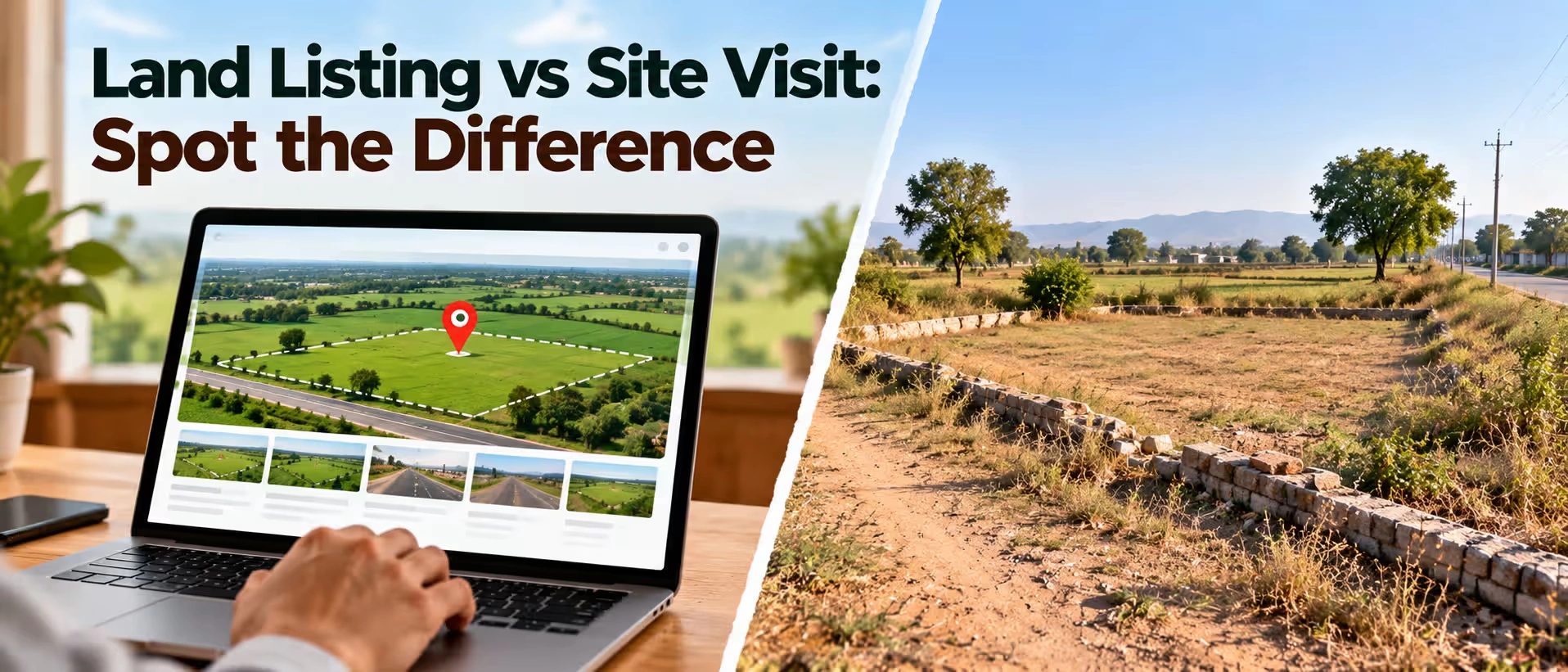
Step one is parcel screening. Shortlist the village, khasra details, access road, irrigation reality, current use, and whether the land sits near a controlled or urbanised belt. Do not confuse “near expressway” with “safe for plotting.” Near-growth land can carry more planning risk, not less.
Step two is title and record verification. Pull Jamabandi, check mutation status, inspect the prior deed chain, and verify whether inheritance or partition issues exist. Haryana’s official system also lets you check mutation status and access land-record tools online, which helps you spot trouble before physical meetings.
Step three is use-case verification. If you are buying strictly for cultivation, you still need title clarity and ceiling compliance. If you are buying for farmhouse use, warehousing, institutional use, resort use, or future plotting, then Section 7A, controlled-area restrictions, and DTP conditions become even more important. The official policy for NOC in urban areas outside controlled areas itself lists compliance conditions, road-width expectations, acquisition caveats and planning restrictions.
Step four is deed preparation and e-stamping. Haryana’s official procedure says deed templates are available online in Hindi and English, e-stamp details are required for appointment, and registration moves through the official system with document scrutiny, photo capture, signatures and delivery.
Step five is registration and post-registration follow-through. Haryana’s official process says the citizen appears before the Sub-Registrar with documents and witnesses, and the deed is processed through HARIS/HALRIS. Registration is not the end of the story. After that, ensure mutation reflects the transfer properly, because practical ownership problems often surface after registry when the revenue record is not updated cleanly.
Also Read: Haryana Bhu Naksha 2026: How to View Land Map Online
What Do The Haryana Land Registration Process Fees Really Mean
Haryana’s official fee schedule shows slab-based registration fees for compulsory registrable documents, starting at Rs. 100 for consideration up to Rs. 50,000 and running up to Rs. 50,000 where value exceeds Rs. 90 lakh. The same schedule also shows service charges through HARIS/Web-HALRIS, including Rs. 200 for sale, conveyance, gift, exchange and certain related deeds.
For stamp duty, Haryana’s official Jamabandi system provides a sale-deed calculator based on transaction value, municipality limit and buyer gender, while widely used tax and real-estate summaries currently show the practical sale-deed pattern most buyers quote: 7% for men and 5% for women within municipal limits, 5% for men and 3% for women outside municipal limits, and lower joint rates in those categories. Use those only as a working benchmark and verify the exact duty on the official calculator before payment.
So if you are comparing Haryana land for sale price, do not compare only per-acre or per-square-foot asking price. Compare total acquisition cost: base land value, stamp duty, registration fee, service charges, legal due diligence, demarcation if needed, mutation follow-up, and future compliance cost if your intended use is not purely agricultural. That is where many “cheap agricultural land in Haryana for sale” deals stop looking cheap.
Best Place To Buy Land In Haryana Depends On Your Goal, Not The Brochure
If your goal is lower entry cost and actual agricultural use, pockets in districts like Karnal and Indri can show much softer asking rates in live listings than land closer to the NCR edge. Recent examples show Indri-area farmland at roughly ₹22 to ₹86 per sq ft, depending on parcel size and location.
If your goal is land banking around infrastructure and NCR spillover, Sonipat and Sohna-Gurugram are a different game altogether. Recent listings show large jumps in asking prices, with Sonipat examples reaching around ₹778 per sq ft in one Jhundpur listing, while Sohna/IMT-Manesar side examples on Housing show prices around ₹1.56k per sq ft and even much higher in premium micro-locations. That does not automatically make them “better.” It makes them more speculative, more location-sensitive and more dependent on planning compliance.
That is why the best place to buy land in Haryana usually breaks into three buckets: cultivation-first buyers tend to prefer lower-ticket agricultural belts with clearer farm utility; growth-corridor investors tend to target NCR-adjacent belts like Sonipat, Sohna or Gurugram edge zones; and hybrid buyers look for parcels that still carry agricultural value but sit near future infrastructure. That is an inference from the current asking-price spread plus the planning overlay, not a guaranteed return formula.
Quick Buyer Checklist Before Immediate Land Purchase In Haryana
Before you say yes to any agricultural plots in Haryana for sale, ask these questions in order:
- Is the seller’s name cleanly supported by Jamabandi and old title documents?
- Has the mutation been updated after sale, inheritance, partition or gift?
- Is the parcel inside a notified urban area or Section 7A zone?
- Do you need a DTP NOC before registration?
- Are you within ceiling limits after the purchase?
- Are you buying for agriculture only, or are you silently assuming future farmhouse, plotting or commercial use? If it is the second case, stop and get land-use advice first.
- Have you checked encumbrance and any stay-order risk? Haryana’s portal provides both routes.
- Are you relying on a broker’s “convert ho jayega” promise without paperwork? If yes, walk away.
Where 2Bigha Fits in the Process
If you want a cleaner way to search, compare and shortlist land, 2Bigha positions itself as a dedicated agricultural-land platform with map-based discovery, land-price and investment insights, and verified-listing positioning for buyers and sellers. For owners who want to reach, 2Bigha also promotes seller plans through its subscription plan, and for remote owners, it offers a separate property-management service. That makes it useful as a discovery and filtering layer, but the final legal checks should still run through Haryana’s official records and registration ecosystem.
In other words, 2Bigha can help you shortlist opportunities faster, compare options more clearly, and manage visibility through a subscription model if you are selling land. But no platform replaces Jamabandi, mutation, NOC checks, ceiling-law review and proper registration. Use the marketplace for speed. Use official records for truth.
Final Word
Buying agricultural land in Haryana can be a smart move, but only when you buy the right parcel for the right reason. If you want pure farm utility, focus on title, water, access and ceiling compliance. If you want Haryana land investment opportunities near NCR, focus even harder on Section 7A, controlled-area status, future-use restrictions and total holding cost. And if you are a non-agriculturist, outsider, or NRI-linked buyer, do not proceed on assumptions. Confirm eligibility first, in writing, with the local revenue side and a competent property lawyer.
That is the real step-by-step answer to how to buy land in Haryana safely: verify the buyer, verify the title, verify the land use, verify the ceiling, verify the cost, and only then verify the dream.
FAQs - Buy Agricultural Land in Haryana
1. Can I buy agricultural land in Haryana online?
You can do a big part of the process online in Haryana, including checklist review, deed-template access, stamp-duty calculation, Jamabandi checks, mutation-status checks and encumbrance certificate workflow. But the transaction still depends on legal verification and the official registration process.
2. Who can buy agricultural land in Haryana?
This needs caution. The official pages reviewed do not give a simple blanket answer, and secondary sources conflict on whether Haryana restricts direct purchase to agriculturists or broadly allows resident Indian buyers other than NRI/PIO categories. So a non-farmer or outsider should confirm eligibility locally before paying token money.
3. Can I buy land in Haryana without a domicile?
Do not assume yes just because you found a listing. The official systems show the registration and record tools, but for the buyer-category question you should obtain local confirmation from the tehsil or sub-registrar side and a Haryana property lawyer, especially for agricultural parcels.
4. Can NRIs buy agricultural land in Haryana?
Generally, no, because RBI’s immovable-property rules do not permit normal purchase of agricultural land, plantation property or farm house by NRI/OCI buyers under the general route.
5. What documents are required to buy farmland in Haryana Legally?
At a minimum, verify proof of ownership, Jamabandi, mutation status, ID documents, map plan, witness documents, GPA verification where relevant, and Section 7A NOC where applicable. The encumbrance certificate should also be checked.
6. What are the registration charges for land purchase in Haryana?
Haryana’s official fee schedule uses slabs. Registration fees for compulsory registrable documents range from Rs. 100 at the low end to Rs. 50,000 for values above Rs. 90 lakh, and sale/conveyance-type deeds also carry service charges through HARIS/Web-HALRIS.
7. What is the stamp duty on agricultural land in Haryana?
Use the official Haryana stamp-duty calculator before payment. Commonly cited current summaries show 7% for men and 5% for women within municipal limits, and 5% for men and 3% for women outside municipal limits, with lower joint rates, but you should verify the exact payable amount on the official portal.
8. Is cheap agricultural land in Haryana always a good investment?
No. Cheap land can carry poor access, weak irrigation, disputed inheritance, encroachment, planning restrictions, or Section 7A issues. Price without legal clarity is not a value.
9. What is the safest way to shortlist agricultural land for sale in Haryana, India?
Use a platform such as 2Bigha for discovery, map comparison and seller visibility, but validate every shortlisted parcel through Haryana’s official land-record and deed-registration systems before moving forward.