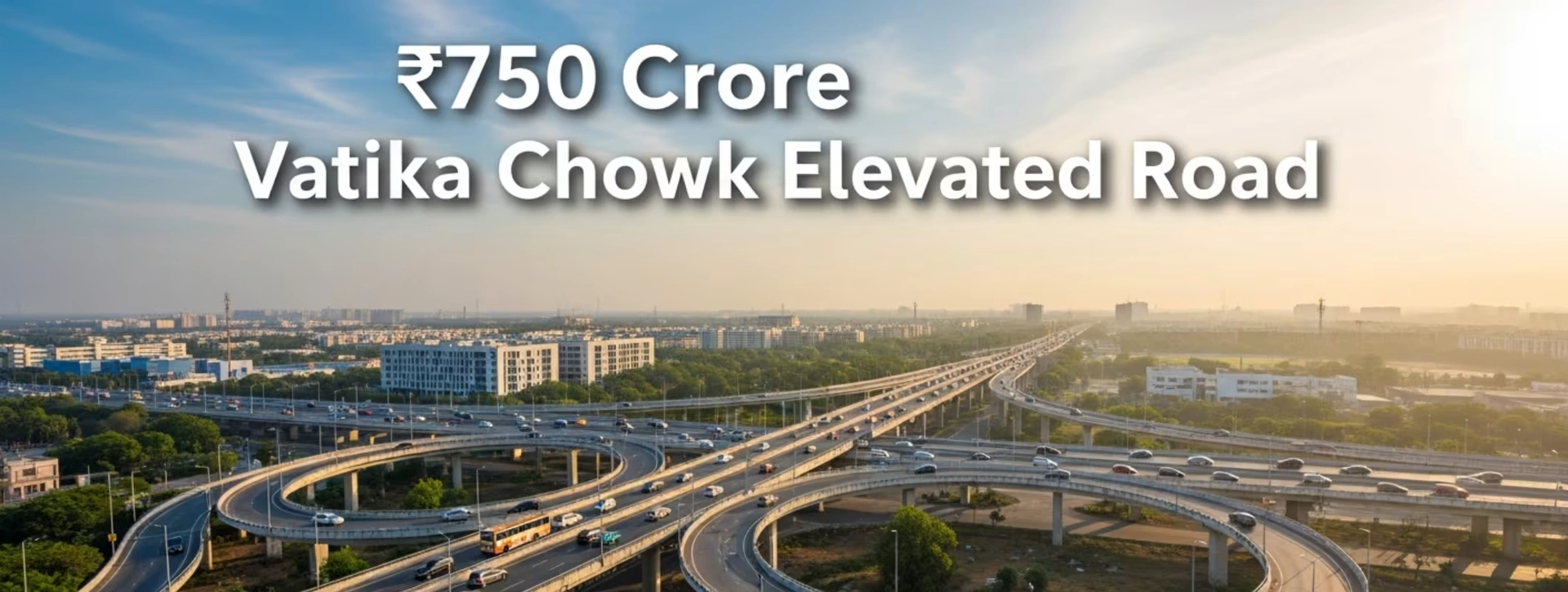
Gurugram has a simple truth: where commute improves, real estate demand follows. That’s why the ₹750 crore Vatika Chowk elevated road plan is getting so much attention, especially among buyers searching land for sale, because it targets one of the city’s most frustrating pain points—bottlenecks around Southern Peripheral Road (SPR), Sohna Road, NH-48, and the Dwarka Expressway side connectivity.
As reported, the plan includes a ~5.3 km, six-lane elevated stretch from Vatika Chowk to NH-48, with entry and exit ramps, along with a redesigned multi-level cloverleaf or trumpet-style interchange at Vatika Chowk to allow smoother movement across key directions. This improved connectivity is expected to make nearby land for sale more attractive to both developers and long-term investors.
Now let’s talk like real buyers and investors: what changes, which sectors benefit, and what happens to property prices?
What Exactly is Being Built?
From the latest updates, GMDA’s plan is to create elevated roads on two SPR stretches:
- Ghata to Vatika Chowk, and
- Vatika Chowk to NH-48 (the one widely linked with the ₹750 crore figure).
The Vatika Chowk junction design aims to let vehicles move between Faridabad Road, Golf Course Road, Sohna Highway, Dwarka Expressway and NH-48 with fewer detours and U-turns.
Also, earlier reporting notes the project cost ₹750 crore including a land acquisition component near Vatika Chowk for the cloverleaf (figures like ₹120–130 crore for land have been mentioned across reports).
Why this Corridor Matters for Real Estate (it’s not just “nice roads”)
1) It upgrades daily livability—then resale demand
In Gurugram, a project doesn’t need to be a metro line to move prices. If it cuts stop-start traffic, it improves:
- school runs,
- office commutes,
- access to NH-48 and expressways,
- and even emergency response times.
That directly boosts end-user preference, and end-users are the most reliable fuel for price growth.
2) It stitches together major growth belts
This corridor is not isolated. It is meant to link movements toward:
- NH-48 (Delhi–Jaipur highway side),
- Dwarka Expressway connectivity, and
- Sohna Highway / Delhi–Mumbai Expressway direction (via NH-248A side linkages discussed in planning).
When roads start acting like connectors (not chokepoints), markets on both ends see higher inquiry volume.
3) It targets a high-traffic, high-housing zone
GMDA has estimated ~50,000 vehicles/day through this corridor, and noted traffic growth due to thousands of families moving into newer residential sectors along the belt.
That matters because real estate reacts faster when infrastructure fixes a pain point that already exists (not a “future promise”).
Which areas in Gurugram are likely to benefit most?
Think in terms of distance-to-ramp and ease-to-NH-48 rather than “sector number hype”.
A) SPR belt + Sohna Road junction influence (New Gurugram side)
Sectors and societies around SPR–Sohna Road–Vatika Chowk benefit because this is where the bottleneck sits. If ramps are planned well, smoother flow improves:
- daily commute comfort,
- visitor access,
- and resale liquidity.
The sectors along SPR that have seen major residential movement (including parts of 69–80 belt) are exactly the kind of markets that respond to commute upgrades.
B) Golf Course Extension / Faridabad Road movement
The interchange is designed to support movement from Faridabad Road and Golf Course Road directions without messy detours. That improves cross-city reach for people living on the “extension side” who often need NH-48 or Sohna connectivity.
C) NH-48 access side (for offices, rentals, and hybrid work)
NH-48 remains a strong anchor for:
- corporate offices,
- industrial/commercial movement,
- and rental demand from employees who still want quick highway access.
An elevated link that reduces signal delays can make certain pockets feel “closer” to NH-48 in real terms.
What happens to property prices (the realistic view)
Here’s the honest truth: infrastructure doesn’t raise prices automatically. Execution does.
Stage 1: Announcement premium (fast, but fragile)
As soon as projects are approved or widely reported, you’ll see:
- higher broker quotes,
- “limited inventory” talk,
- and aggressive new-launch positioning.
This stage can inflate expectations. But if tenders stall, the premium cools off.
Stage 2: Visibility premium (the real shift)
Once tenders are floated and on-ground work begins, markets usually see:
- stronger resale inquiry,
- rent improvement in high-demand societies,
- and price stability even in slower cycles.
Recent updates have discussed expediting execution and floating tenders (timelines have been reported around mid-January for a stretch).
Stage 3: Completion premium (the compounding effect)
After completion, two things kick in:
- time savings become predictable, and
- businesses + families make longer-term relocation decisions.
That’s when capital values typically strengthen more sustainably, especially for well-managed societies near access points.
My practical expectation:
- Rents respond earlier (because tenants pay for convenience quickly).
- Sale prices follow once commute improvement becomes consistent and the corridor stays functional.
Short-term pain points you should not ignore
Construction disruption is real
Elevated road work means:
- dust,
- diversions,
- noise,
- temporary access confusion.
If you’re buying for self-use in the next 12–24 months, choose a home where your daily access doesn’t rely on the most disrupted junction.
Waterlogging and drainage can decide “real livability”
SPR has faced flooding and drainage stress during monsoons, and GMDA has also been working on drainage networks and outfalls in the broader belt to reduce waterlogging.
For property, this is not a small detail. A society that looks great on paper loses demand if roads flood.
Who should consider buying around this project (and who shouldn’t)
Best fit buyers
- End-users planning 3–7 year stay (you enjoy commute gains + capital stability)
- Rental investors targeting working families (rents tend to lift with better connectivity)
- Commercial-minded buyers looking near NH-48 access improvement (depends on micro-location)
Not ideal if…
- You need a quick flip in 6–9 months (execution timelines can slip)
- You can’t tolerate construction disturbance
- You’re buying in a low-quality project just because it’s “near the elevated road”
What to track before you make a decision
If you want to be smart (not emotional), track these:
- Tender award + contractor mobilisation (real work begins here)
- Ramp locations (this decides which pockets truly benefit)
- Land acquisition / ROW clarity (reduces delay risk)
- Drainage upgrades around your approach roads (monsoon reality check)
- Society management + build quality (connectivity can’t fix a poorly built home)
FAQs: Vatika Chowk Elevated Road & Gurugram Property Prices
1) Will property prices increase because of the Vatika Chowk elevated road?
They can—but only after execution becomes visible. Announcements create temporary hype, but sustained growth usually comes when construction starts and commute relief becomes predictable. The corridor is planned as a major connector between SPR, NH-48 and expressway-linked directions, so demand can strengthen in nearby micro-markets.
2) Which is better: buying right next to the corridor or slightly inside?
Slightly inside often wins for families. Homes right next to elevated corridors can face higher noise/dust. The best sweet spot is usually easy access to ramps without being on the loudest edge.
3) Will rentals improve in New Gurugram because of this project?
If commute reliability improves, rentals typically respond first—especially in society clusters with working-family demand. GMDA has cited heavy daily traffic volumes on this corridor, so any relief can lift tenant preference.
4) Does this project help Dwarka Expressway connectivity?
Reports indicate the planning ties movements toward the Dwarka Expressway and NH-48 through the interchange design, so yes—connectivity is a key stated outcome.
5) What are the biggest risks for buyers betting on this infrastructure?
Delays, design changes, and construction disruption are the big ones. Also, if drainage and approach roads remain weak, livability suffers even if the elevated road is excellent—SPR belt flooding concerns have been a public issue.
Bottom line
The ₹750 crore Vatika Chowk elevated road is the kind of project that can reshape micro-markets because it focuses on real commuter pain and major highway linkages. If execution stays on track, areas around SPR–Sohna Road–NH-48 access should see stronger end-user demand, better rental sentiment, and steadier price appreciation over time, creating favorable conditions for those looking to sell agricultural land or convert land assets for future development.