
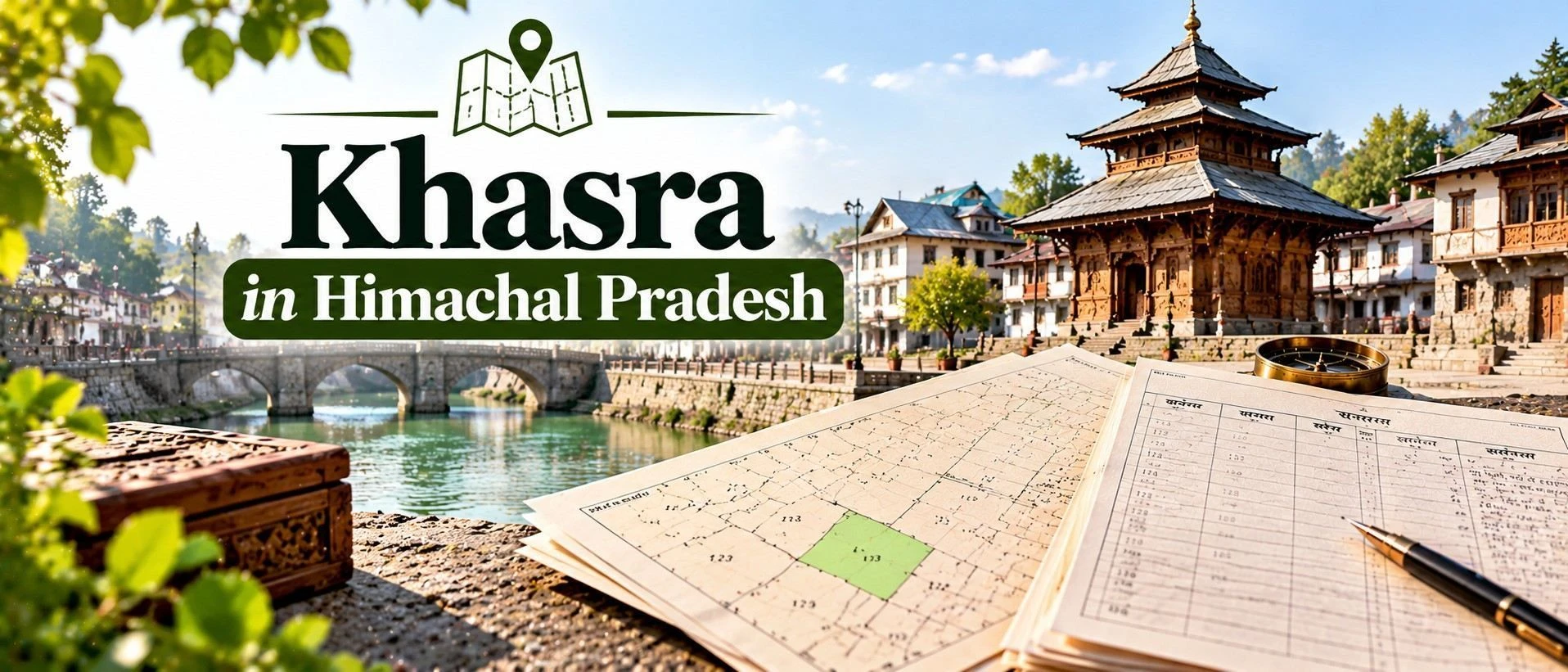
Khasra in Himachal Pradesh is the plot-level land record that identifies a specific parcel by number, showing its area, boundaries, and classification within the state's Jamabandi land record system.
It matters because it protects a buyer from disputes over exactly which piece of land is being sold, and confirms the parcel's legal status before any money changes hands in the hills. Anyone comparing property in Himachal will run into this number sooner or later, so it's worth understanding upfront.
This guide covers what a Khasra number means in HP specifically, how it relates to Khewat and Khatauni, and how to search for it online through Himbhoomi.
Whether you're buying agricultural land, applying for a loan against your holding, or settling an inheritance, this is the number every other land document in Himachal Pradesh is built around.
Section 1 — What is Khasra in Himachal Pradesh?
Before relying on the Khasra number alone, it also helps to see how a specific parcel compares to other property in Himachal on a broader land map.
Definition: A Khasra is the unique number assigned to a specific plot of land in Himachal Pradesh's revenue records, showing that parcel's exact area, boundaries, and land classification as recorded by the Patwari.
A Khasra is different from a Khewat (also called a Khata) and a Khatauni: the Khasra identifies one individual plot, the Khewat is the ownership unit that groups the shares different co-owners hold, and the Khatauni combines Khewat and Khasra details into the readable Jamabandi extract you actually view or download — together, these three numbers are what the entire HP land record system is built on.
A buyer specifically needs the Khasra number because it's the precise identifier that ties a physical piece of hillside, orchard, or plot to its legal record — without it, you're relying on a seller's verbal description of boundaries rather than an official, checkable reference.
It's also what a bank, the Patwari, or a court will ask for first in any dispute, loan application, or transfer, since every subsequent document — mutation entries, Section 118 permission applications, and sale deeds — is filed against a specific Khasra number.
State-specific note:
In Himachal Pradesh's hill terrain, a single Khewat can sometimes span multiple, non-contiguous Khasra numbers across a village due to how landholdings developed historically — don't assume a family's "land" is one single plot until you've checked every Khasra listed under their Khewat.
Expert Tip:
When you search Himbhoomi, note the Jamabandi year shown alongside your result — since HP's Record of Rights is formally revised roughly every four years, an older cached year can miss a recent mutation. If the year looks outdated relative to a recent sale or inheritance you know about, cross-check with the Patwari directly rather than relying on the online copy alone.
Section 2 — How to Check Khasra in Himachal Pradesh?
Himbhoomi makes a basic Khasra search free and largely instant, though a certified copy for formal use still requires a Tehsil visit. The same verified Khasra details also matter if you're later selling property online, since buyers will want to confirm the plot before making an offer.
Method | Cost | Time | Legally valid for registration? |
|---|---|---|---|
Online (unsigned view) | Free | Instant, for digitised villages | No — for information only |
Online (application for certified copy) | Nominal fee | A few days | Yes |
Offline (Patwari/Tehsil/Lok Mitra Kendra) | Nominal fee | A few days | Yes |
1. Visit the Himbhoomi portal — Go to himbhoomi.nic.in and select the "View Land Record" or Jamabandi option.
2. Select district, tehsil, and village — Narrow down to the exact mauza (village) where the plot is located.
3. Choose the Jamabandi year — Select the record year you want to view, keeping the four-year revision cycle in mind.
4. Search by Khasra, Khewat, or Khatauni — Enter whichever number you have — the portal supports searching by any of the three.
5. View or download the record — Review the Jamabandi details online, and download the PDF for your reference.
1. Visit the Patwari or Tehsil office — Carry the Khasra number, village details, and ID proof.
2. Submit a request for a certified copy — Pay the applicable fee for the officially signed and sealed Jamabandi Nakal.
3. Verification — The Patwari may verify the request against the physical revenue register.
4. Collect the certified copy — Collect the signed and sealed document once processed.
Typical turnaround: Typically a few days for a certified copy.
Before you leave the office, check: that the Khasra number, area, and Khewat details on the certified copy match exactly what you found online, and that the Jamabandi year is current relative to any known recent transaction.
Section 3 — What Does a Khasra Record Contain?
For anyone comparing land for sale in Himachal Pradesh across different villages, these are the fields worth checking on any Khasra entry. You can also browse verified land listings and mapping tools at the 2Bigha homepage: https://2bigha.ai/.
Field | What it means | What to check |
|---|---|---|
Khasra number | Unique identifier for this specific plot | Matches the number quoted by the seller and any deed |
Area | Recorded size of the plot, often shown in bigha-biswa or kanal-marla | Consistent with what's being offered and any physical measurement |
Land classification | Type of land — agricultural, orchard, gair mumkin (non-cultivable), etc. | Matches the land's actual current use |
Khewat/Khatauni reference | Links the plot to its ownership unit and co-owners | Cross-checked for a complete ownership picture |
Jamabandi year | The record year this entry reflects | Recent, or explainable if older with no intervening changes |
Good sign: A reliable Khasra record shows a clear number matching your other documents, an area figure consistent with what's being sold, and a recent Jamabandi year with no unexplained ownership gap.
Section 4 — Common Issues & How to Fix Them?
Most Khasra-related confusion in Himachal Pradesh comes down to mixing up plot-level and owner-level numbers, or relying on an outdated cached record. Before assuming an error, it's worth double-checking on the
Khasra Himachal Pradesh- official website (himbhoomi.nic.in).
Confusing Khasra with Khewat/Khatauni number — A Khasra identifies one plot, while a Khewat groups an owner's total holding, which can span several Khasras. Fix: Confirm which number you actually have before searching, and use the portal's option to search by any of the three.
Village not fully digitised — Some tehsils, especially in remote areas, may have connectivity or digitisation gaps. Fix: Visit the local Patwari or Tehsil office for a manual record check if the online search returns nothing.
Outdated Jamabandi year shown — HP's formal Record of Rights revision cycle is roughly every four years, so a cached older year can miss recent mutations. Fix: Check the Jamabandi year on your result and cross-verify with the Patwari if a recent transaction isn't reflected.
Khasra spans a co-owned Khewat with unclear shares — Hill-terrain landholdings are frequently jointly held among family members without an obvious individual breakdown. Fix: Request the full Shajra Nasab (genealogy/ownership tree) to understand individual shares before any purchase.
Downloaded PDF treated as legally sufficient on its own — The free Himbhoomi copy is explicitly for information only. Fix: Obtain a certified copy from the Tehsil or Lok Mitra Kendra for any registration, loan, or legal purpose.
Mismatch between on-site boundaries and the Khasra record — Hill terrain and informal family divisions can create gaps between the record and ground reality. Fix: Request a demarcation through the Himbhoomi portal or the Patwari if boundaries genuinely look inconsistent.
Section 5 — Recent Changes in 2026
No major changes to the Khasra search process itself have been reported as of August 2026. The Himbhoomi ecosystem continues to expand related digital services — including online mutation requests, demarcation applications, and circle rate lookups — alongside the core Jamabandi/Khasra search, though buyers should confirm current digitisation status for their specific village directly on the portal.
Section 6 — Why Khasra Matters for Land Buyers?
It's the precise identifier tying a physical plot to its official government record.
It's required for every subsequent step — mutation, Section 118 permission, and sale deed registration.
It reveals the land's classification, which affects what it can legally be used for.
Cross-checking it against the Khewat helps you understand co-ownership before you buy.
Banks and lenders reference the Khasra number when verifying land offered as loan collateral.
It's the starting point for a demarcation request if boundaries are ever in dispute.
Section 7 — Khasra vs. Jamabandi (Khewat/Khatauni)
These are frequently confused because both come from the same Himbhoomi land record ecosystem. Khasra is the plot-level record — the specific number for one physical parcel, its area, and classification. Jamabandi is the broader Record of Rights document that combines Khewat (the ownership unit) and Khatauni details, showing who owns which Khasra numbers and in what shares — essentially, Khasra is one ingredient within the full Jamabandi extract.
If you're planning to sell agricultural land or sell land online in Himachal Pradesh, having a current Jamabandi that clearly lists the specific Khasra numbers being sold makes a buyer's verification considerably faster. Beyond the government portal, many buyers and sellers also compare listings across realty sites before finalising a deal. You can also explore listing land through
Aspect | Khasra | Jamabandi (Khewat/Khatauni) |
|---|---|---|
Level of record | Plot-level — one specific parcel | Owner-level — full holding and ownership shares |
What it shows | Plot number, area, boundaries, classification | Ownership, co-owner shares, cultivation, mutation history |
Best used for | Identifying and verifying a specific parcel | Confirming overall ownership and title status |
Section 8 — Related Documents
How to Buy Land in Himachal Pradesh
Legal Checklist Before Buying Land
Encumbrance Certificate guides by state
Property Inheritance Laws
